
Last week a nontraditional applicant told me, “I’m 29, I have a kid, I’m already drowning in undergrad loans… what if I run out of money halfway through med school and can’t finish?” And I knew that feeling in my gut, because I’ve run those same numbers at 2 a.m. a hundred different ways, and none of them ever seem to look good enough.
You’re not crazy to be scared. Medicine is brutally expensive, the timelines are long, and being older or nontraditional makes the stakes feel even higher. The fear isn’t abstract—“what if I literally can’t pay rent in MS3?” “What if I match somewhere I can’t afford to live?” “What if loan changes screw me right when I’m locked in?”
Let’s walk through this the way an anxious, worst-case-scenario brain actually thinks about it—then anchor it back to reality and what you can actually do.
First: Could You Literally Run Out of Money Mid‑Med School?
Short answer: almost nobody gets halfway through and is suddenly thrown out because they “ran out of money.” That nightmare almost never happens the way we imagine it.
Not because med school is cheap. It’s not. It’s ridiculous.
But because the system is built around federal loans and schools doing whatever they can to keep you enrolled once you’ve started.
Here’s how the structure usually works:
- U.S. med students primarily use federal loans (Direct Unsubsidized + Grad PLUS).
- As long as you:
- stay enrolled at least half-time,
- make Satisfactory Academic Progress,
- and you’re not in weird default status… you’re usually eligible to borrow the full Cost of Attendance (COA) each year.
- COA includes: tuition + fees + “reasonable living expenses” (their words, not yours).
That means the school’s financial aid office is basically saying:
“We certify that it costs $X for a student to live and attend here for 12 months”
→ Fed gov loans cover that full amount (assuming eligibility).
Could something go wrong? Sure. Worst-case stuff:
- You hit federal loan lifetime limits (rare but an issue for some with multiple prior degrees).
- Your credit blocks Grad PLUS (but even that can often be fixed or appealed).
- Big policy shifts in federal loans (which everyone is scared of, honestly).
But the scenario where you’re sitting in MS2 and the school goes, “Oops, sorry, no more loans for you, good luck paying cash” — that’s not how this usually fails.
The more real risks are:
- You technically can borrow COA, but:
- the COA is too low for your reality (kid, spouse, high rent city),
- you’re bleeding money on credit cards to “fill the gap,”
- you’re stacking more and more personal debt on top of federal loans.
- You go to an insanely expensive private school in a brutal cost-of-living city and your budget is razor-thin every month.
- You enter residency in a high-expense city and PGY‑1 salary doesn’t go as far as you hoped.
So yeah, do people feel like they’re out of money and suffocating? All the time.
Do they literally get evicted and have to drop out? Rare. Possible, but rare.
The Ugly Math: What Nontrads Are Actually Up Against
I’m not going to sugarcoat it. The numbers are terrifying, especially if you’re not 21 with zero dependents.
Here’s a rough layout (yes, this is anxiety fuel, but it’s better than blind optimism):
| Stage | Time | Typical Annual Tuition/Fees | Estimated Living (Modest) | Total Annual Range |
|---|---|---|---|---|
| Post-bacc / prereqs | 1–2 years | $10k–$40k | $20k–$30k | $30k–$70k |
| Med school (public) | 4 years | $30k–$50k | $25k–$40k | $55k–$90k |
| Med school (private) | 4 years | $50k–$70k+ | $25k–$40k | $75k–$110k+ |
| Residency (salary) | 3–7 years | N/A | $25k–$40k living, paid from salary | Loans mostly paused |
Now add:
- Existing undergrad debt: maybe $20k–$80k already hanging over you
- Kids, partner, aging parents, health issues, car that’s one breakdown away from dying
This is the part where your brain goes, “Am I being absolutely delusional even considering this?”
Here’s the thing: thousands of people every year with kids, mortgages, and previous careers do this and don’t go financially extinct. They’re not all trust-fund kids. They’re teachers, nurses, engineers, paramedics, office workers.
Are they tight on money? Yes.
Do they make tradeoffs that younger classmates don’t? Constantly.
But the system mostly gets them to the other side.
Big Worst-Case Fears (and How Likely They Actually Are)
Let’s go through the common financial horror scenarios one by one.
1. “I’ll be forced to drop out because I can’t pay”
How this could happen:
- Federal loans maxed out due to prior graduate degrees + med school.
- Serious academic issues → school puts you on leave → you lose aid while out.
- You go into default on other federal loans and don’t fix it → can block additional federal aid.
How likely?
- For most traditional students: very low.
- For nontrads with prior master’s/PhD, or long-term borrowing history: not zero.
What helps:
- Before committing, literally talk to the financial aid office:
“Here’s my entire educational loan history—am I at risk of hitting federal aggregate borrowing limits?” - Get your NSLDS (National Student Loan Data System) report and review all your loans with an actual human in financial aid.
- If you already have graduate loans, ask explicitly: “If I attend your school, will I have enough federal eligibility to finish all 4 years?”
If they can’t answer that clearly? Red flag.
2. “I’ll match somewhere I can’t afford to live as a resident”
Residency fear is real. PGY‑1 salary is usually around $60–$72k nowadays depending on location and year. Sounds okay until you’re in:
- San Francisco
- NYC
- Boston
- Seattle
- Southern California
Then suddenly you’re paying $2,000–$3,000/month in rent to share a place and working 60–80 hours a week.
Could that break you financially? It can absolutely crush your quality of life. But completely undo you? Less likely, because:
- Resident salaries are stable W‑2 income.
- You can get income-driven repayment (IDR) on your federal loans.
- You can usually forbear your loans temporarily if things get tight (not ideal, but possible).
- Hospitals often offer small housing stipends, meal cards, or union support in some places.
I’ve seen residents live:
- With co-residents in tiny apartments
- With family/parents if local
- 30–60 minutes away to save hundreds on rent
Not glamorous. But survivable.
3. “What if loan rules change halfway through and screw me?”
This one keeps a lot of us up at night, especially with all the drama about PSLF, IDR plans, and legislative fights.
Reality check:
- Loan programs have changed and will change, but:
- Changes usually grandfather or create transition windows.
- The public blowback for pulling the rug out on doctors-in-training mid-way is politically… not smart.
- Worst‑case reasonable scenario:
→ You lose access to the best-case forgiveness plan, but not to loans themselves.
You’re less likely to suddenly be told, “No more loans, pay cash or leave,” and more likely to face: “You’ll probably end up repaying more over time than people a few years before you did.”
Which sucks. But it’s different from literal financial collapse.
Concrete Stuff You Can Actually Control (That Your Brain Keeps Skipping)
Your anxious brain jumps to, “Will I be homeless as an intern?” Valid.
But it often skips the unglamorous, boring steps that massively change the odds.
1. School Choice Is a Financial Decision, Not Just a Prestige Decision
The difference between a cheaper in‑state public and a fancy private school can easily be:
- $30k–$50k per year
- Over 4 years: $120k–$200k+ difference in principal
- Add interest over time: that can be $200k–$300k+ in payback difference
That’s the price of an entire house in many places. Prestige doesn’t magically erase that.
If you’re older, have dependents, or are coming in with debt already, I’m going to say it bluntly:
Chasing prestige over affordability is usually a bad bet unless it comes with seriously better scholarships.
2. Start Thinking in “Runway,” Not Just Total Debt
The scary question in your head is: “Will I owe $400k?”
A more immediate question: “Can I survive month to month during school and residency?”
You want to know your runway: how many months you can function on what you have and what you’ll borrow.
Use something like:
- Projected monthly living expenses
- Projected loan disbursements per semester
- Any savings / partner income / side work (limited in med school, more feasible in residency)
Then ask: “Will I be short during school?” If yes, by how much per month?
That’s a more solvable problem than “I’ll be hundreds of thousands in debt and that number feels fake and abstract.”
A Simple (Uncomfortable) Planning Framework
Let me walk you through a framework that’s not pretty, but honest. This is where an actual plan replaces vague despair.

| Step | Description |
|---|---|
| Step 1 | Start: Considering Med School |
| Step 2 | Pull Loan History & Credit Report |
| Step 3 | Estimate Total Med School Cost by School |
| Step 4 | Check Federal Loan Eligibility with Financial Aid |
| Step 5 | Adjust School List or Timeline |
| Step 6 | Build 4-Year Budget (Monthly) |
| Step 7 | Plan: Cheaper Housing, Partner Income, Savings Goal |
| Step 8 | Apply With Clear Financial Plan |
| Step 9 | Enough Eligibility to Cover All 4 Years? |
| Step 10 | Monthly Shortfall? |
Does this fix everything? No. But it exposes where the real breakpoints are.
Places Nontrads Often Get Blindsided Financially
There are some “oh crap” points I see over and over.
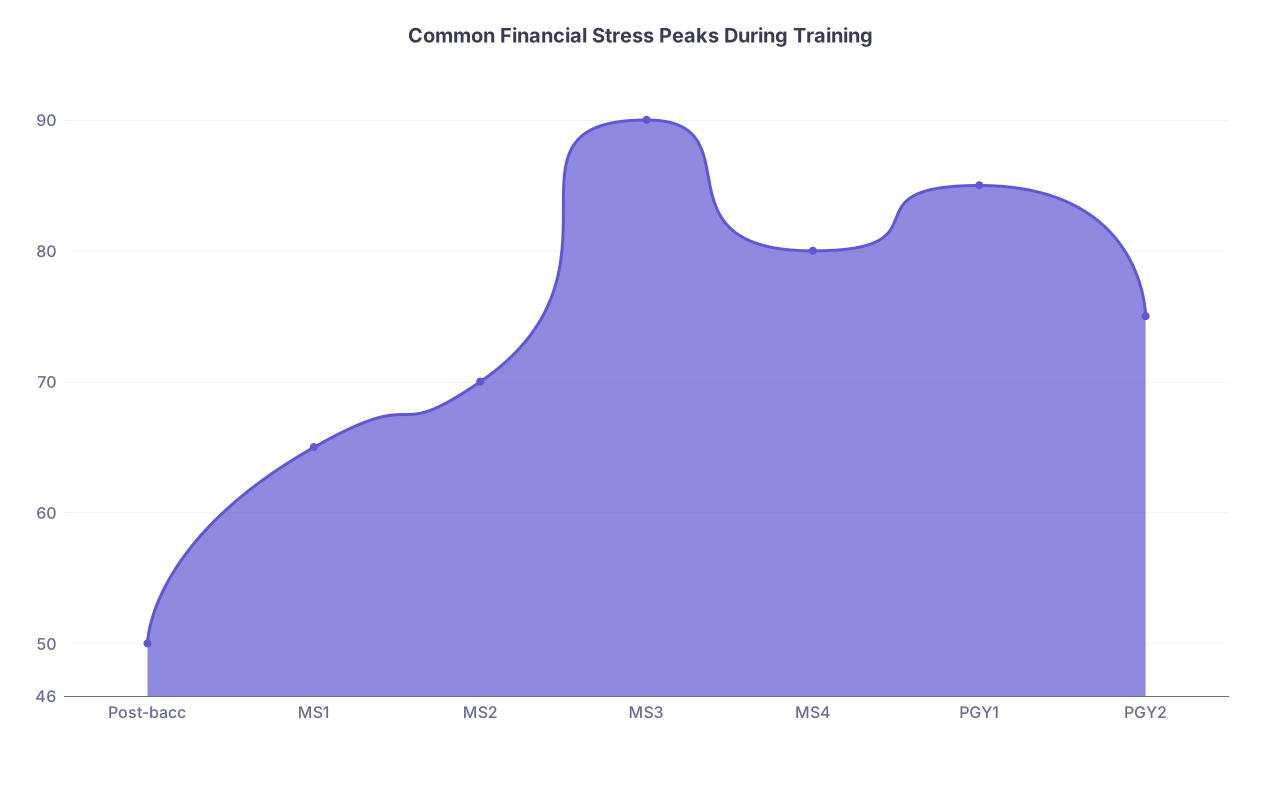
| Category | Value |
|---|---|
| Post-bacc | 50 |
| MS1 | 65 |
| MS2 | 70 |
| MS3 | 90 |
| MS4 | 80 |
| PGY1 | 85 |
| PGY2 | 75 |
MS3 is brutal because:
- You’re on rotations constantly.
- Time for side income = basically zero.
- Travel to distant sites, extra gas/parking, maybe short‑term housing → expenses spike.
- You’re too exhausted to “optimize spending” because you’re just trying to survive.
PGY1 (intern year) hits because:
- You're finally getting paid, but now:
- Loan grace period ends.
- You’re figuring out IDR vs forbearance vs REPAYE vs PSLF.
- You may be moving cities, paying deposits, buying work clothes, etc.
Knowing these spikes are coming lets you:
- Over‑save in MS1/MS2 if at all possible.
- Not inflate lifestyle the second that first resident paycheck hits.
- Use any windfalls (scholarships, tax returns, random checks) to build a small emergency fund instead of disappearing it.
As a Nontraditional, You’re Playing a Different Game
You’re not just choosing a career. You’re gambling with:
- Your 30s or 40s
- Your kid(s)’ timeline
- Your partner’s career flexibility
- Your aging parents’ needs
- Your own body’s ability to keep up with 28-hour calls
So yeah, money feels higher stakes.
Here are the hard but real advantages you might have as a nontrad:
- You probably understand your own cost of living in a way a 21‑year‑old doesn’t.
- You may have:
- a partner who can work,
- a previous career you can use PRN (per diem nursing, tech, etc. during premed or early med school),
- more discipline around lifestyle creep.
- You’re less likely to pretend debt “isn’t real.” That’s painful awareness, but it keeps you cautious.
And here’s the mental reframe I keep coming back to:
You’re not choosing between “med school” and “no debt.”
You’re choosing between:
- Debt + eventual doctor salary
vs. - Less debt + your current career ceiling
Sometimes, when you lay it all out, the best decision is actually, “No, this is too much risk for me, I’m not going to med school.”
That’s not failure. That’s sanity.
But if you do decide to jump in, I want you to do it with your eyes open—not just white‑knuckling it and praying you won’t run out of money.
One Grounding Truth Nobody Tells You
For all the horror stories and justifiable anger about cost, here’s the pattern that keeps showing up:
People who:
- Pick reasonably priced schools when they can
- Actually talk to financial aid instead of hiding from them
- Build a basic budget and adjust their expectations
- Go for IDR/PSLF or a clear repayment strategy instead of ignoring it
…do not typically “run out of money and have to quit.”
They suffer, they feel squeezed, they vent constantly—but they finish.
The ones who really get crushed are often:
- Going to the most expensive schools in high COL cities with no plan
- Pretending future attending salary will fix everything automatically
- Charging lifestyle luxuries (cars, trips, big apartments) to credit on top of loans
You don’t sound like that person. You’re here, panicking in advance, which ironically is a huge protective factor.
Exactly What You Can Do Today
I’m not going to say “don’t worry.” You probably will worry no matter what I say.
But you can swap some anxiety for data.
Here’s a concrete next step:
Today, pull your full federal loan history and make a 1‑page snapshot.
- Go to the Federal Student Aid site and download your loan breakdown.
- List:
- Total undergrad or prior-grad loan principal
- Types of loans (Direct, Perkins, FFEL, etc.)
- Current status (in repayment, deferment, default, etc.)
- Then email or call the financial aid office of one realistic target med school and literally say:
“I’m a prospective nontraditional applicant with previous loans. Can someone help me check if I’d have enough federal eligibility to complete 4 years here?”
No commitment. No massive spreadsheet. Just that.
If you do that one thing, you’ll know way more about your real risk of “running out of money” than 90% of applicants.
FAQ (Exactly 5 Questions)
1. Is it even responsible to go to med school if I’ll end up with $350–$500k in debt?
It can be, if you’re realistic about specialty choice, lifestyle, and repayment strategy. A primary care doc making $220k with $400k in debt on PSLF or smart IDR can live a normal, if not flashy, life. Where it becomes questionable is when people ignore numbers completely, assume they’ll make $800k as a dermatologist, and borrow like it’s free. Look at actual salary ranges in specialties you’d realistically choose and run a conservative repayment projection.
2. What if my partner loses their job while I’m in med school or residency?
That’s one of the most anxiety-inducing what‑ifs, and it happens. The safety nets are: federal loans (during school), income-driven repayment (after school), forbearance if things get extreme, and sometimes moving to cheaper housing or getting family support temporarily. It would be painful, yes. But it’s rarely fatal to the whole med school plan unless everything else was already stretched to the max.
3. Can I realistically work during med school to reduce loans?
During the premed years, yes. During med school, it’s limited. MS1/MS2: a few hours a week in a flexible position (tutoring, remote work, weekend shifts) is sometimes doable. MS3/MS4: almost impossible to do consistently without burning out. You should plan as if you won’t be able to work meaningfully during clinical years and consider any work income a bonus, not a pillar of your budget.
4. Is being older (late 20s, 30s, 40s) a financial deal-breaker?
It raises the stakes but doesn’t make it impossible. You’ll have fewer years as an attending, so your payback period is shorter. That means your tolerance for huge, unnecessary extra costs (like pricey private schools, luxury apartments, etc.) should be lower. Many people start med school at 30–35 and end up fine financially because they make deliberate choices and avoid “prestige at any cost.”
5. What if I start and then realize I absolutely hate medicine—am I just stuck with the debt?
If you leave after a year or two, yes, you’re still on the hook for the loans you borrowed. That’s the harsh reality. That’s why I strongly push people—especially nontrads—to get deep clinical exposure beforehand: scribing, MA jobs, EMT, RN work, PA shadowing, etc. It doesn’t eliminate the risk, but it reduces the chance you borrow six figures only to realize you never wanted this path in the first place.
Open a blank doc or notebook right now and write at the top: “What would it actually cost me to do this?” Then list your current debt, your age, and three realistic target med schools. That’s your starting point—not the vague monster in your head.