
It’s a Tuesday night. You’ve closed your last Jira ticket, pushed your code, and your Slack is mercifully quiet. You’re 38, solid mid‑career engineer. Good salary, decent title, maybe a team lead. And you’ve got a browser tab open that you’d never admit to your manager: “How to become a doctor at 40.”
You’re not bored exactly. But the thought won’t shut up. You keep imagining yourself in scrubs instead of a hoodie. You read stories about nontraditional med students. You do the math on how old you’d be as an attending. You open a spreadsheet. Then you close it because it’s terrifying.
Here’s what you do first. Not next year. Not “once things calm down at work.” Now.
Step 1: Stop Fantasizing About “Being a Doctor” and Get Specific
The worst thing you can do at 38 is chase a vague “I want to help people” dream without specifics. That’s how people blow up their lives unnecessarily.
You need clarity. Concrete, boring clarity.
A. Define what you actually think you want
Right now your brain is probably mixing all of this together:
- Medicine as seen on TV (Grey’s Anatomy, The Good Doctor, etc.)
- Medicine as told by hospital marketing
- Medicine as a noble calling
- Your dissatisfaction with engineering / tech culture
- A midlife “Is this really it?” moment
Strip that away. Sit down and write three short paragraphs:
Why medicine and not:
- PA
- NP
- Psychologist
- Data science in healthcare
- Health tech product work / CTO at a startup
What you think your day‑to‑day would look like in:
- Medical school (age 40+)
- Residency (age 44+)
- Attending life (age 47+)
What problems you’re trying to solve in your current life:
- Meaning?
- Impact?
- Boredom?
- Identity?
If you can’t fill those out honestly, you’re not ready to move. You’re flirting with a fantasy, not a decision.
B. Learn what medicine at 2024+ actually is
Engineers are good at researching… until it’s about themselves. Then you all suddenly get vague. Do this like you’d spec a new system:
- Read 3–4 recent blogs or YouTube channels from:
- Nontraditional med students >35
- Residents talking about burnout, debt, and call
- Search: “nontraditional medical student over 35 Reddit,” “oldest student in my med school,” “midlife career change to medicine.” Ignore the motivational fluff; read the brutally honest posts.
You’re not trying to talk yourself out of it. You’re validating whether you’re attracted to the real thing.
Step 2: Run the Hard Numbers — Financial and Time
If you skip this, you’re being irresponsible. At 22, you can sort of wing it. At 38, you cannot.
A. Timeline reality check
Let’s do a basic, aggressive but realistic timeline if you’re starting from scratch:
| Stage | Age Range | Duration |
|---|---|---|
| Prereqs + MCAT | 38–40 | 1.5–2 years |
| Medical school | 40–44 | 4 years |
| Residency (primary care) | 44–47 | 3 years |
| Residency (surgical, etc.) | 44–49+ | 5–7 years |
If you start seriously this year, you’re looking at:
- Primary care attending: ~47 years old
- Competitive specialty (derm, ortho, etc.): 48–50+
You need to be okay with being supervised by attendings your age or younger and training alongside 26‑year‑olds. If that makes you bristle, note it now.
B. Financial reality check
Rough math (in USD, adjust for your region):
- Med school tuition: $40–70k/year
- Living costs: $25–40k/year (lean but not desperate)
- That’s $65–110k/year x 4 = $260–440k total
- Plus lost engineering income (say $150k/year x 4) = $600k lost earnings
You’re looking at a combined hit (debt + opportunity cost) well north of $800k, often >$1M.
Put this into a spreadsheet. Literally. Open Excel or Sheets, not your “I’ll think about it” brain.
Break it down into:
- Current savings
- Debt (if any)
- Estimated med school cost (public vs private, in‑state vs out‑of‑state)
- Your partner’s income (if relevant)
- Kids’ ages and upcoming expenses
If you’re partnered, you must do this with them. This is not a “surprise, I’m applying to med school!” situation.
Step 3: Before Any Classes, Do a Brutal Reality Test in the Hospital
Do not sign up for prereqs. Do not buy an MCAT book. First you test whether you can stand real clinical environments.
Not the idea of them. The smell, the pace, the boredom, the emotional load.
A. Get into the clinical environment
You need at least 40–60 hours of actual exposure. A weekend shadowing one doc is useless.
Concrete ways:
- Hospital volunteer:
Look for roles that actually put you near patients: patient transport, ED volunteer, inpatient unit assistant. - Shadowing:
Email physicians directly. Yes, cold email. Use your engineer discipline. Write 15–20 emails to:- Hospitalists
- Primary care docs
- EM doctors
- Maybe a surgeon or two
Keep it short and not annoying. Something like:
I’m a 38‑year‑old software engineer considering a serious career change to medicine. Before I commit to prerequisites and applications, I’m trying to get realistic exposure to clinical work. Would you be open to me shadowing you for a day or two to see the day‑to‑day reality? I’m fully vaccinated and happy to follow any hospital policies.
Some won’t respond. Fine. You’re an engineer; you know rejection in production incidents and code reviews.
B. What to look for while you’re there
You’re not just observing medicine. You’re observing yourself in medicine.
Questions to silently ask yourself:
Do I feel energized or drained at the end of a 6–8 hour day on the floor?
When the doc is:
- on the phone with a frustrated family
- explaining bad news
- dealing with system nonsense (prior auth, EMR garbage)
…am I thinking “I want to be in that chair” or “absolutely not”?
How do I react to:
- bodily fluids
- chaos
- unexpected code blues
- long stretches of boredom followed by sudden stress?
If you feel nothing but adrenaline and inspiration: you’re probably high on novelty. You need more hours. If, after 50–60 hours, you still find yourself thinking, “I want this, even with the crap,” that’s a real data point.
Step 4: Audit Your Academic Readiness (Without Nuking Your Life Yet)
Next hard truth: you might not remember what a derivative is. Or how to study like a student instead of a professional.
Before you register for a single formal class, you do a low‑risk academic stress test.
A. Find your starting line
You need to know:
- When was your last real science class?
- Do you already have:
- General chemistry?
- Biology?
- Physics?
- Organic chemistry?
- Calculus or stats?
Pull your old transcripts. Yes, actually request them. Many engineers underestimate how much this matters.
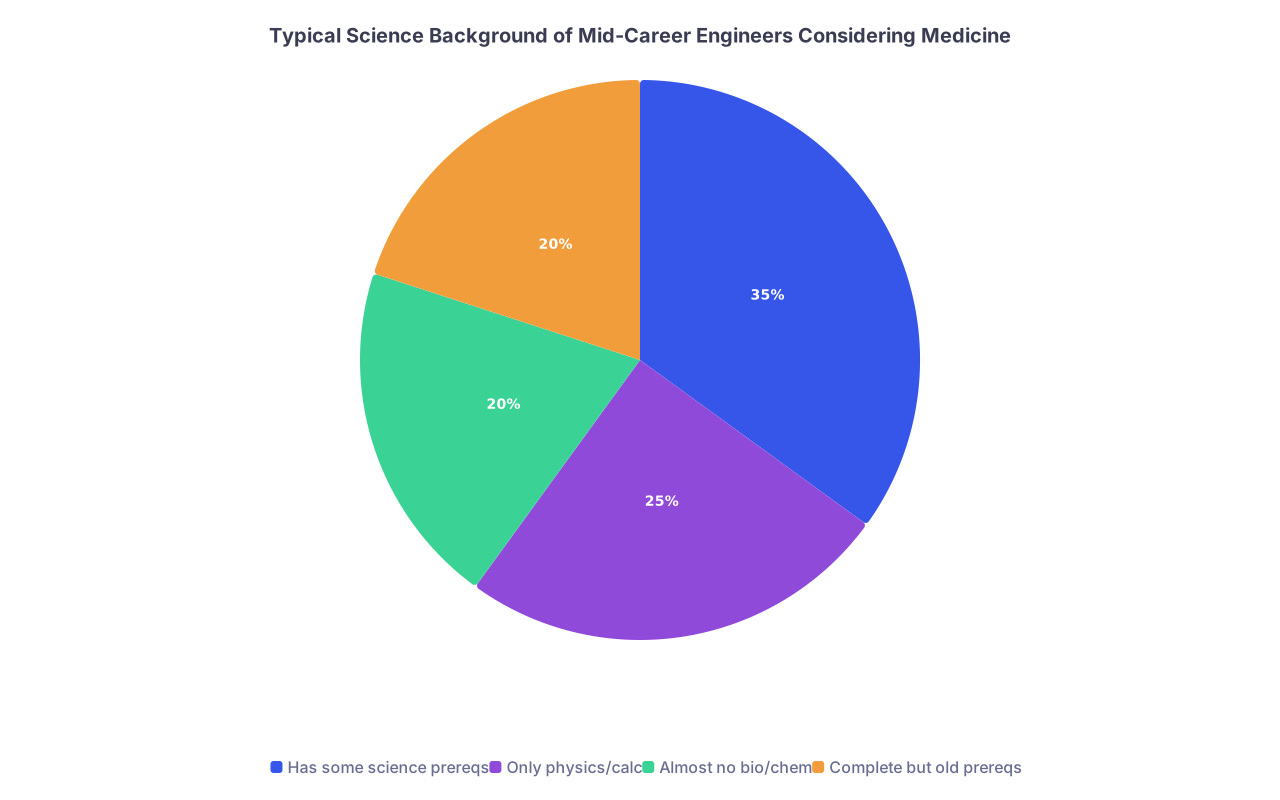
| Category | Value |
|---|---|
| Has some science prereqs | 35 |
| Only physics/calc | 25 |
| Almost no bio/chem | 20 |
| Complete but old prereqs | 20 |
If your prereqs are >7–10 years old, a lot of med schools will either:
- Not accept them, or
- Side‑eye them unless you show recent coursework.
B. Do a self‑study “mini‑semester”
Pick one subject that scares you most (usually orgo or physics). For 4–6 weeks, treat it like a class:
- Get a legit textbook or online course (not Instagram “MCAT hacks”).
- Set 8–10 hours per week aside.
- Do actual problem sets, not just reading.
Purpose is not mastery. It’s to answer:
- Can I sustain this level of focused academic work while:
- working full‑time
- managing a spouse/kids/mortgage
- Do I hate this, or does part of me enjoy the challenge?
If you’ve been out of school for 15+ years, your first week will feel awful. That’s normal. You’re shaking rust off. But if 4–6 weeks in, you’re completely fried and miserable, you need to rethink timeline or strategy.
Step 5: Map the Realistic Educational Path Options
Once you’ve confirmed:
- You’re still interested after real clinical exposure
- You can tolerate some academic grind
…then you look at actual paths. Not all of them involve quitting your job tomorrow.
| Path Type | Best For | Time Commitment |
|---|---|---|
| DIY Postbacc (part-time) | Engineers working full-time | 2–3 years |
| Formal Postbacc | Career changers w/ little science | 1–2 years full-time |
| SMP (Special Masters) | GPA repair, prior heavy science | 1 year full-time |
A. DIY postbacc while you keep working
This is usually your first move as a 38‑year‑old engineer.
- Take 1–2 classes per semester at a local university or reputable online program.
- Sequence:
- Year 1: Gen Chem + Bio
- Year 2: Orgo + Physics
- MCAT prep along the way or right after
This lets you:
- Keep income
- Test how sustainable this is long‑term
- Avoid blowing up your career for something you might decide not to pursue
Yes, it’ll make your life busy and less “fun.” That’s the cost of a midlife pivot.
B. Formal postbacc if you want structure and advising
If money is less of an issue and you want a clean break, structured postbaccs (Goucher, Bryn Mawr, Scripps, local university programs) can:
- Give you advising
- Give you committee letters
- Sometimes have linkage to specific med schools
Downside: they’re expensive and often require quitting your job.
Step 6: Have the Adult Conversations Early
Before you’re “applying next cycle,” talk.
A. With your partner (if you have one)
You’re not just changing your life. You’re changing theirs. A few blunt questions to walk through:
- Can we live on one income (or a sharply reduced two) for:
- 2–3 years of prereqs + MCAT
- 4 years of med school
- Are we okay potentially:
- Moving for med school
- Moving again for residency
- Are we okay having:
- Less time for kids
- Less vacation
- Night shifts, holidays, call?
If your partner is lukewarm or secretly opposed, this will blow up later—during your worst, most exhausted moments. Resolve it now.
B. With yourself
Ask yourself some questions that people avoid because the answers are uncomfortable:
- If I never become a doctor, what’s my alternative plan that still gives me meaning?
- Am I okay being “just okay” at something again, after being a senior engineer or manager?
- If my first two application cycles fail, what’s my line in the sand? Do I apply a third time? Switch to PA/NP? Return to tech and pivot within healthcare?
You don’t need perfect answers, but you need to show you’ve thought about them.
Step 7: Test a “Healthcare Version” of Your Current Skillset
Here’s something most mid‑career switchers completely miss: You can test healthcare without going all‑in on med school.
Instead of jumping straight from software engineering → premed, look for transitional roles or projects:
- Join or transfer to a health‑tech company:
- EHR vendors
- Digital health startups
- AI in imaging / diagnostics
- Contribute to open‑source healthcare data projects
- Do consulting or side projects with:
- Hospitals building internal tools
- Clinics digitizing workflows
- Research groups needing engineering support
This does two things:
- Gives you exposure to healthcare problems and people.
- Might scratch enough of your “impact/meaning” itch that you don’t need med school.
I’ve seen this happen more than once: person thinks they want to be a doctor, realizes they actually wanted to work on real human problems, not another ad‑tech algorithm. Health tech or clinical research engineering is often enough.
Step 8: Decide on a One‑Year Experiment, Not a Life Sentence
You don’t need to decide “I’m going to be Dr. So‑and‑So” right now. That decision is too big and it paralyzes you.
Instead, decide on a 1‑year experiment with clear criteria.
A. Your one‑year plan might look like:
Months 1–3:
- 40–60 hours of shadowing / volunteering
- 4–6 week self‑study academic test
Months 4–12:
- 2–3 formal science courses (part‑time, nights/weekends)
- Continued clinical exposure (2–4 hours/week)
- Initial MCAT prep research (not full study yet, just planning)
B. At month 12, ask yourself:
- Am I still drawn to this, or am I relieved by the thought of stopping?
- Did my performance in classes support this path?
- How is my partner/family handling this?
- Can I see myself doubling down for another 2–3 brutal years of prep?
If it’s a no, that is not failure. That’s a massively successful data‑driven decision that saved you hundreds of thousands of dollars and years of misalignment.
If it’s a yes, then you stop dabbling and commit: full prereq sequence, real MCAT timeline, serious school list.
Step 9: Use Your Engineering Background Strategically (Not As a Crutch)
You bring things to the table med schools actually like:
- Quantitative thinking
- Systems thinking
- Experience on teams
- Real‑world problem‑solving
- Likely some maturity and emotional stability
But don’t be that applicant who thinks, “I worked at FAANG, obviously I can crush this.” Med schools do not care that you crushed Kubernetes at scale.
Your engineering background should show up as:
- Clear upward trajectory in your career
- Specific examples of:
- leading teams
- handling crises (on‑call nightmares)
- communicating technical issues to non‑technical people
Those translate well into medicine. Just don’t assume they override weak academics or a half‑baked story.
Step 10: Red Flags That Mean “Slow Down” or “Stop”
If any of these are true right now, you should pause rather than push:
- You’re miserable in your current job and want escape, not medicine specifically.
- You haven’t talked to a single actual doctor at length.
- You feel more excited about wearing a white coat than about grinding through biochem at 10pm.
- You expect to “keep your current lifestyle” during med school and residency.
- Your partner is clearly not on board and is just staying quiet to avoid conflict.
- You’re already financially strained or heavily in debt.
That doesn’t mean “never.” It means your first move is to fix what’s broken in your current life, then reassess medicine with a clearer head.
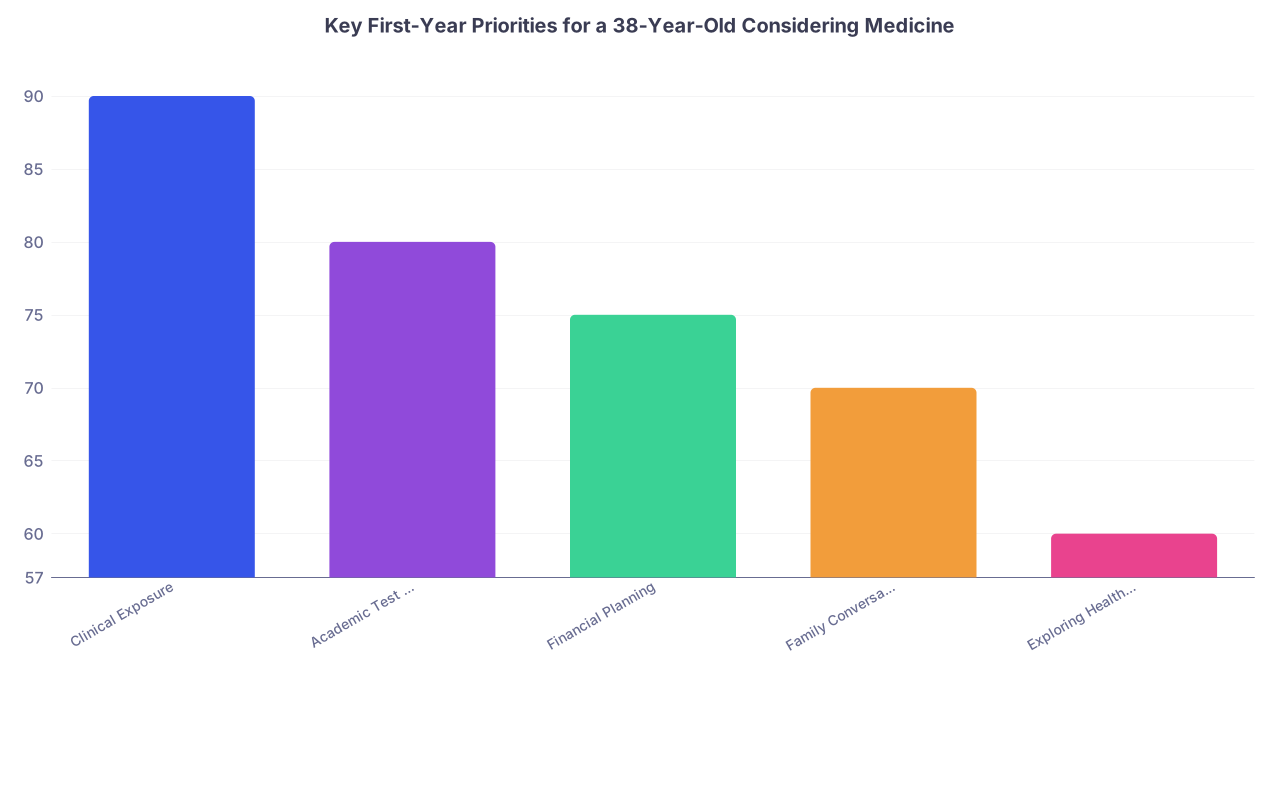
| Category | Value |
|---|---|
| Clinical Exposure | 90 |
| Academic Test Run | 80 |
| Financial Planning | 75 |
| Family Conversations | 70 |
| Exploring Health-Tech | 60 |

| Step | Description |
|---|---|
| Step 1 | Today: Considering Medicine |
| Step 2 | Shadow 40-60 hours |
| Step 3 | Volunteer or Clinical Role |
| Step 4 | 4-6 Week Self-Study Test |
| Step 5 | Enroll in 1-2 Science Courses |
| Step 6 | Basic Financial Modeling |
| Step 7 | Partner/Family Discussion |
| Step 8 | Explore Health-Tech Opportunities |
| Step 9 | Plan Full Postbacc + MCAT |
| Step 10 | Refocus Career Within/Outside Healthcare |
| Step 11 | Still Strongly Interested? |


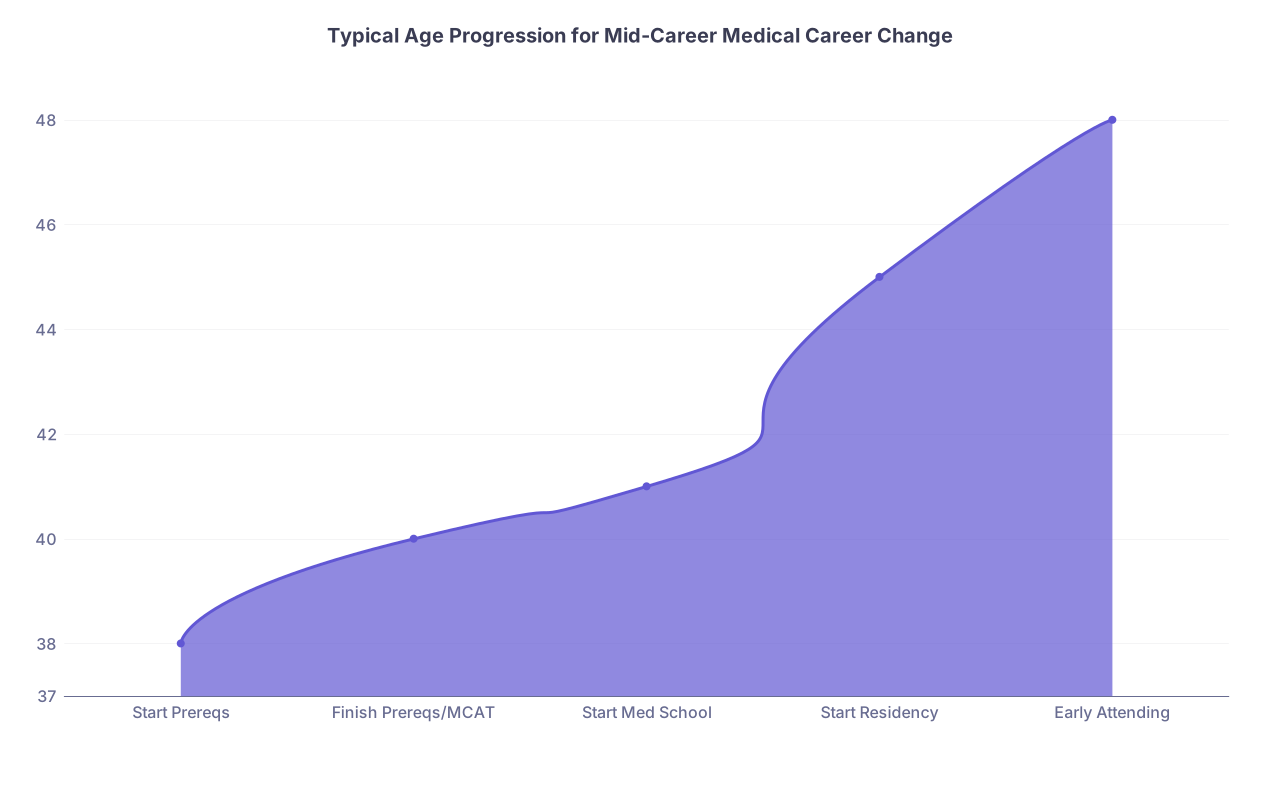
| Category | Value |
|---|---|
| Start Prereqs | 38 |
| Finish Prereqs/MCAT | 40 |
| Start Med School | 41 |
| Start Residency | 45 |
| Early Attending | 48 |
FAQ (Exactly 4 Questions)
1. Am I “too old” at 38 to start medicine?
No, you’re not too old. There are successful physicians who started med school in their 40s and even early 50s. But you’re not 22, and pretending you are is childish. You need to be okay with a shorter attending career, training with younger peers, and some doors (hyper‑competitive specialties) being harder to open. Plenty of programs value maturity, prior careers, and nontraditional backgrounds. The real question isn’t “Am I too old?” It’s “Is this worth 10–12 years of intense work to me, starting now?”
2. Should I quit my engineering job to go all‑in on prereqs and MCAT?
In most cases at 38: no, not at first. Quitting before you’ve:
- Done significant shadowing/volunteering
- Tested academic readiness
- Built a decent savings buffer …is reckless. The smarter move is 12–24 months of part‑time classes and clinical exposure while you keep working. Once you know you’re committed (and you’ve got some savings), then you can consider going full‑time on a postbacc or MCAT.
3. What if my undergrad GPA is mediocre or from a long time ago?
If your GPA is bad (<3.2ish) or ancient, you’re not dead in the water, but you do have work to do. Med schools will look very hard at your recent academic performance. That means:
- Strong grades (A/A‑) in your new science courses
- Possibly a formal postbacc or Special Master’s Program if you need extra repair
Your age doesn’t protect you from academic expectations, and your engineering career doesn’t erase old grades. But a strong upward trend, especially in rigorous science courses, goes a long way. Think of it as writing a new chapter of your academic story, not trying to erase the old one.
4. What if I go through this first year and decide against medicine?
Then the process did exactly what it was supposed to do. You’ll be:
- More clinically literate
- Better at structured self‑study
- Clearer on what you want from your career
You may pivot into health tech, clinical research engineering, healthcare product roles, or something totally different. That’s not wasted time; that’s a disciplined, data‑driven test that prevented you from sinking a decade and a million‑plus dollars into the wrong path. Walking away after a serious exploration is a sign of maturity, not failure.
Key points to hold onto:
- Don’t sign up for classes or quit your job first. Your first moves are clinical exposure, a small academic stress test, and a brutal financial reality check.
- Treat this as a one‑year experiment with clear checkpoints, not a romantic all‑in leap. At 38, discipline beats drama.
- Use your engineering brain: collect real data on yourself in these new environments, then decide with eyes open whether medicine is truly the next system you want to spend a decade building your life around.