
The idea that you can “just make it work” with a mortgage, kids, and medical school is a lie people tell when they have no skin in the game.
You are about to blow up your family’s finances, schedule, and identity for 7–10 years. It can be a smart move. But only if you restructure your entire life on purpose, not by wishful thinking.
Here is exactly how to think about it and what to do, step by step, if you’re a parent with a mortgage and you’re serious about med school.
Step 1: Get Brutally Honest About the Timeline
You’re not deciding “Should I go back to school?”
You’re deciding: “Do I want to commit my entire family to a 7–10 year grind?”
Here’s your likely timeline if you’re starting now:
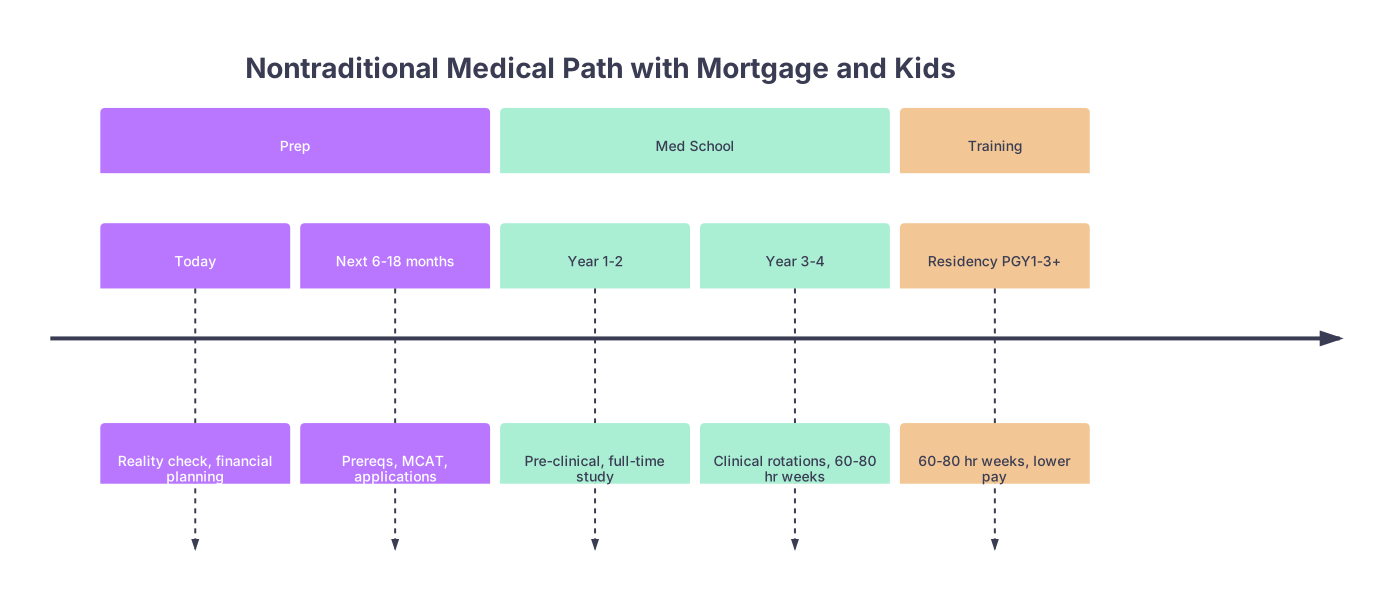
| Period | Event |
|---|---|
| Prep - Today | Reality check, financial planning |
| Prep - Next 6-18 months | Prereqs, MCAT, applications |
| Med School - Year 1-2 | Pre-clinical, full-time study |
| Med School - Year 3-4 | Clinical rotations, 60-80 hr weeks |
| Training - Residency PGY1-3+ | 60-80 hr weeks, lower pay |
If you’re 32 now, you might be:
- Starting med school at 34–36
- Finishing residency at 41–44
That means:
- Your toddlers will be in middle/high school by the time you’re attending level.
- Your mortgage will be mid- or late-term, or up for renewal at least once.
- Your spouse (if you have one) will carry an unfair share of the family weight for years.
If those sentences made your stomach drop, that’s good. That’s your brain doing risk assessment like a grown adult.
You only move forward if you can say: “Yes. Even with that, we want this.”
Step 2: Put Your Current Life on the Table (No Sacred Cows)
You cannot keep your current life and “fit med school around it.” That fantasy is how marriages and bank accounts get wrecked.
List out your real situation:
- Mortgage balance, monthly payment, rate, and remaining term
- Other debts (student loans, cars, credit cards, personal loans)
- Household income (yours + partner’s)
- Ages of kids, childcare situation, school situation
- Commute times, existing support system
Then ask: What are we willing to sacrifice or change?
Typical sacred cows that need to be on the chopping block:
- House size / neighborhood
- Private school
- Second car or car type
- Expensive activities / travel
- “We always…” traditions that cost money or time
You’re not deciding what to cut yet. But you’re letting yourself admit that some of this is negotiable. Because it is.
Step 3: Decide Where You’ll Actually Go to School
The biggest mistake nontrad parents make is applying like a 22-year-old: chasing prestige instead of logistics.
Your #1 priority is geography.
You want one of these if at all possible:
- A med school within commuting distance of your current (or new cheaper) home
- A location where your spouse can get good work + you can afford rent + you have family support
Do not underestimate the cost of a bad location. Commutes, daycare costs, and losing grandparents’ help will crush you faster than a tough anatomy exam.
Here’s how the tradeoffs usually look in reality:
| Option | Pros | Cons |
|---|---|---|
| Stay in current house, local school | Keep community, kids' schools, known costs | Dependent on getting 1 specific acceptance |
| Move to cheaper area near school | Lower housing costs, fresh start | Disrupt kids, spouse job change |
| Live near school, rent house/apt | Short commute, less chaos for you | Pay mortgage *and* rent or sell house |
| Spouse and kids stay, you move solo | Kids' stability, spouse job intact | Family separation, high emotional cost |
You need to decide your preferred model before you apply. Otherwise, you’ll rationalize terrible choices later (“We’ll just make the 90-minute commute work…” Spoiler: you won’t.)
Step 4: Run a 10-Year Financial Stress Test
This is the part people skip. Also the part that kills them later.
You need a 10-year cash flow plan. Rough, not perfect. But real.
A. Map Your Income by Phase
Now – Start of Med School
Your income: current job (maybe part-time later)
Spouse income: same or changing?
Additional: savings, side gigsMed School Years 1–4
Your income: essentially zero
Spouse: primary earner
Loans: federal student loans (and possibly PLUS loans)Residency (3–7 years depending on specialty)
Your income: ~$60–75k/year (varies by region and year)
Spouse: still primary or shared
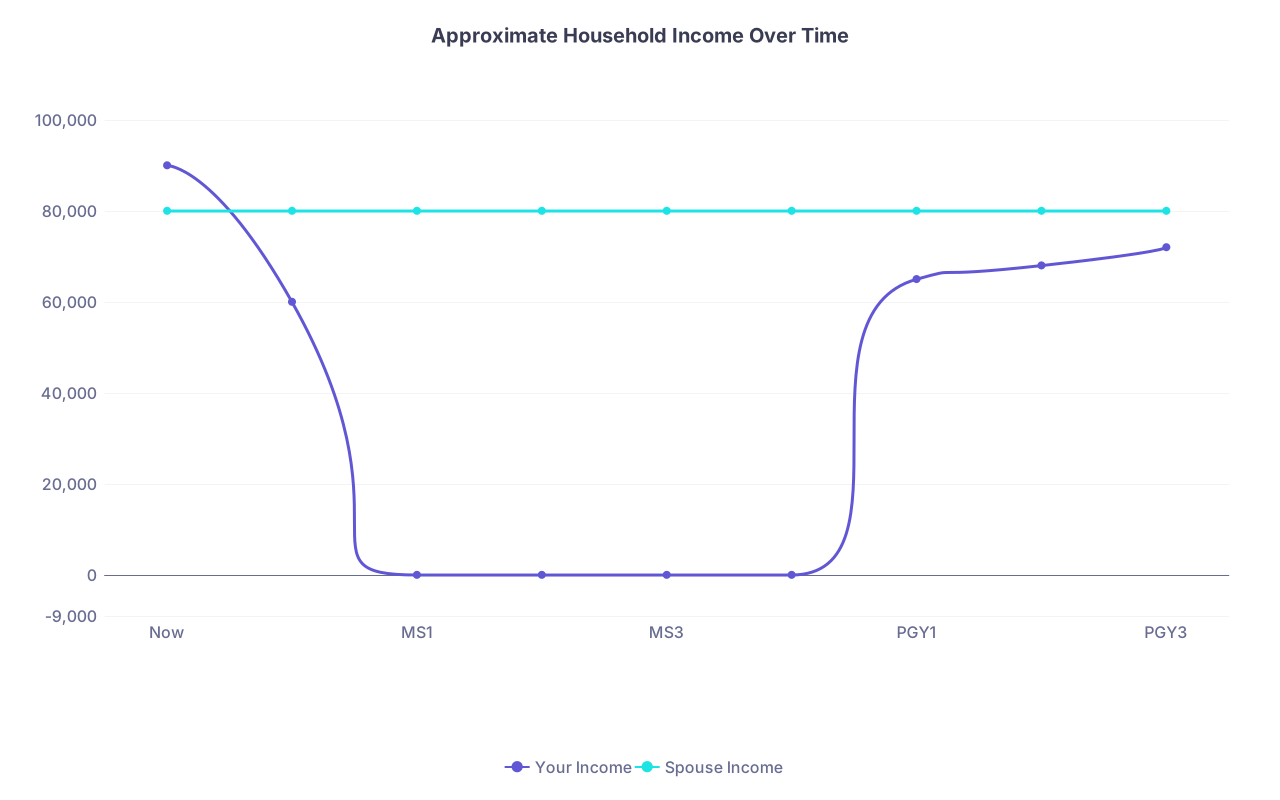
| Category | Your Income | Spouse Income |
|---|---|---|
| Now | 90000 | 80000 |
| Pre-Med Year | 60000 | 80000 |
| MS1 | 0 | 80000 |
| MS2 | 0 | 80000 |
| MS3 | 0 | 80000 |
| MS4 | 0 | 80000 |
| PGY1 | 65000 | 80000 |
| PGY2 | 68000 | 80000 |
| PGY3 | 72000 | 80000 |
These numbers are placeholders; plug in your own. The pattern is what matters: Your income falls off a cliff, then climbs back slowly.
B. Map Your Major Expenses
Big-ticket items:
- Mortgage (or rent if you move)
- Property tax, insurance, HOA
- Childcare / after-school care / summer camps
- Groceries for a growing family
- Health insurance (especially if you’re changing jobs)
- Loan payments from undergrad (if not in deferral)
Then medical school costs:
- Tuition and fees
- Living expenses (your portion if spouse is covering family)
- Exam fees, travel, applications, Step exams
You want a simple spreadsheet: left side: years; across the top: income streams + major expenses. Then see what the gap is.
If the gaps are massive and recurring, that’s not “we’ll tighten our belts.” That’s “this does not work unless we sell the house or delay.”
Step 5: The Mortgage Question – Keep, Sell, or Restructure?
This is usually the emotional center of the decision. The house is stability. Identity. Kids’ rooms, backyard, neighbors. I get it.
But the house is also a financial lever. Use it or it uses you.
Option 1: Keep the House As-Is
Best if:
- Payment is comfortably under ~25–30% of your spouse’s gross income
- You have at least 3–6 months of expenses in savings
- You’re likely to attend a nearby medical school
- The house is not a maintenance nightmare
Worst case scenario: You get into a school 1–2 hours away and now you’re talking brutal commute or weekday apartment plus mortgage. Do not bank on this working.
Option 2: Refinance or Extend Term (If Rates/Terms Make Sense)
Not exciting, but practical. Lower your monthly payment now to build cushion.
You extend the term or adjust the rate, you pay more interest over time, yes. But you free up cash when you need it most (med school years).
Make sure:
- Closing costs are reasonable
- You’re not gambling on future income you may never actually get (don’t assume derm attending money in 10 years as justification for everything)
Option 3: Rent Out the House
This can be brilliant or a disaster.
Good scenario:
- Your mortgage is low enough that realistic rent covers PITI (+ management if needed)
- House is in a strong rental market
- You’re okay being a landlord (or hiring one)
Bad scenario:
- You depend on rent to the dollar to survive and can’t handle vacancies or repairs
- The house is old and needy
- The rental market is soft and you’re guessing optimistic numbers
Option 4: Sell and Reset
Emotionally brutal. Financially freeing.
You sell, wipe out the mortgage, maybe carry equity into a cheaper place or just rent. Suddenly your monthly nut shrinks, and the 10-year plan stops looking impossible.
If keeping the house turns your plan from “tight but possible” into “this breaks if one thing goes wrong,” you sell. That’s the hard truth.
Step 6: Make a Childcare and Family-Life Battle Plan
You cannot wing childcare in medical school. It has to be engineered.
Think in phases.
Phase 1: Premed / Postbacc
Your load: classes, labs, MCAT study, maybe part-time work.
What usually works here:
- Spouse covers afternoons; you do mornings + bedtime
- You batch study early mornings, nap times, evenings
- Grandparents or trusted sitters 1–2 regular blocks per week for deep focus
Phase 2: Preclinical (MS1–2)
You’re in class or studying 40–60 hours/week if you’re serious.
You need:
- Reliable weekday childcare/aftercare
- Protected study blocks when you’re not “on” as a parent
- Clear division of labor at home (who does what, when)
Phase 3: Clinical (MS3–4)
Welcome to chaos: early rounds, late call, unpredictable schedules.
What works better here:
- Longer daycare hours or flexible nanny
- Backup childcare plan for early morning or late pickups
- Spouse (or another adult) who’s fully ready to cover when your schedule blows up

| Category | Value |
|---|---|
| Med school work | 55 |
| Family/Parenting | 35 |
| Sleep | 45 |
| Household/Admin | 15 |
| Personal/Other | 8 |
This is not precise; it’s reality-adjacent. There are only so many hours in a week. Every extra hour of study comes from somewhere: sleep, spouse time, kid time, housework.
That means: you and your partner must be on the same page before you start.
Step 7: Renegotiate Your Marriage/Partnership Contract
If you have a partner, they are about to become part-time single parent, part-time financial engine, part-time emotional support, with less of you.
You don’t “hope they’re okay with it.” You re-contract.
Concrete conversations you need to have:
- Roles: Who’s the default parent for school calls, sick days, appointments?
- Chores: Who owns which chores? Not “we’ll share” — specific: laundry, cooking, dishes, bills, car maintenance.
- Money: How tight are we willing to live? What’s non-negotiable (e.g., kids’ activities) and what isn’t (e.g., new cars)?
- Support: What will you give back during med school to avoid total burnout for your partner? Maybe you always do Saturday mornings with the kids so they get a break.
You will be tired, stressed, and occasionally useless at home. If you don’t plan around that, resentment will grow quietly until it explodes in MS3.
Step 8: Shrink Your Life Now, Before You “Need” To
Do a 6-month trial: live on what your household income will effectively be in med school (spouse income only, or spouse + resident-level income if you’re close to that phase).
If your spouse makes $80k and you currently make $90k, pretend your $90k doesn’t exist.
Cut your lifestyle accordingly:
- Scale down subscriptions, eating out, vacations
- Drive your cars into the ground instead of upgrading
- Test cheaper grocery and activity routines
If you can’t make that work without burning through savings every month, you have your answer: something bigger needs to change (house, timeline, or med school plan).
Step 9: Build a Support Network That Actually Functions
Two kinds of support: practical and emotional.
Practical:
- Grandparents or relatives who can handle school pickups, sick days, or weekend coverage
- Neighbors / close friends you trust enough to call at 6AM when your spouse is on a trip and you have an exam
- Other med students with kids — trade coverage, shared study with kids playing together
Emotional:
- A therapist (yes, proactively)
- At least one friend who doesn’t need you to pretend you’re fine
- A partner who understands this is a season, but a long one
People who make it through this intact usually aren’t superheroes. They’re just not trying to do it alone.
Step 10: Be Strategic with Your Premed and Med School Choices
You don’t have the luxury of chasing ego.
Some concrete tactics:
- Choose nearby postbacc or DIY prereqs at a local university or CC to avoid moving twice
- Apply heavy to schools near family support even if they’re not “top tier”
- Favor schools with pass/fail preclinical and supportive culture over ultra-gunner environments
- Seriously consider primary care–friendly or less competitive specialties if training length and lifestyle matter for family (you can change your mind later, but be aware)
Residency competitiveness, length (3 vs 5 vs 7 years), and call burden matter way more when you’re a 40-year-old with teenagers and a mortgage than when you’re 26 and single.
Step 11: Sanity Rules So You Don’t Implode
You can white-knuckle through one bad semester. You cannot white-knuckle through a decade.
So set rules now:
- Non-negotiable family time windows. Maybe Sunday afternoon is always family, phone away. Protect it like an exam.
- Non-negotiable sleep minimum. You’re not 20. Chronic 4-hour nights will break your brain and your marriage.
- Burnout triggers. Agree with your partner: “If I start doing X (snapping constantly, drinking too much, withdrawing), we reassess workload.”
And accept this: you will not be a perfect student, perfect parent, and perfect spouse at the same time. Pick which ball you’ll allow to drop occasionally, and which one you won’t.
For most nontrads, the smart hierarchy looks like:
- Protect the marriage/partnership
- Protect the kids’ sense of stability and love
- Pass and progress in med school (you do not need honors in everything)
- Everything else is negotiable
Step 12: Decide: Start Now, Delay, or Walk Away
After all this, you’re at a decision fork.
There are three equally valid answers:
- “Yes, we’re in. We’ll cut, move, hustle, and we still want it.”
- “Not yet. We need 1–3 more years to pay down debt, build savings, or reposition housing.”
- “No. The tradeoffs are too big for our family right now.”
Answer #3 does not mean you failed. It means you acted like an attending making a hard call with incomplete data. That’s maturity.
If it’s #1 or #2, then the next step is concrete.
What to Do Today
Open a blank doc or notebook and do three things:
- Write your ages, your kids’ ages, and “projected” ages at med school start and residency completion. Stare at those numbers until they feel real.
- List your top 5 biggest fixed expenses and put actual dollar amounts next to them. Mortgage, childcare, cars, etc.
- Sit down with your partner (or a trusted friend if you’re solo) and say out loud:
“If I do this, our lives will look very different for the next 7–10 years. Here’s what I think that actually means.”
Don’t open an MCAT book until you’ve done that.
You can learn biochemistry anytime. Restructuring a life with a mortgage and kids for med school? That has to be done with your eyes wide open, starting today.