
What do you do when your $120K salary becomes $0… and you still want to be a doctor?
If you’re reading this, you’re probably either:
- Staring at a resignation letter draft.
- Already left industry and are watching your bank balance fall.
- Or you’re stuck in analysis paralysis because the pay cut feels like jumping off a financial cliff.
You’re not crazy to be worried. Going from a stable industry job to being a premed means:
- Massive drop (or total loss) of income
- New education costs (post-bacc, prereqs, MCAT, applications)
- Years before you earn a real salary again
This is not a mindset problem. It’s math. And you have to treat it like math.
Let’s walk through exactly how to handle the financial side of a major pay cut when you move from industry to premed. Not “inspirational” advice. Concrete steps, decision points, and numbers.
Step 1: Get brutally clear on your financial runway
Before you even think about quitting your job, you need one number: how many months you can survive without your current salary.
Not vibes. Not “I think I’ll be okay.” A real number.
Do this:
- Pull the last 3 months of bank and credit card statements.
- Categorize everything into:
- Fixed needs: rent/mortgage, utilities, minimum loan payments, insurance, phone, internet
- Variable needs: groceries, gas, basic healthcare, kids’ essentials if applicable
- Non-essentials: eating out, subscriptions, travel, shopping, décor, etc.
- Calculate a “bare-bones survival budget” where you keep only the fixed needs and the absolute minimum variable needs.
Now compare savings vs that bare-bones number.
| Item | Amount (Monthly) |
|---|---|
| Rent + utilities | $1,700 |
| Groceries | $350 |
| Transportation (gas/metro) | $150 |
| Insurance (health/car/rent) | $300 |
| Phone + internet | $120 |
| Loan minimums | $280 |
| **Bare-bones total** | **$2,900** |
| Savings available for runway | **$25,000** |
| **Runway (months)** | **≈ 8.6 months** |
If your runway is under 6–9 months and you’re planning to quit completely, that’s a red flag. You’re setting up future-you for panic, debt, or both.
If you already quit and you’re realizing your runway is shorter than you thought: fine. You’re not the first. We’ll fix that in a bit with work and expense cuts.
Step 2: Decide your work strategy: not “all or nothing”
The worst trap non-trads fall into is binary thinking:
“I either work full-time in my old job OR I quit cold turkey and become a full-time premed.”
That’s how people blow up their finances.
Here are the realistic options, and how they actually play out:
| Path | Pros | Cons |
|---|---|---|
| Stay full-time | Max income, no debt growth | Slower prereqs, burnout risk |
| Drop to part-time | Some income + classes | May need employer flexibility |
| Quit & work per diem | Control hours, MCAT focus | Variable income, less stability |
| Quit & no work | Max academic bandwidth | Requires strong savings/partner |
If you’re older than ~24 and have any responsibilities (rent on your own, partner, kids, loans), I almost always recommend:
- Either part-time work
- Or flexible/per diem/contract work
Full-time no-work student only makes sense if:
- You have strong savings and/or partner income
- You’re on a compressed timeline (e.g., 1-year intensive post-bacc)
- You’ve already done the math and you’re not guessing
Be honest: the MCAT is not a 24/7 job. Full course-load + 10–20 carefully chosen work hours per week is often possible. Painful? Yes. But often necessary if you’re absorbing a major pay cut.
If you’ve already quit and fully stopped working, your next step is to look for flexible income (we’ll get to that in Step 4) before you burn through your emergency fund.
Step 3: Build the “Premed Budget 2.0” – not your old lifestyle
Industry-you and Premed-you are different people with different financial realities.
Industry-you had money to outsource problems: takeout, Uber, weekend trips, convenience everything.
Premed-you is in survival mode. Your budget now has a new category: education costs.
List out your unavoidable premed/med school prep costs over the next 1–3 years:
- Tuition for prereqs / post-bacc
- Lab fees
- MCAT prep (course or materials)
- MCAT registration
- Application cycle: primary application fees, secondary fees, travel (if in the old pattern; now sometimes less)
- Occasional transcript fees, CASPer, etc.
Now, layer that on top of your bare-bones living budget. You’ll end up with something like:
- Living (bare-bones): $2,900/month
- Education-related (averaged monthly): maybe $400–600/month over 2 years
- Total monthly cash need: ~$3,300–3,500
Then you face the real question: where does that $3,300–3,500 come from? Savings? Partner? Part-time work? Loans?
Do not pretend this isn’t happening. Premed costs add up and blindside a lot of career-changers.
Step 4: Design your income plan: what actually works for non-trads
You are not a 19-year-old who can live with three roommates in a basement for $400/month and eat ramen.
You probably have higher baseline expenses. So income has to be part of the plan.
Here are realistic work options that fit a premed schedule:
Keep your current job but:
- Move to 32 hours/week if possible
- Shift to early hours (7–3) and take evening classes
- Or go fully remote and stack classes at night
Transition to related but more flexible roles:
- Contract analyst, consultant, software dev, graphic design, marketing—whatever your industry skill is
- You might make less per hour, but you can control your schedule
Clinical jobs that double as experience:
- Scribe (often evenings/weekends)
- ER tech (if you have EMT/CNA background or can get trained)
- CNA, MA, phlebotomist, patient transport, etc.
These pay less than industry. But they give you clinical exposure and letters.
High-flexibility, lower-prestige jobs:
- Tutoring (MCAT, SAT, your old field skills)
- Barista, serving, gig work (DoorDash, rideshare) – not glamorous, but flexible
The key thought process:
- Your job is no longer about status or career ladder.
- Your job’s purpose now: buy you time and food while you become a competitive applicant.
If you’re fighting that mentally (“But I used to be a manager / engineer / senior designer…”), fine. Feel that. Then remember: this is a temporary phase. You’re not retiring as a barista. You’re using it to get through orgo and the MCAT.
Step 5: Slash expenses with a premed mindset, not a pride mindset
You cannot take a huge pay cut and keep the exact same life. That mismatch is how people end up with 30% APR credit card debt.
Here are the levers that actually move the needle:
Housing
- Biggest line item. If you’re single and paying high rent, consider:
- Moving in with family (yes, ego will scream; yes, it often makes sense)
- Taking on roommates even if you never wanted to
- Moving a bit farther from city center for lower rent
- I’ve seen people save $800–1,200/month just by swallowing their pride and moving.
- Biggest line item. If you’re single and paying high rent, consider:
Transportation
- If you’re in a city: sell the car if you can and use public transit.
- If you need the car: shop insurance, drop expensive coverage if reasonable, stop using Uber like it’s free.
Subscriptions and “normal life” leaks
- Streaming services, subscription boxes, fancy gyms, frequent Amazon “small” buys.
- You know where your leaks are. Plug them.
Food
- Meal prep. Groceries heavy, eating out light.
- “But I’m so busy” – yes, and broke. One Sunday prep saves $50–100/week easily.
Social life
- You can still have one, but shift to low-cost: potlucks, walks, free events.
- If your friend group’s default is $60 dinners and weekend getaways, you’ll need to start saying no.
The question you ask yourself is no longer “Can I technically afford this this month?” It’s “Is this worth delaying my application or increasing my future debt?”
Step 6: Handle debt like an adult who wants future options
You cannot ignore your debt during this transition. The way you treat it now will box you in later.
You’re in one of three situations:
No debt or very low debt
- You have maximum flexibility. Good. Don’t ruin it with new, avoidable consumer debt.
Manageable debt (student loans, car, a bit of credit card)
- Minimize interest costs.
- Consider income-driven repayment for federal loans if your income drops.
- Prioritize killing high-interest credit card balances first if possible before you quit or drastically cut income.
Heavy debt (large student loans, big consumer debt)
- Do not just hope med school will somehow make it disappear.
- You may need a longer transition: stay in industry a year or two longer, aggressively pay down or refinance, then jump.
- This isn’t weakness. It’s strategy.
Your premed years are not the time to rack up new high-interest debt to maintain a lifestyle you can’t afford now. If you’re putting groceries or rent on a credit card regularly, the plan is broken. Stop and reassess immediately.
Step 7: Timeline sanity check – are your plans and money actually aligned?
Most non-trads underestimate how long the premed → med school pipeline takes.
Rough outline:
- 1–2 years: prereqs/post-bacc (if you need many sciences)
- 3–6 months: MCAT study (sometimes overlapping)
- 1 application cycle: submit in June, interviews in fall/winter, decision next spring
- Then med school: 4 years with minimal to no earning
You might be 4–6 years away from a resident paycheck.
That doesn’t mean you must fully non-earn for all those years. But it does mean: don’t just plan financially for “this year” and ignore the rest.
Build a simple year-by-year sketch:
Year 1: Finish prereqs, work 20 hrs/week, savings flat
Year 2: MCAT + applications, work 10–15 hrs/week, savings slightly down
Year 3: Potential gap year if needed, work more to rebuild savings
Year 4+: Med school (loans, minimal side income at best)
If you look at that and your stomach drops because your money doesn’t cover it, that’s not a sign to give up. It’s a sign you need either:
- More years working before you fully commit to school
- A cheaper cost of living location
- More support (partner/family)
- Or a different pace (e.g., part-time prereqs while staying full-time in industry longer)
Step 8: Emotional side of a major pay cut – and how not to let it wreck you
The money part is one thing. The identity part blindsides people.
You go from:
- “Senior analyst at [big-name firm] making six figures”
To: - “Student at community college taking chemistry with 19-year-olds”
Your brain will tell you you’re regressing. Failing. Wasting your previous career.
You’re not. You’re changing fields. That always looks weird mid-transition.
A few practical ways to stay sane:
- Stop comparing your income to peers who stayed in your old industry. You’re on a different track now.
- Track non-financial wins: A in orgo, solid MCAT practice score, great shadowing experience, strong letter from a PI or physician.
- Have 1–2 people who understand your long game and can remind you why you’re doing this when your bank account is screaming.
You are trading current status and comfort for future training and a different kind of responsibility. That’s not irrational. It’s just expensive and slow.
Step 9: When you already jumped and the numbers aren’t working
Maybe you’re already in classes, income is way down, and your checking account is unpleasant to look at. Fine. Let’s triage.
Do this:
Freeze lifestyle creep immediately.
- No big purchases. No new subscriptions. Stop pretending you’re still at your old salary.
Get some income quickly.
- Short term: restaurant work, tutoring, test proctoring, gig work.
- Medium term: scribe, CNA/MA, remote contract work in your old field.
- Look for something that doesn’t blow up your study schedule but plugs the financial hole.
Talk to lenders/landlord/loan servicers early, not when you’re already defaulting.
- Ask about deferment, hardship programs, income-based plans.
- You get better options when you’re proactive, not when collections is calling you.
Be willing to adjust your premed timeline.
- It is better to take an extra year before applying than to drown in debt and stress so badly that your grades and MCAT suffer.
You’re not a failure if you realize you need to tweak the plan. You’re someone who looked at the data and made a smarter move.
Step 10: Long-term perspective – why this can still be rational
Let me be very clear: going from industry to medicine is not automatically a good financial decision.
But it can be a reasonable one if:
- You’re aiming for a field and lifestyle you actually want, not just chasing the MD letters
- You manage your debt and do not let lifestyle inflation follow you from industry into med school and residency
- You accept that your 20s or 30s will not look like your peers’ in terms of vacations, houses, or savings
You may have a decade where your net worth goes sideways or down while your peers buy houses and max their 401(k)s. Then, in your late 30s or 40s, you start catching up as an attending.
Is that trade worth it to you?
Not to society. Not to your parents. To you.
If yes, then do it with your eyes open and your budget tight, instead of drifting off a financial cliff.
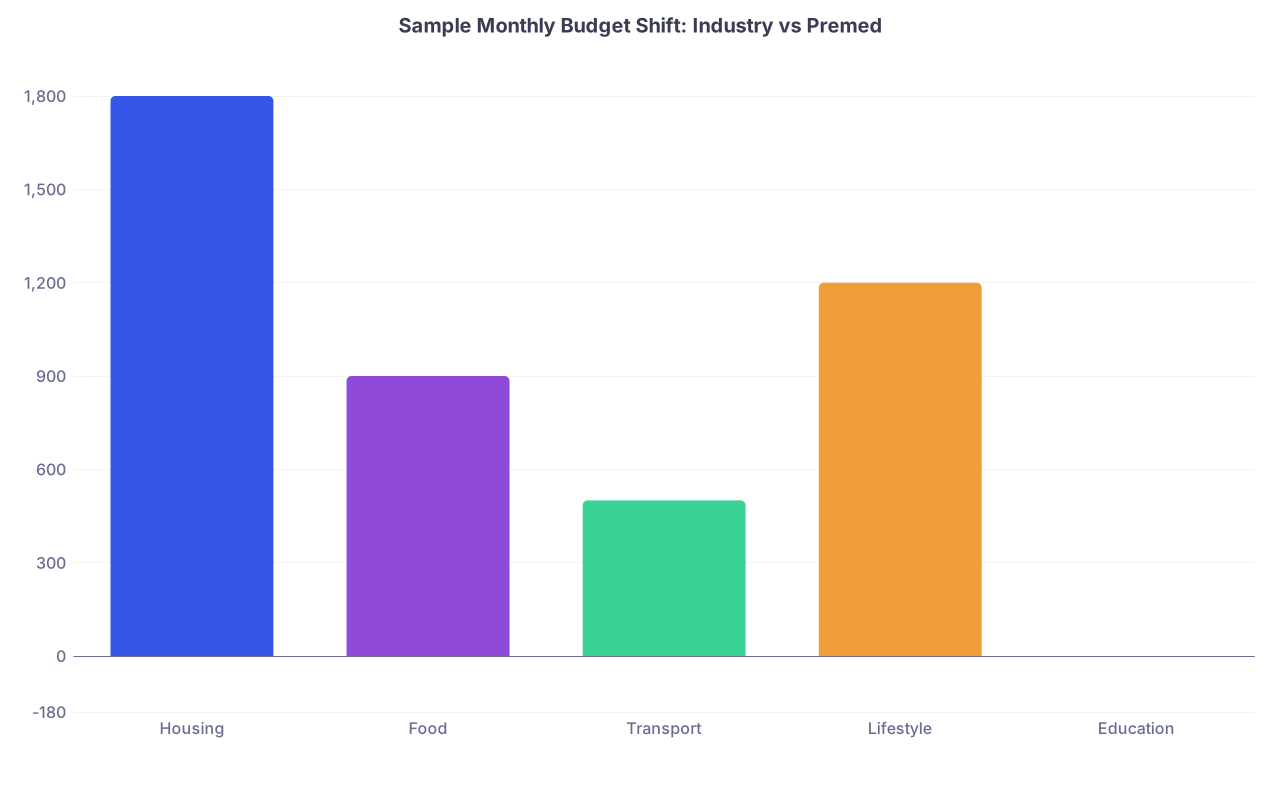
| Category | Value |
|---|---|
| Housing | 1800 |
| Food | 900 |
| Transport | 500 |
| Lifestyle | 1200 |
| Education | 0 |
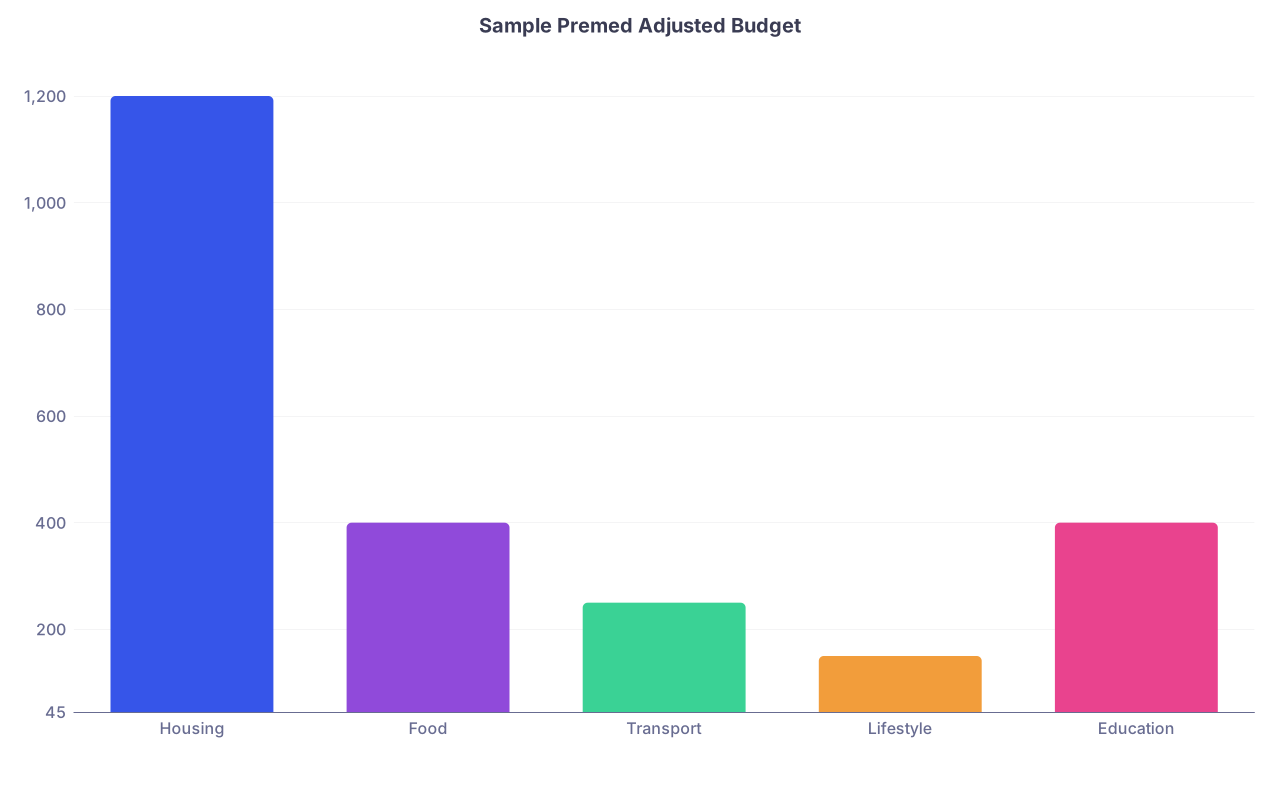
| Category | Value |
|---|---|
| Housing | 1200 |
| Food | 400 |
| Transport | 250 |
| Lifestyle | 150 |
| Education | 400 |
(First chart = old industry lifestyle. Second = post-cut, intentional premed lifestyle. That gap in “Lifestyle” and “Housing” is where your runway comes from.)
FAQ (Exactly 5 Questions)
1. Should I wait until I’m completely debt-free before leaving my industry job for premed?
Not necessarily, but the higher your high-interest debt (especially credit cards), the more dangerous it is to cut income. If your debt is mostly federal student loans with reasonable interest, you can often transition earlier while using income-driven repayment or deferment. If you’re carrying thousands at 20% APR on credit cards, I’d seriously consider a 12–24 month plan to aggressively pay that down first while staying in industry. That extra year will feel long now but will buy you enormous mental breathing room later.
2. Is it realistic to work full-time and do prereqs and MCAT?
Some people do it, but they pay for it in stress and time. If you have a heavy full-time job and you’re taking multiple hard sciences, you’re more likely to get mediocre grades or delay the MCAT endlessly. A more sustainable model I’ve seen work: full-time + 1–2 classes for a while, then drop to part-time or compressed work hours during your heaviest semesters and MCAT prep. The goal isn’t to prove you can suffer; it’s to produce an academic record and MCAT score strong enough to get you in.
3. How much savings should I have before quitting to study full-time?
If you truly plan to have zero income, I’d want at least 12–18 months of bare-bones expenses saved, plus a separate emergency fund and your estimated education costs for that period. Most people don’t have that. Which is why I usually push non-trads to keep some form of income—part-time, per diem, contract—rather than going to zero. If you’re at 3–6 months of savings and no income lined up, you’re in the danger zone.
4. Will medical schools judge me for taking lower-status jobs (barista, server, gig work) after leaving industry?
Not if your story is coherent. Adcoms do not care that you went from “consultant” to “scribe + barista.” They care whether you did what you needed to do to pursue medicine seriously: strong academics, clinical exposure, evidence of commitment. Saying, “I picked up flexible service work to support myself while taking rigorous science courses and gaining clinical experience” actually shows grit and realism. That’s not a negative. It can be a plus.
5. How do I talk to my partner/family about the pay cut without blowing up the relationship?
You do it with numbers, not drama. Sit down with a simple spreadsheet: current income/expenses, projected premed expenses, your proposed work plan, and how you plan to protect the household (insurance, childcare, housing). Ask for feedback and be open to adjusting the timeline. What blows up relationships is vague promises like “It’ll be fine” while the bank account says otherwise. If you can show that you’ve thought through the money—runway, backup plans, debt—you’re much more likely to get real support instead of panic.
Open your banking app and your last credit card statement right now. Write down your true monthly “bare-minimum survival” number on a piece of paper. That’s your starting point. Everything about your transition from industry to premed has to be built around that number.