
The fantasy that “if they really love you, they’ll just support your dream of becoming a doctor” is wrong. Marriage is not a fan club; it’s a business partnership with feelings.
You’re asking your spouse to co-sign a massive, high-risk, decade-long project: premed, MCAT, applications, medical school, residency. If they’re unsure, they’re not being unsupportive. They’re being sane.
Here’s how to handle it like an adult instead of turning this into a slow-motion relationship disaster.
Step 1: Get Very Clear on What They’re Actually Unsure About
Most people misdiagnose the problem. They hear:
- “I’m not sure about this”
and translate it to: - “They don’t believe in me / they don’t love me.”
That’s usually wrong. Your spouse is rarely opposed to you becoming a doctor. They’re scared of specific consequences.
Common real worries:
- Money: “How do we pay bills / mortgage / childcare while you’re in school?”
- Time: “Will I be effectively single for 7–10 years?”
- Stability: “What if you don’t get in? What if you burn out?”
- Geography: “Will I have to leave my job/family/support system for your match?”
- Identity: “Do I lose my own goals so we can chase yours?”
So you start here: one, honest, focused conversation with one agenda—diagnosis, not persuasion.
Concrete script for the start of that conversation:
“I know I’ve been talking about switching to medicine and you’ve seemed unsure. I’m not going to argue tonight. I just want to understand what specifically worries you—money, time, moving, something else. I’ll listen and take notes, no debating.”
And then you actually shut up and listen. You take notes. You don’t rebut. You don’t fact-correct mid-sentence. You might say, “Anything else?” until they’re empty.
You’re trying to leave that conversation with a list of fears, not a win.
Step 2: Turn Vague Fear into Concrete Numbers and Timelines
Ambiguity is gasoline on anxiety. If all your spouse hears is:
- “It will be hard for a while”
- “We’ll figure it out”
- “Lots of people do this”
you’re confirming their worst suspicion: you haven’t done your homework.
You need a concrete plan—years, dollars, and what-life-actually-looks-like.
Use this as a rough, honest outline for a nontraditional path:
| Phase | Duration | What It Looks Like at Home |
|---|---|---|
| Premed coursework (post-bacc/DIY) | 1–2 years | Classes, labs, studying evenings/weekends |
| [MCAT prep](https://residencyadvisor.com/resources/nontraditional-path-medicine/advanced-timeblocking-techniques-for-working-professional-premeds) | 3–9 months | Heavy study blocks, especially weekends |
| Application year | 1 year | Essays, secondaries, interviews, travel/Zoom |
| Medical school | 4 years | 60–80 hr weeks, limited flexibility |
| Residency | 3–7 years | 60–80+ hr weeks, often worse schedule than med school |
And then map your reality onto it:
- What classes you actually need and how long they’ll take
- When you’d realistically sit for the MCAT
- Which application cycle you’re targeting
- A time window when medicine starts paying (attending salary) vs when expenses spike (applications, tuition, lost income)
Put this into an actual basic family financial scenario: income, rent/mortgage, childcare, debt, savings.
This is where most nontrads get exposed. They love the dream but they haven’t done the spreadsheet.
So your move:
- Build a basic 8–12 year timeline.
- Build a rough budget at 3 key points:
- Now, with your current job
- During medical school (are you both working? kids? loans?)
- Early residency
Then show that to your spouse. Not to steamroll them. To prove you’re taking joint reality seriously.
Step 3: Separate “No Forever” from “Not Like This” and “Not Yet”
Your spouse’s hesitation usually falls into one of three buckets:
- “I’m scared, but maybe”
- “I’m okay with the goal, but not okay with the current plan”
- “I really don’t want this life, even if the money/status are good”
You need to find out which one you’re dealing with.
Ask explicitly:
“If this were completely free and didn’t change our time together at all, would you be excited for me to become a doctor? Or does the idea itself not feel right to you regardless?”
If they say, “If it didn’t cost us anything, sure”—you’re mainly fighting logistics and fear, not values. That’s workable.
If they say, “Honestly, no, I don’t want you to be a doctor. I don’t want that life”—that’s not a planning issue. That’s a core incompatibility question. It doesn’t mean your marriage is over. It does mean you’re not going to “argue them into” being okay with this.
Two very different problems:
- Problem A: “I’m worried about how we’d do this.”
- Problem B: “I don’t want to be married to a physician at all.”
Stop treating B like it’s A. That’s how people waste three years of coursework and then blow up their relationship at the start of MS1.
Step 4: Build a Trial Phase Instead of Demanding a 10-Year Commitment
If your spouse is in “scared but maybe” or “okay with goal, not the plan,” you don’t jump straight to “I’m applying to 30 schools and quitting my job next year.”
You propose a trial phase with clear boundaries and checkpoints.
Example structure:
Phase 1 (6–12 months):
- Take 1–2 prerequisite courses while working.
- Start very light MCAT content review (or just confirm you still like the material).
- Meet with a premed advisor or physician mentor.
- At the end of this phase, have a scheduled, serious check-in with your spouse.
Phase 2 (another 6–12 months, if both agree to continue):
- Increase coursework.
- Study more seriously for MCAT.
- Draft concrete application plan (school list, costs, dates).
Present it like this:
“I’m not asking you to sign off on the entire path to attending physician tonight. I’m asking you to agree to a 6–12 month test period where I do [A, B, C], we track how it affects us, and then we sit down and you have full veto power on whether we escalate to the next phase.”
Why this works:
- It gives your spouse some control back.
- It tests your discipline and capacity without blowing up your current life instantly.
- It forces both of you to deal with reality instead of imagined worst-case (or best-case) scenarios.
You’re making it reversible at clear points, instead of one giant irreversible leap.
Step 5: Address the “Invisible Workload” Problem Head-On
Your spouse’s fear is often not just about hours at the hospital. It’s about ending up doing everything.
I’ve watched this play out in several couples where one partner goes to med school:
- The med student says, “I’ll still help around the house,” and they mean it.
- Reality: they’re gone 12 hours, wiped out when home, anxious about exams.
- The non-med spouse quietly picks up: laundry, cooking, bills, kid logistics, emotional labor.
- Resentment builds because they feel like they never agreed to be a solo parent/household manager.
So you handle this now, before you apply.
Have a blunt conversation:
“If I do this, there’s a real chance my available time and energy will drop a lot. Let’s look at what you’re already doing now vs me. Then talk about what would need to change, be outsourced, or dropped altogether so you’re not just quietly carrying everything.”
Make an actual list of:
- Current household tasks (daily, weekly, monthly)
- Current childcare tasks (if applicable)
- Emotional/administrative work (school emails, doctor appointments, scheduling, family events)
From there, options:
- Can you simplify your life before starting?
- Can you budget for cleaning help, grocery delivery, childcare hours?
- Can you move closer to family support if that’s an option?
- Can you do specific recurring tasks that fit your future schedule? (e.g., always handle weekend cooking, bills on Sunday nights, kids’ bedtime when you’re not on call)
Promise specifics, not “I’ll try.”
Step 6: Stop Romanticizing the Job for Them
You may be starry-eyed about medicine. Your spouse doesn’t have to be. They’re not applying.
Don’t sell them on:
- “Doctors are so respected.”
- “We’ll be financially set.”
- “I’ll be helping people every day.”
They’ve watched Grey’s Anatomy. They’ve also seen burned-out physicians, terrible schedules, and articles on depression in residency.
A better frame is something like:
“I know this career is hard and sometimes ugly. I’m not asking you to love medicine. I’m asking if you’d be open to us pursuing this together as a joint project if we can agree on safeguards that protect you and us.”
If you try to convert them into superfans, you’re just making them feel unheard. Treat them like a critical co-founder, not a cheerleader who’s “not positive enough.”
Step 7: Involve a Neutral Third Party Early (Not After a Huge Fight)
If you’re already looping the same arguments—money, kids, “you don’t understand”—stop doing this solo.
Options that actually help:
- Couples therapist, ideally one who’s seen medical couples or big career transitions
- Financial planner with experience in professional school debt
- Physician couple you know who’s willing to be very honest (not Instagram-happy, actually honest)
- A nontraditional student advisor or dean if you can access one
The key is: you’re not bringing them in to prove you right. You’re bringing them in to help both of you see trade-offs clearly.
You can say to your spouse:
“I don’t want this to become ‘me vs you.’ This is big enough that I think we owe it to ourselves to talk it through with someone who’s seen this before—both the success stories and the disasters. Would you go with me to one or two sessions to explore it?”
If they refuse every kind of help or neutral input and still say “no” across the board, that’s data too. Then you’re at the “values conflict” stage, not “we just need more info.”
Step 8: Decide What You’re Actually Willing to Sacrifice
This is the part people gloss over because it’s ugly.
There are three non-pretend possibilities:
- You don’t go to medical school. You decide your marriage and current/future life together matters more.
- You go to medical school with your spouse’s active support, after a ton of planning and compromise.
- You go despite their deep misgivings or refusal, or the relationship ends so you can pursue medicine.
All three happen in real life.
You’re not a bad person if you’re unwilling to kill this dream. You’re also not a failure if you decide the dream costs too much in the context of your actual family.
But you need to be honest with yourself:
- If your spouse says, “I really don’t want this and won’t sign up for it,” are you going to drop it?
- Or are you going to resent them forever if you walk away?
If the answer is, “I’ll resent them for the rest of my life,” then the issue is no longer “how do we handle their uncertainty?” It’s: can this marriage survive you shelving the core of what you want?
At that point, you need professional help (therapy, mediation) pronto. Not another night of arguing over school lists.
Step 9: Translate Talk into a Written “Family Game Plan”
Once you’ve talked this stuff to death, you need something in writing. Not a legal contract—just a living document you both agree reflects reality as of now.
It should include:
- The tentative multi-year timeline
- Financial assumptions (tuition, living costs, loans, your spouse’s income, childcare)
- Commitments around household labor and childcare
- Checkpoints:
- “If I don’t hit X on the MCAT by Y date, we pause and reconsider.”
- “If we’re not accepted after Z cycles, we stop vs consider other paths.”
- What your spouse needs to feel respected and prioritized:
- Regular date nights?
- One protected evening per week together?
- You showing up for specific key events (kids’ recitals, anniversaries, etc.)?
You review this document every 6–12 months and adjust. It keeps expectations from drifting into fantasy.
Step 10: Specific Moves You Can Make This Month
If you’re in this situation right now, not someday, here’s a concrete short list:
- Schedule a serious 60–90 minute talk with your spouse with one goal: list their fears. No debating.
- After that, spend 1–2 weeks building:
- A rough 10-year timeline
- A basic budget at 3 key points (now, med school, residency)
- Propose a 6–12 month trial phase with:
- 1–2 classes
- Limited, scheduled MCAT prep
- One or two meetings with advisor/physician
- Book one joint session with:
- A couples therapist or
- A financial planner or
- A physician couple willing to talk
If you can’t get your spouse to the table for any of those without huge drama, that’s your signal this isn’t a simple hesitation problem. That’s a deeper relationship issue you can’t paper over with promises and timelines.
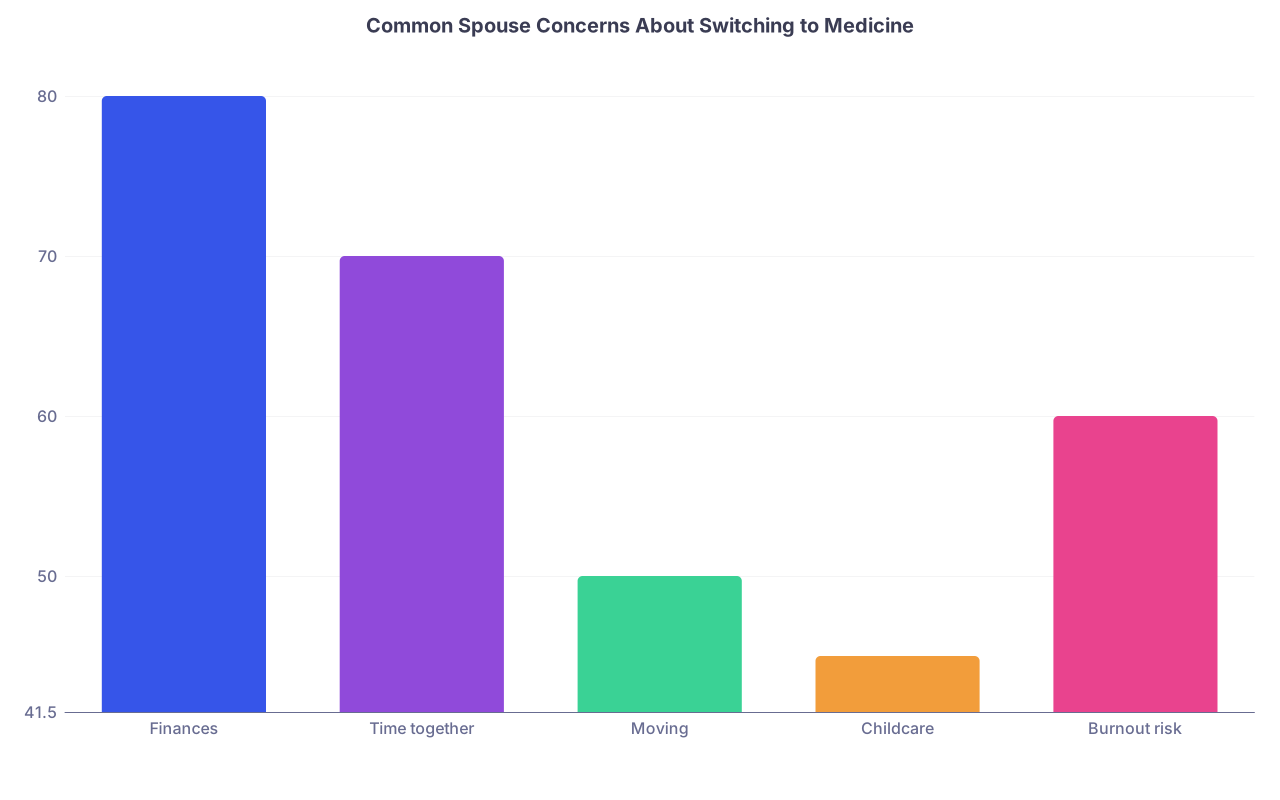
| Category | Value |
|---|---|
| Finances | 80 |
| Time together | 70 |
| Moving | 50 |
| Childcare | 45 |
| Burnout risk | 60 |

| Step | Description |
|---|---|
| Step 1 | Desire to switch to medicine |
| Step 2 | Talk: List spouses specific fears |
| Step 3 | Build timeline & budget |
| Step 4 | Decide: Medicine vs Marriage priority |
| Step 5 | Propose 6-12 month trial phase |
| Step 6 | Couples/financial/mentor meeting |
| Step 7 | Apply to med school with shared plan |
| Step 8 | Reassess path & relationship |
| Step 9 | Spouse says: No way ever |
| Step 10 | Spouse says: Maybe/Not sure |
| Step 11 | After trial: Both still on board? |
FAQs
1. What if my spouse keeps saying, “Do whatever you want,” but seems resentful or checked out?
That’s not consent; that’s avoidance. Treat “do whatever you want” as “I don’t feel safe or heard enough to say what I really think.” You respond by slowing down, not speeding up. Say: “I’m not comfortable making a decision this big without knowing where you truly stand. If you’re scared to say you don’t want this, say that. I’d rather hear no than pretend we’re fine.” And yes, this is a good moment to bring in a therapist—someone who can help both of you say the quiet parts out loud.
2. Should I delay having kids (or having more kids) until after training if my spouse is unsure?
Often, yes—or at least, you need a brutal honesty session about timing. Kids + med school + an unsure spouse is a stress multiplier. There’s no universally “right” sequence, but you shouldn’t just drift into pregnancy while also launching this path. Decide intentionally: are you doing kids first, then medicine? Medicine first, then kids? Kids during residency? Make that part of the plan, not a side quest.
3. Is it a red flag if my spouse wants me to choose between them and medicine?
It’s a red flag if it’s delivered as a manipulative threat (“If you loved me, you’d drop this”) without any attempt at discussion or compromise. But a clear boundary—“I genuinely cannot sign up for the lifestyle that comes with this path”—is not inherently abusive; it’s honest. The hard truth: sometimes your core life vision and your spouse’s core life vision just don’t match. That’s not solved by “better communication.” It’s solved by accepting that two good people can want incompatible futures.
4. How do I know if I’m being selfish by pushing for medicine?
Ask yourself three things:
- Have I done serious, boring homework—budget, timeline, lifestyle trade-offs—or am I just chasing a fantasy?
- Have I invited my spouse into the planning as an equal partner, or am I presenting a done deal and demanding support?
- If our roles were reversed, and they wanted a 10-year, high-debt, high-burnout path that would reshape our life, would I feel heard with the way I’m behaving now?
If the honest answers are “no, no, and hell no,” you’re being self-centered, not just ambitious. Fix that first, then revisit the dream.
Key points to remember:
- Your spouse’s hesitation is usually about specific, solvable fears—not a rejection of you.
- You need a concrete, shared plan (timeline, budget, division of labor), not vague optimism.
- At some point, you’ll face a real value choice: prioritize this marriage as it is, or prioritize medicine. You can’t pretend that decision doesn’t exist.