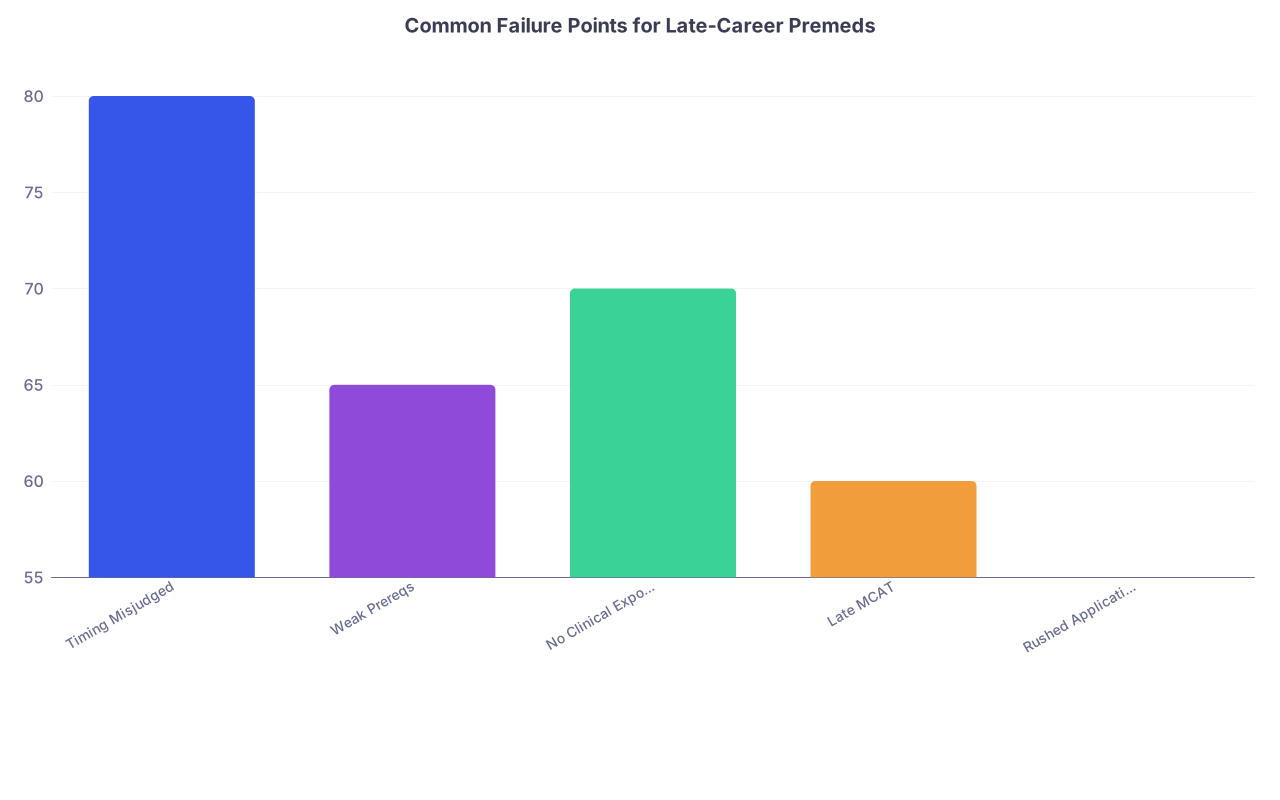
| Category | Value |
|---|---|
| Timing Misjudged | 80 |
| Weak Prereqs | 65 |
| No Clinical Exposure | 70 |
| Late MCAT | 60 |
| Rushed Applications | 55 |
What happens when you realize you want to be a doctor at 35… and then lose two years just “getting ready to get ready”?
That is the silent killer for late‑career switchers: not lack of ability, not age discrimination, but a badly managed premed timeline that bleeds time, money, and morale.
If you are coming from business, tech, teaching, nursing, the military—wherever—you are not a traditional 20‑year‑old sophomore. The rules are different for you. Your margin for error is smaller. And the common mistakes other nontraditionals make are brutally predictable.
Let’s walk through those traps so you do not fall into them.
Mistake #1: Treating This Like a Casual “See How It Goes” Project
The biggest error I see: drifting into the process.
You keep your full‑time job. You “start with one class.” You “see how the MCAT looks.” And suddenly you are 3 years older, thousands of dollars in, and still do not have:
- Completed prerequisites
- An MCAT score
- Consistent clinical experience
- A coherent narrative
This “dip your toes in” mindset is deadly for late‑career switchers because your clock is not the same as a college sophomore’s. You have:
- Family responsibilities
- Financial obligations
- Biological clock worries
- Career trajectory already built in another field
You cannot afford a wandering, unstructured approach.
How this looks in the real world:
You enroll in a random evening Gen Chem at a community college, no plan beyond that. The next year you do Organic at a different place. You wait to “see how those go” before deciding on physics. You postpone the MCAT because “work is crazy right now.” You vaguely think you will apply “in a couple years.”
Result: You string together 4–5 years of scattered coursework and shadowing, but when it is time to apply, your story is: “I’ve been kind of exploring medicine for a while.” That is not compelling. That sounds like you are not decisive.
Avoid this by making one hard decision up front:
Decide: Am I truly pursuing medical school, or just exploring?
Exploring is fine for 3–6 months. Shadow 2–3 physicians. Do 50–100 hours of clinical volunteering. Talk to actual residents, not just Reddit threads. But after that, make a binary decision:
- Yes, I am going for this.
- No, I am not.
If it is yes, you need a concrete, written 2–4 year plan. Not vibes. Not “sometime.” Actual semesters, courses, and target dates.
Mistake #2: Misjudging How Long the Premed Timeline Actually Is
A depressing number of people think: “I will knock out the prereqs in a year, take the MCAT next summer, apply immediately, and be in med school the year after.”
That is the standard fantasy timeline. It usually dies around Organic Chemistry II.
Here is the reality for most late‑career switchers starting from scratch:
- 2 years of prerequisite coursework (if done part‑time while working)
- 6–12 months of serious MCAT prep
- 1 full application cycle (which itself is a year: June apps → interviews through March/April)
Many people end up at 3–4 years from “I am doing this” to sitting in an MS1 lecture. Not because they are slow, but because they tried to cram, burned out, or underperformed on the MCAT and had to reapply.
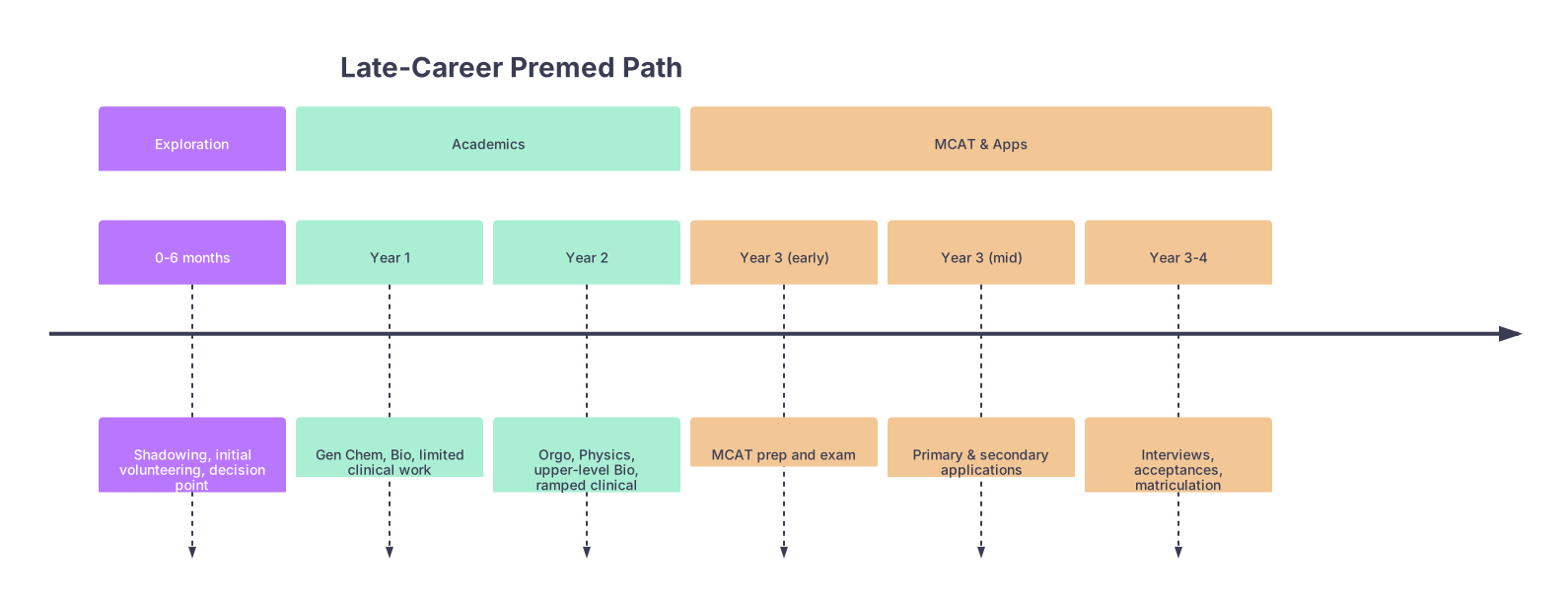
| Period | Event |
|---|---|
| Exploration - 0-6 months | Shadowing, initial volunteering, decision point |
| Academics - Year 1 | Gen Chem, Bio, limited clinical work |
| Academics - Year 2 | Orgo, Physics, upper-level Bio, ramped clinical |
| MCAT & Apps - Year 3 (early) | MCAT prep and exam |
| MCAT & Apps - Year 3 (mid) | Primary & secondary applications |
| MCAT & Apps - Year 3-4 | Interviews, acceptances, matriculation |
The mistake is not being optimistic. The mistake is building your life around optimism.
You quit your job too soon. Or you promise your partner “Medical school in 2 years max.” Or you lock in a lease, school plans for your kids, or financial commitments assuming the fast track.
When the timeline stretches—as it usually does—you are suddenly:
- Out of money
- Under family pressure
- Feeling like a failure before you even submit an application
Better approach: Plan on a 3–4 year path. If you manage 2.5, good. But do not set up your life assuming best‑case everything.
Mistake #3: Ignoring How Your Old Transcript Actually Looks to Adcoms
Many late‑career switchers have an ugly undergrad behind them. Maybe:
- A 2.8 GPA from 15 years ago
- Several withdrawals
- An entire semester of Cs because you were working 40 hours
And they think: “I will just crush my post‑bacc and they will ignore the old stuff.”
No. They will not “ignore” it. The past does not disappear. What you can do is build a trajectory story that makes sense.
The mistake is not the bad GPA. The mistake is pretending it does not matter.
Here is how this goes wrong:
You take a few scattered classes, do okay (B+/A−), and assume that is enough to override a 2.8. It is not. Your overall GPA still looks mediocre. Your science GPA is hard to interpret because it is spread across years and institutions.
The admissions committee has to work to see your improvement. Many will not work that hard.
You need:
- A clearly defined academic “redemption arc”
- A strong, recent science GPA (ideally 3.7+ in at least 30–40 credits of solid science)
- Consistency: not A, A, then a C+ in Biochem because “work got busy”
If your old record is rough, consider a formal or structured post‑bacc, or at least a disciplined DIY sequence at one institution. Random community college courses sprinkled over years send a message: “still scattered.”
Mistake #4: Scheduling the MCAT Backward From Your Hope, Instead of Forward From Your Readiness
This one ruins more nontraditional applications than any other single choice.
Late‑career switcher logic often goes like this:
“I want to apply next June, so I must take the MCAT in April. I will be ‘ready’ by then because I have to be.”
You lock in a test date based on your application fantasies, not your baseline performance. You still have Physics II unfinished. You are scoring in the 503–505 range on practice exams. But you tell yourself: “I just need a few more weeks.”
You sit for the exam. You get a 503. Now:
- You are debating a risky re‑take
- Or submitting a weak score because you are “already this far”
- Or losing an entire cycle and a big chunk of confidence
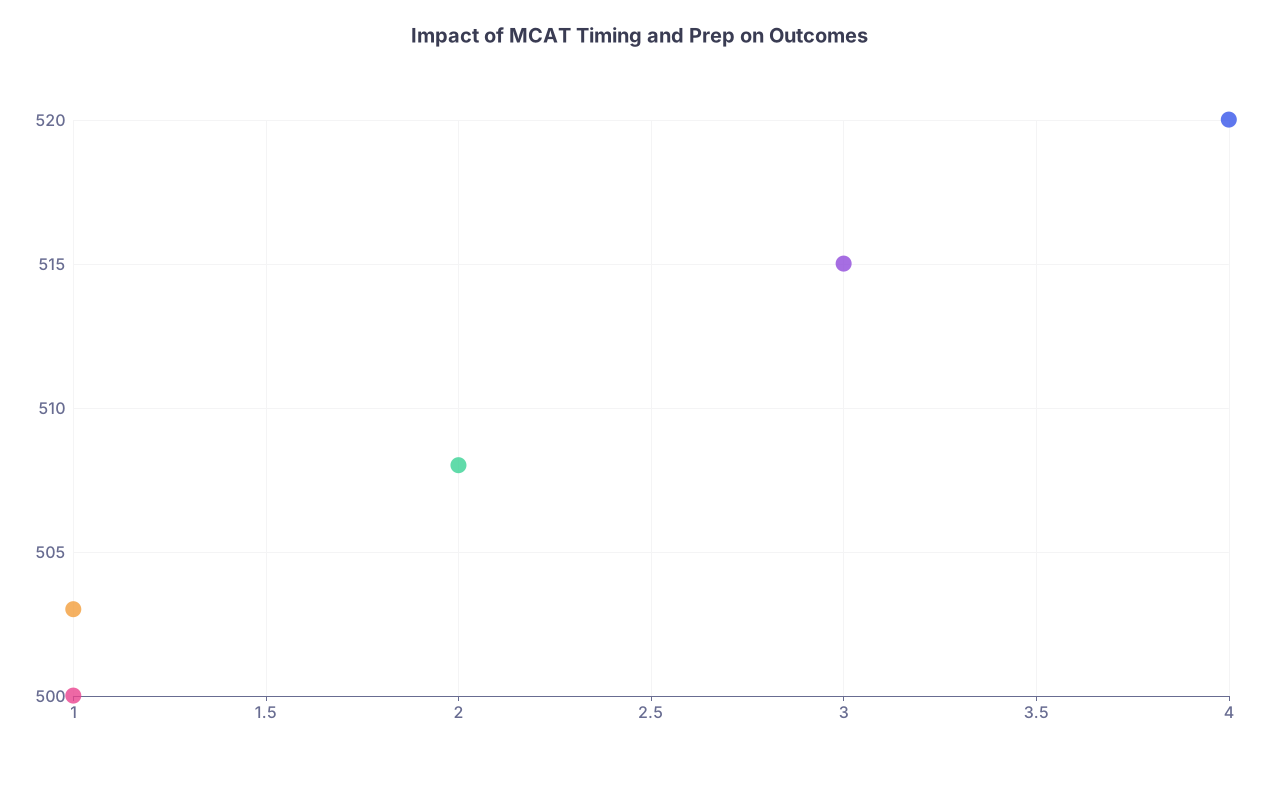
| Category | Value |
|---|---|
| Applicant A | 4,520 |
| Applicant B | 3,515 |
| Applicant C | 2,508 |
| Applicant D | 1,503 |
| Applicant E | 1,500 |
(The x‑axis here is months of serious prep; the pattern should be obvious.)
You cannot bully your brain into MCAT readiness on your schedule. Especially when:
- You are 10–15 years removed from basic sciences
- You have a full‑time job
- You have kids or other major responsibilities
The safer process:
- Finish the core prereqs or at least be deep into them.
- Take several full‑length practice exams over a few months.
- Use those scores (not your hope) to determine whether you are ready.
- Schedule the actual MCAT once your practice scores are consistently near or above your target.
Yes, this might push your application back a year. That delay is nothing compared to building your med school career on a 503.
Mistake #5: Underestimating How Much Clinical and Shadowing Time You Actually Need
Career‑changers with “adjacent” backgrounds love this one:
“I am a physical therapist / nurse / PA / paramedic / tech / healthcare admin. I already know medicine. I do not need much shadowing.”
Wrong. You know health care. You do not know what it means to be a physician.
Medical schools are not just checking boxes; they are screening for people who genuinely understand the physician role and still want it. If your application does not show physician‑specific exposure, you look naïve at best and arrogant at worst.
Common mistakes here:
- Logging 20–30 shadowing hours and calling it a day
- Only shadowing one specialty (often something glamorous)
- No primary care exposure
- Inconsistent or last‑minute volunteering thrown together right before applying
You should be thinking in this range, minimally:
- Clinical volunteering / work: 150–200+ hours, sustained over at least a year
- Shadowing: 40–60 hours, with at least a couple of different specialties, including something less flashy (internal medicine, family med)
And those hours need to start early in your timeline, not in a panicked sprint 6 months before you apply.
If you are late‑career, admissions committees will assume you have less time to waste. That you did your homework. That you understand what you are getting into. If your experiences do not reflect that, they will doubt your judgment.
Mistake #6: Letting Your Nontraditional Story Turn Into a Messy, Unfocused Narrative
Being nontraditional can be a huge strength—or a liability.
The strength: You have real‑world experience, maturity, perspective.
The liability: If you cannot clearly explain your switch, it sounds unstable or impulsive.
Here are the narrative mistakes I see in personal statements and interviews:
- Rambling life stories that never answer “Why medicine, and why now?”
- Overly negative talk about your first career (“I hated every minute of consulting”)
- Vague inspiration stories (“I always knew I wanted to help people”) that ignore your 15‑year detour into corporate sales
- No clear explanation of why physician, not NP/PA, not staying in your current field, not something else
Your timeline needs to support a coherent story:
- You explored medicine with intention (shadowing, volunteering)
- You tested your academic chops with recent hard science coursework
- You committed fully once you confirmed the fit
- Your prior career skills clearly connect to what you will bring as a physician
If your activities look like random stabs: one semester here, one volunteer gig there, a gap, an abrupt MCAT, a rushed application—it reads as “confused” to committees.
You are allowed to change your mind later in life. But you are not allowed to look confused while asking for a seat in a medical school class.
Mistake #7: Planning Your Finances Like You Are Still 22
A 35‑year‑old with a mortgage, possibly kids, loans, and a partner does not get to copy the standard “I’ll just live on ramen” script.
Here is the silent financial bomb I see over and over:
- You cut back work hours to do prereqs.
- You take on extra debt for post‑bacc tuition.
- You skip building an emergency fund because “once I am in med school, loans will cover everything.”
- You assume you will get in on the first try.
If your first application cycle fails—or you need a glide year—your finances may implode.
For late‑career switchers, the most dangerous mistake is underestimating the cost of:
- 2–4 years of premed prep (with reduced income)
- MCAT prep, application fees, secondaries, and interviews
- Potential reapplication year
- 4 years of medical school with little to no income
You need a realistic, conservative financial plan that covers:
- “What if I do not get in on the first try?”
- “What if I need to delay the MCAT a year?”
- “What if my partner loses their job?”
If that means spreading your prereqs over 3 years instead of 2 so you can maintain a stable income, that is not weakness. That is survival.
Mistake #8: Not Building a Support System Early Enough
You cannot brute‑force this alone indefinitely. Not at 30, 40, 45. The “lone wolf” mentality is romantic and stupid.
Late‑career switchers often hide the process:
- They do not tell their employer, fearing backlash.
- They tell family very late, then get slammed with skepticism right before taking huge steps.
- They do not connect with other nontraditional premeds, so they assume their struggles mean they are uniquely unfit.
Then the crunch hits: finals, MCAT, applications, maybe kids getting sick, parents needing help, partner burning out. And your entire timeline gets wrecked because you have zero buffer in your support system.
You need people who:
- Know what you are doing and why
- Are on board with the time and financial hit
- Can pick up slack at home during crunch periods
- Can pressure‑test your plans (course loads, MCAT date, application timing)
You also need peers. Other nontrad premeds, not just 19‑year‑olds complaining about orgo on Discord. People who understand trying to memorize glycolysis after putting kids to bed.
Do not wait until you are collapsing to build this. That is the mistake.
Mistake #9: Rushing to Apply “Because I Am Getting Older”
Age panic derails a lot of good candidates.
You hit 33, 36, 40, and the internal monologue starts: “If I do not apply this year, I will be 41 when I start. That’s too old. I have to go now.”
So you apply with:
- Mediocre MCAT
- Thin clinical hours
- Half‑baked letters of recommendation
- Sloppy essays written at 1 a.m. after clinic shifts
You do a massive, expensive application blitz. 30+ schools. You tell yourself you will “fix things later” if needed.
Result: Rejections or radio silence.
Now you are older, poorer, and more demoralized. Sometimes with a weaker reapplication position because schools have already seen your name with a subpar file.
Here is the uncomfortable truth: waiting one more year to apply with a strong application is usually better than applying one year earlier with a weak one.
The age difference between starting med school at 37 vs. 38 does not matter to anyone. What does matter is whether your file screams “clear, capable, committed” or “rushed and borderline.”
Give yourself permission to miss the next cycle if you are not ready. The alternative is wasting it.
Mistake #10: Not Owning Your Time Constraints and Energy Limits
You are not 19. You do not have the same brain recovery, free hours, or sleep flexibility. Pretending otherwise is how you get burnout, broken relationships, and failed classes.
Late‑career switchers make two opposite but equally bad errors:
- Overloading: Stacking full‑time work, 10–20 hours of volunteering, night classes, intense MCAT prep, and family responsibilities under the fantasy that “it’s only for a year.”
- Under‑committing: Taking a single light class per term, dragging the process out but not actually making forward progress in a focused way.
Your timeline has to respect the reality of your life. That means:
- Being brutally honest about how many hours of deep study you can consistently do per week
- Choosing course loads that challenge you but do not guarantee collapse
- Scheduling genuine rest periods into the long multi‑year push
Too many late‑career switchers burn all their psychological fuel in year one. Then limp painfully through the MCAT, hate every minute of applications, and seriously consider quitting right before they actually start to look competitive.
Better to move slightly slower but with sustainable effort than sprint for a year and then crawl for three.
FAQs
1. How late is “too late” to start a premed path as a career‑changer?
“Too late” is less about age and more about realism and health. I have seen people start in their early 40s and do well. What matters is:
- Your physical and mental health
- Your financial stability and support system
- Your willingness to commit to 10+ years of training
If you are in your late 30s or 40s, the mistake is not the age itself. It is underestimating the sacrifices and trying to rush the process to “make up time,” which usually backfires.
2. Should I quit my job to focus full‑time on prereqs and the MCAT?
Sometimes, but not by default. Quitting too early is a common and serious mistake. Ask:
- Can I maintain B+/A‑ level work in sciences while working?
- Will quitting create financial stress that sabotages my studying?
- Do I have at least 6–12 months of living expenses saved?
A phased approach often works better: reduce to part‑time, test how you handle heavier coursework, then decide. Do not set fire to your livelihood based on optimism alone.
3. Do I need a formal post‑bacc or SMP as a late‑career switcher?
Not always. The mistake is assuming either “I absolutely need an expensive formal program” or “I can just take random classes anywhere.” If your old GPA is weak or ancient, a structured post‑bacc or well‑planned DIY post‑bacc (coherent set of courses at one institution with strong performance) can help.
An SMP (special master’s program) is higher risk—expensive, and if you underperform, it can hurt you. Those are for specific situations, not a default solution. Your actual need depends on your existing GPA, course recency, and where you want to apply.
Key Takeaways
- Do not drift. Make a binary decision, then build a realistic multi‑year plan that respects your age, finances, and responsibilities.
- Do not rush the MCAT or applications out of age panic. A strong file one year later beats a weak file now, every time.
- Do not go it alone. Build academic, financial, and emotional support early so your timeline bends, instead of breaks, when life inevitably hits.