
The biggest threat to professionals returning to science for the MCAT is not intelligence. It is arrogance disguised as “I’ve been successful before, I’ll figure it out.”
If you are a career changer, a nurse, a PA, a business executive, an engineer, or a lawyer coming back to hardcore science after years away, your risk of studying wrong is significantly higher than a typical college junior’s. You have habits, responsibilities, and blind spots that traditional students simply do not.
Let me walk you through the most common mistakes I see professionals make with MCAT prep—and how to avoid sabotaging yourself.
1. Believing “I’m Smart, I’ll Just Power Through It”
This is the classic professional mistake: confusing general competence with specific readiness.
You have probably heard or said phrases like:
- “I crushed the SAT/LSAT/GRE, I just need 2–3 months.”
- “I work in healthcare; the science will come back quickly.”
- “I’m good at standardized tests. Once I get going, I’ll be fine.”
This mindset quietly kills scores.
The MCAT is not:
- A quick-cram exam.
- A basic science test.
- Just an IQ proxy.
It is:
- A content-heavy, stamina-heavy, pattern-recognition exam.
- Built to expose weak foundations and sloppy thinking.
- Brutal for people who underestimate it.
Warning signs you are making this mistake:
- You refuse to take a full-length diagnostic early because you “don’t want to see a low score.”
- You plan a 6–8 week sprint because “that is all I needed for other exams.”
- You keep telling yourself you’ll “flip the switch” once work slows down. It never really does.
How to avoid this:
Take a cold diagnostic early.
Use an AAMC sample or a reputable full-length from a major company. Do not cherry-pick a short quiz. You need the full pain: 7+ hours, all sections.Accept that this is closer to a part-time job than a side project.
For most professionals:- 4–6 months is realistic.
- 10–20 hours/week of quality study is typical.
- Anything less than 250–300 total hours is risky unless your science background is very recent and strong.
Let the data humble you now, not on test day.
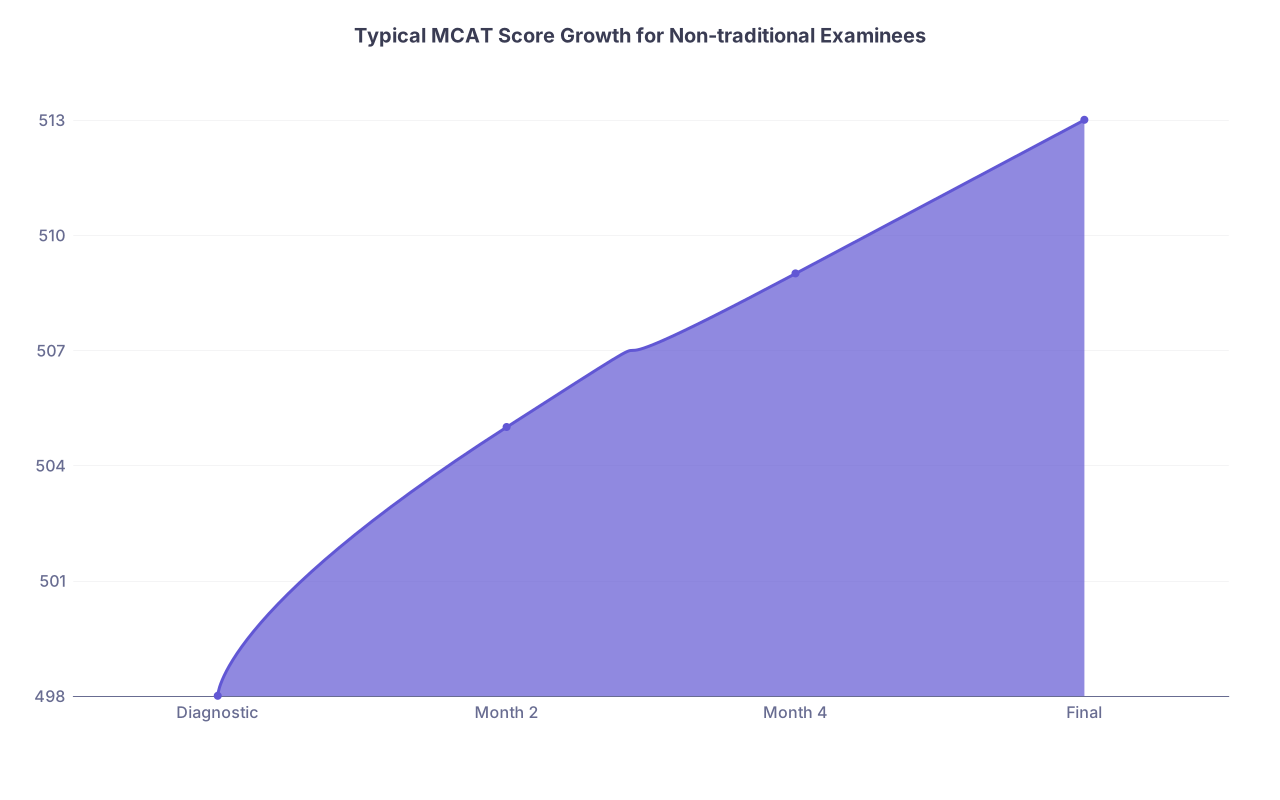
It is better to get punched in the face by a 498 diagnostic than be lulled into false confidence and walk out with a 503 when you needed a 512.
| Category | Value |
|---|---|
| Diagnostic | 498 |
| Month 2 | 505 |
| Month 4 | 509 |
| Final | 513 |
2. Misjudging How Much Your Old Science Knowledge Is Worth
Another killer: overvaluing stale science.
If your last serious biology, chemistry, or physics course was:
- 8–10+ years ago, or
- Pre–new MCAT (before 2015), or
- Memorization-heavy without real application
…you are not “brushing up.” You are rebuilding.
I have seen plenty of nurses, pharmacists, and even PhDs score in the low 500s on their first full-length because they assumed their background would carry them.
Specific traps for professionals:
- Healthcare professionals (RNs, PAs, paramedics): Your practical knowledge is strong. MCAT questions do not care. They will hit:
- enzyme kinetics
- Henderson–Hasselbalch
- random psych/soc theorists
- experimental design None of which you use day-to-day.
- Engineers / hard science people: Physics and math may feel comfortable, but:
- Biology and psych/soc will destroy you if you treat them as “common sense.”
- Social science / humanities professionals: Your reading skills are an asset, but:
- You underestimate the sheer volume of content in bio/biochem and chem/phys.
How to avoid this:
Treat each science subject as new until proven otherwise.
- Take a content diagnostic for each section: C/P, B/B, P/S.
- Use detailed topic lists (AAMC or solid review books) and mark:
- Green = solid
- Yellow = weak
- Red = forgotten / never learned
Be brutally honest about time since last exposure.
- 0–2 years: refresh.
- 3–5 years: partial rebuild.
- 6+ years: rebuild from scratch.
Do not skip psych/soc.
Professionals consistently underestimate this. It is "new" content for many people who graduated before it was emphasized.
3. Treating MCAT Prep Like Another Work Project
Professionals are good at planning. Gantt charts. Calendars. Color-coded Trello boards. You build a beautiful study schedule…and then everything implodes by week three.
Here is the problem: You are trying to fit MCAT into leftover time. Leftover time does not exist.
Common professional scheduling errors:
- Studying only after work, when your brain is cooked.
- Planning study blocks across 7 days with no rest.
- Assuming future months will be “less busy” (they will not).
- Overloading weekends with unrealistic 10-hour cram days.
How this shows up:
- You start skipping CARS because “I am too tired tonight; I will double up later.”
- You keep rescheduling full-length exams.
- You move topics around like furniture instead of cutting commitments.
How to avoid this:
Time-block energy, not just hours.
- If you are sharper in the morning:
- Use early mornings for MCAT (even 60–90 minutes) before work.
- Leave evenings for lighter review (Anki, flashcards, quick passages).
- If evenings are your only option:
- Accept lower intensity. 2–3 hours of focused work beats 5 hours of glazed-over highlighting.
- If you are sharper in the morning:
Lock in non-negotiable anchors:
- Full-length practice tests:
- Every 1–2 weeks in the last 2 months.
- Same time of day as your real exam.
- Review days after each full-length:
- Do not skip. This is where you actually learn.
- Full-length practice tests:
Subtract before you add. You cannot:
- Work full-time + be primary caregiver + run side projects + do MCAT seriously.
Something has to give: - Reduce hours (if financially feasible).
- Pause non-essential volunteering.
- Put hobbies on “maintenance mode” temporarily.
- Work full-time + be primary caregiver + run side projects + do MCAT seriously.

| Step | Description |
|---|---|
| Step 1 | Current Life Load |
| Step 2 | Reduce work or commitments |
| Step 3 | Assign high-focus AM blocks |
| Step 4 | Free 10-15 hrs/week |
| Step 5 | Plan 60-90 min weekday study |
| Step 6 | Schedule full-lengths and review |
| Step 7 | Protect schedule like patient care |
| Step 8 | Any flexible time? |
4. Ignoring Practice Exams Until “I Finish Content”
This one is almost universal among returning professionals, especially perfectionists.
The logic sounds reasonable:
- “I need to review all the material first.”
- “Why waste a full-length when I haven’t covered everything?”
- “I do not want to get discouraged by a bad score.”
Translation: “I am afraid of objective feedback.”
And that fear costs people 3–5 points easily.
Why this is a serious mistake:
- The MCAT is not a “content recall” exam. It is:
- Long passage reading
- Timed decision making
- Stamina under pressure
- You only build those muscles by doing full-lengths. Not flashcards.
Common professional pattern:
- 3 months of “content review only.”
- 2 full-lengths in the last 3 weeks.
- Panic when scores stall, then no time left to adjust.
How to avoid this:
Integrate practice early.
- By Week 3–4:
- Start doing at least some passages under timed conditions.
- By Month 2:
- Take your first real full-length (even if content is not done).
- Last 8–10 weeks:
- 1 full-length every 1–2 weeks.
- Focused review afterward: every question, right and wrong.
- By Week 3–4:
Use non-AAMC full-lengths early; save AAMC for later.
- Early: third-party exams to practice stamina and exposure.
- Later (final 4–6 weeks): AAMC exams for score calibration.
If you are waiting to be “ready” before taking practice exams, you are already behind.
5. Using the Wrong Study Tactics for an Exam Like the MCAT
Professionals often fall back on how they studied in college or grad school:
- Reading entire textbooks.
- Taking copious notes.
- Highlighting everything.
- Watching hours of videos passively.
That might have worked for your BA in economics or your MBA finance course. It does not work well here.
I see these mistakes constantly:
- Spending 3–4 weeks just “reviewing” Kaplan books cover to cover.
- Watching every Khan Academy video while half-distracted.
- Writing beautiful, complete notes that you never re-read.
Reality check:
- Passive review feels good because it is comfortable.
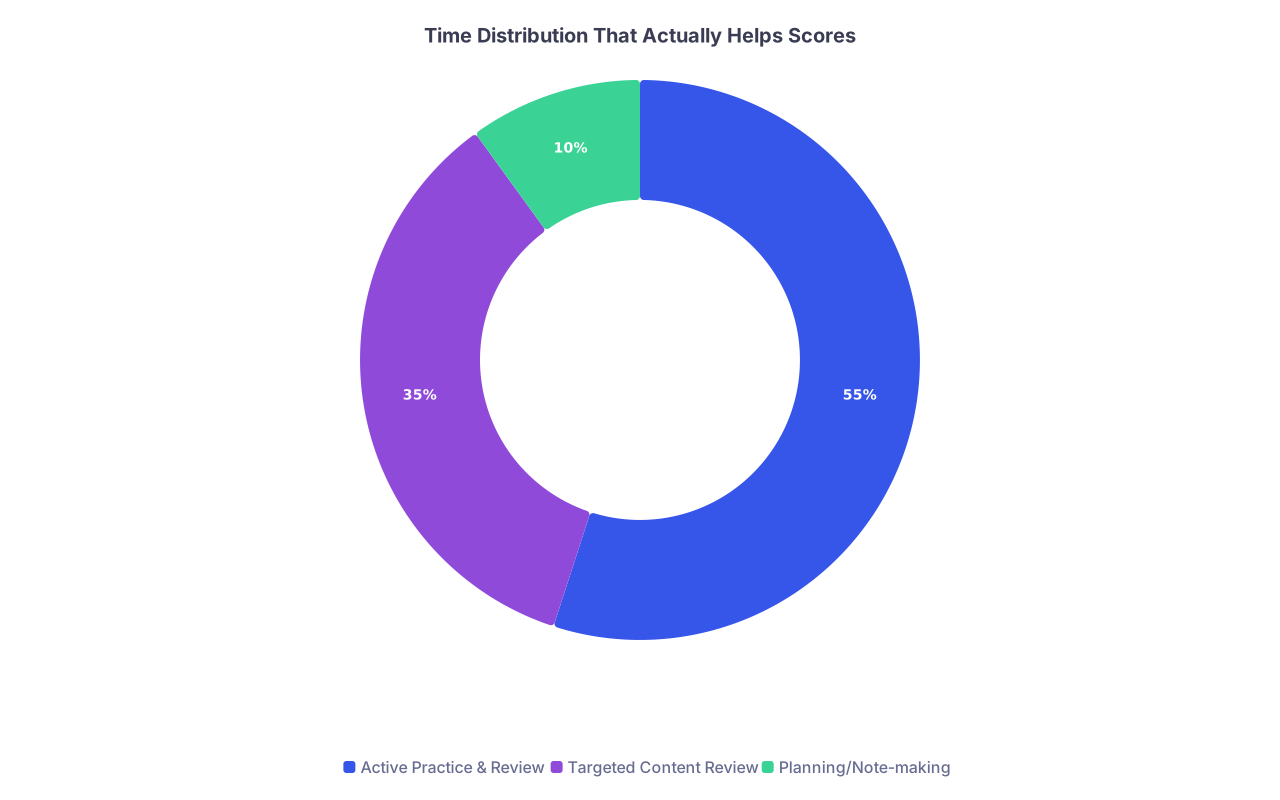
- MCAT improvement comes from active struggle with questions and passages.
What you should be doing instead:
Content review = brief, targeted, and immediately followed by practice.
- Example:
- Watch/skim acid–base content for 45 minutes.
- Then do 15–20 related questions.
- Review them deeply.
- Example:
Shift quickly to question-driven learning:
- Use question banks and passages to expose your weak areas.
- Then revisit content specifically for those gaps.
Track types of mistakes, not just topics:
- Misreading the question stem.
- Getting lost in dense passages.
- Panicking with math.
- Mixing up similar terms.
You are not just learning facts. You are re-training how you think under exam pressure.
6. Failing to Respect CARS (Especially High-Achieving Professionals)
CARS (Critical Analysis and Reasoning Skills) humbles smart people fast.
Lawyers, consultants, policy analysts—people who read for a living—often assume CARS will be easy. Then they consistently underperform.
Why? Because:
- CARS is not testing content knowledge.
- Your professional reading habits might actually hurt you:
- You insert outside knowledge.
- You argue with the passage.
- You “read between the lines” in a way that is not rewarded.
Typical professional CARS errors:
- Doing CARS only occasionally, “when I have time.”
- Refusing to use a method because “I know how to read.”
- Rushing through passages due to overconfidence.
How to avoid this:
Train CARS like a language, not a chapter.
- 3–5 passages a day, most days of the week.
- Timed, but with honest review afterward.
Adopt a simple, consistent approach:
- Focus on:
- Main idea.
- Author’s attitude.
- Function of each paragraph.
- Practice eliminating answer choices that:
- Are too extreme.
- Introduce new ideas not in the passage.
- Misrepresent the author’s tone.
- Focus on:
Do not skip CARS during your busiest weeks.
It is easier to maintain than to rebuild.
7. Overbuying Resources and Underusing the Right Ones
Professionals have disposable income. That is both a blessing and a trap.
I see this all the time:
- Buying 3 different full book sets.
- Subscribing to multiple Qbanks.
- Signing up for a $3,000 course and separate tutoring…then barely using either.
Tools do not replace time, focus, or discipline.
Common resource mistakes:
- Spreading yourself across 4 different content sources.
- Hoarding practice exams “just in case.”
- Ignoring official AAMC materials until very late.
How to avoid this:
Keep your core resources lean:
- One full set of content review (Kaplan, Princeton, etc., or a solid online equivalent).
- One question bank.
- Official AAMC materials (non-negotiable).
Prioritize AAMC when it matters most:
- Use question packs and section banks once you have some baseline content.
- Save AAMC scored full-lengths for the last 4–8 weeks.
Spend money on accountability only if you will actually engage.
- Tutoring or courses help if:
- You show up.
- You do the homework.
- You are honest about weaknesses. Paying for a course you are too busy to attend is just self-sabotage with a receipt.
- Tutoring or courses help if:
| Category | Value |
|---|---|
| Active Practice & Review | 55 |
| Targeted Content Review | 35 |
| Planning/Note-making | 10 |
8. Letting Your Identity as a “Successful Professional” Get in the Way
This one is more subtle. But very real.
You are:
- Used to being competent.
- Used to being respected in your field.
- Used to solving problems quickly.
MCAT prep forces you back into beginner territory. You will:
- Miss questions that feel insultingly easy.
- Forget basic equations.
- Score lower than college students who have not worked a day in their life.
If you let your ego drive the bus, you will:
- Avoid confronting weak areas.
- Make excuses about “not being a good test taker.”
- Rush the exam date because you are embarrassed to delay.
How to avoid this psychological trap:
- Treat MCAT like learning a new language, not a referendum on intelligence.
- Normalize being bad at it for a while. That is part of the process.
- Decide in advance:
- “If my scores are not where they need to be X weeks out, I will reschedule.”
And then honor that decision.
- “If my scores are not where they need to be X weeks out, I will reschedule.”
I have watched too many smart, accomplished professionals take the exam “just to see how I do” and walk away with a score that permanently complicates their application narrative.
You do not need that drama.
9. Underestimating Logistic and Lifestyle Stress
Another professional blind spot: assuming you can just “add MCAT prep” on top of everything else without emotional cost.
You are not:
- A 20-year-old with optional clubs and Netflix. You might be:
- Supporting a family.
- Paying a mortgage.
- Managing a team at work.
- Dealing with aging parents.
When you ignore that reality, you overcommit and then burn out.
Hidden stressors professionals overlook:
- Studying in a household that does not fully understand what the MCAT entails.
- Feeling guilty about taking time from partner/kids.
- Trying to hide your med school plans from your employer while also needing time off for the exam.
How to avoid the burnout spiral:
Have blunt conversations early with:
- Partner/spouse: “For 4–6 months, I will need X evenings and Y weekend hours.”
- Family: “These are the dates I cannot commit to extra travel/events.”
- Employer (if safe): Plan ahead for exam day, heavy practice test weekends, and final month flexibility.
Build recovery into your schedule:
- 1 full day off from MCAT each week.
- Real sleep. Not 5 hours + energy drinks + panic.
You are not weak for needing rest. You are human.
FAQ (Exactly 4 Questions)
1. How long should a working professional realistically plan for MCAT prep?
Most full-time professionals should plan for 4–6 months of structured preparation, averaging 10–20 focused hours per week. If your science background is older than 6–8 years or very weak, lean closer to 6–8 months. The key is consistency and early integration of practice exams, not a last-minute sprint.
2. Is a prep course necessary for non-traditional or returning students?
No, it is not mandatory. Many professionals succeed with self-study plus AAMC materials and a good question bank. A course can help if you need external structure and accountability and you have the time to fully participate. If your schedule is unpredictable, targeted 1:1 tutoring for weak areas is usually a better investment than a giant one-size-fits-all course.
3. I scored low on my diagnostic. Does that mean I am not cut out for medicine?
No. A low diagnostic mainly reflects distance from the material and unfamiliarity with the MCAT format. I have seen people jump from the high 490s to the low 510s with disciplined work. What matters is not where you start, but whether your scores rise over time with deliberate practice, honest review, and enough total study hours.
4. How do I know if I should postpone my MCAT date?
Look at your recent full-length scores, especially AAMC ones, not your feelings. If your practice scores in the last 3–4 weeks are consistently below your target by more than 2–3 points, and you have no realistic extra time to significantly change your approach, postponing is usually safer. A rushed, below-target official score is harder to explain to admissions than a delayed but stronger performance.
Key takeaways:
- Do not underestimate the MCAT or overestimate your old science background. Let diagnostic data, not ego, drive your plan.
- Build a realistic schedule that respects your energy, integrates early practice exams, and relies on active learning—not endless passive review.
- Protect yourself from burnout and bad decisions by planning for the psychology and logistics, not just the content.