
You’re 34, staring at your laptop at 11:47 p.m.
Your LinkedIn still says “Senior Analyst,” but your search history is a graveyard of phrases like “non-traditional medical student,” “too old for med school,” and “doctor burnout statistics.” You toggle between AMCAS instructions and Reddit threads where people scream about 80-hour weeks and ruined marriages.
Part of you is inspired. The other part is quietly panicking: Am I about to burn my life to the ground for a job that burns me out anyway?
You’re not wrong to worry about burnout. But most career changers handle this conversation in exactly the wrong way—with themselves, with loved ones, and especially with admissions. And it backfires.
Let’s walk through the mistakes that will hurt you, not protect you.
Mistake #1: Using “Burnout” as a Vague, Catch-All Story
You quit consulting. Or tech. Or marketing. You were tired, disillusioned, working 70 hours a week, no purpose. So your brain simplifies the narrative:
“I burned out in my last career, so now I want to do something more meaningful: medicine.”
That line feels honest. It’s also a trap.
Admissions readers have read some version of that sentence 500 times. It signals three things you do not want to signal:
- You’re using “burnout” as a buzzword to justify a pivot you haven’t deeply examined.
- You still don’t understand what actually caused your distress.
- You might be about to recreate the same dynamic in medicine.
The worst version of this story looks like:
- Personal statement: “I burned out in finance and realized I want to help people.”
- Secondaries: “I saw firsthand how toxic corporate life can be, and I want something more fulfilling.”
- Interview: “My old job burned me out, so I know I’ll avoid that in medicine.”
That’s not reassuring. That’s a flashing red light.
The better move? Get brutally specific about what actually happened before you ever write a word.
Ask yourself:
What exactly about my previous job drained me?
- lack of autonomy?
- moral misalignment?
- unstable schedule?
- toxic boss/team?
- meaningless output?
Where did I contribute to the problem?
- poor boundaries?
- inability to say no?
- perfectionism?
- chasing external validation?
Saying “I burned out” is lazy. Saying:
“I realized that every time a project became high-profile, I volunteered to take on more, skipped weekends, and refused help. It took a near-panic attack at 2am in the office to see that I was part of the pattern.”
That shows insight. Growth. It’s uncomfortable—but that’s exactly what makes it credible.
Talking about burnout without dissecting your own role just tells people: “I think the system is the entire problem, not me.” Medicine will not buy that.
Mistake #2: Turning Burnout into a Sales Pitch for Medicine
A very common (and very bad) move:
“My last career was soul-crushing. Medicine will finally allow me to do something meaningful and avoid burnout.”
That line feels honest, earnest, idealistic. It also reveals you do not understand how medicine works in 2026.
You know what admissions committees and physicians hear?
“I am currently projecting fantasy-level expectations onto a system I have not actually experienced.”
They know:
- Physicians are burning out at alarming rates.
- EMR clicks, RVUs, insurance fights, prior auths, staffing shortages—this is not a wellness retreat.
- Meaningful work + brutal system still equals risk.
They are not looking for people who think medicine is the antidote to misery. They are looking for people who can stand in the storm eyes open and say, “I know it’s hard. I still choose it. And here’s how I’ll protect myself.”
Do not say:
- “Unlike finance, medicine offers true work-life balance.” (False in a lot of specialties.)
- “Medicine will finally give me stability and burnout won’t be an issue.”
- “Doctors are respected and fulfilled.”
All of that reads as naïve. And naïve gets rejected.
Better framing looks like:
“I’ve seen how demanding medicine is—both during my shadowing in a safety-net hospital and through conversations with physicians about charting, admin burden, and burnout. I don’t see medicine as an escape from hard work or stress. I see it as a field where the hard work aligns with values I’ve tested over years: sitting with people in crisis, handling uncertainty, and staying present when situations don’t have easy solutions.”
You’re not selling medicine as a wellness cure. You’re showing that you understand it’s different stress, not no stress.
Mistake #3: Using Burnout as a Victim Badge Instead of an Ownership Story
There’s a subtle but deadly tone some applicants take: burnout-as-badge.
The narrative sounds like:
- “My last field was toxic.”
- “They overworked us, underpaid us, and didn’t care about our well-being.”
- “The system was broken; I had no choice but to leave.”
Is some of that true? Absolutely. Many industries are brutal. But in your application, that framing does two things:
- Positions you as primarily acted upon, not as an active agent.
- Hints that when things get hard in medicine, you might default to blame instead of adaptation.
Here’s the part no one tells you:
Medical training will absolutely put you in situations where you are overworked, under-supported, and face broken systems. The question isn’t “Will this happen?” It’s “What do you do when it does?”
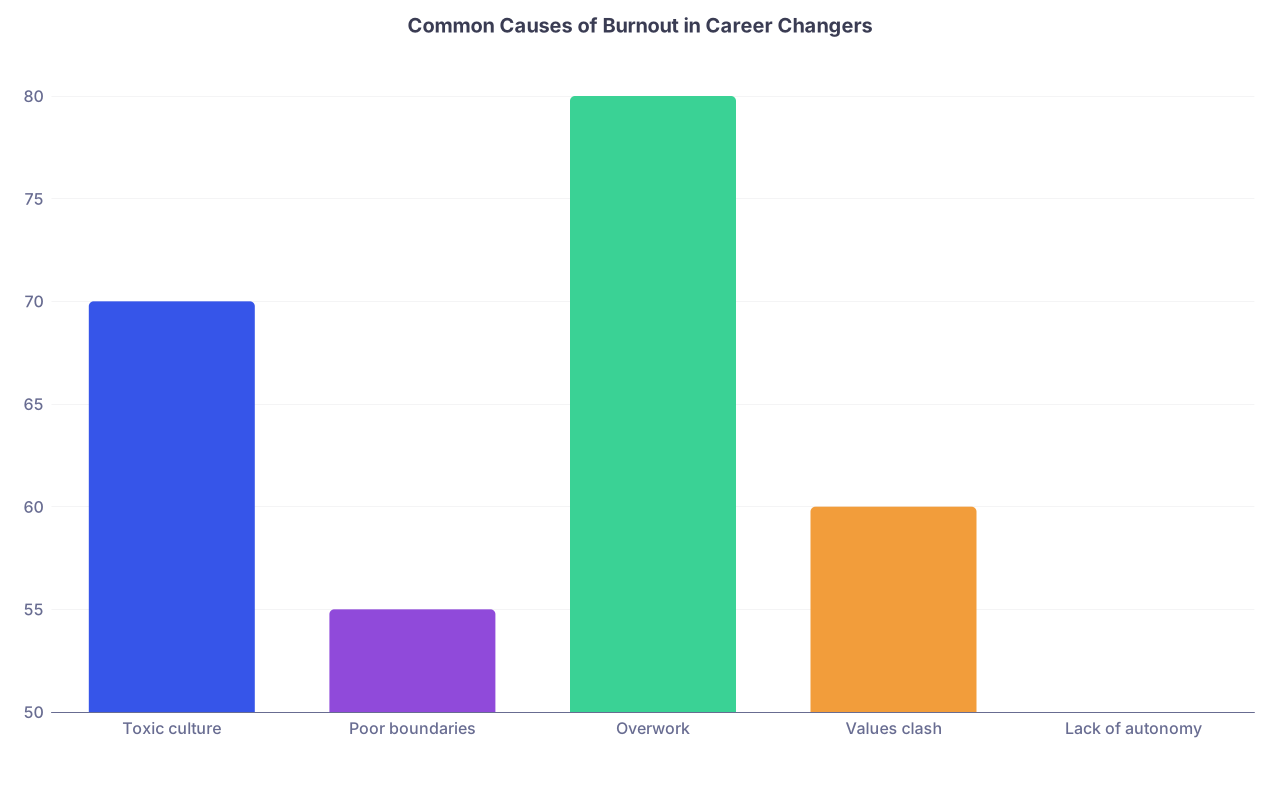
| Category | Value |
|---|---|
| Toxic culture | 70 |
| Poor boundaries | 55 |
| Overwork | 80 |
| Values clash | 60 |
| Lack of autonomy | 50 |
The wrong way to talk about it:
“I burned out because my company exploited us and had no boundaries.”
The better way:
“The culture rewarded 80-hour weeks and constant availability. At first I leaned into it, saying yes to everything, checking email at midnight, and tying my worth to being the ‘reliable’ one. Eventually, I hit a wall. Therapy and time away helped me see I didn’t have boundaries and I hadn’t learned to protect time for rest or relationships. I’ve since practiced setting limits and having hard conversations at work—skills I’ll need in medicine too.”
See the difference?
- One blames the external system only.
- The other acknowledges the system and your personal contribution—and shows change.
Burnout that “just happened to you” is not a reassuring story. Burnout that forced you to change how you operate? That’s growth.
Mistake #4: Trauma-Dumping or Over-Disclosing in Applications and Interviews
Another very real mistake: confusing vulnerability with oversharing.
You do not need to unload the following in detail in your personal statement or interview:
- Every panic attack
- Your full therapy journey
- Detailed descriptions of suicidal ideation
- A blow-by-blow of being fired, written up, or placed on performance improvement
- Every grievance against your manager, company, or previous field
Admissions is not your therapist. Interviewers are not your support group. And when you cross that line, you don’t look “authentic”; you look uncontained.
Uncontained is a red flag. Medicine demands that you can regulate yourself under stress.
Signs you’re crossing into the wrong territory:
- You feel a compulsion to “tell them everything or it’s not the whole truth.”
- You’re using the story to get emotional validation more than to show growth.
- You walk out of mock interviews feeling drained or exposed.
Keep your burnout story tidy:
- Name it.
- Give just enough context to make it real.
- Focus most of your words on: what you learned, what you changed, how you operate differently now.
Wrong way in an interview:
“Yeah, I totally burned out. I was crying in the bathroom at work every week, stopped sleeping, my partner threatened to leave, and my boss still kept piling on more. I was on meds, in therapy twice a week, and eventually I just quit and moved back with my parents. It was awful.”
Better:
“I hit a point where I was constantly anxious, not sleeping, and dreading work. I realized I couldn’t continue at that pace. I stepped back with the help of a therapist, changed how I worked, and eventually left the role after a structured transition. That experience forced me to learn boundaries, ask for support early, and define myself by more than productivity—all of which I plan to bring into a medical career that I know has its own pressures.”
You’re not hiding the struggle. You’re shaping it.
Mistake #5: Pretending You’re Now “Burnout-Proof”
Career changers love to say some version of:
- “I’ve done the hard work, so I know I won’t burn out again.”
- “Because I already burned out once, I’m more resilient than traditional students.”
- “My previous career hardened me, so med school will be fine.”
No. Just no.
That’s like telling a marathon coach, “I sprained my ankle last race, so this time I definitely won’t.” They don’t feel reassured. They feel cautious.
Burnout is not an exam you pass once. It’s an ongoing risk in any high-demand field.
When you imply you’ve “fixed it,” admissions silently thinks:
- “You likely underestimate the grind of training.”
- “You may ignore warning signs because you believe you’re ‘past that.’”
- “We’ve watched interns who said the same thing crumble on night float.”
The healthier, more credible stance:
- You accept that burnout is a possibility, not a personal failing.
- You’ve built specific tools and structures to monitor yourself.
- You are committed to course-correcting early, not heroically pushing through until collapse.
Name your tools concretely:
- Monthly check-ins with a therapist
- A rule about sleep minimums, with contingency plans
- Saying no to certain leadership roles if clinical workload is high
- Protecting one non-negotiable outside identity (parent, musician, community role)
Not aspirational habits. Existing ones.
You want to sound like someone who’s learned to manage a chronic risk, not someone who “got cured.”
Mistake #6: Never Actually Pressure-Testing Your New Life Before Committing
Here’s a quiet but devastating mistake:
You talk about burnout, but you never actually test the realities of the new field you’re betting your 30s and 40s on.
You compare:
- Your lived experience in your prior career
to - Your imagined experience in medicine.
Of course medicine always wins that comparison. Fantasy always beats reality.
Then you show up in an interview saying: “I know what I’m getting into.”
They ask: “Tell me about a time you saw the demands of medicine up close.”
You mention:
- 12 hours of shadowing
- One health-related nonprofit
- “Lots of reading and podcasts”
That’s not enough. You’re trying to jump into deep water after dipping one toe in the pool.

| Step | Description |
|---|---|
| Step 1 | Curious about medicine |
| Step 2 | Shadow multiple specialties |
| Step 3 | Work in clinical setting |
| Step 4 | Talk to burned out & satisfied physicians |
| Step 5 | Reflect on fit & risks |
| Step 6 | Decide to apply or revise plan |
Wrong way to talk about burnout in this context:
“I know medicine is hard, but I’m not afraid of hard work.”
That phrase is meaningless. Everyone says it.
Better:
“In my clinical job as a scribe in the ED, I watched attendings go from room to room for 10 hours, then spend another 2 charting. I saw one physician quietly cancel a long-planned weekend trip because of staffing shortages. Seeing that up close didn’t scare me away, but it did make me have concrete conversations at home about how we’ll handle childcare and support if I match into a demanding residency.”
If you haven’t:
- Shadowed meaningfully
- Worked in a clinical or patient-facing setting
- Talked to physicians and residents about both their burnout and how they manage it
…you’re talking about burnout in theory, not in reality. That’s risky self-deception.
Mistake #7: Making Burnout the Centerpiece of Your “Why Medicine”
Another easy trap: letting your burnout story become the main character of your application.
You were miserable in your last career. You found medicine. Instant narrative structure. It practically writes itself.
Too many people then build:
- 70%: Past misery and burnout
- 20%: Discovery of medicine
- 10%: Why they’re fit for medicine now
That ratio is lethal.
Admissions is not accepting you to rescue you from your past. They are accepting you to serve their patients for decades.
If your “Why medicine?” sounds like:
- “Because I can’t go back to what I was doing”
- “Because I was so unhappy before”
- “Because I crave meaning and stability”
…you are framing this as an escape, not a choice.
You want burnout to show up like this:
- 1–2 sentences: context of prior field and emotional state.
- 2–3 sentences: catalyst that forced reflection and change.
- Majority: concrete, positive reasons medicine fits who you are now, backed by real experiences.
Something like:
“After years in product management, I realized my best days were never about launch metrics—they were about the rare times I could sit with frustrated users, explain complex changes in plain language, and stay with them until their problem was solved. That stood in stark contrast to the burnout I felt chasing quarterly targets that meant nothing to the people we served. Shadowing in an outpatient clinic and working as a medical assistant gave me a setting where those exact strengths—patient explanation, patience under stress, and comfort with uncertainty—were daily, not rare. That alignment, rather than simply leaving a difficult job, is what keeps pulling me toward medicine.”
Burnout is the background radiation. Not the plot.
Mistake #8: Ignoring How Burnout Will Look to Your Loved Ones
This one isn’t about admissions. It’s about your life.
If you talk about burnout in your old career like this:
- “They broke me.”
- “I lost years of my life.”
- “I’ll never do something like that again.”
But you haven’t sat down with your partner, kids, or family and said:
- “Medicine may put us through seasons that look very similar.”
- “Here’s what I’m asking you to sign up for.”
- “Here’s how I’ll protect myself and you differently this time.”
You’re not being honest. You’re rebranding the same pattern with a lab coat.
I’ve watched this blow up marriages. I’ve listened to late-30s residents in call rooms say, “My wife feels like she didn’t sign up for this.” Often, she didn’t. She signed up for “medicine will be hard but worth it,” not “another decade of me never home and always exhausted.”
Do not promise:
- “It’ll be better than consulting—residency is only a few years.”
- “Once I’m attending, things will calm down.” (Depends heavily on specialty and job.)
- “Medicine is more flexible.” (Not for most trainees.)
Instead, say:
- “Training will probably be worse, schedule-wise, than my old job—but for a defined window.”
- “I will likely be tired, stressed, and less available at times.”
- “Here are the guardrails I’m willing to put in place so we’re not right back where we were.”
If you cannot have a sober burnout conversation with the people who love you, you’re not ready to have a convincing one with admissions.
Mistake #9: Treating Burnout as a Shameful Secret You Must Hide Completely
Let’s flip to the other extreme.
Some career changers decide: “I can’t mention burnout at all. They’ll think I’m weak.” So they:
- Erase any hint of struggle
- Rewrite their exit as purely strategic and rational
- Present themselves as unstoppable productivity machines
That backfires too.
An application that reads like you’ve never faced genuine difficulty—and never cracked—is not believable at 30+, especially if you’ve had a demanding career. It also wastes a powerful narrative: how you respond when you finally hit your limit.
The trick is not to hide burnout. The trick is to:
- Name it once, clearly.
- Claim your part in it.
- Show how it changed your behavior.
- Move on.
You’re aiming for:
“Yes, I broke. Here’s how I rebuilt, and here’s how I operate differently now.”
Not:
“I’m fine. Never had a problem. I just decided medicine is my destiny.”
A clean, owned burnout story can actually help you stand out as a non-traditional applicant—if handled correctly. It shows:
- You’ve already encountered a very real career crisis and survived.
- You know what you look like at your worst.
- You’ve put systems in place so you’re not flying blind into the next high-pressure environment.
Mistake #10: Never Translating Your Burnout Lessons into Concrete Medical Contexts
Last big mistake: you say you’ve “learned from burnout” but you never tie those lessons to specific demands of training.
You leave it abstract:
- “I learned balance.”
- “I prioritize self-care now.”
- “I know how to set boundaries.”
Those are fortune-cookie lines. Interviewers have heard them all.
Translate your lessons into situations they recognize:
- “On night float, when you’re already 10 hours in and a new admission rolls in.”
- “When a rotation culture expects you to stay 2–3 unpaid hours past sign-out.”
- “When the EMR inbox is full but your kid’s recital is in 30 minutes.”
| Vague Lesson | Concrete Medical Context Version |
|---|---|
| I set better boundaries now. | I’ve practiced saying, ‘I can stay 30 more minutes, but I have a hard cutoff after that,’ and I expect to use that on rotations with staying-late culture. |
| I prioritize self-care. | I track sleep weekly. If I drop below 6 hours for more than 3 nights, I adjust: cutting optional tasks, asking for help, or rescheduling nonessential commitments. |
| I ask for help earlier. | In my current clinical job, if I’m falling behind on notes, I tell my supervisor mid-shift rather than staying 3 hours late in silence. I would do the same as a resident. |
This is what “I learned from burnout” sounds like to someone who actually works in a hospital:
“In my last career, I waited until I was at a breaking point to ask for help. Now, when I notice early signs—irritability, cutting down sleep, skipping meals—I bring it up with my supervisor and adjust. In medicine, that might mean flagging concerns with my chief resident or program director early, before I’m making tired mistakes on call.”
Specific. Behavioral. Connected to real training situations.
One Visual to Keep in Your Head
If you remember nothing else, remember this mental model:
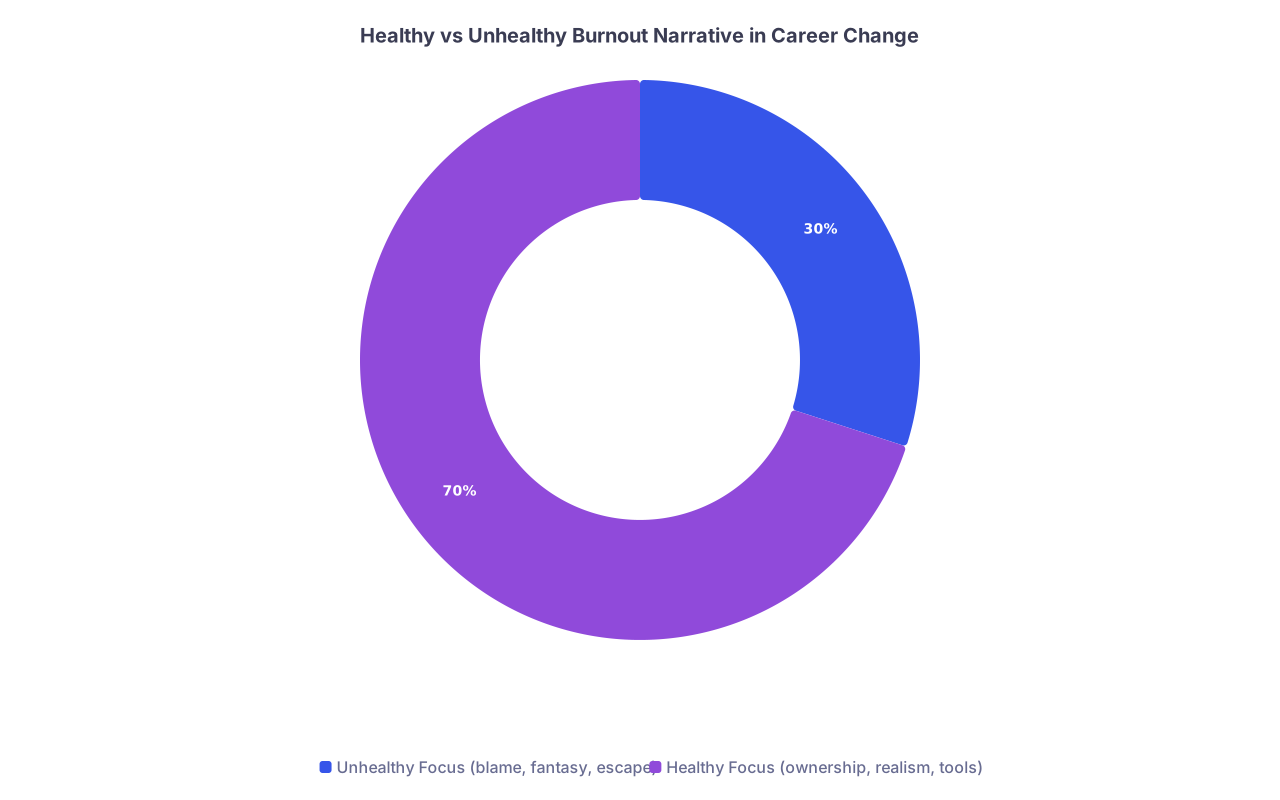
| Category | Value |
|---|---|
| Unhealthy Focus (blame, fantasy, escape) | 30 |
| Healthy Focus (ownership, realism, tools) | 70 |
The unhealthy 30%:
- “They did this to me.”
- “Medicine will save me.”
- “I’m fixed now; burnout’s in the past.”
The healthy 70%:
- “Here’s what I contributed to the problem.”
- “Here’s how I tested medicine’s reality before committing.”
- “Here are the concrete habits and structures I use to monitor my limits.”
Make sure your essays, conversations, and self-talk stay in that 70%.
Key Takeaways
- Don’t use “burnout” as a fuzzy, catch-all excuse or a victim badge. Be specific about what happened, how you contributed, and what you changed.
- Don’t sell medicine as your escape or your cure. Show that you understand its own burnout risks and have concrete, tested strategies to protect yourself and the people around you.
- Don’t hide or overshare. Mention burnout briefly, own it, connect it to realistic medical contexts, and then get back to the real point: why you are a strong, clear-eyed fit for this profession now.