
It’s 8:05 a.m. in a carpeted conference room that smells faintly like burned coffee and anxiety.
You’re sitting in a circle of applicants. Most of them look 21. Perfect suits, fresh haircuts, leather padfolios they probably bought last week. You’re… not that.
You’re the one in your late 20s or 30s. Maybe 40s. Maybe with a mortgage. Maybe with kids. You’ve been a nurse, a teacher, an engineer, a bartender, a Marine. You’ve done performance reviews or managed budgets or literally held dying people’s hands.
And now you’re staring at a second-year med student tour guide who keeps saying, “So like, during your gap year…” and you’re thinking: Gap year? I had a whole other life.
Let me tell you what’s really happening behind those closed doors you don’t see.
At the faculty table, before you even walk in, there is always some version of this comment:
“We actually like the older applicants. They just need to show they can still handle the grind and that they’re not rigid.”
That’s your entire interview strategy in one sentence:
Prove you can do the grind. Prove you’re flexible. And then use your life story to make everyone else in the room look flat by comparison.
Let’s go through how you actually do that.
What Admissions Committees Secretly Think About Non‑Trads
Here’s the part nobody tells you: when your file lands on the table on interview day, you are not starting from zero. You’re starting from a strong narrative or a red flag, depending on how cleanly your story reads.
Behind the scenes, your application is usually framed with something like:
- “This is the former teacher with three kids.”
- “This is the Navy corpsman who did two deployments.”
- “This is the engineer who worked at [Company X] for 7 years.”
- “This is the career changer who took post-bacc classes at night while working full-time.”
Faculty like those stories. They’re sick of reading carbon-copy premed files. But they have three big questions they rarely say out loud.
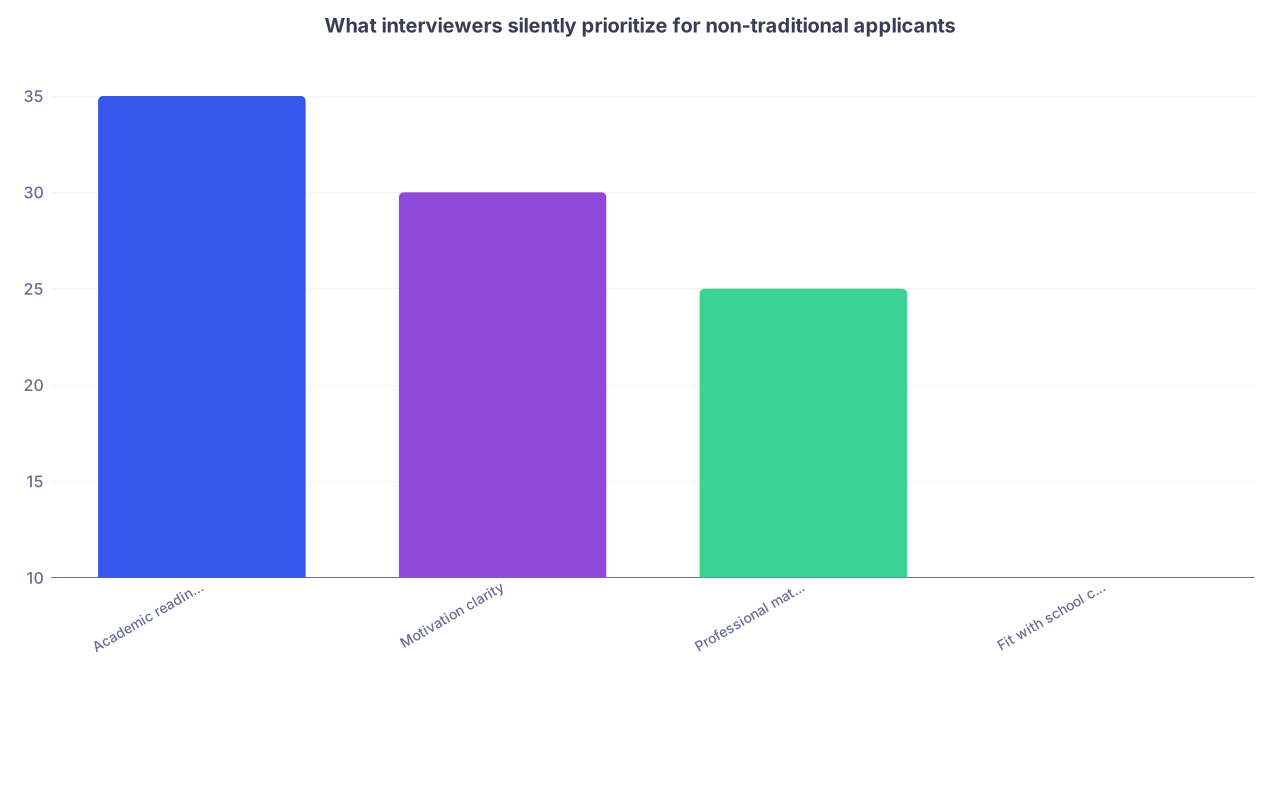
| Category | Value |
|---|---|
| Academic readiness | 35 |
| Motivation clarity | 30 |
| Professional maturity | 25 |
| Fit with school culture | 10 |
The three unspoken questions:
- Can you still do hard science at a fast pace, or are you romanticizing medicine?
- Are you running toward medicine with a clear why, or running away from something else?
- Are you going to be a pain to teach? (Rigid, argumentative, “I already know this from my previous career.”)
On interview day, everything you say either reassures them or feeds those fears.
Your goal is to walk in and, within the first 5–10 minutes, make them think:
- “Okay, this person knows exactly what they’re getting into.”
- “They’ve already operated in high-pressure environments.”
- “They won’t crumble the first time they’re told no.”
If you can trigger that reaction early, the rest of the interview becomes easier. They stop testing your baseline sanity and start thinking, “Where will this person fit here?”
Your Story: The Weapon Almost Every Non‑Trad Wastes
Most non-trads walk into interviews with dynamite and use it like a candle.
They say things like:
- “I’ve always wanted to be a doctor, but life got in the way.”
- “I love science and working with people.”
- “My previous career just wasn’t fulfilling.”
Every interviewer over 40 has heard that so many times they could say it with you in unison.
You’re not “interesting” because you’re older. You’re interesting if your story has:
- A clear pivot point
- Evidence you tested reality, not just fantasy
- Sacrifice that cost you something real
The insider move is to compress your story into a tight, repeatable narrative you can drop in the first “Tell me about yourself” and then reference throughout.
Here’s how I tell applicants to structure it behind closed doors:
The 4-Sentence Non‑Traditional Origin Story
Sentence 1: Who you were
“One-line version of your prior life: role + context + length.”
“I spent seven years as a high school chemistry teacher in an under-resourced district in South Dallas.”
Sentence 2: What cracked the old path
A specific moment or pattern, not some vague “I wanted to help people.”
“Over time, I noticed that the problems keeping my students sick and absent weren’t educational—they were medical and systemic, and I kept running into the limits of what I could do from the classroom.”
Sentence 3: How you tested medicine, not just dreamed about it
Shadowing, scribing, CNA, EMT, working nights while taking classes—this is where committees lean in.
“Instead of jumping blindly, I started working weekend shifts as a medical assistant in a community clinic while taking evening prereqs to see if the day-to-day reality matched what I imagined.”
Sentence 4: Why now, and why this is the durable path
Show you understand the cost and still choose it.
“After three years of living both lives, it was obvious where I was most effective and most engaged, so I made the deliberate choice to pursue medicine fully, even knowing I’d be starting training in my 30s.”
That 4-sentence arc—said calmly, without drama—does more work than 10 minutes of “I’ve always been passionate about…”
On the faculty side, this answers their biggest fear: that you’re chasing an idea of medicine, not the real thing.
How to Answer the Questions You Will Get (And What They’re Really Asking)
Let me walk through the questions that get debated in the pre-interview huddle: “Make sure someone asks them about X.”
1. “Why medicine now?”
What they really mean:
Why didn’t you do this earlier, and what changed?
Wrong answers:
- “I always wanted to, but…” (sounds like you drift through life)
- “I just realized life is short.” (sounds impulsive)
- “My previous job wasn’t fulfilling.” (sounds like an escape)
Right approach:
Explain why you were committed to your previous path, what specifically shifted your trajectory, and how long you took to test this new path before committing.
You want them thinking: “This person is deliberate, not flaky.”
2. “How will you handle the pay cut / being older / having a family?”
This is a stress test of your realism. They’re checking whether you’ve actually done the math.
Faculty have seen older students struggle with:
- Going from a solid salary to debt
- Being mentored by people younger than them
- Missing kids’ events or partner time
- Studying for Step while their peers are buying homes
The trick is not to overcompensate with bravado. Avoid “I’ll just work hard” or “We’ll figure it out.”
Instead:
- Show you’ve already restructured your life for this (moved, cut expenses, changed work)
- Show your support system is on board, by name if appropriate (“my partner and I reworked our finances for a single income and childcare”)
- Acknowledge it will be hard and then state plainly why it’s still worth it
The line that always lands:
“I’m not choosing between an easy path and a hard path. I’m choosing between a life that fits who I am and one that doesn’t. The logistics are challenging, but they’re solvable.”
3. “How will you adjust from being [experienced professional] to being a student again?”
What they really worry about:
You coming in hot as “the older one who thinks they know better,” undercutting residents, questioning attendings in ways that derail teaching.
You kill that fear fast by saying something like:
“I’ve supervised people and I’ve been supervised. Coming back as a learner is very intentional for me. My past experience will help with communication and stress, but clinically I’m starting where everyone else starts.”
If you’ve been in leadership before, add:
“One thing my previous career taught me is the difference between asking questions to understand and questioning to undermine. In medicine, I know my role will be to learn and contribute within the team structure.”
Yes, that sounds polished. That’s the point.
The Real Advantage: Professional Presence
Here’s the part you probably underestimate: your presence in the room is your biggest asset.
Faculty love interviewing someone who:
- Actually looks them in the eye without jittering
- Knows how to sit in a chair like they’ve been in real meetings
- Can answer a question without spiraling into a monologue
- Has failed at something as an adult and can discuss it without melting down
Traditional applicants struggle here. They’re smart, but many have never had a boss who wasn’t a PI or professor. Never had a 360 review. Never had to fire someone. Never had to stay calm during a 12-hour shift with real consequences.
You have. Use it.
That means:
- When they ask about conflict, you draw from a real workplace story, not “My group project in orgo…”
- When they ask about leadership, you talk about supervising staff, managing crises, coordinating teams
- When they ask about stress, you don’t say “MCAT studying was hard,” you say, “Here’s how I handled X situation at work and what systems I built for myself.”
The unspoken reaction in the room when you do this well is:
“Thank God, an adult.”
Where Non‑Trads Accidentally Shoot Themselves in the Foot
Let’s talk about the mistakes that get you quietly down-ranked in the post-interview meeting. I’ve seen all of these.
Talking down to younger peers
Huge red flag. If you say anything that smells like:
- “People your age don’t understand…”
- “Students these days…”
- “I’m not like the typical 22-year-old…”
You just told the committee you’re going to alienate your classmates.
The move is to respect both sides. You can say:
“I bring perspective from a longer career, and I’m also really looking forward to learning from my younger classmates, especially since they’re coming straight from current coursework and new ways of learning.”
They want to hear you say out loud that you’re not special, you’re just different.
Oversharing your disillusionment with your old career
Complaining about your past job is poison. Medicine has plenty of its own systemic problems. If you rant about your old field, they picture you ranting about medicine in five years.
You can absolutely be honest about limitations—just keep it controlled, specific, and balanced with what you did like.
Bad: “Corporate America was soulless and profit-driven.”
Better: “I appreciated the analytical rigor in engineering, but I missed longitudinal human relationships and direct impact on individual lives.”
Subtle difference. Massive effect.
Making your age the whole story
They know you’re older. They saw your birth year. If you keep circling back to it—“as an older applicant,” “as someone my age”—it starts to sound like insecurity.
Treat it like a detail, not your headline. You’re not “the old applicant.” You’re:
- The teacher who built out a science curriculum from scratch
- The EMT who ran calls on the night shift for four years
- The project manager who coordinated multimillion-dollar timelines with high stakes
Your experiences are your story. Your age is just a time stamp.
How to Talk About Academics Without Sounding Fragile
Every non-trad knows the academic question is coming, in some form:
- “How did you find going back to school after time away?”
- “Can you talk about your post-bacc experience?”
- “I see there was a break in your education—tell me about that.”
They’re trying to answer one thing: Are we going to regret giving this person a seat when the firehose turns on?
If your academic record has scars—old low GPA, withdrawals, a rough term—you address it head-on. Avoid tortured justifications.
Here’s the structure that calms faculty down:
Briefly own the problem
- “My early undergrad grades weren’t at the level I expect of myself.”
Give the mature explanation, not the melodramatic one
- “At 18, I didn’t have the discipline or study strategies I needed, and I took on too much work outside class.”
Show, with data, that you fixed it under realistic pressure
- “In my post-bacc, while working 30 hours a week, I earned As in upper-level biology and chemistry. I built a system that works for me now.”
End in the present, not the past
- “The student represented by my recent coursework is the one you’d be getting in your program.”
The behind-the-scenes discussion after that kind of answer sounds like:
“Yeah, they were a mess at 19, but look at the last 3 years. They’ve clearly grown up.”
That’s the story you want in their mouths when you’re not in the room.
The Group Interview, the MMI, and the “Non‑Trad Advantage”
Non-trads usually either crush MMIs and group settings or implode. There isn’t much middle.
Faculty watch for very specific behaviors in these formats.
In group activities
They do NOT want to see:
- You taking over as “the manager”
- You using corporate language and turning it into a board meeting
- You assigning roles like you’re running a scrum session
They want to see:
- Listening before speaking
- Noticing the quiet person and pulling them in (“What do you think, Alex?”)
- Offering structure without domination (“We’ve got 8 minutes, maybe we can quickly choose one person to scribe and one to keep time?”)
The internal comment that gets you ranked high is: “They’re a natural stabilizer, not a steamroller.”
In MMIs with ethical scenarios
Your edge is that you’ve seen real gray zones. You’ve probably dealt with confidentiality, informed consent-like situations, workplace ethics, resource limitations.
Bring that in—but carefully. Keep it general enough to be de-identified and relevant, specific enough to sound real.
For example:
“In my role as a nurse, I faced a similar tension between respecting a patient’s autonomy and what the team felt was safest. What helped was making sure the patient fully understood the risks and documenting that conversation, even when their choice made us uncomfortable.”
You sound mature, grounded, and experienced. They will mark that down.
Very Practical Day-Of Moves That Change How You’re Perceived
You want to stand out as a non-traditional applicant? Half of that happens in the informal spaces: hallway walks, lunches, waiting rooms.
A few tricks I’ve seen work repeatedly:
- When other applicants introduce themselves, don’t say, “Oh, I’m so old compared to you.” Just say your background confidently: “I worked as a paramedic for eight years before coming back to school.”
- When students or faculty ask about your path, avoid giving them your entire life story. Two concise sentences, then let them ask for more.
- Ask residents and students questions that show you actually get adult life: “How do people here with families manage call?” or “What kind of support do non-traditional students have?”
The student interviewer will absolutely report back: “They were asking really thoughtful, grounded questions. They’re clearly thinking long-term.”
That matters. A lot.

| Step | Description |
|---|---|
| Step 1 | Clarify your pivot story |
| Step 2 | Test your narrative aloud |
| Step 3 | Prepare answers to non-trad questions |
| Step 4 | Identify 3 key experiences to highlight |
| Step 5 | Practice professional presence |
| Step 6 | Plan day-of logistics and questions |
| Step 7 | Interview Day: Execute with calm confidence |
FAQs: Non‑Traditional Applicants on Interview Day
1. Should I bring up my age directly, or let them do it?
You do not need to announce your age. They can read your dates. Address life-stage realities (family, finances, prior career) in terms of logistics and motivation, not birthdays. If someone explicitly asks “How do you feel about starting training later?” answer the underlying question: you understand the trade-offs and still choose this path.
2. How honest should I be about disliking my previous career?
Be honest, but controlled. You’re allowed to say your old work didn’t align with your long-term goals or values. Just avoid sounding bitter, resentful, or contemptuous. Frame it as: “I appreciated X and Y from that chapter, but I realized I wanted Z, which is why medicine is a better fit.”
3. What if my clinical exposure is limited compared to my work experience?
Then you’re vulnerable. Admissions committees get twitchy when non-trads haven’t really test-driven patient care. On interview day, emphasize what you have done clinically and be explicit about what you learned from even limited shadowing or volunteering. Pair it with a clear plan to expand that exposure regardless of the outcome. They want to see you’re not just dabbling.
4. How do I handle a question about future specialty as a non‑trad?
Do not lock yourself into a hyper-specific plan that sounds like you’ve already written the script. Better to say something like: “Given my background in X, I can see myself leaning toward Y or Z, but I’m very aware that clinical rotations will reshape that. What I know I’m drawn to is [type of patient interaction / setting], not just a label.” Shows direction without rigidity.
5. Do schools really value non‑traditional applicants, or is that just brochure talk?
The good ones absolutely do. Every committee I’ve sat in on has at least one faculty member who champions non-trads because they stabilize classes, bring perspective, and often perform very well clinically. But—and this is non-negotiable—they must see academic readiness and humility. If you pair strong recent academics with a mature, teachable attitude, you move from “diversity brochure” to “priority admit.”
Key takeaways:
- Your story is only powerful if it’s specific, tested in reality, and delivered concisely.
- Faculty are weighing two things: can you still handle the grind, and will you be teachable despite your prior experience.
- Professional presence—calm, grounded, adult—is your unfair advantage. Use it.