
The vast majority of “career changer” personal statements are scored as cautious maybes before anyone even finishes the second paragraph.
Let me tell you why.
Admissions committees like nontraditional applicants far more than they publicly admit—but only when the narrative hits certain internal checkboxes the website never mentions. You’re not competing with the 21‑year‑old biochem major on story. You’re competing on credibility. Can you actually do this life? Or are you just in love with the idea of medicine?
I’ve sat in committee rooms where a 45‑year‑old ICU nurse with a mediocre MCAT got ranked over a 23‑year‑old with near-perfect numbers. And I’ve watched a highly accomplished engineer with a 520+ get quietly buried because their essay set off every red flag we have for “this person will quit when it stops being fun.”
Your category—career changer—gets scored differently. More harshly. More clinically.
Here’s how it really works.
How Committees Actually Read a Career Changer Essay
Forget the website language about “holistic review” for a second. When your file is opened and someone sees your age, your work history, or your prior degree path, the reader shifts mental gears.
They’re no longer thinking: “Is this a promising student?” They’re thinking: “Is this an investment that’s actually going to finish residency?”
Unspoken reality: schools care deeply about completion rates and downstream reputation. Nontrads who burn out, fail exams, or drop out after M1 are expensive—not just financially, but in accreditation reports.
So your personal statement is being silently scored on these axes long before anyone cares about your “passion for helping people.”
The 5 Hidden Questions Every Reader Is Scoring
We don’t say this out loud on interview day, but here’s the mental checklist:
Is this pivot rational or impulsive?
Do you sound like someone who thought this through over years, or someone who had a bad week at work and decided medicine would be more meaningful?Do you actually understand what physicians do day to day?
Generic “I want to help people and love science” is scored as ignorance, not idealism, if you’re 28, 32, 40. You’ve been in the world long enough to know better.Can you handle the sacrifice profile?
Debt, sleep deprivation, relocation, being older than classmates, kids at home. We’re looking for evidence you’ve really run that math.Can you still grind academically?
If you’ve been away from formal schooling for 5–10+ years, your statement has to convince us your brain—and life structure—can tolerate preclinical years and standardized exams.Does your previous career add value, or is it baggage?
Are you bringing transferable skills and maturity, or unresolved bitterness and identity confusion?
Readers don’t always articulate those questions, but they’re scoring them, consciously or not.
The First 3 Paragraphs: Where Career Changers Lose the Adcom
Most career changers sabotage themselves in the first half page.
They either write like an undergrad (“Ever since I was young…”) or like a midlife spiritual memoir (“After years of corporate success, I realized something was missing in my soul…”).
Both get mentally tagged as: not ready.
The insider truth: for nontraditional applicants, origin story is less important than decision process.
We’re not asking “What first exposed you to medicine?” We’re asking “What finally made you move, and why should I trust that decision?”
What a Strong Opening Looks Like to an Adcom
The best career-changer openings I’ve read do something very specific: they compress the pivot into a clear, grounded, recent inflection point tied to actual patient care or healthcare systems.
Not vague yearning. Concrete pressure test.
For example, from a former engineer who got into a top-10:
By the time our device reached the ICU, I had spent four years optimizing its battery life and manufacturing cost. I knew its specs intimately. I did not know the name of a single patient who used it—until I watched an intern silence its alarm while comforting a hypoxic, terrified man who looked younger than me.
Notice what that does:
- Establishes prior career in one sentence
- Drops us directly into a clinical environment
- Shows a gap between technical work and human consequence
- Hints at long-term exposure (“four years”), not a weekend shadowing trip
Contrast that with the common weak opener:
I have always wanted a career that allowed me to help others and combine my love of science with meaningful human connection. Although I enjoyed my time in marketing, I never felt truly fulfilled and knew I was meant for something more.
That’s an auto-eye-roll from experienced readers. Generic, untestable, and says nothing about whether you can actually do medicine.
The Quiet Scoring Rubric: What “Career Change Readiness” Looks Like
No committee has a formal “career-changer rubric” on paper. But patterns emerge. We absolutely talk about you using the same phrases over and over.
Here’s the unofficial scoring system we’re running in our heads.
1. Narrative Coherence (Does your story track?)
We’re scanning for a through-line. Not a Hollywood arc. Just a consistent logic.
If your path looks like: business → coding bootcamp → yoga teacher → premed → medicine “because meaning”… that’s unstable unless you explain the thread.
What helps your score:
- Showing a consistent theme across roles: teaching, problem-solving, working in crises, long-term service
- Owning past misalignment without melodrama: “I chased prestige and compensation, and it worked—until I was bored” is more believable than “I suddenly realized capitalism was empty”
- Explaining time gaps, failures, and pivots directly, without apology but with responsibility
What hurts:
- Vague “seeking meaning” clichés with no clear turning point
- Blaming previous fields or colleagues: we worry you’ll do the same with medicine
- Magical thinking: “I knew from that moment in the ER that medicine was my destiny” (no you didn’t, you were impressed, that’s all)
We’ve all seen the “med school as spiritual rescue” essay. It consistently scores poorly.
2. Exposure Depth (Do you know what you’re signing up for?)
Career changers get grilled harder on this than traditional students. Because you should know better.
If your only clinical exposure is a semester of shadowing and some volunteering, but you’re 35 with two kids and a mortgage, any savvy reader is thinking: you don’t actually know what residency hours feel like on a body that age with that life load.
Pieces that score well:
- Longitudinal commitment: years of EMT work, scribe time, nursing, physical therapy, social work, military medicine
- Evidence you’ve watched physicians on bad days: codes that went nowhere, bad outcomes, system failures
- Explicit acknowledgement of downsides: “I’ve seen residents asleep on workroom desks post-call. I’ve watched attendings miss school plays. I’m not romantic about the hours; I’m choosing them with my eyes open.”
That last category is gold. It calms one of the biggest hidden fears: that you’re idealizing this.
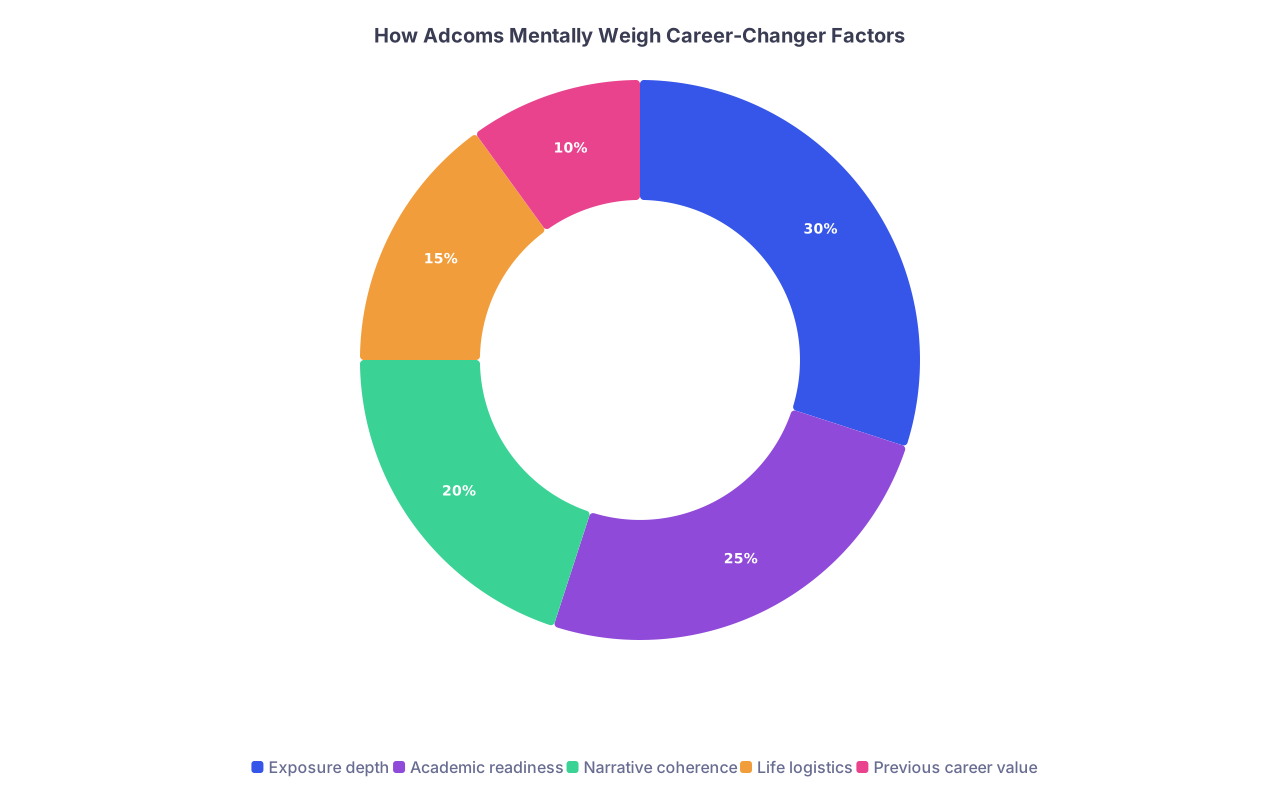
| Category | Value |
|---|---|
| Exposure depth | 30 |
| Academic readiness | 25 |
| Narrative coherence | 20 |
| Life logistics | 15 |
| Previous career value | 10 |
Roughly speaking, that’s the internal weighting. Notice what’s not here: “how dramatic your story sounds.”
3. Academic Readiness Without Desperation
If you’ve been away from organic chem for 10 years, your essay must do something traditional applicants don’t have to: reassure us your prefrontal cortex and life systems are built for sustained cognitive punishment.
Do not do this by proclaiming how hard you’re willing to work. Everyone says that. We don’t believe anyone who says they love “hard work” in the abstract.
Do it by:
- Alluding briefly to recent academic wins: finishing a post-bacc while working, acing high-level coursework after a long break
- Describing how you build structure into chaos: early mornings before kids wake, carving out protected study time, concrete tactics you already use
- Showing realistic awareness of the pace: “The volume and velocity of medical training are unlike any other learning I’ve done. That’s precisely why I’ve tested myself with…”
When a reader can see you’ve already war-gamed your life logistics, your academic readiness score jumps—no MCAT score needed.
The Most Common Career Changer Red Flags (That You Don’t Realize We See)
There are patterns that, once you’ve read a few hundred files, jump off the page.
Here are the ones that quietly tank your score.
Red Flag 1: The “Medicine Will Fix Me” Narrative
Any whiff of “medicine will finally give my life meaning/structure/identity” is radioactive.
It sounds like this:
- “I’ve tried several careers but none have given me the sense of purpose I know I’ll find in medicine.”
- “I’ve always felt a bit lost, but when I was in the hospital, everything clicked.”
We don’t want people trying to heal themselves through a $250k, 10-year training process. Those applicants burn out, become bitter, or turn into toxic colleagues.
Reframe:
Show that you already have purpose, relationships, and some stability—and you’re adding medicine, not using it as a life raft.
Red Flag 2: Romanticizing Suffering
This one’s huge for ex-finance, ex-law, ex-tech folks.
They overcorrect from their “cushy” jobs and write things like:
- “I’m eager to trade long hours at a desk for the more meaningful exhaustion of medicine.”
- “I miss going home at the end of the day feeling truly spent for a good cause.”
We’ve watched people like that hit their third 80-hour week and realize exhaustion feels the same no matter the setting. They’re miserable and confused.
Better: respect the grind. Don’t worship it. A line like, “I’m not seeking hardship for its own sake; I’m accepting hardship in pursuit of work I find morally and intellectually worthwhile” shows maturity.
Red Flag 3: Contempt for Past Career or Colleagues
You’d be shocked how many essays trash their old field.
Subtle version:
“Unlike the self-interested culture of corporate law, medicine offers a chance to truly help others.”
What we hear:
- You devalue other professionals
- You lack nuance
- You may turn on medicine too when it disappoints you (and it will)
Strong career-changer statements honor the old world while outgrowing it: “Corporate law trained me to think precisely under pressure and advocate relentlessly. Over time, I realized I wanted to direct those skills toward patients rather than clients.”
That scores very well.
Red Flag 4: The “Too Unique” Complex
Some career changers lean hard into “no one like me has ever applied here” energy. The essay becomes a performance instead of a conversation.
They spend 80% of the statement explaining what makes their path unprecedented, and 20% on why they actually want to be a physician.
We’re not awarding creativity points. We’re building a functioning class. If you sound like you believe you’re a special snowflake, we assume you’ll be painful in small groups and resentful when evaluated like everyone else.
Show how your difference will integrate into teams, not sit above them.
How Different Backgrounds Get Quietly Scored
Let’s go even more specific. Different prior careers come with baked‑in stereotypes in adcom rooms. People won’t say this on record, but I’ve heard these conversations for years.
| Background | Initial Reaction (Unspoken) | What Helps You Most |
|---|---|---|
| Nursing/Allied Health | “Understands hospitals, may underestimate MD role” | Clear reason for MD vs current role |
| Engineering/Tech | “Smart, may be naïve about human side” | Concrete clinical exposure, humility |
| Law/Finance/Consult | “High-achieving, potential flight risk” | Long-term commitment, debt realism |
| Teaching/Social Work | “Great with people, may struggle with hard science” | Recent strong academics, MCAT or post-bacc |
None of those are destiny. But they’re the mental starting point. Your essay either confirms or dismantles those biases.
For example, the nurse who writes, “Becoming a physician will finally let me be in charge” triggers concern. The nurse who writes, “I’ve learned the value of interdependence and want to expand my role in diagnosis and longitudinal management” gets nods around the table.
The engineer who only talks about devices and algorithms? Red flag. The engineer who writes about patients they met volunteering in free clinics and what they didn’t understand at first? Much higher score.
How to Signal “I Will Actually Finish This Path”
Your real job in a career-changer personal statement isn’t inspiration. It’s risk mitigation.
You are quietly telling a committee: “You can bet on me. I’ve already pressure-tested this.”
The signals that work best are surprisingly mundane.
Show Long-Term, Unsexy Commitment
Not just: “I volunteered in the ER.”
Better: “For three years, I spent Saturday nights as an ED volunteer, stocking rooms, transporting patients, and watching residents manage the fallout of drunk driving and untreated psych disease.”
Translation to the adcom: You’ve seen the ugly, boring, chaotic parts and you stayed.
Show You’ve Had Serious Conversations With Real Physicians
Drop one or two lines that show actual mentorship, not fanboying.
“I’ve asked every attending I shadowed what they would change about their career if they could. Their answers were honest—documentation, time pressure, burnout—and I’ve taken those seriously in deciding to move forward.”
That tells us:
- You didn’t just bask in white coats
- You sought disconfirming evidence
- You made a decision after hearing the worst, not just the best
Show You’ve Already Made Sacrifices
Committees trust behavior over intention. If you’ve already absorbed hits to income, comfort, or status, that’s powerful evidence.
Examples:
- Leaving a six-figure job to do a lower-paid clinical role while in post-bacc
- Downshifting lifestyle to accommodate tuition and study time
- Relocating for a post-bacc or to be near a support system
You don’t need to martyr yourself on the page, but one or two clean sentences about tangible sacrifices carry a lot of weight.

| Step | Description |
|---|---|
| Step 1 | Longstanding doubts in prior career |
| Step 2 | Incremental exposure to clinical world |
| Step 3 | Tested academics with post-bacc/DIY |
| Step 4 | Discussed realities with physicians |
| Step 5 | Adjusted life logistics and finances |
| Step 6 | Applied with eyes open |
If we can see that sequence between the lines of your personal statement, you’re ahead of 90% of career changers.
FAQ: What You’re Probably Still Wondering
1. Do I have to explain exactly why I didn’t choose medicine earlier?
You have to give a plausible, adult explanation. Not a confessional. A sentence like, “I grew up without physician role models and pursued the paths I saw around me—business and technology—until clinical experiences in my late 20s exposed me to medicine in a sustained way” is enough.
What hurts you is dodging the question entirely. Readers will fill the gap with less flattering assumptions.
2. How much should I talk about my previous career vs medicine itself?
If you’re a career changer, the ratio that tends to work best is about 40% prior path and pivot, 60% present and future as a physician-in-training. If you’re still talking about your old job in paragraph 6, you’re anchoring yourself there. Use the old world as context, not center stage.
3. Can I mention worries about debt, age, or family?
Yes—and you should, briefly. Mature applicants score well when they show they’ve thought about these constraints and still choose medicine. A single clean sentence acknowledging financial planning or childcare logistics demonstrates realism. Just don’t spiral into a list of anxieties. Mention, then move on with confidence.
4. What if my clinical exposure isn’t that deep yet?
Then you need to be very careful not to oversell certainty. Lean into intellectual curiosity and humility. Make clear this is the beginning of a serious, structured exploration you’ve already started, not the capstone of a midlife crisis. And if you’re more than a few years out of college with thin exposure, understand: the essay alone will not save you. You’ll need to fix the experiences, not just the narrative.
If you remember nothing else, remember this:
Committees are not asking “Is this story inspiring?” They’re asking “Does this person understand the tradeoffs, and will they still be here in ten years, finishing residency, representing our school well?”
Write like someone who has already lived those questions for a while. Not someone who just discovered them last month.