
You’re sitting in a coffee shop with a half-finished personal statement on your laptop. On your resume you’ve got VP of product, or associate at a major law firm, or senior engineer at a FAANG company. And you keep hearing the same question, usually from people who’ve never sat in a committee room:
“Won’t med schools love that you were an executive/lawyer/engineer? That makes you stand out, right?”
Let me tell you how it actually plays out behind closed doors.
In the committee room, your file does not land with a gentle, neutral “oh, interesting background.” It lands with a thud and one of three reactions from the program director or admissions dean:
- “If this person is for real, they’ll be fantastic.”
- “This is a midlife crisis file. Hard pass.”
- “Cool story. But can they do actual medicine, or are they here to cosplay?”
Which one you get is not random. It’s painfully predictable once you know how program directors and admissions people actually think about former executives, lawyers, and engineers.
Let’s walk through it specialty by specialty, role by role, and I’ll show you the stuff nobody tells you in advising offices.
The Unspoken Framework: How They Classify Nontraditional Applicants
There’s a mental flowchart faculty run whenever they see a nontraditional background. They don’t say it out loud, but I’ve watched versions of this conversation play out year after year.

| Step | Description |
|---|---|
| Step 1 | Nontraditional Applicant File |
| Step 2 | Midlife crisis / Career tourist |
| Step 3 | Too risky to remediate |
| Step 4 | Neutral curiosity at best |
| Step 5 | High ceiling / Worth the bet |
| Step 6 | Real commitment? |
| Step 7 | Academic readiness? |
| Step 8 | Does background add value to residency? |
They are asking, in order:
- Is this a real, durable commitment or a phase?
- Is this person academically safe, or are they going to struggle with Step exams and call nights?
- Does their prior career add operational value to my residency or medical school class?
If you don’t hit all three, you don’t become “the impressive former X.” You become “the risky story we’d rather not touch.”
Let me break down how each of your prior careers is really perceived.
Former Executives: “Leader or Prima Donna?”
When a program director sees “former executive,” “director,” “VP,” or “founder” in a file, there’s a visible shift in body language. Someone at the table always says some version of: “Okay, this one could either be amazing or a nightmare.”
Here’s the candid truth.
They like:
- P&L responsibility. If you’ve actually owned a budget, managed people, and been accountable for outcomes, that translates directly to chief resident potential, QI projects, and system-level thinking.
- Operations and strategy experience. Running a 200-person org, leading a turnaround, building a process from scratch—those are catnip to academic departments trying to fix clinic flow, reduce readmissions, or implement new service lines.
- Evidence you’ve been humbled. The exec who took time to shadow, volunteered in unglamorous roles, accepted feedback from nurses—this is the one they trust.
They worry about:
- Entitlement. The stereotype they’re guarding against: the ex-CEO who can’t handle being an intern told to draw labs, chase consults, and stay late for notes. If your essays or interviews smell like “I’m above grunt work,” faculty shut down.
- Inability to be supervised. On PD calls, I’ve heard this exact phrase: “Will they actually take orders from a PGY-2 who’s never had a real job?” If they doubt that, you’re done.
- Burn-and-churn pattern. Three careers in 10 years, constant “pivots,” always “seeking a new challenge”—they see that as an unstable personality, not a “bold, dynamic trajectory.”
You know the former consultant or ex-MBA who rocks it? Their file usually has:
- Clean, recent science coursework or a post-bacc with A’s. Not “I did orgo 12 years ago and hope for the best.”
- A sustained track record of clinical exposure: free clinic, hospice, ED tech, actual patient-facing stuff. Not just “I joined the hospital board.”
- Recommenders who say, in plain language, “I’ve seen them take feedback and function as part of a team.”
The way executives talk can hurt them, too. If you walk into interviews talking about “disruption” and “healthcare as a vertical” and “leveraging synergies,” you sound like a keynote speaker, not a future PGY‑1. People roll their eyes internally. They want to hear you talk about patients and ward life, not just system redesign.
So how do they really view you?
As a high-ceiling, high-risk bet. If you clear the commitment and humility bar, you often get extra credit for maturity and leadership. If you don’t, you get filtered out fast.
Former Lawyers: “Advocate or Argument Engine?”
Law degrees trigger a different set of reflexes.
In adcom and PD meetings, the lawyer background gets two immediate reactions:
- “They’ll be fantastic with communication and ethics.”
- “Please God do not send me someone who argues every order.”
Lawyers bring things programs quietly crave:
- Precision with language. Good lawyers write clearly, chart well, and handle complex informed consent conversations better than average from day one.
- Comfort with conflict. Hospitals live in conflict—families vs. team, admin vs. clinicians, consultants vs. primary. Someone trained to navigate adversarial systems? Useful.
- Policy and advocacy horsepower. Departments drool over residents who can help with legislative advocacy, contracts, and institutional policy.
But there are real red flags that sink lawyer-applicants every year.
Biggest ones:
You talk like a litigator in interview. I’ve seen this. Candidate gets a mildly challenging question and responds with: “Well, to push back on that…” or “I’d argue that…” The faculty may keep a straight face, but debrief later with: “I’m not training someone who cross-examines every attending note.”
You frame medicine as a “better platform” for your advocacy brand. When you say: “As a physician, I’ll have more authority to drive change,” faculty hear: “Patients are a means to an end for my public persona.” Major turnoff.
You have pristine rhetoric and weak science. They have zero interest in someone who can construct a gorgeous personal statement but barely passes biochem. Every PD has seen the “brilliant humanities brain” struggle and burn out on wards.
If you’re a lawyer, there are two profiles that get big respect:
- Public interest/impact litigator who has clearly been in the trenches (domestic violence, asylum, health justice), then gradually shifted toward direct patient care with consistent clinical volunteering and science coursework to back it up.
- Corporate/transactional attorney who hit the wall, did a deliberate 2–3 year transition (post-bacc, scribing, research assistant in a clinical department), and arrived with strong recs from physicians saying, “yes, this one gets it.”
What they do not trust is the “I always wanted medicine but law happened” story, unless your timeline and actions back it up. They have heard that line too many times from people who do not survive first year.
Bottom line: they view former lawyers as potentially excellent communicators and ethicists—but only if they see track record of being coachable and scientifically competent, not just verbally slick.
Former Engineers: “Workhorse or Broken Human?”
Engineers are a bit different. PDs and admissions committees have a kind of default respect here. The stereotypes generally work in your favor:
- Quantitative discipline
- Comfort with complex systems
- Evidence of grinding through hard problems
But there’s a dark side they see up close that premed advising glosses over.
On paper, former engineers often look fantastic. 3.7 in mechanical engineering. Years of experience in industry. Maybe some patents. That part’s easy.
The questions faculty ask are uglier:
- Does this person have any emotional range beyond solving technical problems?
- Have they ever handled human chaos, not just system chaos?
- Are they socially functional enough for night float and family meetings?
They’ve all worked with the stereotype: the resident who is incredible at generating differential diagnoses, loves the EMR, writes scripts to auto-format notes—yet freezes in an emotionally heavy conversation or has subpar bedside manner.
So committees scrutinize for:
- Real people-facing experience. Not just “I mentored junior devs.” I’m talking hospice, crisis hotline, community clinics, EMS, coaching, anything that shows non-technical interpersonal work.
- Ability to reflect in human terms. If your essays and interviews sound like a systems engineering white paper—optimizing throughput, reducing error rates—they start doubting your patient-centeredness.
- Burnout profile. There’s concern that former engineers often come from burnout-heavy environments (big tech crunch culture, defense industry, etc.) and are running away from something. If your story is “software was too demanding, medicine will be more meaningful,” you’ve just outed yourself as naive.
On the plus side, engineers:
- Crush standardized tests. PDs like that. It protects their board pass stats.
- Do well in procedural fields, radiology, anesthesia, EM, surgery—anywhere pattern recognition and complex technical execution matter.
- Help fix broken processes. You give a good engineer M&M data and they’ll quietly design you a better handoff system.
But again, they want to see:
- You’ve already tested your tolerance for emotional work and irregular hours, not just thought about it.
- You can work for someone younger and less experienced in non-technical ways without bristling.
Viewed correctly, former engineers are often seen as very safe academic bets with upside in operations and quality improvement—if they show they’re not emotionally tone-deaf.
The Common Landmines Nontraditional Applicants Step On
Executives, lawyers, engineers—the same mistakes keep showing up.
Here are the ones that get talked about when the door is closed and the recording is off:
You overplay the “unique perspective” card.
Every third essay from a nontraditional candidate says some version of: “My background gives me a unique vantage point that will enrich your class.” They know. They can see that from your CV. What they want to know is whether you can tolerate scut work, humiliation, 2 a.m. pages, and learning from people who, on paper, are much “less accomplished.”
You underdocument the transition.
“I realized I wanted to go into medicine after X experience two years ago.” Fine. What have you done every month since that realization that demonstrates seriousness? Shadowing, coursework, letters from physicians, MCAT performance, research in a clinical domain. Vague “exploration” doesn’t cut it.
You write like you’re applying to an MBA, not med school.
The language of “impact,” “scale,” “leadership,” “innovating healthcare delivery” is everywhere in your file, and there’s very little about the lived reality of patients. Faculty roll their eyes. They know 90% of your life in medicine will be unglamorous service, not TED talks.
You expect bonus points for sacrifice.
“I’m giving up a high-paying career to do this” does not impress them. If you say it outright, it often irritates them. Their reaction: “So? We all did.” They care that you’re the right person for this work now, not how much money you left on the table.
You hide your prior successes out of shame.
On the other side, some of you downplay your previous career to seem more “relatable.” That’s a mistake. They want your full story—just grounded. Own your accomplishments, then pivot fast to why you’re willing to start at the bottom again.
What Program Directors Actually Want From You
Programs are selfish. They’re not a therapy clinic for your career dissatisfaction. They are asking a blunt question:
“Does this person make my residency or medical school class better, safer, and easier to run?”
Here’s how a former executive, lawyer, or engineer does that, in their eyes:
You stabilize the team.
You’ve already learned how to get screamed at by a client or board member and not crumble. That translates to staying calm with angry families, consultants, or attendings. Maturity in crisis is gold.
You shoulder responsibility.
You’re used to being responsible for more than yourself. When there’s a system failure—missed labs, discharge delays—you don’t just say “not my job.” You step in, gather data, propose fixes. PDs remember residents who do that.
You mentor downward.
You can take scared MS1s, shaky interns, and rotating students under your wing and make them better. Programs love residents who can teach and calm the pipeline below them.
You bring specific institutional value.
Former executive with hospital ops or payer experience? You help with throughput, clinic redesign, value-based care projects.
Former lawyer? You help with consent policies, ethics committee, medico-legal risk issues.
Former engineer? You help fix workflow, EMR tools, analytics, and quality metrics.
When those things show up in your letters, when attendings say, “This person already acts like a junior attending,” you get bumped up the rank list.
How to Present Yourself So They Take You Seriously
Let me be concrete. This is how your application looks when committees take you seriously, regardless of prior career:
Your timeline makes sense.
There’s a clear moment or period where you pivoted toward medicine, followed by consistent action: coursework, clinical exposure, reflection, more exposure, MCAT, more reflection. Not a series of random spikes.
Your story is less about escape, more about pull.
If you write pages about how toxic corporate life or BigLaw or FAANG was, and only one paragraph about what medicine means to you, they notice. The emotional gravity needs to be toward patients and teams, not away from your prior misery.
You demonstrate respect for hierarchy.
Somewhere in your essays or interviews, you say—without sounding fake—that you’re ready to be the least experienced person in the room again, to be supervised by people younger than you, to learn from nurses, MAs, techs. When that feels authentic, PDs exhale.
Your recommenders talk about humility.
Letters that say “Despite their impressive background, they consistently sought feedback, accepted correction, and took unglamorous tasks seriously” are rocket fuel for you. Those lines are the antidote to every fear committees have about you.
Your metrics remove doubt.
You don’t get a pass on MCAT or grades because you’re “unique.” If anything, the bar’s higher. Recent A’s in hard sciences and a solid MCAT tell them you’re ready to survive the firehose. If those are marginal, your story probably doesn’t save you.
A Quick Reality Check: Competitiveness by Specialty
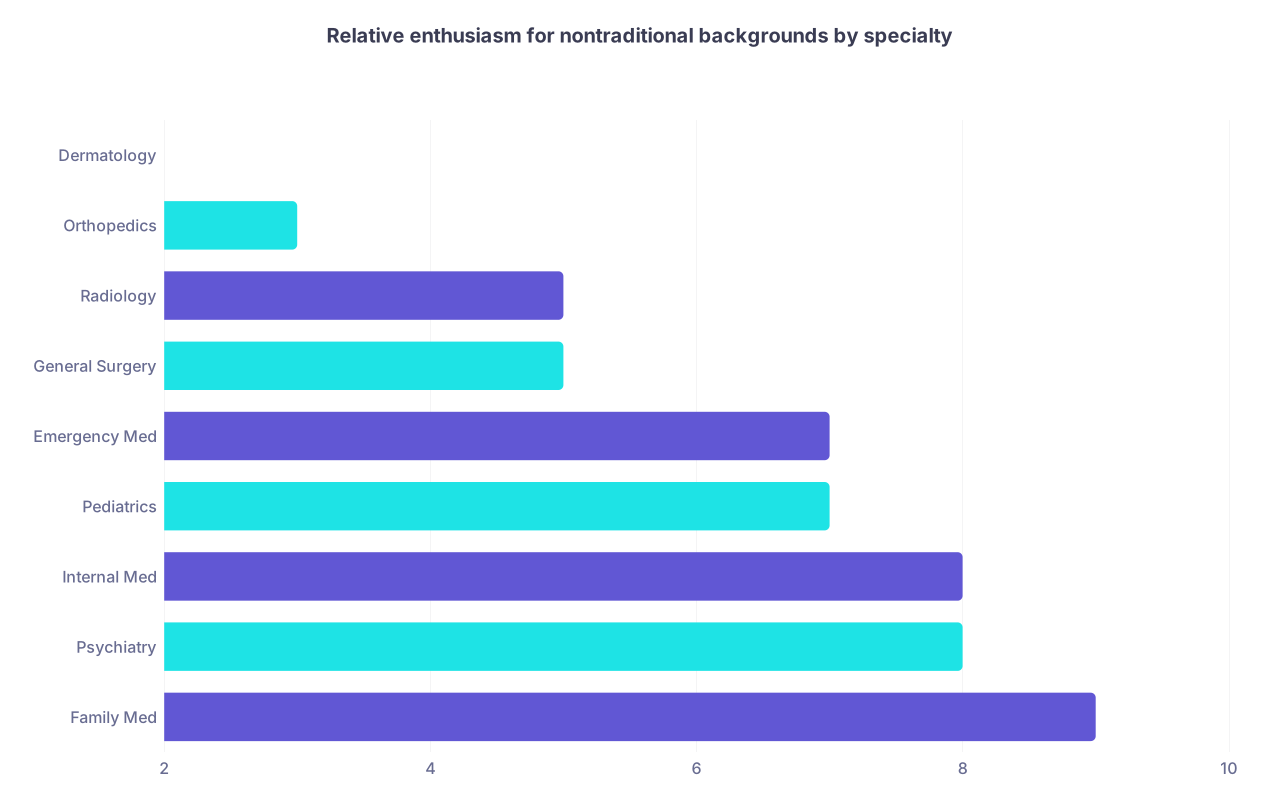
One more hidden truth: not all specialties view nontraditional backgrounds the same way.
| Category | Value |
|---|---|
| Family Med | 9 |
| Psychiatry | 8 |
| Internal Med | 8 |
| Pediatrics | 7 |
| Emergency Med | 7 |
| General Surgery | 5 |
| Radiology | 5 |
| Orthopedics | 3 |
| Dermatology | 2 |
This isn’t formal data. It’s pattern recognition from years of match lists and PD conversations.
- Primary care (FM, IM, psych, peds): Often very welcoming. They like maturity, and they’re used to building teams around varied backgrounds.
- EM, anesthesia, radiology: More neutral but intrigued, especially by engineers and operations-focused execs.
- Surgical subspecialties, derm, ortho: Brutally metrics-driven and prestige-focused. Your prior career might be a curiosity, but it won’t overcome weaker boards or lack of research.
So no, your VP title or JD or engineering pedigree will not magically walk you into neurosurgery if you don’t have the numbers and track record. Programs don’t turn off their usual filters because you had a fancy previous life.
Final Thought
Someday, if you go through with this, you’ll be standing on night float at 3:17 a.m., holding a pager that won’t stop screeching, trying to reason with an agitated family while your intern is in the bathroom crying and your senior is scrubbed in a case.
In that moment, nobody will care what your job title was before medicine. They will care whether you’re calm, competent, and on their side.
Program directors and admissions committees are trying to predict that moment from the pile of PDFs in front of them. Former executives, lawyers, and engineers are not exotic unicorns to them anymore. They’re bets. High-upside if you’re real, costly if you’re not.
Your job right now isn’t to convince them your story is dramatic. It’s to prove that when you walk away from your old life, you’re not just chasing a new identity—you’re committing to the grind they know intimately.
Years from now, you will not remember how anxiously you searched forums about whether your JD or VP title was a “hook.” You’ll remember whether you told the truth—to them and to yourself—about why you belonged in the call room in the first place.