
You’re 32. You’ve got a solid career, maybe in engineering, business, or the military. You’ve taken the prereqs at night, crushed the MCAT respectably, rewritten your personal statement eight times. You finally feel like a serious candidate for medical school.
Then the cycle tanks. Rejections. Silence. Maybe a waitlist that never moves.
You start reading between the lines of feedback: “We had many strong applicants this year.” “Best of luck in your future endeavors.” Nothing specific. Until one advisor, off the record, hints: “Your letters didn’t really match the story you’re telling.”
That’s the nightmare I want you to avoid.
Nontraditional and experienced applicants get burned by recommendation letters in ways traditional students don’t. Different work history, different supervisors, different timelines — and a whole different set of ways this can go wrong.
(See also: MCAT preparation strategies for detailed guidance.)
Let me walk you through the landmines, because I’ve seen very qualified people blow their entire application cycle thanks to letter mistakes they could have prevented.
The Nontraditional Trap: Assuming Your Experience Speaks For Itself
The classic mistake: “I’ve been a nurse/engineer/consultant for 8 years. Obviously my supervisor’s letter will be strong.”
No. Not “obviously.”
I’ve seen letters from supervisors that read like this:
“John is reliable and arrives on time. He completes tasks as assigned and gets along with others. He has expressed interest in applying to medical school.”
That’s death by faint praise.
Why this hits nontraditional applicants harder
Admissions committees look at you differently than a 21-year-old with a biology degree:
- You’re expected to have stronger professionalism and more mature insight
- Your letters are supposed to confirm that you are exceptional, not just “fine”
- They’re looking for evidence that your experience actually makes you better prepared, not just older
When your letter from a boss of 5–10 years sounds like it could’ve been written for any random employee, that disconnect is loud.
Do not assume:
- Years worked = strong letter
- Title of letter writer = strong letter
- Shared history = strong letter
The only assumption you’re allowed is this: if you do not actively manage the letter process, it will be mediocre at best.
Mistake #1: Choosing the Wrong Letter Writers
Experienced applicants love to chase “impressive” names instead of the people who can actually write.
I’ve seen this a hundred times:
- VP who barely knows you writes a generic letter
- Former PI from a job five years ago who doesn’t remember specifics
- “Dr. Famous Surgeon” you shadowed for 10 hours who can say nothing beyond, “seemed interested”
Meanwhile, the person who actually watched you take care of patients every weekend? Not asked.
Prioritizing the wrong criteria
You’re probably overvaluing:
- Title (MD, PhD, CEO, Director)
- Institutional prestige (big hospital, big-name university)
- Shared alumni status (“He also went to my undergrad, so…”)
Admissions readers know how to read between the lines. A bland letter from a prestigious person is worse than a detailed, specific letter from a “normal” person.
Here’s the order that actually matters:
- How well do they know you, recently?
- Can they describe concrete examples of your work, character, and growth?
- Do they actually think you should be a physician — and are willing to say so clearly?
- Then, and only then, do we care about title and prestige.
Special danger for nontraditional candidates
You probably have:
- Long work relationships with managers who see you as “the dependable senior person,” not “future physician”
- Professors from years ago who don’t remember you
- Physicians who know you as “that career-changer shadowing in clinic sometimes”
If any of those people are lukewarm or distant? They should not be writing your core letters.
Ask yourself this blunt question:
“Would this person be genuinely excited to see me become a physician?”
If the answer is anything less than a confident yes, move on.
Mistake #2: Letters That Don’t Back Up Your Narrative
You tell schools:
- Medicine is your calling
- You lead under pressure
- You thrive with complex, human problems
- You bring something unique from your prior career
Then your letters just talk about how you’re “polite, punctual, and completes tasks as assigned.”
That mismatch kills you.
The narrative problem
As a nontraditional applicant, your whole application is about trajectory:
- Why you pivoted
- What you learned from prior work
- How your experience makes you ready for medicine now
If your letters ignore that — or worse, subtly contradict it — committees lose confidence.
Common contradictions I’ve seen:
Personal statement: “I love working closely with patients.”
Letter: “He prefers independent work and is most comfortable with limited direct interaction with clients.”Personal statement: “I am fully committed to medicine and have planned this for years.”
Letter: “She has explored multiple careers and interests over time and is still deciding on a long-term path.”Personal statement: “I want to serve underserved communities.”
Letter: “He hopes to advance in leadership roles within the company and has expressed interest in an MBA.”
That’s how you end up in the “not sure who this person really is” pile.
Fixing this before it happens
You do not script their letter. That’s unethical and transparent.
But you absolutely should:
- Share your personal statement draft
- Share a 1-page “summary sheet” with:
- Your path to medicine in 3–5 bullet points
- Key stories/achievements they’ve seen first-hand
- Qualities you hope they can comment on (with examples they know)
- Have a blunt conversation: “I want to be sure my application tells a coherent story. Here’s how I’m framing my transition. Does that match how you’ve seen me?”
If they seem misaligned with your narrative or hesitate? Do not use them.
Mistake #3: Academic Letters That Quietly Signal “Rusty”
Another nontraditional landmine: academic letters that hint you’re academically out of shape.
You went back for a few prerequisites or a DIY post-bacc. You ask your orgo or physiology professor for a letter. Then they write something like:
“Given his long time away from formal education, he did reasonably well. He earned a B+ in my course. While he sometimes struggled with the rapid pace of material, he consistently put in effort.”
You just told the admissions committee: “This person may not keep up with med school.”
Red flags buried in academic letters
Watch for these signal phrases — they’re not always malicious, but they hurt you:
- “Given her other responsibilities…” = divided attention
- “For someone out of school for so long…” = concern about baseline ability
- “With sufficient support, he will be able to…” = needs hand-holding
- “She improved significantly over time, although initial performance was weak…” = rocky foundation
You can’t read the letter. But you can drastically reduce the chance of this happening.
How to avoid the “sympathy letter”
Do not ask for letters from:
- Professors where you barely scraped by
- Courses where you constantly needed extensions
- Professors who primarily saw you struggle, not succeed
Instead:
- Choose professors from courses where you were near the top of the class or clearly one of the “standouts,” not just the loudest in office hours.
- Ask them directly: “Do you feel you know my work well enough to write a strong letter that supports my ability to handle rigorous science coursework at the medical school level?”
- If they hesitate or use lukewarm language — “I can write a letter,” “I’d be happy to write something general” — that’s a no.
Mistake #4: Letting Letter Writers Expose Your Doubt or Delay
Nontraditional applicants often have complex timelines:
- Several years exploring other options
- Long gaps between deciding on medicine and actually applying
- Family or financial constraints slowing things down
Some letter writers feel compelled to “explain” this background — and they do it terribly.
I’ve seen this kind of phrasing:
“He has considered several paths over the years including business school, consulting, and academics, and more recently medicine seems to be his current area of interest.”
Translation: “This might be a phase.”
Or:
“Because of her family responsibilities, she may require additional time to complete demanding training.”
Translation: “She might not be able to handle the schedule.”
Guarding your trajectory
Your background doesn’t need to be hidden. But it needs to be framed, not “excused.”
To avoid this:
You must clearly articulate to your letter writer:
- How long you’ve been serious about medicine
- What actions you’ve taken to commit (courses, clinical work, shadowing)
- How you’ve structured your life to make training feasible
Then ask them directly:
- “Is there anything about my path or timeline that concerns you regarding medical school?”
- Listen. If they have doubts they can’t be talked through, don’t use them.
Do not assume “supportive personally” = “supportive on paper.” People will smile to your face and then write hedged letters because they think they’re being honest and helpful.
They’re not. They’re sinking you.
Mistake #5: Vague “Professional” Letters That Say Nothing
Nontraditional applicants often lean on work supervisors and professional colleagues.
Done right, these can be gold.
Done wrong, they’re useless filler that waste one of your limited letter slots.
This is the classic bad professional letter:
“I have supervised Maria for three years at XYZ Corporation. She is punctual, reliable, and completes tasks on time. She is well-liked by her colleagues. I believe she will do well in whatever path she chooses.”
That letter doesn’t hurt you. It just doesn’t help you. At all. And that’s the problem — you needed it to do real work.
What a professional letter must do for you
Especially as an experienced applicant, your professional letter should:
- Show you can handle high responsibility and pressure
- Demonstrate leadership, initiative, and judgment
- Give specific examples of you dealing with complex human situations or ethical dilemmas
- Confirm you’re not just “transitioning on a whim” but have thought deeply and demonstrated commitment
If your supervisor can’t speak to any of that? They’re the wrong writer.
Help them by giving:
- 3–5 concrete examples of:
- Times you solved a difficult problem
- Conflicts you handled
- Ways you exceeded your role
- A very blunt ask: “Could you speak specifically to my judgment, reliability under pressure, and ability to handle high cognitive load?”
If they go vague in response? Again — not your letter writer.
Mistake #6: Missing Required Types or Having an Unbalanced Set
Another way experienced applicants quietly weaken themselves: weird letter combinations.
I’ve seen applicants apply with:
- Three professional letters, zero science faculty
- Two physician letters, no academic letter at all
- Only “character reference” style letters (chaplain, coach, neighbor)
Med schools expect a certain structure. When you deviate, you look either uninformed or like you didn’t have strong options.
| Area | What Schools Commonly Want | Common Nontraditional Error |
|---|---|---|
| Science Letters | 1–2 recent science professors | Only old letters from 8+ years ago or none |
| Non-Science | 1 humanities/social science professor | Replaced entirely with employer letters |
| Clinical | 1 physician or [clinical supervisor](https://residencyadvisor.com/resources/nontraditional-path-medicine/shadowing-and-clinical-experience-mistakes-latecareer-applicants-make) (optional) | All letters from clinicians, no academic voices |
| Professional | 1 supervisor (for nontrads, very helpful) | 3–4 professional letters, no science voices |
If your situation is unusual — like you did all prereqs online, or many years ago — you absolutely must:
- Check each school’s specific letter policies (not just “AMCAS guidelines”)
- Email schools if you can’t meet a requirement and ask what combination they will accept
- Document those responses
Do not assume “they’ll understand because I’m nontraditional.” Some will. Some won’t. You don’t want to gamble here.
Mistake #7: Ignoring the Timeline and Letting Letters Arrive Weak and Late
Nontraditional applicants often juggle jobs, families, and school. They push letter logistics to the last minute.
That’s how you end up with:
- Rushed letters written in 24–48 hours
- Letters missing key details because the writer had no time to think
- Letters that arrive after schools start reviewing files — so early impressions form without your strongest voices present
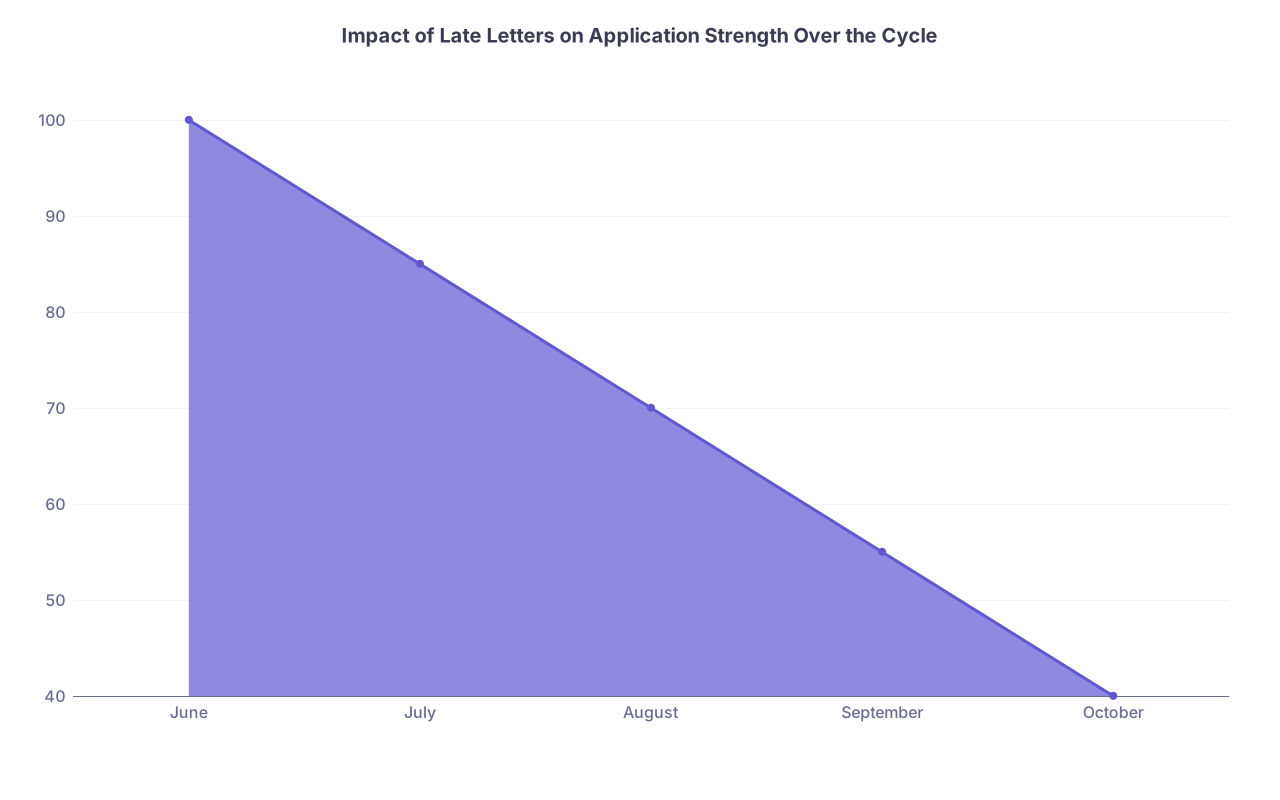
Look at how this plays out over time:
| Category | Value |
|---|---|
| June | 100 |
| July | 85 |
| August | 70 |
| September | 55 |
| October | 40 |
By the time late letters finally arrive, their impact is diluted. People already skimmed your app, maybe prelim-screened you out.
Nontraditional-specific timing mistakes
- Waiting to ask until final grades post (professor is now on vacation, or overloaded with other requests)
- Hoping an old supervisor “remembers you well enough” without time for a real conversation
- Not using a letter service (like Interfolio) and trying to chase down individual submissions while working full time
You need to start the letter process months earlier than you think:
- 3–4 months before you submit: identifies writers, talk to them
- 2–3 months before submitting: send them your materials (CV, draft PS, summary sheet)
- 1–2 months before submitting: gentle, polite reminders
If asking for a letter stresses you out, good. That stress is useful. It means you’ll do it early instead of pretending it’ll magically happen.
Mistake #8: Not Protecting Yourself Against a Bad Letter
Worst-case scenario: you accidentally get a negative or clearly hesitant letter.
You will probably never see it. But admissions will. And one bad letter can outweigh three good ones.
Nontraditional applicants are actually at higher risk for this because:
- You have more complex histories for people to comment on
- You’ve worked under more personalities, including ones who may not like your decision to leave
- Some supervisors feel betrayed when a strong employee leaves and unconsciously (or consciously) poison their letter
How you reduce this risk
You do not “trust” people blindly. You verify.
Before asking:
Have a direct, uncomfortable conversation:
“I respect your judgment and I’m only asking you because I believe you can support my application strongly. Would you feel comfortable writing a strong, positive letter of recommendation for medical school?”Then shut up and listen.
- If they say “yes, absolutely” → good sign
- If they say “I can write you a letter” → that’s a dodge
- If they say “I don’t usually do that” or “I’m not sure I’m the right person” → believe them. That’s a no.
If your school or letter service gives you the option to waive your right to see the letter: you should almost always waive. Many committees distrust letters the applicant could have read and edited. But that means you must be even more careful upfront about whom you trust.
Practical Process: How to Manage This Like an Adult, Not a Panicked Applicant
Let me be blunt: nontrad applicants who “wing it” on letters almost always underperform what their stats and experience should get them.
Here’s a clean, protective process that stops most of the disasters above.

| Step | Description |
|---|---|
| Step 1 | Define Narrative |
| Step 2 | List Potential Writers |
| Step 3 | Check Requirements per School |
| Step 4 | Rank Writers by Strength & Fit |
| Step 5 | Ask: Strong Letter? |
| Step 6 | Provide Materials & Guidance |
| Step 7 | Choose Alternate Writer |
| Step 8 | Set Clear Deadlines |
| Step 9 | Polite Reminders |
| Step 10 | Confirm Receipt in Portal |
Key protections built into that:
- You align your narrative before picking writers
- You confirm strength before committing
- You respect timelines so no one rushes
- You verify that letters actually arrive
This is how adults handle letters. Which is exactly the impression you want to give as an older, experienced applicant.
FAQ: Recommendation Letters for Experienced / Nontraditional Applicants
1. Is it okay if one of my science letters is from 5–7 years ago?
Sometimes, but do not assume. Many schools prefer recent academic evidence, especially for career changers. If all your recent coursework was online or at a community college, that’s still usually better than a single ancient letter from a big-name university where the professor barely remembered you. When in doubt, email specific schools and ask what they’ll accept for a nontraditional with older coursework — then build your strategy around those responses.
2. I don’t have a single supervisor I trust for a strong letter. What do I do?
That’s a bigger problem than just letters. It signals either a pattern of strained work relationships or extremely short job tenures. You can partially repair this by cultivating one strong relationship now — even if it means having a deliberate conversation with your current supervisor about your goals and stepping up your performance and visibility for several months before asking. Meanwhile, lean harder on academic and clinical letters, and be strategic about which cycle you apply in; applying before you have at least one rock-solid professional advocate is asking to get burned.
3. Can I reuse old letters from a previous unsuccessful application cycle?
You can, but it’s risky to rely on them exclusively. For a nontraditional applicant, letters that are more than one cycle old start to look stale, especially if your career or coursework has evolved since then. At minimum, try to get your strongest prior letter writers to update or refresh their letters to reflect your growth, new experiences, and reaffirmed commitment. If a letter writer can’t update a letter after 1–2 years, that also tells you something about how central you are in their mind — and whether their letter ever carried real weight.
If you remember nothing else:
- Do not chase titles; chase people who actually know your work and believe in your future as a physician.
- Make sure your letters reinforce — not contradict — your story as a nontraditional applicant.
- Protect yourself early: ask directly for strong letters, manage the timeline like it matters, because it absolutely does.