
The thing faculty notice first about late‑career premeds is not your age. It’s whether you’re still telling yourself a story—or you’ve done the work to face reality.
Let me walk you through what actually happens behind those closed‑door committee meetings when your file hits the table and you’re 30, 35, 40+.
What Jumps Off the Page in the First 30 Seconds
Here’s the unfiltered truth: no one is sitting there counting your gray hairs. We’re scanning for three things in brutal, rapid succession:
- Is this person serious or dabbling?
- Can they handle the academic firehose now, not 10–15 years ago?
- Are they going to be a headache administratively, emotionally, or professionally?
And we decide that frighteningly fast.
The four “tells” that scream at faculty immediately
In the first pass through your file, four things dominate attention for any late‑career applicant:
Recency of rigorous coursework
Not just your GPA. The timestamp on your science courses. If your last real science class was 11 years ago and your personal statement says you “rediscovered a passion for medicine,” committees exchange looks. I’ve seen it happen.Step‑function in your trajectory
Faculty want to see a clear pivot—an inflection point. You were doing X, then you made a decisive, costly move toward medicine. Not a vague, meandering “I kind of thought about it for a while and…”.Evidence you understand what clinical medicine actually is
This is where many late‑career folks embarrass themselves. They write like they’re applying to a philosophy PhD with blood involved. Vague “helping people,” zero understanding of teams, shift work, EMR hell, or hierarchy. Dead on arrival.Logistics and stamina
Quietly, people are asking:
“Who’s watching the kids?”
“Can this 39‑year‑old really handle 80‑hour weeks as a PGY‑1?”
They won’t ask you that in the interview. They ask each other that in the rank meeting.
You need to build your application so these four questions are answered before anyone has to voice them.
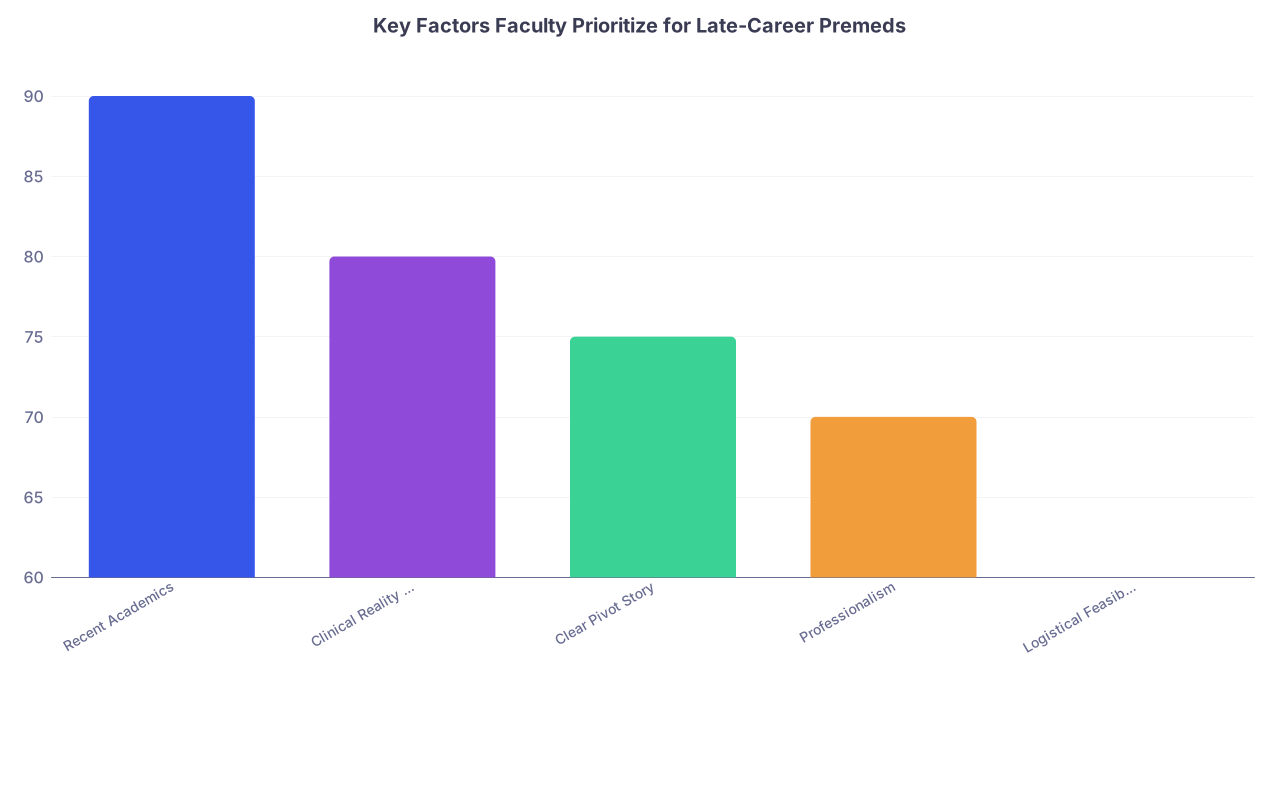
| Category | Value |
|---|---|
| Recent Academics | 90 |
| Clinical Reality Check | 80 |
| Clear Pivot Story | 75 |
| Professionalism | 70 |
| Logistical Feasibility | 60 |
Those numbers aren’t from a formal paper. They’re from what actually gets argued over in committee rooms: recent grades and reality awareness dominate; your inspirational backstory is a distant second.
Your Age Isn’t the Problem. Your Academic Trail Is.
I’ve heard this line from a 42‑year‑old applicant: “I had a 3.8 in undergrad, so that shows I can handle the coursework.”
He graduated in 2005.
No one cares about your 3.8 from 20 years ago if you have nothing recent that proves your current brain, with adult responsibilities, can still operate at that level.
Here’s how faculty really read your academics as a late‑career applicant:
1. The “clock” on your sciences
Anything older than 7–10 years? It mentally gets discounted. Harsh but accurate.
Committees will say things like:
- “These are good grades, but they’re ancient.”
- “Has he done any upper‑division work recently?”
- “I don’t know what she looks like in a modern, compressed curriculum.”
That’s why serious late‑career candidates almost always go through one of three routes:
- Formal post‑bacc
- DIY post‑bacc with upper‑division sciences
- SMP (Special Master’s Program) with real medical school coursework
They’re not doing that for fun. They’re doing it because they know we do not trust old transcripts on their own.
2. The pattern matters more than perfection
If you’re 33, have a rough 2.9 from your early 20s, and then a consistent 3.7–3.9 over 30+ recent credits of hard sciences—or a solid SMP performance—faculty talk about that like this:
“Okay, this person grew up. I trust the recent data more than the ancient history.”
I’ve sat in rooms where a 3.2 from 2009 stopped mattering the second we saw a 3.8 in recent upper‑division sciences and a strong MCAT.
Flip side: if your recent post‑bacc is mixed—A, B+, B–, C+ in Orgo II—your age amplifies the concern. The thought is: “They’re older, more motivated, presumably more focused and still not nailing it? That’s concerning.”
3. MCAT as the great equalizer
For late‑career applicants, the MCAT isn’t just a score. It’s a stress test.
Behind closed doors, your age makes the MCAT more consequential, not less. Why?
Because faculty know:
- You’ve been out of school
- Your life is more complex
- Your neuroplasticity is not 19‑year‑old level
So if you still manage a strong MCAT, it strongly reassures them. I’ve seen skepticism flip in a single sentence:
“His undergrad is old, but he just pulled a 517 after a decade out of the classroom.”
That gets everyone’s attention.
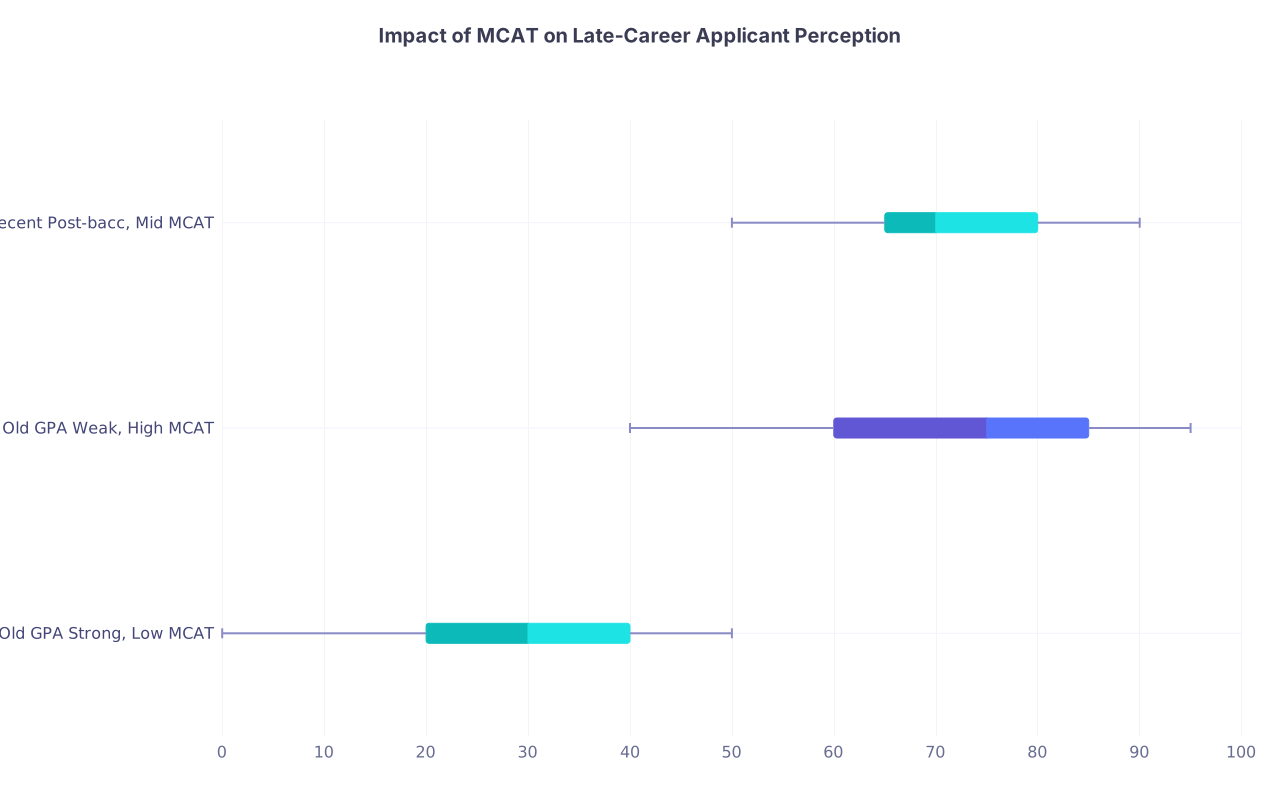
| Category | Min | Q1 | Median | Q3 | Max |
|---|---|---|---|---|---|
| Old GPA Strong, Low MCAT | 0 | 20 | 30 | 40 | 50 |
| Old GPA Weak, High MCAT | 40 | 60 | 75 | 85 | 95 |
| Recent Post-bacc, Mid MCAT | 50 | 65 | 70 | 80 | 90 |
Again, not journal data. This is a visual proxy for what people say: a high MCAT in a late‑career candidate massively shifts confidence in your academic readiness. Weak MCAT? Every concern about age hardens.
The Signal That You’re Either A Risk… or Gold
There’s one quiet calculation every faculty member does that few applicants think about:
“Will this person still be practicing 10–15 years from now?”
You don’t see that written in any handbook. But I’ve heard variants of it at almost every admissions or selection meeting for late‑career people.
The unspoken “ROI” calculation
A 22‑year‑old M1 might practice for 35–40 years.
A 38‑year‑old M1 might practice for 20–25 years.
A 45‑year‑old M1 might practice for 10–15 years.
No one will say, “We shouldn’t take them because they’re older.” That’s illegal and stupid. What we do say is:
- “Will this person realistically get through training?”
- “Do they understand what 7+ years of training actually feels like at their stage of life?”
- “Are they going to burn out halfway through an IM residency because their kids are in high school and their spouse is at a breaking point?”
Here’s how you either worsen or calm those fears.
Things that quietly scare faculty about late‑career applicants
These red flags get whispered about more often than you think:
- Vague explanation of prior career shift (“I just wasn’t fulfilled”) without specifics
- Zero evidence of long‑term commitment to anything (job‑hopping every 1–2 years)
- No clear plan for family/financial logistics during training
- Overly romantic language about medicine as pure altruism, with no acknowledgment of system realities
When I see a 37‑year‑old applicant say, “I realized medicine was my one true calling,” I immediately look for:
- Years of sustained clinical exposure
- Steps already taken to reorganize life
- Any concrete understanding of scheduling, residency, and pay realities
If those are absent, the story feels like fantasy. And late‑career fantasies are very expensive—for you and for the school.
What reassures us you’re not a midlife crisis project
I’ve seen older applicants turn a skeptical room into outright supporters with a few details:
A detailed, non‑defensive explanation of the career shift:
“I spent 10 years in software engineering. I plateaued. Two specific experiences with my father’s cancer care, and later volunteering in an oncology clinic, made me realize what I wanted was direct clinical responsibility, not abstract products. So I tested that assumption by doing 300+ hours of clinical volunteering and shadowing over 2 years before registering for a single prereq.”Evidence they’ve already started reorganizing their life:
“My partner and I met with a financial planner. We’ve modeled living on a resident’s salary. We’ve already downsized our home and paid off high‑interest debt.”Long‑term commitments that show grit:
5–10 years in a demanding prior field. Leadership. Promotions. People who vouch for your work ethic.
That combination flips the mental model from “crisis” to “mature pivot.”
The First 10 Seconds of Your Personal Statement: What Faculty Actually Notice
Nobody reads your personal statement slowly the first time. They skim it. Brutally.
In those first 10–15 seconds for a late‑career premed, they’re looking for:
- What was your life before medicine?
- What exactly triggered the pivot?
- What have you done since—specifically, consistently—to test it?
- Do you sound grounded or delusional?
The dead giveaways of a weak late‑career narrative
I’ve seen so many versions of this it’s almost a template:
“I’ve always wanted to help people. After years in corporate America, I finally decided to pursue my dream of medicine. When my grandmother was in the hospital, I realized I wanted to be the kind of doctor who truly listens…”
That paragraph could belong to a 19‑year‑old. When you’re 35, it’s tone‑deaf. Faculty think:
“Really? Only that? After a decade of adult life, that’s your level of reflection?”
You need to show a different level of insight. You’ve lived more. Use that.
What a strong opening looks like from a late‑career applicant
Good late‑career statements tend to:
- Start with a specific moment from your adult professional life
- Acknowledge what your prior career gave you—and what it couldn’t give you
- Show you understand medicine as work, not just meaning
Something like:
“On a Tuesday afternoon conference call, I was managing a seven‑figure logistics contract while replying to text updates about my sister’s sepsis in the ICU. I knew exactly how to model supply chain risk for a Fortune 500 client, and absolutely nothing about the decisions keeping her alive. Three months later, I was back in a hospital—this time as a volunteer—shadowing a hospitalist at 6 a.m. and then logging into my operations job by 9. That double life lasted 18 months. By the end of it, I was certain: I wanted the responsibility on the clinical side of the whiteboard, not the spreadsheets.”
That sounds like an adult talking. Not a sophomore.

What Faculty Notice in Your Letters of Recommendation
Your letters do different work when you’re late‑career.
For a traditional student, letters answer: “Is this kid smart and hardworking?”
For you, letters answer: “Is this grown adult reliable, adaptable, and not a nightmare to work with?”
The most powerful thing we look for in older applicants’ letters isn’t praise. It’s translation of your prior professional life into medical currency.
The letters that move the needle
The best letters for late‑career candidates usually come from:
A recent science professor who can say:
“They’ve been out of school for 12 years and are still one of the top three students in my upper‑division physiology course. They sat front row, did every practice problem, and lifted the level of peer discussion.”A supervisor from your prior career who can say:
“I’ve managed dozens of direct reports over 15 years. This is the person I would pick to handle a crisis at 2 a.m. They are calm, decisive, and they don’t offload problems onto others.”A clinician you’ve worked closely with who can say:
“They understood the team dynamic, respected boundaries, took feedback, and showed up at 6 a.m. rounds for months without external pressure.”
When letters just say “hardworking, compassionate, team player,” they’re wallpaper. When they say, “I trusted her to represent our department to executive leadership” or “patients consistently remembered him by name and asked for him,” that matters.
What quietly undermines you
Faculty see through generic praise instantly. Red flags:
- All letters from long‑past undergrad mentors
- Zero letters that reflect your recent self
- Overly emotional letters without concrete examples
- Letters that hint at rigidity: “very strong opinions,” “prefers to work independently,” “does best when given full control”
Medicine is team sport plus hierarchy. A hint of “doesn’t play well with others” sticks.
Clinical Exposure: Are You Chasing the Idea of Medicine or the Reality?
Shadowing hits differently in a 40‑year‑old than in a sophomore.
When I see a 19‑year‑old with 40 hours of shadowing, I shrug. That’s typical.
When I see a 38‑year‑old with 40 hours of shadowing and “lifelong dream of medicine,” I’m done. You had years to test this and you barely scratched the surface?
For late‑career people, we look at depth and continuity more than raw hours.
Signs you actually understand the job
Faculty lean in when they see:
- Longitudinal clinical experience (e.g., 1–2 years as a scribe, MA, EMT, volunteer with direct patient contact)
- Work in less glamorous settings: community hospitals, safety‑net clinics, SNFs, ED, night shifts
- Reflections that mention interprofessional teams, system constraints, EHR frustrations—not just “I saw the doctor comfort the patient”
The mature applicant shows respect for the grind, not just reverence for the hero moments.
The “reality check” test in interviews
In interviews, older applicants often get subtle reality‑check questions:
- “How do you see yourself balancing training with your family responsibilities?”
- “You’ve been in a higher‑earning role. How are you thinking about the financial trade‑offs of residency?”
- “What specialty do you imagine yourself in—and how did you arrive at that?”
We’re not asking those just to be polite. We’re checking: have you actually done the math, the emotional calculus, the conversations with your partner, your kids, your parents?

| Stage | Activity | Score |
|---|---|---|
| Before Pivot | Stable non-medical career | 4 |
| Before Pivot | Increasing exposure to healthcare | 3 |
| Transition | Formal post-bacc or SMP | 3 |
| Transition | Longitudinal clinical work | 4 |
| Application | Strong MCAT and recent grades | 4 |
| Application | Grounded personal statement | 5 |
| Training | Clear life logistics plan | 4 |
How to Make Your Age an Asset Instead of a Liability
Here’s the part no one tells you: when done right, late‑career applicants can actually be easier sells than 22‑year‑olds.
Because when you’re good, you’re very good.
Faculty get excited about older applicants who:
- Bring leadership and maturity to small groups and wards
- Need less hand‑holding on professionalism
- Understand workplace culture, proper email, conflict management
- Add perspective and stabilize the class socially
I’ve heard versions of: “She’ll be the adult in the room and that’s a good thing.”
To get there, your application needs to telegraph three things clearly:
You can still run with the 22‑year‑olds academically
Recent As in hard sciences. Solid MCAT. No hand‑wavy excuses.You’ve already tested the clinical reality
Not just shadowing, but sustained proximity to actual patients and teams.You’ve done the life logistics work
Show you’ve talked with your family. Structured your finances. Thought about timing of kids, caring for elderly parents, moving cities.
That third one rarely appears explicitly in applications, but it comes out in how you talk, how grounded your answers are, and whether your story is coherent.

FAQ: Late‑Career Premed Applicants
1. Am I “too old” to start medical school in my late 30s or 40s?
No, you’re not “too old” in any absolute sense. There are people who start in their 40s and have excellent careers. What changes with age is scrutiny, not eligibility. Faculty will scrutinize your academic recency, your stamina, and your life logistics more intensely. If you can convincingly demonstrate recent academic strength, long‑term clinical exposure, and a realistic life plan, your age won’t stop you. If you can’t, it will.
2. Do I need a formal post‑bacc or SMP, or can I just take a few classes?
If your undergrad is old, weak, or non‑science, you usually need more than “a few classes.” A structured post‑bacc or SMP sends a strong, clean signal: this person can handle a modern, intensive curriculum. DIY can work if it’s coherent, rigorous, and recent (upper‑division sciences, not just “Bio 101”). But if you’re coming from a 2.8 GPA in 2008 and no science background, and you think two community college classes will fix it—that’s fantasy.
3. How much clinical experience is “enough” for a late‑career applicant?
For you, “enough” means “clearly not a dabble.” Hundreds of hours, longitudinal, ideally over at least a year. Scribing, MA work, EMT, hospice, ED volunteering with direct patient exposure—those land well. Forty hours of shadowing and a few Saturday health fairs? That’s the profile of a college junior, not someone reorganizing an adult life around medicine.
4. Will my prior career actually help, or is it just background noise?
It helps if it’s translated. Your prior career in finance, teaching, engineering, the military, or the arts can be a massive asset if you show how the skills map to medicine: leadership, crisis management, communication under pressure, complex problem‑solving, dealing with difficult people. If you just list job titles and generic responsibilities, it becomes noise. The key is integration: your story should sound like a coherent evolution, not an abrupt personality transplant.
5. How honest should I be about family and financial concerns in my application or interviews?
You should be honest, but strategic. Don’t dump your entire financial life story. Do show you’ve thought about it like an adult. Saying, “My partner and I have planned around living on a resident’s salary; we’ve already made adjustments,” reassures faculty. Saying, “I’m really worried about the debt but hoping it’ll work out,” does not. Same with kids: you don’t need to overshare, but you should project that you’ve considered the realities and have support structures, not that you’re wandering in blind.
If you strip this down, three things decide your fate as a late‑career premed: recent academic performance, whether you clearly understand the real job of being a physician, and whether your life is actually ready to absorb the hit of training. Get those right and your age stops being a problem—and starts looking like an advantage.