
You have the acceptance email open. “We are pleased to offer you admission…” You should be thrilled. Instead, you are staring at the Cost of Attendance sheet, realizing the numbers do not make sense with your current life.
Car loan. Credit cards. Apartment lease that is way too nice. That private post-bacc you financed on high-interest debt because “it will be worth it.” And suddenly you see it: you planned the application but never truly planned the money.
Let me be blunt. The financial mistakes people make on the nontraditional path to medicine do not just sting. They compound. They show up years later as impossible monthly payments, restricted job choices, delayed milestones like buying a home or having kids, and a constant low-grade panic every time loan servicer emails hit your inbox.
You are becoming a physician. You cannot afford to be sloppy about this.
Below are the biggest financial missteps career changers regret once they start medical school – and how to avoid joining them.
1. Keeping Your “Old Life” Lifestyle Right Up Until Matriculation
The most common, most destructive mistake: treating your pre-med years like a holding pattern where you live as if your current income will last forever.
You know the story. Mid-career professional making $60–120k, decides to go back for medicine. Instead of gradually ratcheting down lifestyle, they keep:
- High rent in a “nice” complex
- New car with a sizeable payment
- Frequent travel because “I’ll never have this time again”
- Eating out constantly because they are “too busy to cook”
Then school starts. Income plummets to zero. The fixed expenses do not.
I have watched people start M1 with:
- $600–$900 / month car payments
- $1,500–$2,200 rent for a solo 1-bedroom
- $15k+ credit card balances
- Zero emergency fund
They then borrow extra student loan money to carry their preexisting lifestyle. That is the trap.
Here is the harsh truth: every fixed expense you carry into medical school inflates the total amount of high‑interest or long-term debt you will graduate with. You are not just “getting by.” You are buying your future freedom on layaway at a brutal interest rate.
Avoid this mistake:
Twelve to twenty-four months before you plan to start medical school, you should be aggressively lowering lifestyle:
- Move to cheaper housing, even if less convenient or glamorous.
- Downsize the car. If you have equity, trade into something cheaper and kill the payment.
- Cut recurring subscriptions ruthlessly.
- Freeze lifestyle inflation entirely, even if your income bumps.
If you are not embarrassed by how frugal you look compared to your old colleagues, you are probably not cutting enough.
2. Financing a Post-Bacc or SMP You Cannot Afford or Do Not Need
A massive one for career changers: treating expensive special master’s programs (SMPs) or private post‑baccs as a magic ticket. They are not.
The mistake is threefold:
- Choosing a $40–70k/year SMP or post‑bacc when a cheaper alternative would have worked.
- Paying for it with high-interest private loans, personal loans, or even credit cards.
- Doing it without a realistic assessment of whether it will actually fix your application.
I have seen people spend $80–120k on a private post‑bacc/SMP, then still have to apply three cycles before a single acceptance. That debt does not disappear when you matriculate. It just sits there, often at worse terms than federal med school loans.
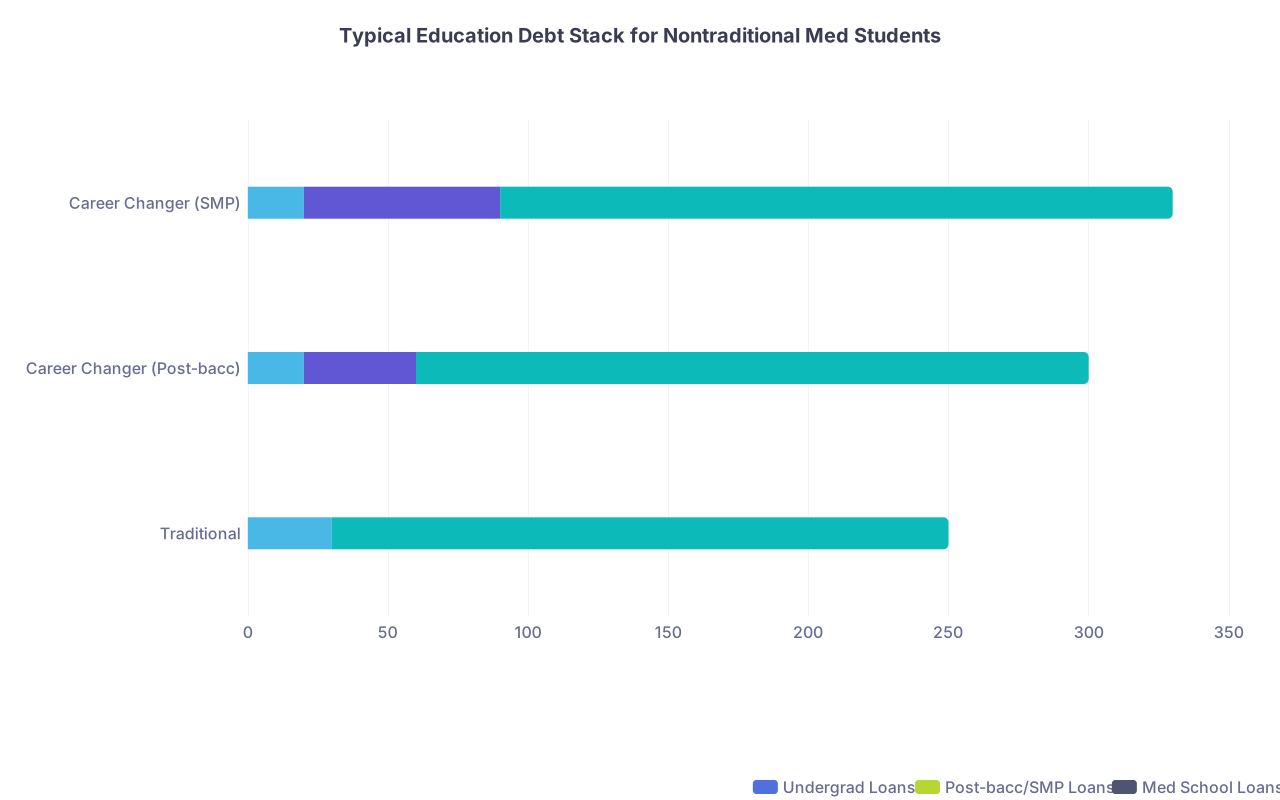
| Category | Undergrad Loans | Post-bacc/SMP Loans | Med School Loans |
|---|---|---|---|
| Traditional | 30 | 0 | 220 |
| Career Changer (Post-bacc) | 20 | 40 | 240 |
| Career Changer (SMP) | 20 | 70 | 240 |
The regret hits in M2 or residency when they realize other classmates have just med school + undergrad loans, while they have a third stack of expensive pre‑med grad debt that does not qualify for good repayment programs.
Avoid this mistake:
- Get an honest read on whether you actually need a formal post‑bacc/SMP. Sometimes a DIY post‑bacc at a local state school solves the GPA problem for a fraction of the price.
- Only consider costly brand‑name programs if:
- Your academic record is truly weak, and
- The program has documented strong linkage or placement to MD/DO schools.
- Refuse to finance pre‑med programs with high‑interest personal or private loans unless you have no other path and you fully understand the total projected debt and repayment options.
If you cannot clearly write out how this program changes your competitiveness, and how you will afford the added debt on a resident salary, pause. Do not sign.
3. Ignoring Your Credit Score Until You Need Loans
Career changers love to ignore credit until suddenly they are filling out FAFSA and Grad PLUS applications. Then the surprise hits.
Federal Direct Unsubsidized loans do not require a credit check. Grad PLUS loans do. Grad PLUS is how many students cover:
- Remaining tuition after unsubsidized max
- Living expenses
- Relocation for rotations and residency
Destroy your credit in your late 20s, and you might walk into med school needing a co‑signer for Grad PLUS or paying higher interest on private alternatives. I have seen people panicking two weeks before orientation because their PLUS application was denied due to:
- Recent charge‑offs
- Large delinquent accounts
- Defaulted prior student loans
Cleaning this up takes time. Time you will not have when tuition is due.
Avoid this mistake:
Eighteen months before matriculation target:
- Pull your full credit reports from all three bureaus (free annually).
- Identify any delinquencies, collections, or defaults.
- Put every account you possibly can on-time auto‑pay for at least the minimum.
- Do not close your oldest cards randomly – that can hurt your score.
- If you have federal loans in default, work on rehabilitation or consolidation early.
Treat your credit score like an oxygen line: boring when it works, deadly when it does not.
4. Entering Med School With High-Interest Consumer Debt
This one is brutal because it seems small at first.
“I only have $8k on my credit card.” “Just $12k left on my car loan.” “I can handle that.”
No. You cannot “handle that” with zero income, constant demands on your time, and the psychological load of medical training. What actually happens is:
- You defer doing anything about it because you are overwhelmed.
- Minimum payments keep bleeding your limited monthly cash.
- You end up borrowing extra student loans to float those payments anyway.
So you pay interest… with more interest.
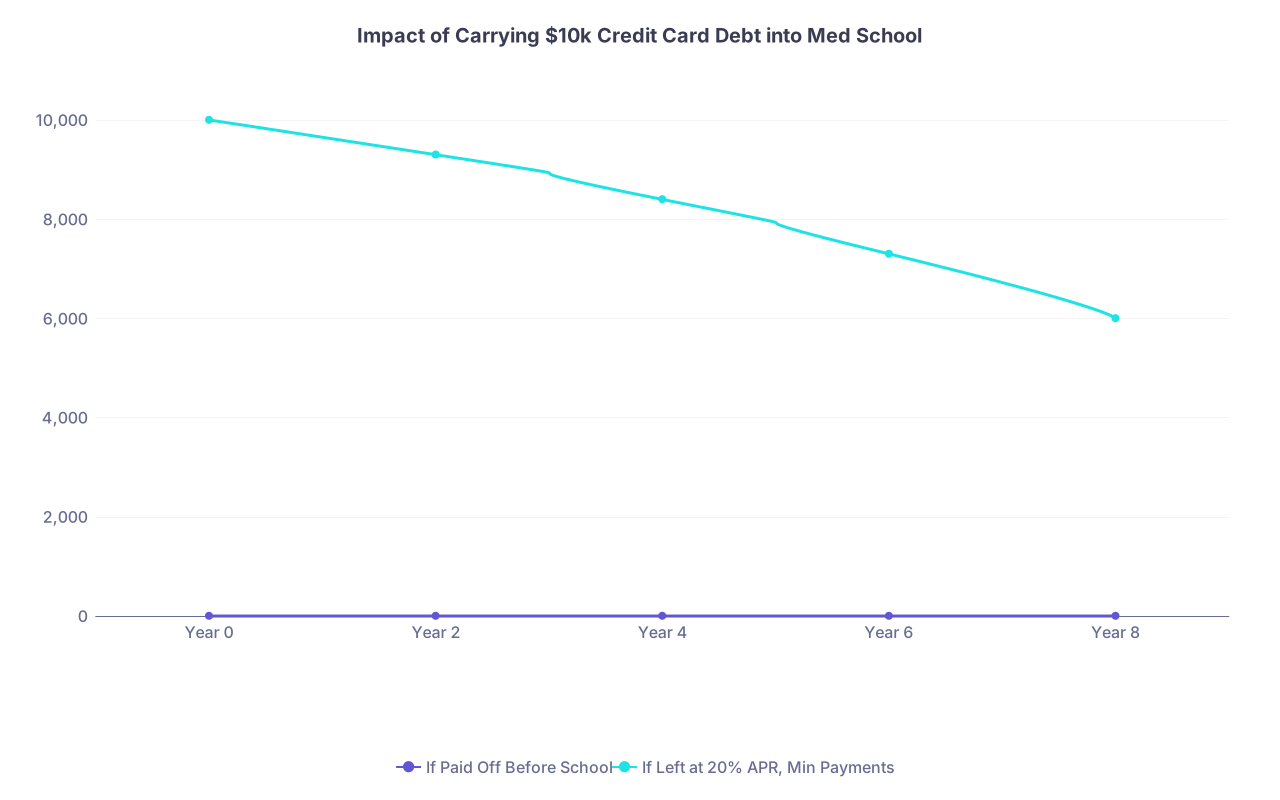
| Category | If Paid Off Before School | If Left at 20% APR, Min Payments |
|---|---|---|
| Year 0 | 0 | 10000 |
| Year 2 | 0 | 9300 |
| Year 4 | 0 | 8400 |
| Year 6 | 0 | 7300 |
| Year 8 | 0 | 6000 |
You will deeply regret every dollar of high‑interest consumer debt you carry into M1. Because compared to 6–8% federal loans (which at least come with flexible repayment options), 18–25% credit card interest is financial self‑harm.
Avoid this mistake:
While you are still working:
- Make an aggressive, prioritized payoff plan for:
- Credit cards
- Personal loans
- High‑interest car loans
- Consider temporarily overworking (extra shifts, side contract work) purely to kill this debt before M1.
- If you truly cannot clear it, at least reduce the balance as much as possible and look into strategic balance transfers (with caution and a clear payoff timeline).
Your goal is simple: start M1 with no high‑interest consumer debt. Or as close to zero as you can get.
5. Leaving Free Money and Cheaper Options on the Table
Career changers often come from careers where salaries were the main thing. Benefits, tuition assistance, and scholarships were afterthoughts. That mindset will cost you six figures if you carry it into your pre‑med path.
Common missed opportunities:
- Employer tuition benefits for pre‑reqs or post‑bacc classes.
- State school post‑baccs instead of expensive private programs.
- In‑state tuition eligibility that could be obtained by establishing residency a year earlier.
- National Health Service Corps (NHSC), HPSP, or state service‑based scholarship/loan forgiveness programs.
I have met students paying $65k/year at a private med school when they could have positioned themselves for in‑state tuition at a public school at half that cost by moving one year earlier and working locally while doing pre‑reqs.
| Path | Pre-med Cost | Med School Type | 4-year Med Tuition & Fees | Total Direct Education Cost |
|---|---|---|---|---|
| Unplanned, private everything | $80,000 | Private | $260,000 | $340,000 |
| Strategic, state-based | $25,000 | Public (in-state) | $160,000 | $185,000 |
That is a $155,000 difference before interest. For basically the same MD/DO degree.
Avoid this mistake:
- Aggressively hunt for:
- Employer tuition assistance for pre‑reqs.
- Community college or in‑state post‑bacc options.
- Residency rules in states with strong public med schools.
- If you are service‑minded, study the NHSC and HPSP terms early, not as an afterthought in M4 when you are desperate.
“Cheaper” does not mean “worse” in this space. It usually means “you took the time to do the paperwork and plan ahead.”
6. Not Building a Realistic Med School Budget Before You Apply
Most nontrads do a vague mental calculation: “Tuition is X, loans will cover it, doctors make good money, I will be fine.”
That is not budgeting. That is magical thinking.
Here is what actually blindsides people once they start:
- How little is left after tuition, fees, and mandatory school charges.
- The real cost of moving for clinical years, board exams, applications, interviews.
- The fact that you cannot just “work extra” during med school to fix mistakes.
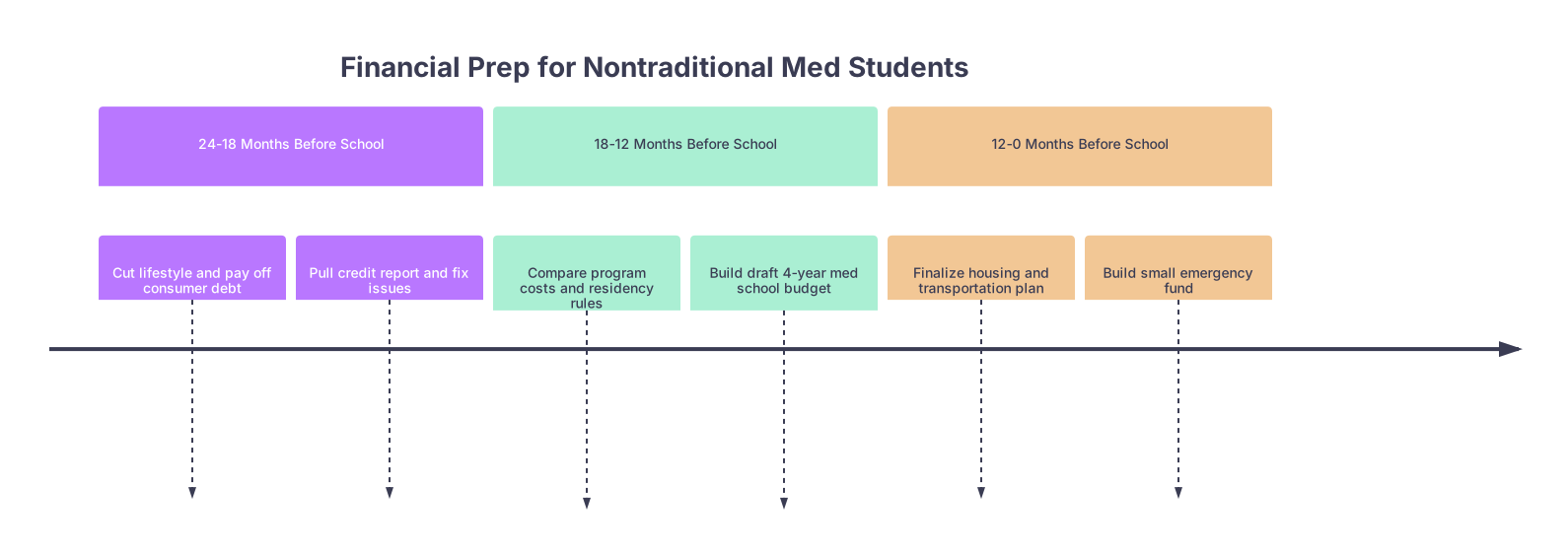
You need an actual budget before applications go out. With numbers. Not vibes.
Avoid this mistake:
Sit down and:
- Pull a real Cost of Attendance (COA) from a few example schools that resemble where you might go.
- Break COA into:
- Fixed: tuition, fees, required insurance.
- Variable: rent, utilities, food, transportation, exam fees, travel.
- Compare the COA with a lean lifestyle vs. a “comfortable” one. See how much future debt each version creates.
- Decide deliberately: what quality of life can you afford, knowing you will be earning resident pay (not attending pay) when repayment starts?
If the numbers horrify you, good. They should. That horror is your warning to adjust now, not later.
7. Assuming You Can “Just Work” Your Way Through Med School
Career changers often underestimate how physically and cognitively taxing medical school is. “I worked full-time and did my MBA at night, I’ll be fine.”
Medical school is not an MBA. It is not your post‑bacc. It will eat every spare mental calorie you have.
I have watched nontrads try to:
- Keep a 20–30 hour/week job during M1/M2.
- Drive Uber on weekends.
- Continue freelance consulting on the side.
What happens? Grades suffer, Step/Level prep suffers, health suffers. Some fail courses. Others barely pass boards on the second attempt. You do not want to trade a smaller loan balance for a weak academic record and limited residency options.
Yes, some limited work is possible, usually:
- Very part‑time and flexible (occasional shifts).
- During lighter blocks or summers.
- Once you have proven to yourself you can handle the baseline workload.
But planning your financial survival around regular outside income during med school is a planning failure.
Avoid this mistake:
- Design your budget so that if you earn zero outside income during med school, you still function.
- If work happens, great – treat that income as buffer or extra loan reduction, not a necessary lifeline.
- Be brutally honest with yourself after the first exam block. If you are not solidly on top of material, drop the job.
8. Forgetting That Your Future Self Will Not Be an Instant Rich Attending
This one is more subtle but lethal: mentally anchoring on attending salary instead of resident salary.
I hear it constantly:
“I’ll be a doctor, I’ll pay it back.”
No. Residents pay it back. For 3–7+ years. On $60–80k/year before taxes, in high cost-of-living cities, with interest that has been quietly compounding for 4+ med school years.
You will regret it deeply if your only repayment “plan” is:
- “I will just do PSLF” with no idea if your specialty, practice setting, and life plans actually align with it.
- “I will refinance and crush my loans once I am an attending” without realizing how life events (marriage, kids, illness, burnout) complicate that fantasy.
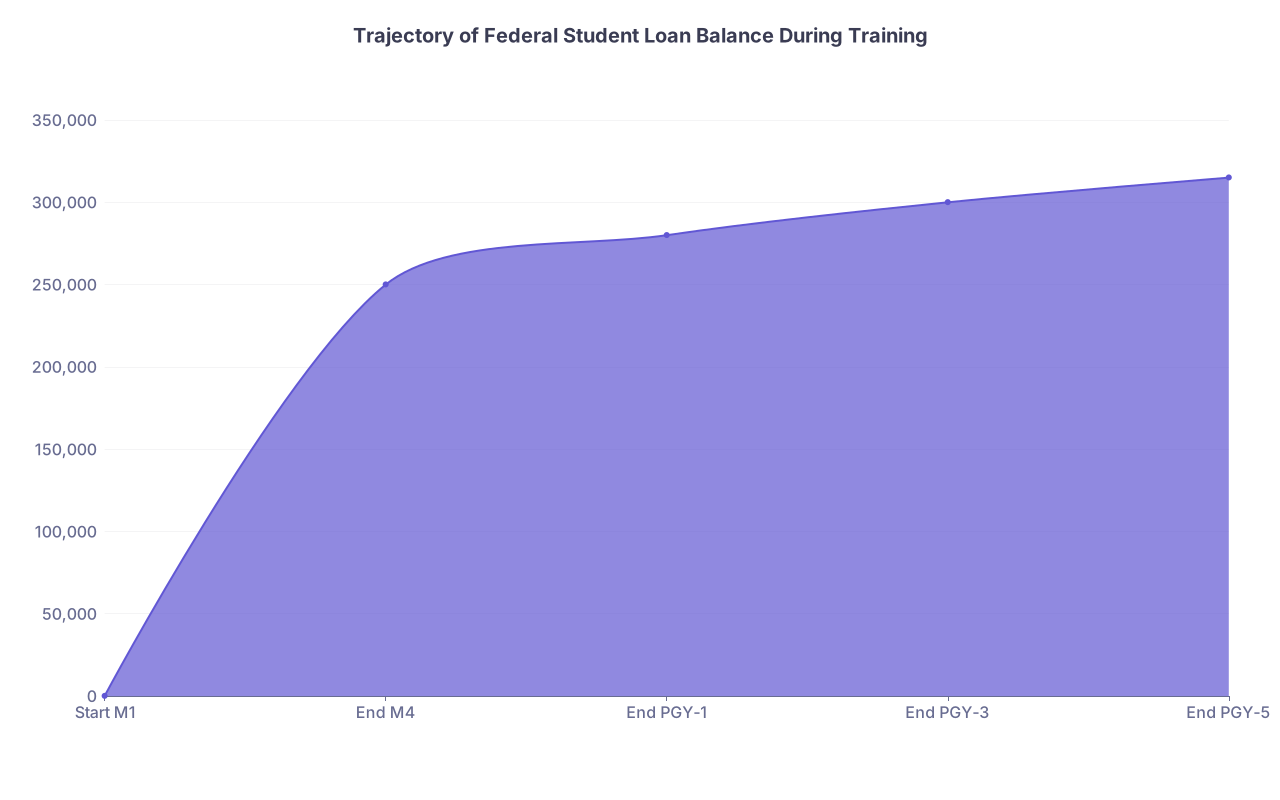
| Category | Value |
|---|---|
| Start M1 | 0 |
| End M4 | 250000 |
| End PGY-1 | 280000 |
| End PGY-3 | 300000 |
| End PGY-5 | 315000 |
Watch that growth. That is what happens when you borrow aggressively for lifestyle and ignore the math.
Avoid this mistake:
Before you even apply, run a worst‑case projection:
- Total projected debt at graduation (include undergrad + post‑bacc/SMP + med).
- Interest accumulation through residency.
- Monthly payments under:
- Standard 10‑year repayment.
- An income‑driven plan at resident income.
- How many years of IDR/PSLF you would likely need if you go that route.
Then ask yourself: are you comfortable with that timeline and those numbers if you end up in a mid-paying specialty, not derm or ortho?
If the answer is no, you need to adjust now: cheaper school, lower living expenses, more realistic service‑based programs, or reconsidering timing.
9. Not Planning for “Hidden” Medical School Costs
The COA sheets do not fully prepare you for the nickel‑and‑diming of professional training. Career changers get blindsided by:
- Board prep subscriptions and QBanks (hundreds to thousands).
- Exam registration fees (USMLE/COMLEX, OSCEs).
- Away rotation travel and housing.
- Residency application and interview expenses.
- Technology upgrades when the old laptop dies at the worst possible moment.
These do not care that you are broke. They are required.
If you have no buffer, you borrow more last-minute, usually at the least favorable terms and the highest stress point of your life.
Avoid this mistake:
Build a pre‑matriculation emergency + “extras” fund, even if small:
- Aim for at least $3–5k in cash by the time you start M1.
- Label it mentally: “Boards / Emergencies / Rotations.” Do not touch it for DoorDash.
- During pre‑med years, anytime you get a bonus, tax refund, or side‑gig money, divert a chunk into this fund.
You will thank yourself in M3 when your car dies the same month you owe for your Step exam.
FAQs
1. I am late 20s with significant savings. Is it a mistake to use too much of my savings instead of loans?
The mistake is not using savings; it is using them blindly. You want a balance. If you drain every cent of your savings to minimize loans, you leave yourself no buffer for emergencies, board fees, or life events. Then you end up taking out high‑interest personal or credit card debt when something goes wrong.
General rule I see work well: keep a core emergency fund (3–6 months of very lean expenses) intact, especially if you have dependents. Use money above that to reduce how much you borrow each year. But do this with a clear multi-year view, not year‑to‑year improvisation.
2. Is it always a mistake to go to a more expensive private school over a cheaper state school?
Not always, but you should treat large cost differences as guilty until proven innocent. Paying, say, $120k more over four years might be rational if:
- The more expensive school has significantly better match outcomes in the specialty you reasonably expect to pursue, and
- You have a strong reason to live in that region (support system, partner job, childcare support) that will prevent other costly problems, and
- You have explored all scholarship, service, or loan repayment options connected to that institution.
But most of the time, people choose the pricier school for prestige, vibe, or city preference without running the 10–15 year numbers. That is what they regret later.
3. I already have high-interest debt and am one year from starting. Is it a mistake to delay school to pay it down?
It depends on the amount and your realistic ability to reduce it. Delaying one year can be smart if you can:
- Wipe out a large chunk of bad debt (credit cards, personal loans, car)
- Build a modest emergency fund
- Avoid adding new debt that same year
But delaying a year only to lower your debt by a tiny amount while losing a full physician year of earnings is usually not worth it. The key is scale: if a focused year could remove, say, $20–30k of 20% APR debt, that is almost always a good trade.
4. Is working during a post‑bacc or SMP a financial mistake if it slows me down?
Not necessarily. The mistake is pretending you can give 100% to everything. If working 20 hours/week at decent pay allows you to avoid new high-interest debt and you still maintain excellent grades in your post‑bacc/SMP, that may be a very smart move.
But if work causes your GPA to be mediocre in the very program that is supposed to fix your academic record, then you just bought yourself more rejection cycles and more years of lost earnings. Your priority there is GPA first, debt second. You cannot “finance” your way around a weak academic record.
5. How early should I start planning financially if I am considering a career change to medicine?
Earlier than you think. Three to five years out is ideal. That sounds excessive until you realize you may need:
- Time to clean up credit and kill bad debt
- A year to establish residency in a cheaper state
- Space to complete pre‑requisites without high-interest private loans
If you are already inside that window, start now. Tonight. Open a spreadsheet and list:
- Current debts (amounts, interest rates, monthly payments)
- Current recurring expenses
- Estimated pre‑med and med school costs
Then highlight every line item that can be lowered, paid off, or eliminated within the next 12–24 months. Those changes are your first real step toward not hating your financial life as an M4.
Open your banking app and your credit report today. Not next week. Look at your recurring expenses and your debt list side by side, and pick one concrete financial change – cancel a subscription, increase a card payment by $100, move a payoff date earlier. Small, immediate, and real. That is how you start avoiding the financial mistakes most career changers only recognize when it is far too late.