The most common application mistake nontraditional premeds make is not their GPA, not their MCAT, not their story. It is applying to far too few schools with far too narrow criteria.
If you are a career changer heading toward medicine, under-applying can quietly kill your chances more effectively than a 505 MCAT.
I have watched strong nontraditional applicants spend years fixing prerequisites, retaking coursework, crafting beautiful personal statements—then apply to 8 schools “because I do not want to move,” or “these are all places that value nontrads,” or “I only want MD.” Then act surprised when they get shut out.
Let me be clear: the application volume standards you see in Reddit success posts and from 21-year-old traditional applicants do not apply to you. If you copy them, you will regret it.
The Silent Killer: Narrow Application Volume
Career changers systematically underestimate how many schools they need to apply to. They think: “I am older, I am focused, my story is strong, so I should be more competitive.”
Reality is harsher. You are competing in the same pool as everyone else, but with:
- Region restrictions (family, mortgage, kids, spouse’s job)
- Nontraditional academic histories
- Sometimes lower recent MCAT experience
- Often fewer “classic” premed activities
And yet, I routinely see something like this:
- 35-year-old applicant
- 3.45 cGPA, 3.6 sGPA, 512 MCAT
- Great upward trend, strong clinical exposure, no research
- Applies to 10 MD schools. All “nontrad-friendly” they found on a blog.
- No DO applications. No reach on geography. Refuses to consider moving away from one major metro area.
Result: 0 interviews. One polite “reapply” email that just says what they could have done better—apply broadly and early.
Here is what usually goes wrong in the thinking.
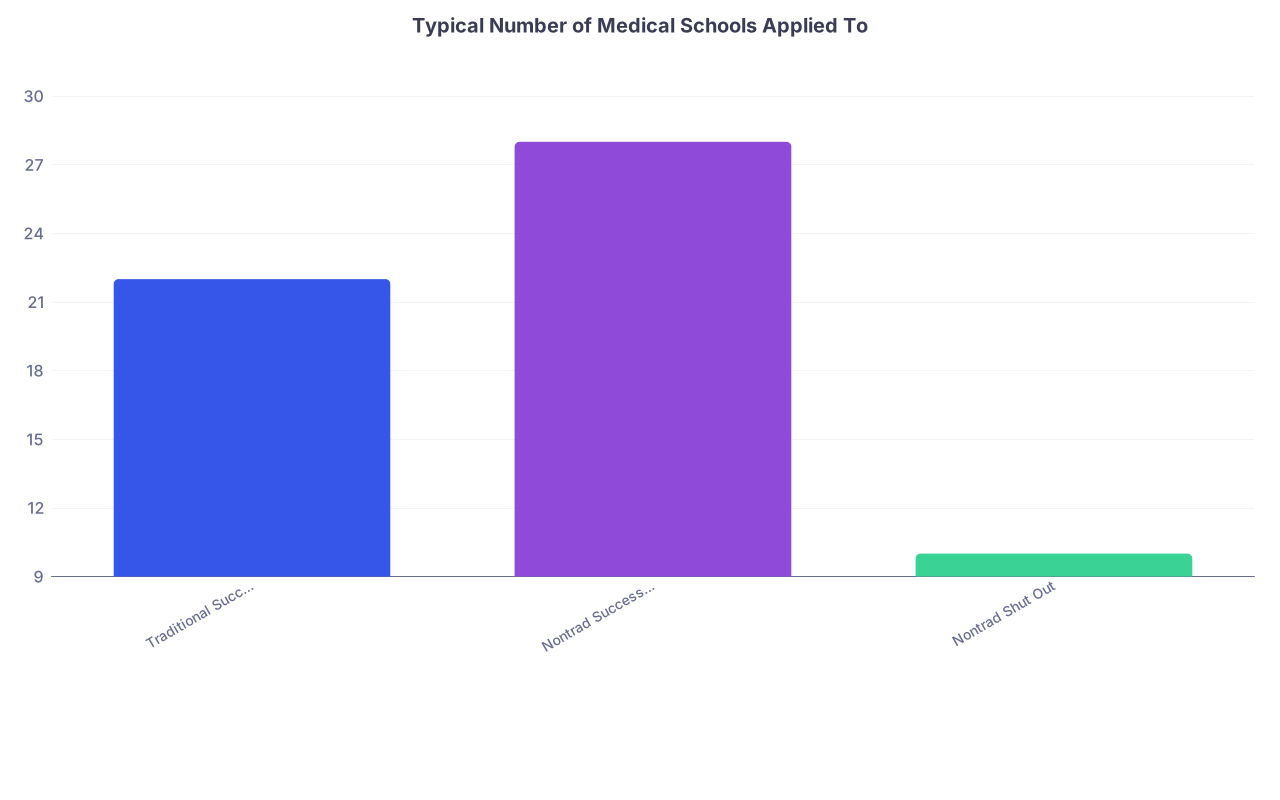
| Category | Value |
|---|---|
| Traditional Successful | 22 |
| Nontrad Successful | 28 |
| Nontrad Shut Out | 10 |
The numbers are not fictional. Talk to any advisor who works with nontraditional students. The “shut out” group almost always has tiny school lists.
Mistake #1: Confusing “Targeted” With “Too Small”
Nontraditional applicants love the word “targeted.” It sounds strategic. Mature. Efficient.
Used incorrectly, it is just code for “I do not want to apply broadly because it feels uncomfortable or expensive.”
You say: “I am doing a targeted application to 8 schools that really fit me.”
What I hear: “I am gambling an entire year on 8 admissions committees understanding and valuing my story exactly the way I hope they will.”
That is not targeted. That is reckless.
Targeted should mean: well-researched list spread across tiers and regions, inclusive of MD and DO (unless you have a specific, rational reason not to), with enough volume to handle statistical variance and institutional bias.
Too small usually means:
- All schools in one region or state
- All MD, no DO despite borderline stats
- Overweighting “top 30” prestige that does not match your metrics
- Overweighting “mission fit” buzzwords from school websites that every applicant reads
- Avoiding schools that are actually more in your range because you “never heard of them growing up”
Strategy is not about cutting your list to 10. Strategy is about picking the right 25–35.
Mistake #2: Building a Fantasy List Instead of a Realistic One
Many career changers build a school list that matches who they want to be, not who they are on paper right now.
Common version:
- “I am passionate about academic medicine” → adds multiple research-heavy, T20 schools
- “I care about underserved populations” → adds every mission-focused school with low acceptance rates
- “I have strong life experience” → assumes that compensates for stats that are just okay
What gets left off?
- Solid mid-tier MD programs with more modest research requirements
- DO programs that would actually appreciate your clinical background and life history
- Newer schools with less name recognition but reasonable outcomes
You are not applying to an identity. You are applying with numbers plus story. Both count. A lot.
| List Type | MD Reach | MD Target | MD Safety* | DO Programs |
|---|---|---|---|---|
| Fantasy (10) | 6 | 3 | 1 | 0 |
| Realistic (28) | 4 | 10 | 4 | 10 |
*There are no true “safeties” in med admissions, but some are statistically less risky than others.
The mistake is not having reaches. The mistake is having only reaches and “vibes.”
Mistake #3: Overvaluing Location and Lifestyle (Too Early)
Nontraditional applicants often have legitimate constraints: kids in school, partner with a career, aging parents, a mortgage. I am not dismissing any of that.
The mistake is treating preference like constraint.
I have seen this exact line more times than I can count:
“I will only apply to schools within a 2–3 hour drive of [city], because my spouse works there and my parents are close by.”
Then I check. That radius contains:
- 2 very competitive in-state schools
- 1 private school with heavy research focus
- 0 DO schools
They apply to all 3. Maybe one more “dream” school further away. Then cross their fingers.
This is you saying: “I prefer no acceptance to moving.” Which is fine, if you say it to yourself honestly. Most people are not that honest. They are shocked when the outcome is no acceptance, then a year older, more burned out, and suddenly willing to move—but now behind another cycle.
Here is the pattern I see:

| Step | Description |
|---|---|
| Step 1 | Decide to apply, strong location limit |
| Step 2 | Apply narrowly, few schools |
| Step 3 | No acceptances |
| Step 4 | Re-evaluate constraints |
| Step 5 | Broaden geography and school types |
| Step 6 | Next cycle: more interviews |
You will save yourself a year if you do step E now, not after getting burned.
Reasonable geographic prioritization: absolutely. Hard line “this one city or I do not go”: understand that you are accepting a very high probability of reapplication or permanent derailment.
Mistake #4: Refusing to Consider DO or Caribbean for Emotional, Not Rational, Reasons
I am not here to sell you DO vs MD. But I have to call out the emotional pitfalls.
Many mid-career applicants:
- Come from other professional tracks (law, engineering, business)
- Are used to prestige hierarchies
- Have spouses, friends, or mentors who only know MD
- Have read just enough about Caribbean schools to be scared—and then lump DO into the same mental bucket
Result: “MD or bust” mentality, even with stats that are very clearly borderline for most MD schools.
Typical example:
- 38-year-old EMT transitioning to medicine
- 3.3 cGPA, 3.4 sGPA after post-bacc; 505 MCAT
- Great clinical, excellent narrative
- Refuses DO because “I want to be a surgeon and I heard DOs have trouble matching competitive specialties”
- Refuses Caribbean because of horror stories (many of which are valid)
- Applies to 12 MD schools, mostly in one region
This is a person who almost certainly could attend medical school and become a physician. But their volume and type are misaligned with reality.
What you must avoid:
- Discarding DO categorically without actually understanding match data and your true competitiveness
- Jumping to Caribbean as a first-line option when you have not exhausted a strong, broad MD+DO cycle in the U.S.
- Letting pride dictate your school list more than outcome probabilities
For many nontrad applicants, a balanced, broad mix of MD and DO is the safest route. Not glamorous. But safe.
Mistake #5: Ignoring How Much Randomness Is Involved
You can do everything “right” and still get burned by randomness: reviewer preferences, institutional needs, hidden cutoffs, timing quirks.
Traditional applicants compensate with volume. Nontrad applicants too often do not.
Think about it statistically. If each school, on average, gives you:
- 5–10% interview chance at match-level places
- Maybe 15–20% at your “best-fitting” targets
- Much lower at reaches
You blunt the randomness by applying to 25–35 schools, not 8–12.
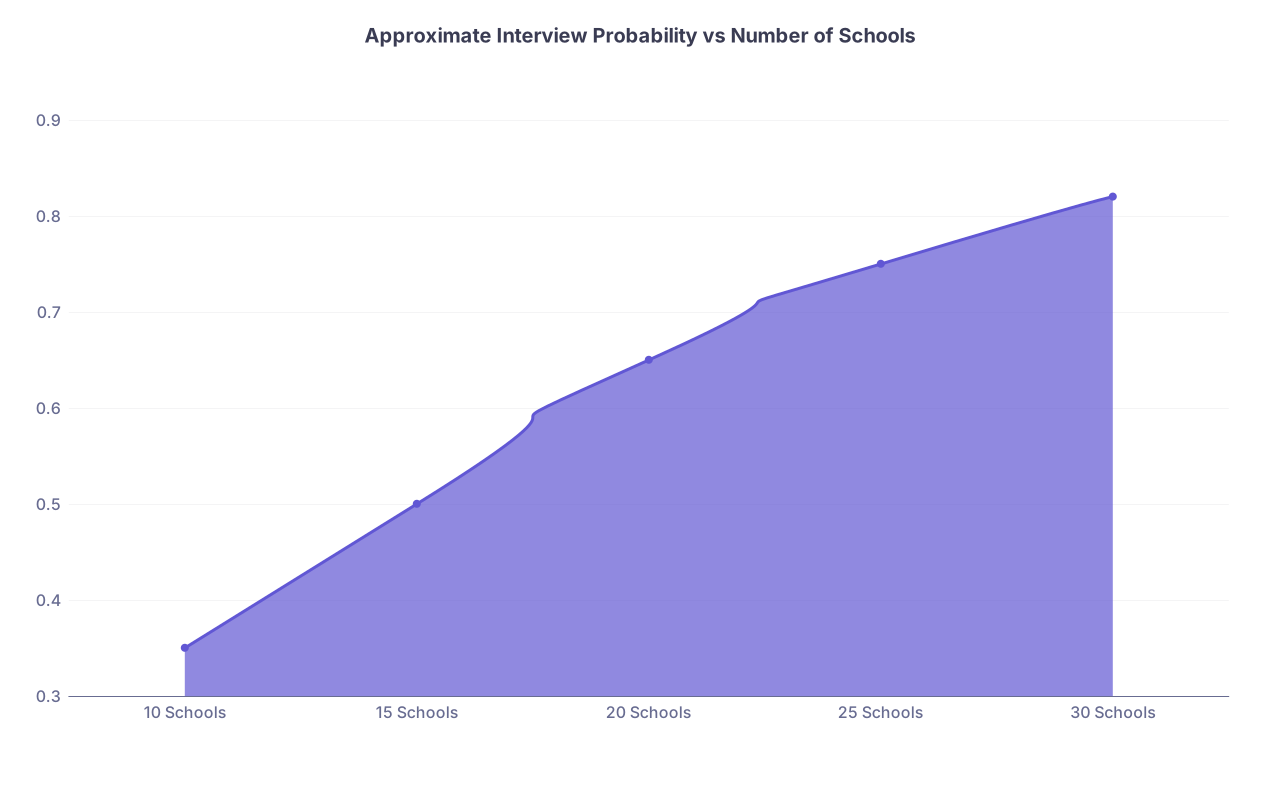
| Category | Value |
|---|---|
| 10 Schools | 0.35 |
| 15 Schools | 0.5 |
| 20 Schools | 0.65 |
| 25 Schools | 0.75 |
| 30 Schools | 0.82 |
(The exact numbers are illustrative, but the curve is real: more schools → better odds that at least one adcom “gets” you.)
I have seen multiple nontrad applicants with 510+ MCAT and 3.6+ GPAs get 0 interviews from 10–12 schools, then 5+ interviews the next year with 28–30 schools and no major change to their stats.
Same applicant. Same story. Just more doors knocked on.
Mistake #6: Letting Cost Fear Shrink Your List Too Much
Application costs are ugly, especially for career changers already retraining mid-life. But under-applying is not saving. It is deferred failure.
Let me be blunt: if you can afford to do a full post-bacc, MCAT prep, and take time off work to add clinical hours, you cannot then claim that going from 10 to 25 schools is “too expensive” as your primary reason. It is emotionally convenient, not financially rational.
Typical rough numbers (AMCAS/primary + secondaries, no travel):
- 10 schools: ~ $1,700–2,000
- 25 schools: ~ $3,500–4,500
That extra $2,000–2,500 is not trivial. But compare it with:
- Another gap year of lost physician income down the road
- Lost current income if you reapply and delay training
- Emotional cost of waiting and uncertainty
The real financial mistake is:
- Spending thousands on MCAT courses, post-bacc classes, and tutors
- Then trying to “save” $1,500 by cutting your school list in half
If cost is truly constraining:
- Maximize fee assistance programs (AAMC FAP, AACOMAS fee waivers)
- Drop vanity “dream” schools that are unrealistic based on stats
- Avoid heavy travel by prioritizing schools more likely to interview you virtually
- Trim waste, not core volume
But do not pretend that applying to 10 schools “to save money” is a smart play when you are mid-career and have already invested heavily.
Mistake #7: Overconfidence in “Nontraditional Appeal”
Here is the ego trap: your life story really is impressive, but adcoms see impressive all day.
You:
- Ran a successful small business for 8 years
- Managed a nonprofit
- Served in the military
- Raised kids while working full-time and taking classes
That is admirable. It will help. But it does not magically turn 3.2/505 into 3.8/520.
Many career changers tell themselves: “I bring something unique, so the right schools will see that and take a chance.”
Maybe. But the right schools need to actually see your application. Multiple of them. Not the four you decided “get” nontraditional students because you read one line on their website.
Schools do not admit “types”; they admit individual humans after filtering through hundreds—or thousands—of similar “nontraditional” narratives.
So do not commit the arrogance error:
- “I only need to apply to 8–10 because my story is strong.”
- “Once they see my personal statement, they will overlook my stats.”
- “I am older and more mature; that will set me apart.”
Reality check: every cycle has a pilot, a veteran, a teacher, an engineer, a mom of three, a PhD, a startup founder. You are not the only one with a compelling path. You are competing within that group too.
Volume protects you from the randomness of who reads your file, what they value, and how many similar applicants they have already tentatively flagged.
How to Avoid These Application Volume Traps (Without Losing Your Mind)
Let me lay out a sane, protective approach. Not perfect, but much safer than what most career changers do.
Step 1: Get a Cold, Brutal Read on Your Competitiveness
Not from your mom. Not from your coworker who is a dentist. From someone who actually knows admissions patterns:
- Pre-health advisor familiar with nontraditional students
- A physician who has sat on an admissions committee
- A reputable advising service with real data, not just vibes
You want:
- Realistic MD/DO probabilities for your stats
- Honest feedback on whether your story compensates slightly, moderately, or not at all
- An idea of how many schools someone like you usually needs
Step 2: Build a Tiered List With Volume in Mind First, Preference Second
Do this roughly:
- 4–5 reach schools (MD)
- 10–14 target MD schools where your stats are at or near the median
- 8–12 DO schools where you are a strong candidate
- Add or subtract a bit based on your exact profile, but stay near 25–35 total
Then, and only then, start tightening by:
- Removing true outliers (crazy research focus you do not have, heavy mission misalignment)
- Prioritizing regions where you actually have ties
- Considering where your age/family situation would be more supported
Do not start by saying “I want to live in Boston or San Diego” and then hunting for schools to justify that dream.
Step 3: Decide What You Are Actually Willing to Trade
Write this down somewhere private:
- “I am / am not willing to move cross-country for medical school.”
- “I am / am not willing to attend a DO program.”
- “I am / am not willing to reapply if I do not get in this year.”
If you write “not willing” for move + DO + reapply, you are essentially saying: “I am willing to never become a physician.” That is a valid life choice. But do not pretend it is the system’s fault if your ultra-narrow list fails.
If your real answer is, “I would rather move than reapply,” then your list must reflect that now, not next year after a shutout.
Step 4: Budget for a Broad Cycle Like It Is Part of Your Training Cost
Add application fees into your overall “cost of becoming a doctor” calculation from the start, same as:
- MCAT registration
- Prep materials
- Post-bacc tuition
- Lost wages
Treat “apply to enough schools” as non-negotiable, and cut costs elsewhere if needed (fewer expensive MCAT add-ons, less travel during the application year, etc.).
, Application Fees, Lost Wages During Preparation](https://cdn.residencyadvisor.com/images/articles_svg/chart-components-of-a-nontraditional-applicant-s-financi-8198.svg "Components of a Nontraditional Applicant's Financial Investment")
| Category | Value |
|---|---|
| Post-bacc/Prereqs | 45 |
| [MCAT Prep & Exam](https://residencyadvisor.com/resources/nontraditional-path-medicine/mcat-prep-errors-common-among-professionals-returning-to-science) | 15 |
| Application Fees | 15 |
| Lost Wages During Preparation | 25 |
You are already going all-in. Do not cheap out at the one stage where volume directly buys you probability.
FAQ (Read This Before You Finalize Your School List)
1. I am 35 with a family. How many schools should I realistically apply to?
If you are competitive for MD (say ≥3.5 GPA and ≥510 MCAT), a protective range is usually 25–35 schools combined MD and DO. If you are realistically only competitive for DO or lower-tier MD, you still want 20–30 schools, heavily weighted toward DO. Less than 15 total is usually asking for trouble unless you are truly stellar and geographically flexible.
2. I really cannot move far because of shared custody / medical issues in the family. Am I doomed?
You are constrained, not doomed. But you must be brutally honest: if your geographic radius only includes 3–5 realistic schools, your odds drop dramatically. Focus on becoming an absolute top-tier applicant for those few schools (fix GPA, crush MCAT, heavy clinical), and consider adjacent paths (PA, NP, local DO if possible). Do not pretend a narrow list has the same probability as a broad one.
3. Is it better to do two “targeted” cycles of 10 schools each or one broad cycle of 25–30?
One broad, well-prepared cycle almost always beats two underpowered ones. Every cycle costs money, time, emotional energy, and another year of lost physician income. Front-load your effort and your volume into a single strong attempt rather than “testing the waters” with too few schools.
4. What is one quick way to tell if my current list is too narrow?
Run a simple check tonight: count your schools. If you have fewer than 20 total and you are not sitting on clearly top-tier stats (3.8+/518+ with strong everything), your list is probably too small for a nontraditional applicant. Open your spreadsheet and ask yourself, for each line: “Am I cutting this school for a hard constraint or just because it feels uncomfortable?” Then start adding back until you hit a protective volume.
Open your school list spreadsheet right now and write the total number at the top. If it is under 20, do not close the file. Add three realistic schools this evening—ones you would actually attend—that expand your odds instead of shrinking your future.