
The way age and prior careers influence scholarship decisions is not what the brochures tell you—it's messier, more political, and often brutally pragmatic.
I’ve sat in those scholarship committee rooms. I’ve listened to faculty say out loud what you probably suspect: “She’s 37, how long is she going to practice?” and “He was an engineer at Google, he does not need our need-based money.” You will not hear this in info sessions. You will absolutely hear it when the door closes and the spreadsheet is open.
Let me walk you through how this actually works for nontraditional applicants—especially in the premed and “about to start” phase—so you stop guessing and start playing the game strategically.
The myth of the “age-blind” scholarship committee
On paper, age is “not a factor.” In reality, it’s a background variable that quietly colors almost every evaluation.
Here’s the mental math programs are doing, whether they admit it or not: scholarships are an investment. They’re deciding where to put limited money to get the most “return”—in prestige, retention, outcomes, and future donations.
So age triggers three hidden questions in people’s heads:
- How long will this person practice and carry our name?
- How likely are they to finish without burning out or stepping away?
- Will they ever donate back or boost our metrics in a visible way?
They’ll never write that in criteria. But I’ve seen it play out in a dozen different schools, from mid-tier state schools to “brand name” private programs.
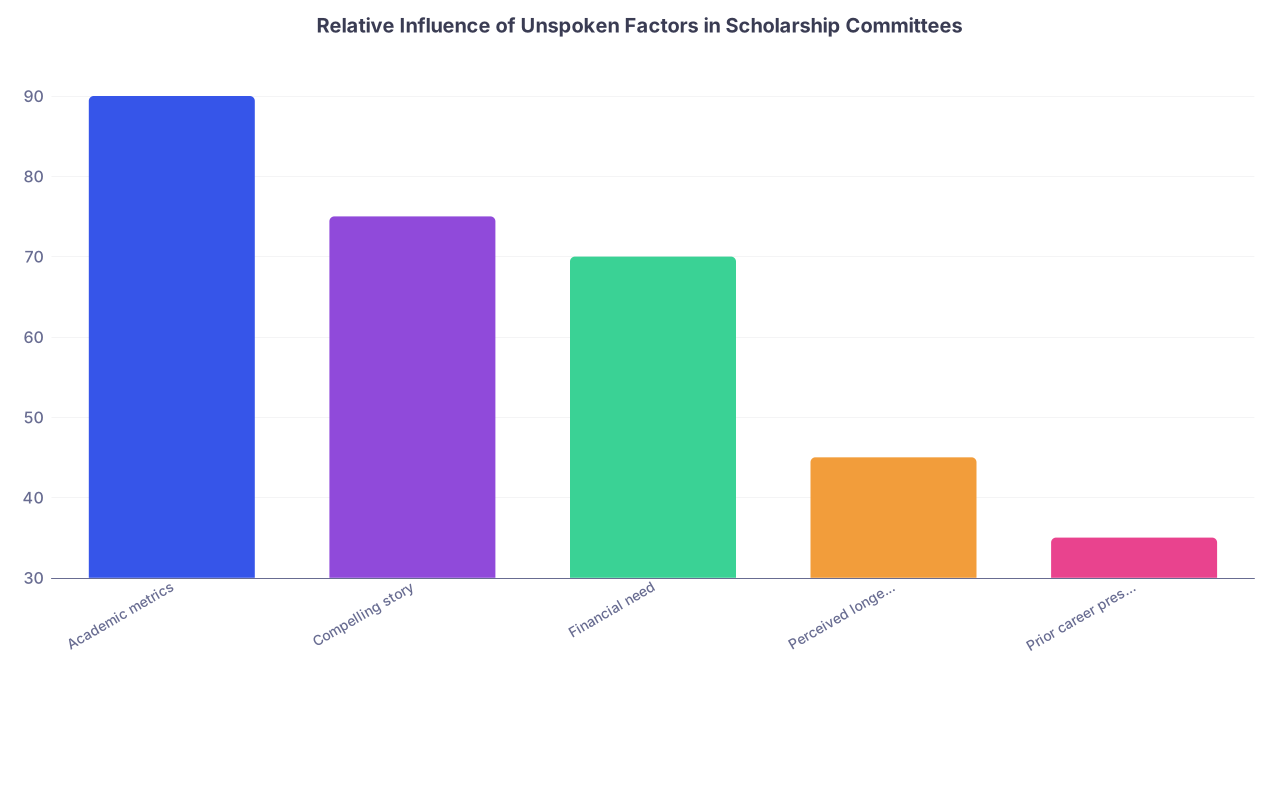
| Category | Value |
|---|---|
| Academic metrics | 90 |
| Compelling story | 75 |
| Financial need | 70 |
| Perceived longevity | 45 |
| Prior career prestige | 35 |
Notice what’s buried in there: “perceived longevity” and “prior career prestige.” That’s exactly where age and background come in. Not as formal boxes, but as quiet tie-breakers and justification tools.
How age really plays out: under 25 vs late 20s vs 30s+
Different thresholds trigger different conversations in committee rooms. Nobody announces these categories, but patterns repeat.
Under 25: the “default” bucket
If you’re 21–24, you’re not “nontraditional” to them. You’re standard inventory. The committee brain goes:
- Probably four straight years of college.
- No major career before this.
- Long runway ahead.
For scholarships, you win or lose mostly on:
- GPA and MCAT
- Undergrad prestige
- Research and leadership
- Diversity / background factors
- Financial need
Age basically disappears. That’s the baseline against which everyone else is compared.
Late 20s (25–29): the “we can work with this” group
This is where the quiet commentary starts.
Typical thinking:
- “She’s 27, still plenty of career time.”
- “He did a few years in the workforce; that maturity is a plus.”
- “We like that she’s seen real life. Patients will like her.”
This age band can be an advantage—if your narrative is tight. Committees often see you as:
- Less likely to flake out because you know what you’re getting into.
- More grounded and professional.
- Good for class dynamics and group work.
But you also trigger one particular skepticism: “Why now?” If that question is not clearly answered in your application, it quietly hurts your odds for the competitive merit awards. Nobody wants to spend scarce money on someone they think might still be sorting themselves out.
30s and up: admiration… and risk analysis
This is where it shifts. I’ve watched it happen repeatedly.
Publicly: “We love our nontraditional students. They bring richness to the class.”
Privately: “She’s 39. We’re not going to put a half-tuition scholarship on her. By the time she’s done with residency, she’ll be, what, mid-40s?”
You don’t have to like that logic. But you need to understand it.
Here’s what committees are actually weighing with 30+ applicants:
Years of practice left
They’re thinking: full training + settling into attending life = shorter window to “represent” the school. It’s crude, but it happens.Burnout / life load risk
If you’re 34 with three kids and aging parents, someone will say, “Can she really handle this?” A guy on one committee literally said, “I respect this, but I don’t want to be paying for someone who might step out to prioritize family.”Debt vs realistic earning horizon
They sometimes quietly judge whether you’re “making a rational decision” given your age and projected debt. Again, not kind. But real.
Now here’s the nuance: age itself doesn’t kill your scholarship chances; murky narrative and poor framing do. I’ve seen early-40s applicants win serious merit money because their story screamed: “I am disciplined, focused, and already performing at a high level in a demanding field.”
Your job is to flatten their anxiety about your timeline and amplify their sense that you’ll be a high-yield bet even with fewer decades left.
The quiet assumptions about prior careers
Your previous career isn’t neutral. It’s a lens they see you through. And some careers buy you credibility, while others unfairly make them skeptical.
I’ve heard all of these, word-for-word, in real committee rooms:
- About a former nurse: “She’s basically been doing half the job already. Patients will love her. She’ll hit the ground running.”
- About a former teacher: “We need more people like this—great for patient education and maybe med ed.”
- About a former software engineer at a big tech firm: “He’s not getting need-based money. He has savings. And if not, that’s a personal choice issue.”
- About an ex-military officer: “Leadership, discipline, service. This is exactly the profile donors like.”
No one will tell you this at an info session, but certain prior careers are “scholarship-attractive” because they fit donor narratives and institutional branding.
Highly favored profiles include:
- Military (officer or enlisted with leadership roles)
- Nursing, PA, RT, paramedic – especially with strong clinical exposure
- Teaching, especially underserved or special education
- Public health with real on-the-ground work
- Social work, community organizing, advocacy
More neutral / tricky profiles:
- Corporate business roles (especially with high incomes)
- High-earning tech roles
- Finance, consulting, law
Why tricky? Because another thought creeps in: “Do they really need our money?” And yes, that affects “need-based” decisions, even when they swear it doesn’t.
I’ve watched someone with a modest 3.5 GPA and strong community health worker background pull a full-tuition scholarship at a mid-tier private school. Meanwhile, a former FAANG engineer with a 3.9/520 got interview praise, an acceptance—and zero institutional aid, despite a rough family and debt story. The prior salary number stuck in everyone’s head, even though that job was long gone.
Need-based scholarships: where your past “wealth” haunts you
Here’s another secret you won’t see written cleanly: “need-based” is rarely pure.
Yes, schools use FAFSA, CSS, parental info, tax data. But when the committee faces a finite pool of aid, they make judgment calls. And for nontraditional students, those judgment calls often revolve around:
- Past income level
- Whether you “could have” saved more
- Spouse’s earning potential
- “Lifestyle choices” (their phrase, not mine)
If they see:
- Several years at $150–250k in tech, consulting, or finance
- A spouse currently earning a strong salary
- Assets that look “comfortable” on paper
They will mentally move you down the priority list for institutional need-based money, regardless of your future debt projections. I’ve seen committee members say, “This person has options,” while giving more aid to a 23-year-old whose parents make less but have zero savings.
Does that always make sense? No. Does it happen? Constantly.
To be very clear: federal aid doesn’t care about these narratives. But institutional grants and “named” scholarships do.
Your job, if you’re coming from a higher-earning field, is to:
- Clearly explain why your past income does not translate into security now (supporting others, lost time due to illness, divorce, immigration, medical bills, etc.).
- Avoid sounding entitled to aid because you’re “walking away from money.”
- Emphasize vulnerability without melodrama: show that you’ve planned carefully but still face substantial, genuine need.
Merit scholarships: where prior career can be your weapon
Merit money is where nontraditional applicants can absolutely dominate—if you know what committees are looking for.
Here’s the hidden math: merit scholarships are marketing tools. Schools use them to:
- Boost their stats (MCAT/GPA)
- Attract “interesting” students who make the class look strong
- Impress donors with compelling “stories”
- Predict strong residency match outcomes
Your prior career is ammunition if it proves:
- You already operate at a high level in a demanding environment
- You’ve demonstrated resilience and long-term commitment
- You fit a narrative the school loves (service, innovation, leadership, diversity)
If you’re mid-30s with a background as a decorated ICU nurse, a military medic with combat deployments, or a Teach for America alum who built a school program from scratch, you’re not just “nontraditional.” You’re valuable brand material.
I watched one school allocate a half-tuition scholarship to a 33-year-old former paramedic with an okay-but-not-stellar MCAT, partly because they wanted more strong rural-focused clinicians, and his story was fundraising gold. Another applicant, 24, 522 MCAT, clean cookie-cutter research record, got less money. Privately, a committee member said: “He’ll be fine. She makes our brochure write itself.”
Your essays and interviews need to do one thing: make it easy for them to use your story in a fundraising email or “Student Spotlight” page. If they can picture you on that page, your merit odds go up.
The age-career combo that quietly scares committees
There’s one profile that reliably makes committees nervous when it comes to scholarship dollars:
- Mid-to-late 30s
- Very high-earning prior career (tech, law, finance, specialty expertise)
- Large visible lifestyle jump downward
The concern isn’t that you’re not sincere. It’s that you might regret the decision and bail—or finish, but burn out quickly and leave clinical work.
I sat in one meeting where a 38-year-old ex–big firm lawyer with a compelling personal health story was on the table for a big merit award. Then someone said: “He has three kids, a partner still in law, and has never made less than $250k. Med school will be a shock. Is he really going to grind through residency?” The room cooled. He got in. He did not get the merit scholarship.
If that’s you, you have to hit three messages hard:
- You understand the numbers and the sacrifice cold. No illusions.
- You’ve already taken concrete steps that prove you’re not just “trying this out” (years of clinical volunteering, shadowing, downshifting work, etc.).
- You’re not framing medicine as an escape from your prior career, but as a logical next step in a long trajectory of service or problem-solving.
Committees are more willing to spend money on you if they believe you’re past the “romantic” phase and already deep into the “hands dirty, eyes open” phase.
What you can actually do about all this (pre-med and preparation phase)
You can’t change your age or rewrite your background. But you can absolutely control how they land on the other side of the table.
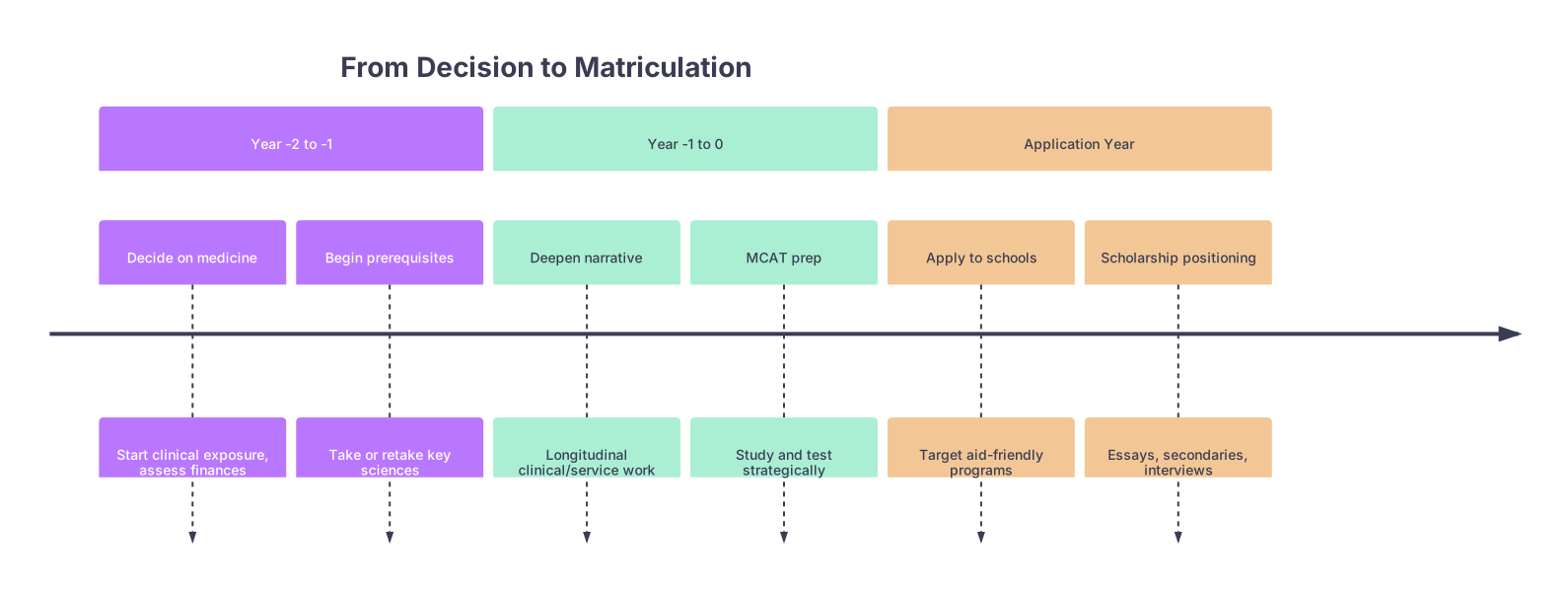
| Period | Event |
|---|---|
| Year -2 to -1 - Decide on medicine | Start clinical exposure, assess finances |
| Year -2 to -1 - Begin prerequisites | Take or retake key sciences |
| Year -1 to 0 - Deepen narrative | Longitudinal clinical/service work |
| Year -1 to 0 - MCAT prep | Study and test strategically |
| Application Year - Apply to schools | Target aid-friendly programs |
| Application Year - Scholarship positioning | Essays, secondaries, interviews |
Shore up the parts committees doubt
If you’re older:
- Demonstrate stamina: multi-year commitments, long hours, sticking with hard things.
- Show real clinical exposure: not just a three-month volunteer stint. Years are better.
- Mention practical family planning: brief, factual clarity about support systems, childcare, partner buy-in—so they stop imagining chaos.
If you’re coming from a high-earning career:
- Briefly acknowledge the financial trade-off, then move on. Don’t center your “sacrifice.”
- Explain concretely where your money went if you appear to have “nothing to show” on paper (supporting family overseas, paying off prior degrees, major life events).
- Keep language humble. Committees react badly to “I’ve been successful in [X], now I want to conquer medicine” energy.
Build the kind of story donors pay for
Like it or not, big scholarships often attach to donor money with implicit themes: underserved care, primary care, rural medicine, leadership, diversity, innovation, public health.
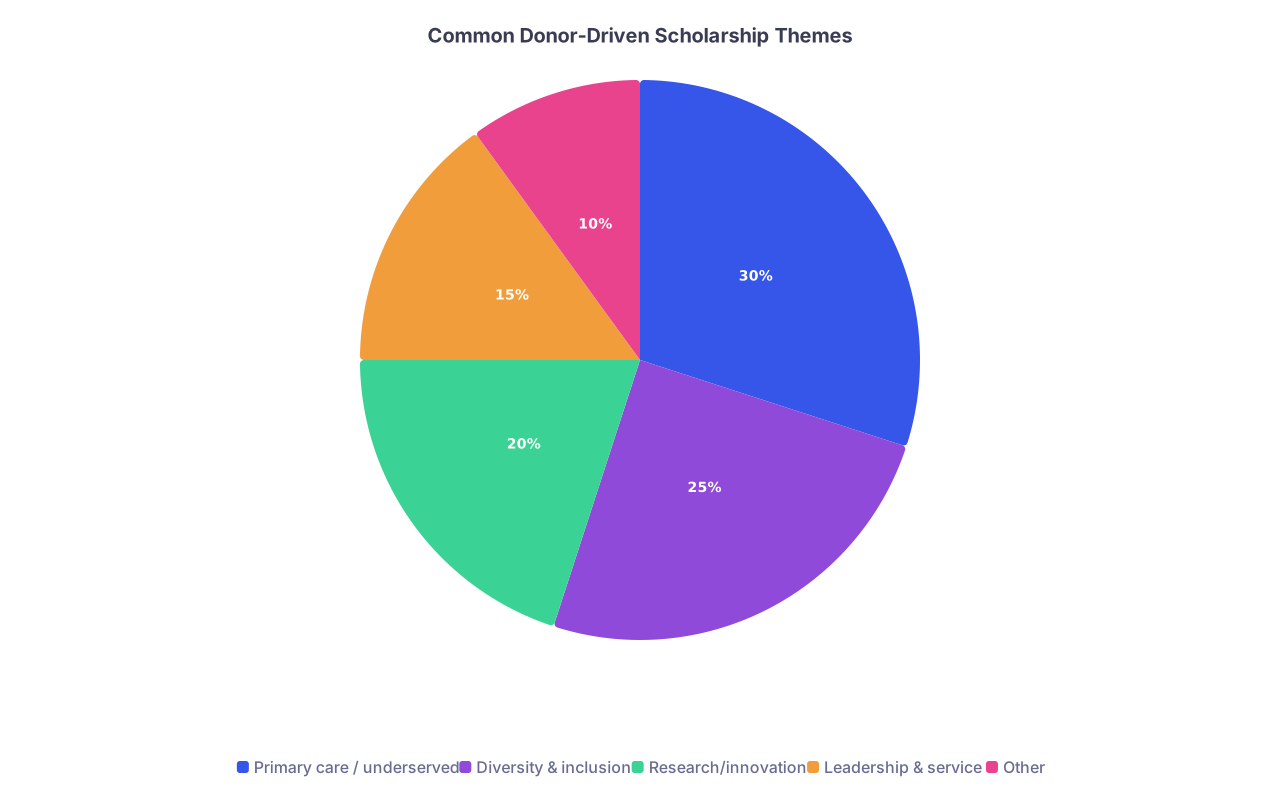
| Category | Value |
|---|---|
| Primary care / underserved | 30 |
| Diversity & inclusion | 25 |
| Research/innovation | 20 |
| Leadership & service | 15 |
| Other | 10 |
If your background and goals align with any of these, say it directly. Donors love:
- “First in family to go to college, returning to serve my community.”
- “Combat medic now committed to trauma surgery in underserved regions.”
- “Former teacher focused on patient education and health literacy.”
Don’t fake it—committees can smell that—but don’t bury it either. Spell it out.
Target schools where your profile is actually valued
I’ve watched nontraditional applicants kill themselves over “top 10” schools while ignoring places that aggressively support older or second-career students.
You want to look for:
- Schools with a visible number of older students in class photos and student spotlight pages.
- Programs that highlight military, career-changers, and parents in their marketing.
- State schools with strong missions around service and local workforce needs.
- Places with separate “nontraditional” or “career-changer” scholarships listed.
And you should be blunt on interview days. Ask students: “Do 30+ students here get decent financial aid, or do they tend to get squeezed?” The answers behind closed doors will be very different from the panel script.
The ugly truth about bias—and how to work around it
There’s ageism. There’s classism. There’s bias about what “real need” looks like.
You are not going to fix that by writing a perfect personal statement.
But here’s what you can do:
- Anticipate the unspoken objections and answer them before they come up.
- Choose schools that have a track record of backing people like you.
- Build a profile that, on paper, looks low-risk and high-yield for them.
- Never assume that because you’re older or have a prior career, you’re automatically doomed to pay full freight. I’ve seen people in their 30s walk away with full rides. It happens.
And if you’re still in the premed and early preparation phase, you have time. You can craft the story, bank the experiences, and get your financial house in order in a way that makes committees say: “Yes, they’re older, but they’re clearly one of our best bets.”
That’s how you win this game.
If you remember nothing else
Three points.
First: Age doesn’t disqualify you from scholarships, but it forces committees into a risk-benefit calculation. Your job is to crush every doubt about your staying power and clarity.
Second: Prior careers are not neutral. Service-heavy, people-facing roles often help; high-earning, corporate roles can quietly hurt unless you frame them intelligently and humbly.
Third: Most “need-based” decisions at the institutional level are not pure math. They’re judgment calls. Understand the biases, tell a clear, grounded story, and target schools and scholarships that actually value what you bring as a nontraditional applicant.