
The thing nobody tells you: your 15‑year‑old MCAT is not “interesting context.” It’s invisible. Or worse, it’s a red flag the moment you try to make it matter.
You want the blunt truth from inside those committee rooms? Let’s go there.
I’ve sat in rooms where faculty literally pushed old MCAT scores aside with two fingers and said, “Irrelevant. What’s recent?” I’ve also seen older scores weaponized when applicants tried to argue, “But I once scored a 36…” and a skeptical surgeon on the committee replied, “Yeah, 3 presidents ago.”
If you’re coming back to medicine after a decade or more, you’re playing a different game. The rules are not printed on AAMC’s website. But committee members talk. A lot. About applicants exactly like you.
Here’s what they really say—and how you actually win them over.
How Committees Actually Look at a 15‑Year Gap
Let me be very clear: almost no MD or DO school treats a 15‑year‑old MCAT as valid for admissions decisions. Their formal policies usually say something like “MCAT must be taken within 3–5 years of matriculation.” That’s the public part.
Behind closed doors, the conversation is sharper and less diplomatic.
I’ve heard variations of all of these:
- “This score is ancient. It might as well be from the old SAT era.”
- “I don’t even want to see pre-2015 MCATs when we’re looking at readiness.”
- “If they haven’t taken a recent MCAT, they’re not serious enough yet.”
Your old MCAT is, at best, a historical artifact. Committees might glance at it for curiosity—especially if it was strong—but they do not use it to make decisions in 2026.
They ask three core questions about you instead:
- Can this person still handle hard science at a high level, today?
- Will they be able to pass Step 1/Level 1 and the board exams on time?
- Are they disciplined enough now, with career and family responsibilities, to get through medical school?
Your 2009 or 2010 MCAT doesn’t answer those. Your recent academic work does.
So when you cling to that old number—509, 35, whatever—you’re signaling that you don’t understand how the game is played now. Committee members pick up on that instantly.
The Three Categories They Put Nontrads With Old MCATs Into
This will sting a bit. But you need to know what box you’re being dropped into when your file hits the table.
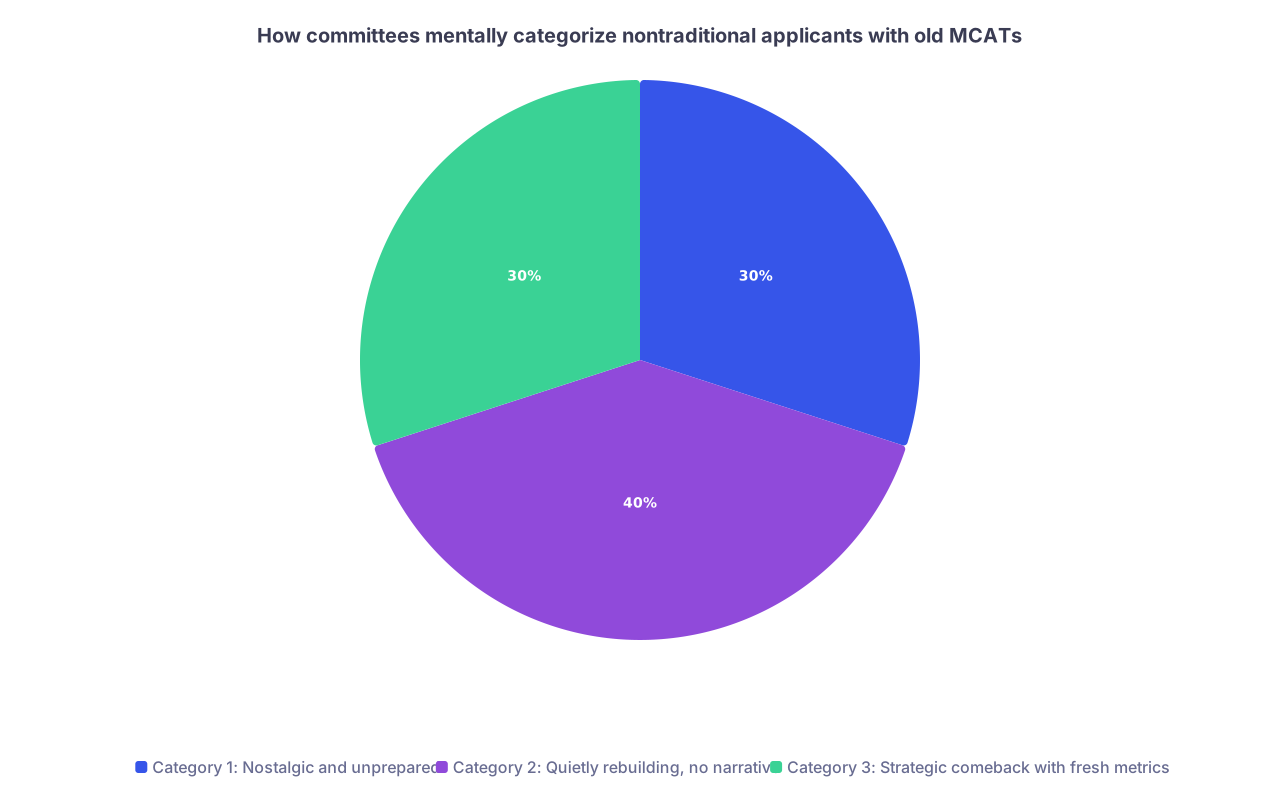
| Category | Value |
|---|---|
| Category 1: Nostalgic and unprepared | 30 |
| Category 2: Quietly rebuilding, no narrative | 40 |
| Category 3: Strategic comeback with fresh metrics | 30 |
I’ve watched admissions meetings where every older applicant gets slotted into one of these three buckets.
1. The “Nostalgic and Unprepared” Applicant
This is the person who keeps trying to make their old MCAT a thing.
Their personal statement says, “I once scored in the 90th percentile on the MCAT, but life circumstances took me away from medicine…”
Their secondary essays mention, “I previously took the MCAT and had a competitive score…”
The reaction around the table:
- “If that was 15 years ago, it’s basically trivia.”
- “Where’s the current MCAT?”
- “Where’s the recent science?”
That applicant usually gets screened out quickly unless something else is extraordinary.
If you’re leading with an old MCAT, you’re placing yourself here. Don’t.
2. The “Quietly Rebuilding” Applicant
This one is more promising but incomplete.
They’ve gone back to school. Post‑bac classes. Maybe a few A’s in organic, biochem, upper-level science. No recent MCAT yet, or a mediocre one.
In committee, they sound like this:
- “The academic comeback is encouraging, but I don’t see the standardized test to match.”
- “They’ve proven coursework, but I’m nervous about boards.”
- “If they’re serious, I’d like to see an updated MCAT before we commit a seat.”
These applicants sometimes get waitlisted or “hold for more information” if timing allows. If not, they become easy reapplicant material.
3. The “Strategic Comeback” Applicant
This is the group committees actually respect.
Profile looks like this:
- Old MCAT buried deep in the chronology, not used as a crutch.
- Recent MCAT (within 1–2 years) that’s solid for their target school tier.
- Fresh, strong science grades in the last 3–5 years.
- A clear, coherent story of what happened in the gap—and what changed.
Comments you hear in the room:
- “They had a strong academic past and then life happened, but the new MCAT and post‑bac prove they’re back in shape.”
- “This is the kind of nontrad I trust to survive the preclinical grind.”
- “Older, but tested recently. I’m comfortable with boards risk.”
This is the only group where your distant MCAT, if it was high, becomes a supporting detail. Not the headline.
What They Say When Your Old Score Was Great vs. Bad
Here’s the ugly little secret: committees don’t treat all old MCATs the same, even though they’re technically “expired.”
They use them as psychological data points.
If Your Old MCAT Was Strong (e.g., 33+ old / 512+ new scale)
Behind the scenes, you’ll hear things like:
- “They’ve always been a strong test-taker. That pattern is reassuring.”
- “If they can get close to that again, I’ll believe in their Step potential.”
- “I’m curious if the new score matches the old ability level.”
If your recent MCAT is anywhere in the same neighborhood, that old score becomes evidence of consistent ability. The gap in years doesn’t bother them as much.
But if your new MCAT is much lower, the tone shifts:
- “They were sharper 15 years ago. Have they lost a step?”
- “I worry that family/work has cut too much into their cognitive bandwidth.”
- “If they can’t clear MCAT again, boards are going to be rough.”
They won’t say that in an email, but they absolutely say it in the room.
If Your Old MCAT Was Mediocre or Poor
Here the thinking is different:
If you don’t retake the MCAT:
“They never really showed they could perform on a national exam. I have no reason to think they’ll be able to do boards now.”If you do retake and significantly improve:
“Finally shows growth. They’ve matured, learned how to study, and the trajectory is good.”
“Old score doesn’t bother me anymore. This new one is what I’ll stand on.”If your retake is only slightly better:
“They struggled then and they struggle now. I don’t see board‑level improvement.”
They’re not obsessed with where you started. They care about where you’ve proven you are now.
How They Judge You With No Recent MCAT
Some of you are hoping your story, your age, your life experience will carry you, and maybe a post‑bac, without retaking the MCAT.
Let me translate how that lands in committee.
You: “I don’t want to retake the MCAT; I’ve proven myself in my career, and my old score shows I was once capable.”
Committee reaction:
- The basic scientist: “Boards are standardized, timed multiple-choice. Jobs and life experience do not substitute.”
- The clinician: “I’ve failed residents who couldn’t pass boards. I’m not doing that again. I want to see a recent score.”
- The dean: “Attrition is expensive. This person is a financial and accreditation risk without current metrics.”
I’ve heard one committee chair say, almost word for word:
“If they won’t retake the MCAT, they’re telling me they won’t do hard, annoying things medicine requires. That’s a no.”
You cannot “philosophy” your way around a current MCAT. Not for MD. Not for DO. The very rare exception is a special linkage or early assurance program for internal candidates, and that’s not what you’re asking about.
What They Actually Respect From a 15‑Year Nontraditional
If you want committee members on your side, you stop asking, “Will they value my old MCAT?” and start showing them four things:
- Recent, rigorous science – post‑bac or DIY with A/A‑ grades in upper-level bio, biochem, physiology, maybe stats.
- Updated MCAT in range – doesn’t have to be perfect, but has to be compatible with your target schools.
- Proof of real commitment to medicine now – consistent clinical hours, shadowing, ideally some longitudinal patient contact.
- A gap story that sounds like growth, not drift – “Here’s why I left, here’s why I came back, and here’s what’s different about me now.”
Let me give you a real composite example.
Case Study: The 37-Year-Old With the 35 MCAT From 2010
I’ve seen this pattern more than once.
- Age 22: Scores a 35 on the old MCAT, applies half‑heartedly, gets waitlisted at two mid-tier MDs, never gets in.
- Spends a decade in consulting/tech/teaching.
- Age 35: Realizes they actually want medicine now.
- Age 36–37: Takes 24 credits of upper-level sciences: all A’s.
- Retakes MCAT: gets a 512. Not as shiny as the 35, but absolutely fine.
Committee comments:
- “I like the maturity. The old 35 plus a fresh 512 tells me the floor is high.”
- “They know how to go back to school and excel. Strong predictor for M1/M2.”
- “This is a nontrad I’d bet on. Good judgment to retake and rebuild.”
Notice what didn’t happen. No one tried to argue that the 2010 score should “count” now. It simply served as part of a consistent pattern.
How to Talk About the Old MCAT Without Sounding Out of Touch
You don’t pretend the old MCAT never happened. You just don’t overplay it.
Here’s how experienced applicants phrase it in ways committees like:
In a secondary or interview:
“I was first premed over a decade ago and took the MCAT then, but I ultimately stepped away from the path. When I decided to return seriously, I knew I had to demonstrate current readiness, so I retook the MCAT and completed recent science coursework. The more recent results are a better reflection of where I am now.”
That line does three things:
- Acknowledges the past without making it central
- Signals you understand the need for current data
- Frames your retake as responsibility, not punishment
What you don’t say:
- “I once scored in the 90th percentile, so I know I can do it.”
- “I didn’t think I should have to retake the MCAT after doing so well before.”
- “My old MCAT shows I’ve always been capable.”
Every time you lean too hard on the old exam, a committee member silently writes you off as not understanding the current bar.
The Timeline Committees Expect From You Now
If you’ve been out 10–15 years, there’s an unspoken “re-entry sequence” that makes committees comfortable. It looks roughly like this:
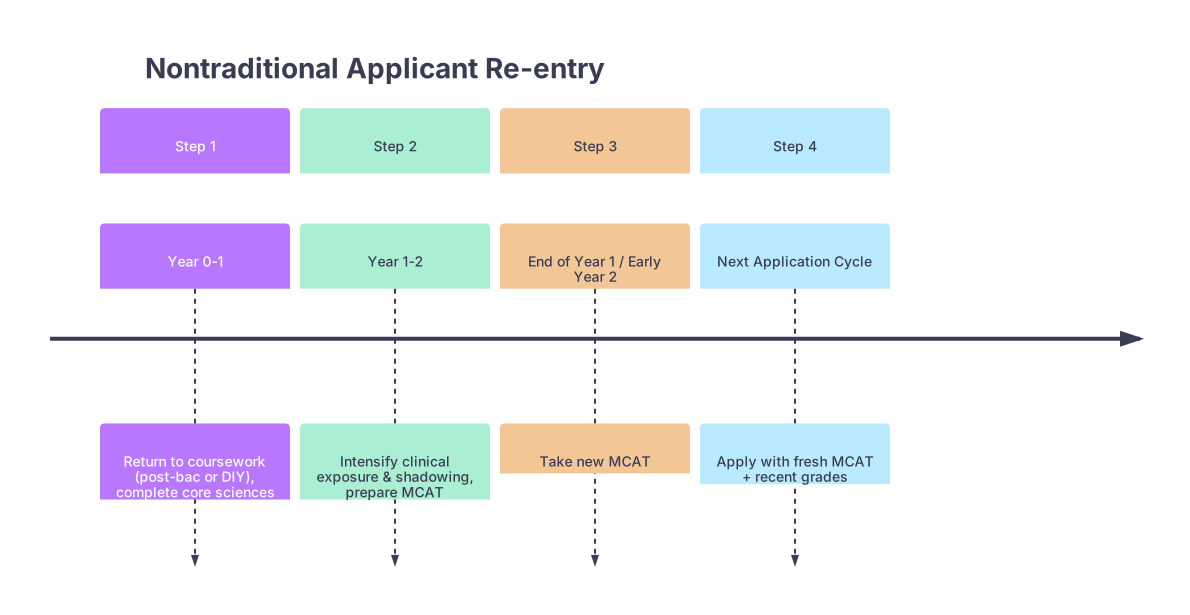
| Period | Event |
|---|---|
| Step 1 - Year 0-1 | Return to coursework (post-bac or DIY), complete core sciences |
| Step 2 - Year 1-2 | Intensify clinical exposure & shadowing, prepare MCAT |
| Step 3 - End of Year 1 / Early Year 2 | Take new MCAT |
| Step 4 - Next Application Cycle | Apply with fresh MCAT + recent grades |
When your file shows something like that, the conversation is easy:
- “Everything here is recent and relevant.”
- “They’ve taken the re-entry process seriously.”
- “Risk is manageable; let’s bring them in.”
When instead you try to shortcut it—
- No recent coursework
- Old MCAT only
- Minimal clinical experience in the last few years
—then whatever your personal narrative is, it doesn’t matter. You’re not giving them the tools to argue for you.
Where the 15‑Year Gap Can Help You
Now the good news: your age and your gap can absolutely help you, if you’ve done the work above.
Committee members, especially clinicians, love certain nontraditional traits:
- You’ve had a real job. You know how to show up, deal with people, take criticism.
- You probably have better emotional regulation than the average 22‑year‑old.
- You’re less likely to crumble the first time an attending yells at you or a patient dies.
But—and this is the critical point—they only get to lean on those strengths after they’re convinced you can handle the academics and boards.
That conviction does not come from a 15‑year‑old MCAT.
It comes from what you’ve done in the last 3–5 years.
If those pieces are strong, then the mood in the room shifts. You’ll hear things like:
- “I like their maturity; I trust them with patients.”
- “They’ll be great for the culture of the class.”
- “They’ll probably be a class leader, informal mentor.”
You want to get to the point where your age and path are an asset. Right now you’re stuck on whether your old MCAT can be resurrected. It can’t. Stop trying.
A Simple Rule: “Would You Bet $200,000 On You?”
Here’s a mental trick some committee members actually use, even if they don’t say it out loud:
“Would I bet $200,000+ of institutional resources and a seat in this class on the likelihood that this person will pass Step 1 and graduate on time?”
When you cling to a 15‑year‑old MCAT as your main academic credential, the answer is no.
When you show:
- Recent A-level science
- An MCAT from the last cycle or two in range
- Continuous clinical involvement
- A coherent, mature story of the gap and return
Now the answer becomes yes. Not because you were once impressive, but because you’ve proven you still are.
FAQs: What Committee Members Really Think About Your 15‑Year‑Old MCAT
1. Can any MD or DO school waive the MCAT “expiration” for a strong old score?
Informally? No. Not in a way that will help you. Schools have hard policies—usually 3 to 5 years. Sometimes they make case‑by‑case exceptions for combined degree programs or internal candidates, but I have never seen a standard applicant admitted on a 15‑year‑old MCAT alone. If someone tells you “maybe they’ll consider it,” they’re trying not to hurt your feelings.
2. If my old MCAT was very high, do I hurt myself by retaking it and scoring lower?
You don’t hurt yourself nearly as much as you think. Committees care far more about recent ability than about matching an ancient peak. A 35 from 2010 and a 511 from 2025 is a perfectly acceptable combo; it tells them your floor is still solid. What hurts is no recent MCAT at all. An imperfect but current score beats an obsolete perfect one every time.
3. I’ve taken a lot of graduate courses since then. Can strong grad work substitute for a new MCAT?
Not for most MD/DO programs. Graduate work, especially in non‑hard‑science fields or low‑rigor programs, is treated as supplementary. Nice, but not decisive. If your graduate work is in a rigorous science program with a thesis, that helps with the “can they study?” question, but it still doesn’t answer “will they pass standardized, timed, high‑stakes exams?” That’s what MCAT and boards measure. You can’t bypass that expectation.
4. How should I mention my old MCAT in my application, if at all?
Briefly and strategically, if it adds context—but never as your main selling point. You might reference it once in passing if it connects to your original attempt at medicine: “I applied to medical school more than a decade ago and took the MCAT at that time, but after not matriculating, I pivoted into another career.” Then shift quickly: “When I committed to returning, I updated my prerequisites and retook the MCAT to demonstrate current readiness.” That’s it. No bragging about the old score. No complaining about retaking it.
5. Is there any scenario where it makes sense not to retake the MCAT after 15 years?
Only in edge cases where you’re pursuing a very niche path: a special post‑bac linkage that explicitly waives the MCAT, a small Caribbean or offshore school with very different policies, or a non‑US system that doesn’t use the MCAT at all. If you want a realistic shot at US MD or DO programs, you retake it. That’s the cost of re‑entering the game. You can fight that reality, or you can accept it and start preparing. Only one of those moves you closer to a white coat.
Years from now, you won’t care that your 2010 MCAT died in some forgotten AAMC database. You’ll care whether, when it really counted, you were willing to rebuild yourself from where you stood—not from who you once were.