
The worst mistake non-traditional premeds make isn’t a bad grade or a late MCAT. It’s quitting a stable job way too early—and backing themselves into a financial and psychological corner they didn’t need to be in.
If you’re even thinking about leaving your job to “focus on premed,” you are already in a high‑risk zone. I’ve watched smart adults with real careers torch their savings, pile up credit card debt, and end up with no acceptance, no income, and no clear Plan B. Not because they weren’t capable—but because they underestimated how long, expensive, and uncertain this process really is.
Let me walk you through the red flags. If you see yourself in more than a couple of these, do not resign yet.
You’re not avoiding laziness. You’re avoiding unnecessary damage.
Red Flag #1: You Quit Before You’ve Proven You Can Actually Handle the Coursework
Quitting your job before you’ve taken any serious science classes is reckless. There’s no nice way to say it.
Medical school admissions committees do not care that you “always loved science” in high school. They care what you did in your post‑bacc or recent university work—especially as a non‑trad.
Major mistake:
People quit jobs to “go full-time premed,” then discover:
- They hate organic chemistry
- Their study skills are rusty
- Their first semester GPA is a 3.0 and now they’re in a hole
You absolutely do not need to be full‑time school to test whether you can succeed in the sciences.
Bare minimum before quitting:
- At least 1–2 semesters of recent, rigorous science with strong grades (A/A‑ range), while working at least part‑time
- Evidence that you can balance responsibilities and still perform academically
- A realistic sense of the workload, not a fantasy based on YouTube “day in the life” vlogs
If you haven’t yet completed—or even started—core premed courses like General Chemistry, Biology, and likely Organic or Biochem, quitting your job is like jumping off a cliff hoping you’ll grow wings on the way down.
I’ve seen people quit first, then realize they can’t get above a B- in Gen Chem even when it’s their only class. That’s a harsh way to learn you might not actually want (or be competitive for) medicine.
Test yourself before you torch your paycheck.
Red Flag #2: You Don’t Have a Ruthlessly Honest Financial Plan
The fantasy:
“I’ll quit for a year or two, live cheaply, knock out my prereqs and MCAT, then start med school. It’ll be tight, but fine.”
Reality:
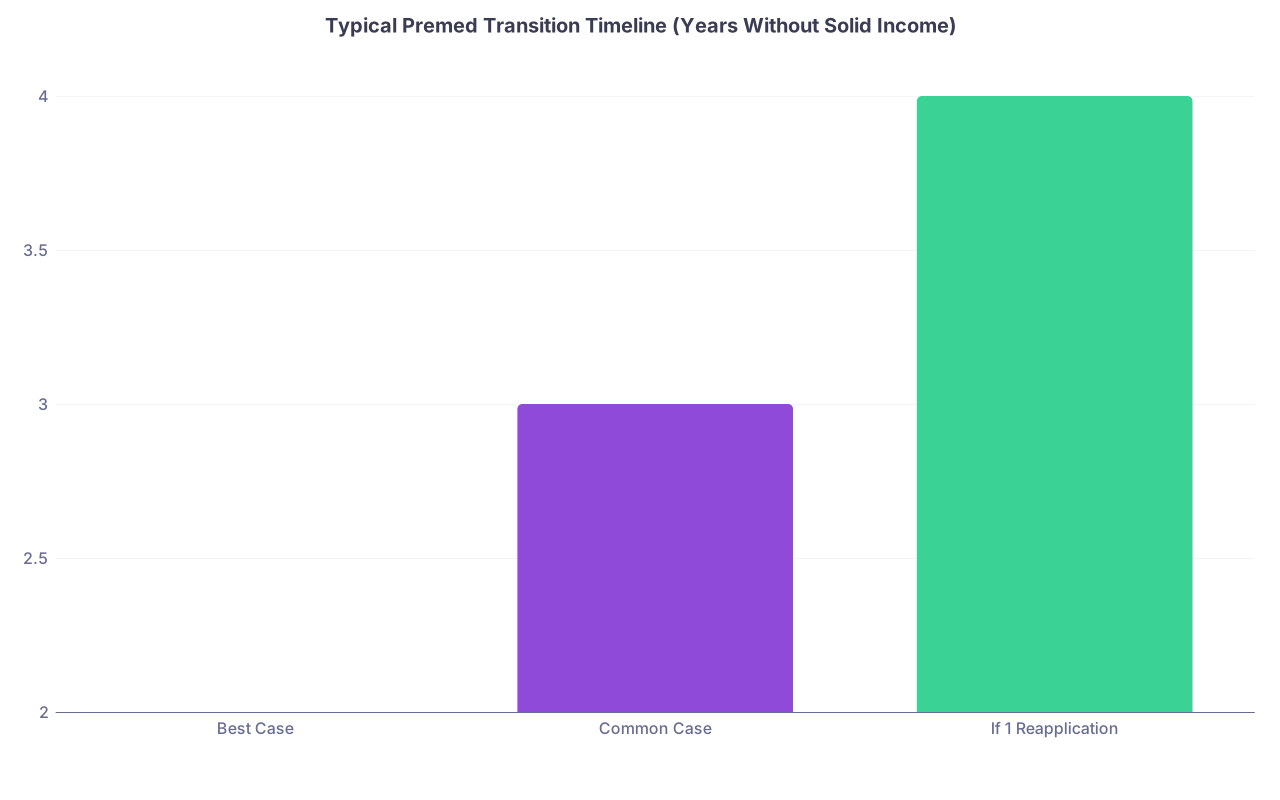
You might be out of stable income for 4–6 years before residency:
- 1–2 years of coursework
- MCAT prep and retake if needed
- 1–2 application cycles if you don’t get in the first time
- A potential glide year between applying and starting school
- Unexpected delays (family, health, failed classes, needing more ECs)
If your financial plan is basically “I’ll use my savings and maybe some loans,” pause. That’s not a plan. That’s wishful thinking.
| Category | Value |
|---|---|
| Best Case | 2 |
| Common Case | 3 |
| If 1 Reapplication | 4 |
Common money mistakes when quitting too early:
- No hard budget. You “think” your savings will last, but you’ve never actually calculated monthly burn rate (rent, insurance, food, car, interest payments, emergencies).
- No health insurance plan. You walk away from employer coverage with some vague idea you’ll “figure out marketplace insurance later.” Then you see the premiums.
- Ignoring opportunity cost. Every month not working is lost income and lost retirement contributions and lost career progression in your current field.
- Underestimating application costs. Primaries, secondaries, MCAT fees, travel (even in the virtual era, there are still costs), deposits—this easily hits several thousand dollars.
If you cannot show on a spreadsheet that you can survive 3–4 years on your savings without incurring high-interest debt, you’re quitting too early.
And no, “I’ll put tuition and living on credit cards until loans come through” is not a workaround. That’s how you trap yourself.
Red Flag #3: You’re Quitting Because You’re Burned Out, Not Because You’re Ready
A lot of non‑trads don’t leave because premed requires it. They leave because their current job is soul‑sucking.
So they reframe it as “I’m committing fully to my dream of medicine” when what’s really happening is “I need an escape now.”
Here’s the problem: if you use premed as an escape hatch from burnout, you’re mixing two different issues:
- You’re trying to solve a mental health / career satisfaction problem
- With a high‑risk, high‑cost, multi‑year commitment that has no guarantees
That’s like curing a headache with brain surgery.
Medicine is not a vacation from your current misery. It’s another demanding path with its own misery if you go in for the wrong reasons.
You’re at risk of quitting too early if:
- You haven’t thoughtfully considered other career changes outside medicine that might make you happier sooner and with less risk
- Your main emotional driver isn’t “I want to practice medicine,” it’s “I can’t stand my boss / my industry / corporate life”
- You’re expecting the student identity to feel like a huge relief and fresh start
It can feel like that for a few months. Honeymoon phase. Then the grind sets in, and now you’ve got no income, a heavy course load, and the same brain that was burned out at your old job.
By all means, leave a toxic workplace. But don’t confuse “I need out” with “I must quit and go full‑time premed right now.” There are intermediate steps: reduced hours, job change within your field, remote roles, consulting, etc.
Red Flag #4: You Haven’t Even Confirmed You Like Real Clinical Work
Another common disaster pattern: quitting a solid job to chase a dream based on zero real clinical exposure.
I’ve sat across from people who’d quit six‑figure tech jobs, then realized a year later that:
- They get lightheaded around blood
- They hate hospitals
- The emotional weight of sick patients wrecks them for days
- They actually like physiology podcasts, not sick humans
You should not leave your job before you’ve done all of this:
- Shadowed physicians in more than one setting (clinic + hospital at minimum)
- Worked or volunteered in direct patient contact roles (scribe, MA, EMT, CNA, hospice, etc.)
- Talked frankly with at least 3–5 physicians about their real life—hours, stress, regrets, what they’d do differently
If you can’t confidently say “I’ve seen the grind up close and still want it,” you’re gambling with your career and finances.
And no, watching YouTube “day in the life of a med student” videos is not clinical exposure. That’s highly edited marketing.
Do this while you’re still working. Even if it takes longer. If your path is truly to medicine, an extra 12–18 months spent working + exploring is not wasted time. It’s insurance against a massively expensive mistake.
Red Flag #5: You Think You Need to Quit to Get a Strong Application
You don’t.
You might want to quit. You might feel tired. But admissions committees actually like non‑traditional students who:
- Balanced work and school
- Showed upward academic trajectory while employed
- Paid their own bills and handled adult responsibilities
I’ve seen people keep a 0.8–1.0 FTE job, take 1–2 classes a semester, and build a fantastic application over 2–3 years. They matched into strong schools because they had a compelling story of persistence and adult functioning.
Compare that with someone who:
- Quit early
- Did school full time with mediocre grades
- Had thin extracurriculars because they underestimated how long things take to build
- Ended up with a big gap after finishing prerequisites because they applied late or needed to retake the MCAT
Cutting your income does not automatically make your application stronger. Often it does the opposite, because the financial stress undercuts your performance.
Danger signs in your thinking:
- “If I just had more time, I’d be a 4.0 student.” Maybe. But time is rarely the only problem.
- “Medical schools will see how committed I am because I quit my job.” They don’t reward financial self‑sabotage. They care about outcomes, not theatrics.
- “Everyone on Reddit says they took 5 classes a semester + MCAT + 20 hours of shadowing.” You’re not “everyone on Reddit.” They rarely tell you the full context of their situation or their burnout level.
Do not quit your job merely to signal “commitment.” You can show commitment by grinding through night classes after work. That story actually plays better in interviews.
Red Flag #6: You Have No Plan for the “What If I Don’t Get In?” Scenario
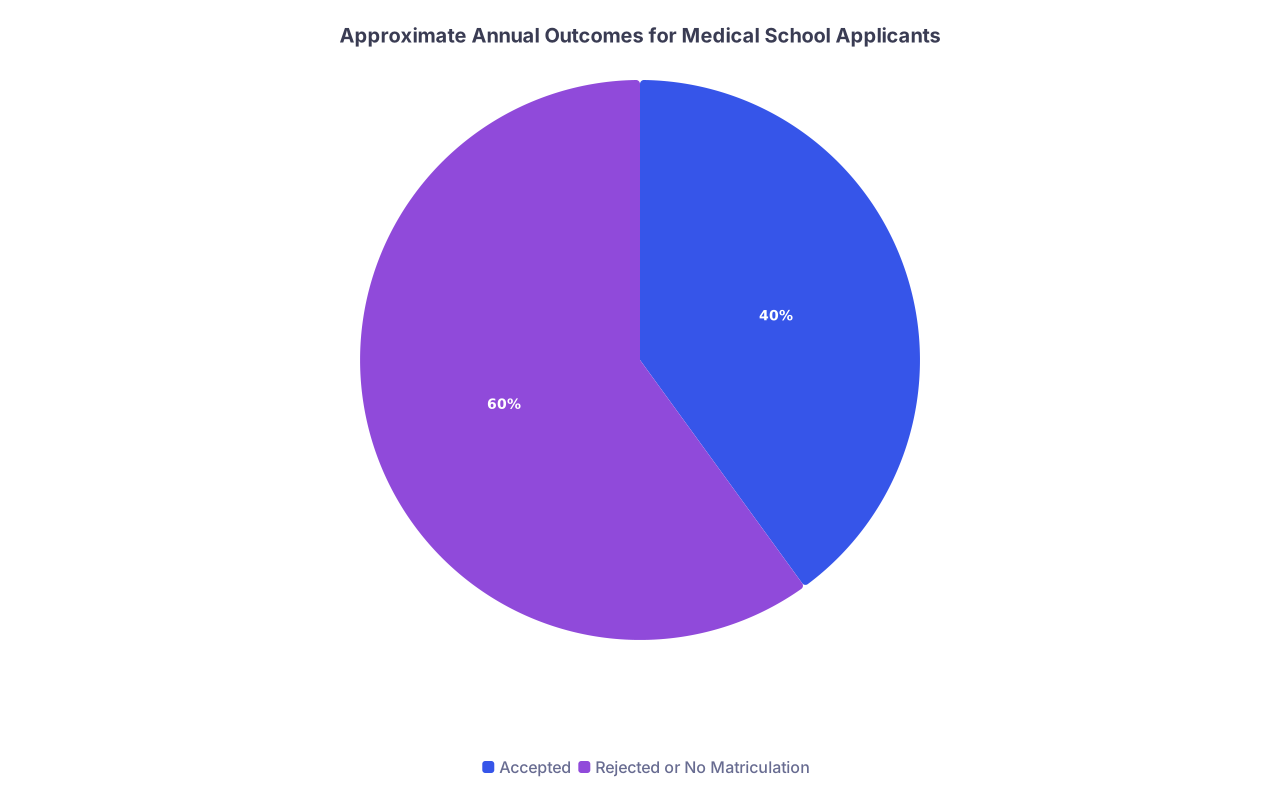
Here’s the ugly secret: a lot of strong applicants don’t get in the first cycle. Or the second. The numbers are public. Look at them.
| Category | Value |
|---|---|
| Accepted | 40 |
| Rejected or No Matriculation | 60 |
If your plan is:
- “I’ll apply once. If I don’t get in, I’ll just apply again.”
- With no clear job path, no financial buffer left, and a resume full of short, fragmented experiences
You’ve set yourself up for catastrophe.
Before you resign, you should be able to answer, in specific detail:
- If I don’t get in after 1–2 cycles, what exactly will I do for employment?
- How will I explain my gaps and pivots to non‑medical employers?
- Can I re‑enter my current field at a reasonable level, or will I be starting from scratch?
- Am I okay, emotionally and financially, with the possibility that I may never be “Dr.” anything?
I’ve seen mid‑30s professionals give up a decade‑long career track, then at 38–40 face no acceptance letters and no obvious way back. Employers wonder what they’ve been doing. The narrative becomes muddled.
You need an off‑ramp that doesn’t lead into a brick wall.
That might mean:
- Keeping one foot in your current profession via part‑time consulting, per diem work, or maintaining licenses/certifications.
- Choosing science coursework that could also serve another career (e.g., data analytics + biostatistics, public health, nursing pathways, etc.)
- Documenting transferable skills the entire way, not just obsessing over “what med schools want.”
If your only plan is “med school or bust,” you’re gambling not just your savings—but your future employability.
Red Flag #7: You Underestimate How Long You’ll Be a “Non‑Earner”
People love to say “it’s never too late.” That’s motivational poster talk, not planning.
If you quit your job at 30 to go premed, best‑case timeline might look like:
- 2 years of prereqs
- 1 year application cycle and glide time
- 4 years med school
- 3–7 years residency/fellowship depending on specialty
You won’t be a fully trained attending physician until your early 40s at least. Most of those years you’ll be making either nothing (premed) or modest trainee salaries (med school loans, lowish residency pay vs. responsibility).
That’s not a reason not to do it. But it’s absolutely a reason not to casually dump a stable income at the front of that process.
If you can:
- Continue working
- Stretch prereqs over a bit longer
- Apply at 33 instead of 31
You’ve kept thousands of dollars of income flowing in while you were still exploring whether this path is actually right for you.
People get dazzled by the identity of “future doctor” and forget they are voluntarily signing up for 10+ years of constrained financial choices. Quitting early just front‑loads the pain.
Red Flag #8: Your Decision Is Driven by Comparison and Impatience
If your internal monologue sounds like this:
- “I’m already behind.”
- “Traditional students will be attendings by the time I finish med school.”
- “I need to hurry or it won’t be worth it.”
You are about to make a rushed, emotional decision.
Non‑traditional paths are, by definition, slower. The successful ones embrace that and build a sustainable plan around it. The disaster cases try to “catch up” by quitting jobs, overloading their schedule, panicking about age, and burning out.
The big lie is: “If I quit my job and go all‑in, I’ll shave years off this process.” Often you don’t.
You might:
- Take heavier course loads, then have to retake classes due to poor performance
- Rush the MCAT before you’re ready because your savings are running out
- Apply earlier with a weaker application because you’re in a hurry, leading to rejections and reapplication cycles
What looks like “speed” on paper ends up being slower and more expensive in real life.
Be suspicious of any plan whose main selling point is “I’ll be done sooner,” especially when it rests on huge assumptions about perfect grades, one‑and‑done MCAT, and first‑cycle acceptance.
Red Flag #9: You Haven’t Talked Honestly with People Who’ve Done This
Not with anonymous commenters. With real humans who:
- Quit a job and successfully became physicians
- Chose not to quit and still got in
- Quit and did not get in, and had to rebuild a career
If all your data is coming from forums and social media, you’re seeing survivorship bias. People who flamed out quietly don’t make “day in the life” videos.
You need to hear:
- The person who kept working as a nurse, took 2 classes a semester, and matched into a great med school at 35
- The ex‑engineer who quit too early, ran out of money, ended up back in tech but 5 years behind his peers and deeply frustrated
- The one who did quit and is glad—but can tell you exactly why it worked: strong savings, clear timeline, prior academic success, robust support system
Here’s a brutal heuristic:
If everyone you talk to who actually knows you says, “I’d feel better if you didn’t quit yet,” listen. They’re not trying to kill your dream. They’re trying to protect you from an avoidable disaster.
How to Do It Smarter If You Are Going to Quit
Sometimes quitting is still the right move. Fine. But then it should look more like a calculated, boringly conservative decision—not a heroic leap.
You’re in a safer zone if:
- You’ve already proven you can excel in 2+ hard science courses while working
- You have at least 12–18 months of living expenses saved after accounting for tuition and application costs
- You’ve lined up part‑time or flexible work you can ramp up if needed
- You’re insured (health, disability if possible), and you know exactly what will happen if you get sick or injured
- You’ve built real clinical exposure and are still convinced medicine is right, even on your worst days
- You and a few trusted, clear‑eyed people in your life think the timing makes sense
If that doesn’t describe you yet, your job is not to quit.
Your job is to buy time. Test assumptions. Improve your odds. Stack the deck.
The Bottom Line
Don’t quit your job early and call it courage. Sometimes it’s just poor risk management dressed up as passion.
If you remember nothing else, keep these three points:
- Prove you can handle the academics and still pay your bills before you give up your income.
- Have a brutally realistic financial and backup plan—on paper—before you resign.
- Do not use medicine as an escape from a bad job; fix your life first, then commit to this path with clear eyes.
You can absolutely become a doctor as a non‑traditional student. Just don’t blow up your current life sooner than you have to.