
Older applicants do not scare admissions committees. Sloppy older applicants do.
Let me tell you what actually happens behind those closed‑door admission meetings when your file comes up and your age isn’t 22. I’ve sat in rooms where a 33‑year‑old got an interview within 24 hours of file completion, while a 28‑year‑old with better stats was quietly moved to “pre‑interview hold” and never heard back.
Same age bracket. Same general story: “career change,” “found my calling later,” “nontraditional path.” Completely different outcomes.
The difference is not what Reddit tells you it is. It’s not just “stats + story.” Committees are more transactional and more strategic than that. They’re asking a tougher question:
“If we invest one of our limited seats in this older applicant, are we highly confident they will (1) finish, (2) thrive, and (3) make us look smart for admitting them?”
When the answer feels like a solid yes, they fast‑track you. When there’s any doubt, they park you on the waitlist—or quietly bury your file.
Let’s walk through how that judgment is really made.
What “Fast‑Tracked” Actually Looks Like Behind the Scenes
At most schools, there is a quiet priority system. Nobody calls it that officially, but it’s obvious if you’ve watched enough cycles.
There’s the pool of:
- “Read immediately / interview ASAP”
- “Interview if space allows”
- “Hold for later review”
- “Nope”
Older applicants are far more likely to be in the extremes. You either make decision‑makers excited or nervous. You almost never get treated as neutral.
I’ve seen this exact sequence at a mid‑tier MD program with a large non‑trad population:
- File gets marked complete on Monday.
- By Tuesday afternoon, the faculty reviewer flags it: “Strong non‑trad, bring for interview.”
- Coordinator sends an invite that same day.
- At the next committee meeting, someone literally says, “Let’s not lose this one. This is the kind of person we like to highlight.”
That’s fast‑tracked.
Compare that to the older applicant who lands in “hold”:
- File is technically complete, but the reviewer writes: “Non‑trad, unclear academic readiness, story a bit vague. Consider later.”
- No one is in a rush. No one feels urgency.
- You become a “maybe if we’re short on strong traditional applicants later.”
If you’re older, you don’t want to be “consider later.” You want people fighting not to lose you to other schools.
So what triggers that fight?
The Secret Equation Committees Use for Older Applicants
They won’t say this out loud, but the mental math looks like this:
Older applicant value = (Maturity + Reliability + Distinct contribution) – (Risk of burnout, failure, or drama)
Traditional applicants get graded more on raw potential. Older applicants get graded on proof.
Here are the levers that really matter.
1. Academic recency: the silent gatekeeper
This is the first filter for older applicants—before your story, before your service, before your “calling.”
Admissions folks look at your transcript and think, “Can this person survive our curriculum right now?” Not in theory. In reality.
A 34‑year‑old who did a strong post‑bacc with A’s in the last two years? They feel low‑risk.
A 31‑year‑old with a 3.1 from 9 years ago and no recent coursework? Giant red flag. That file gets comments like:
- “Hard to know current academic level.”
- “Would like to see more recent science.”
- “Risky given rigor of M1.”
That “risky” label is fatal for older applicants.
Here’s how this plays out in practice:
Applicant A: 32, former engineer
Old GPA: 3.2 in undergrad (10 years ago)
Recent: 36 credits of upper‑level science post‑bacc, 3.9, A’s in orgo, biochem, physiology
MCAT: Solid, say 512–515This person gets fast‑tracked a lot. Because the committee can say with a straight face: “Yes, they can handle it. We have proof.”
Applicant B: 29, former teacher
Old GPA: 3.0 from 7 years ago
Recent: One online biochem, B+; no formal post‑bacc; MCAT 508This person may be wonderful, but the academic story is muddy. Files like this end up in “hold” land. Or “reject and wait for them to reapply with a stronger record.”
If you’re older and you have any academic question marks, you do not get the benefit of the doubt. You must impose clarity on your academic story with recent, rigorous, high‑performance coursework.
2. The three‑sentence test: can your story be sold?
Admissions committee members don’t pitch your story with your 5‑page personal statement. They pitch you with three sentences, max.
In closed session, it sounds like this:
“She spent 8 years as an ICU nurse, went back for a post‑bacc, crushed it, and has phenomenal letters from physicians who say she already functions like a resident. She’s mentoring new nurses and running QI projects. I think she’ll be a strong leader and hit the ground running.”
That applicant gets nods around the table. People can see her.
Compare that to:
“He was in business consulting for a while, then did some volunteer work, said he always liked science. Took some prereqs, did fine. Wants to give back.”
Nobody’s excited. Nobody sees a clear, differentiated value. That’s how you slide into “waitlist if we have space.”
Older applicants who get fast‑tracked have a story that hits three beats very clearly:
- What you actually did before (specific, substantial, not vague).
- Why medicine became the next logical step (not a random pivot, not a midlife crisis).
- How you’ve already tested the reality of medicine up close (not just shadowing 20 hours; more like repeated, longitudinal, real, unglamorous exposure).
The committees love to be able to say: “They already know what they’re getting into.”
When the story sounds like “I was unfulfilled in career X and decided medicine would be more meaningful,” eyes glaze over. Every second file says that.
You don’t need drama. You need coherence and evidence.
3. Professionalism and reliability: your hidden advantage—or your silent killer
Older applicants are supposed to be the adults in the class. That’s the expectation.
So the second something in your file whispers “flaky” or “unreliable,” your age flips from asset to liability.
I’ve seen older applicants killed by:
- Multiple short, unrelated jobs with vague explanations
- Large unexplained gaps in work or school
- Last‑minute cancellations of interviews
- Late secondary submissions with no clear reason
- Letters that mention “still learning to manage deadlines” or “sometimes overextends themselves”
One program director said it bluntly in committee:
“If a 22‑year‑old ghosts a physician shadowing once, I shrug. If a 35‑year‑old does it, that’s character.”
Harsh. But that’s the mindset.
On the flip side, older applicants who get fast‑tracked often have letters that scream reliability:
- “She was always the first to arrive, last to leave.”
- “He was the go‑to person in crises.”
- “She’s who I’d want on my team at 3 a.m. when everything’s going wrong.”
Those are the phrases that move you from “interesting candidate” to “we need this person in our cohort.”
4. Fit with school mission: where age helps or hurts
Some schools love non‑trads. Some tolerate them. A few, frankly, avoid them.
They won’t put that on their website. But you can see it if you look at their class profiles and student bios.
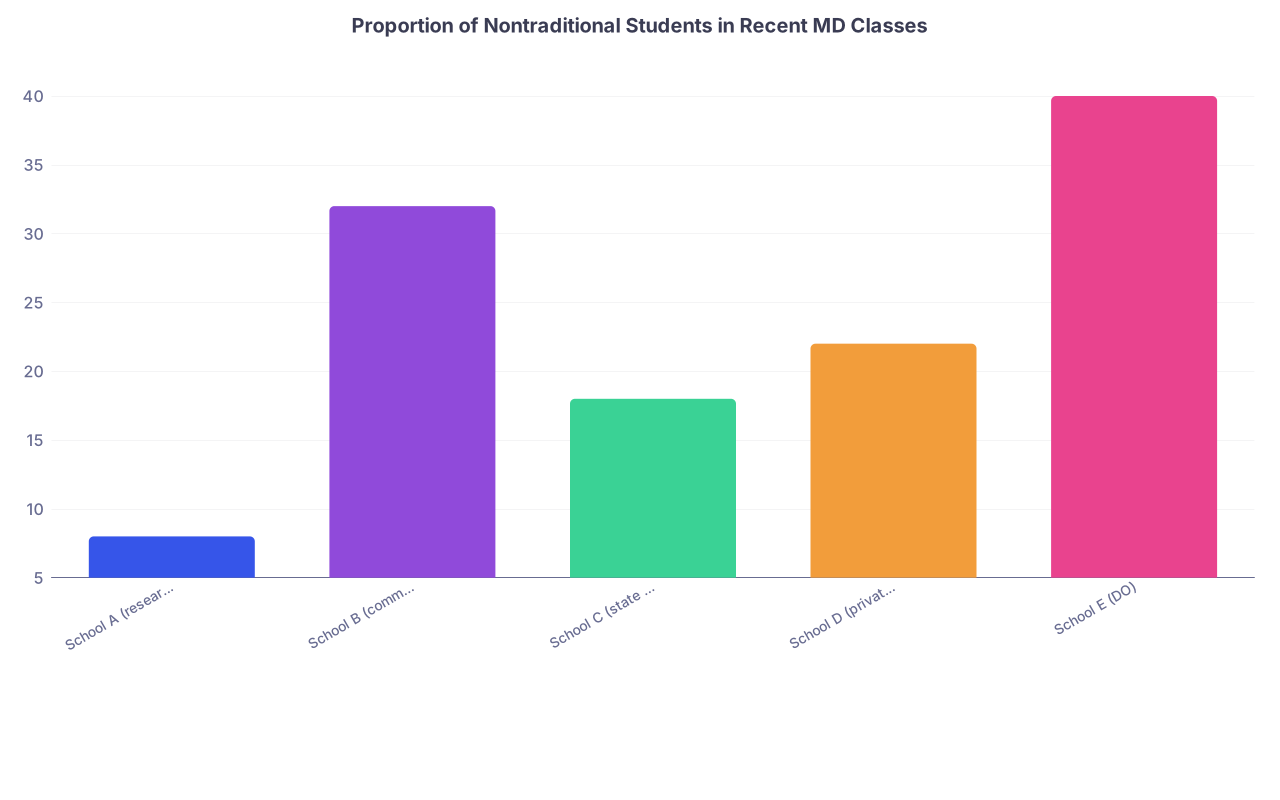
| Category | Value |
|---|---|
| School A (research heavy) | 8 |
| School B (community focused) | 32 |
| School C (state MD) | 18 |
| School D (private MD) | 22 |
| School E (DO) | 40 |
The higher those non‑trad percentages, the more likely your age is a positive signal rather than a risk.
In committee rooms at non‑trad friendly schools, I’ve heard:
- “We need a few more older voices in this class.”
- “She’d be a great peer mentor and role model for the younger students.”
At schools with more rigid, traditional cultures, the talk is different:
- “Will he struggle to fit in socially?”
- “Is she going to be frustrated with the structure?”
- “We’ve had mixed experiences with older students in the past.”
If you apply blindly, you’ll blame age for outcomes that are actually about institutional preference and culture.
You want to target:
- Schools that proudly highlight career‑changers on their websites
- Programs with evening/weekend info sessions that attract working applicants
- State schools and DO schools that explicitly mention “non‑traditional students welcome” and actually show them in their class photos, not just in marketing copy
Being older at the wrong school makes you an edge case. Being older at the right school makes you exactly what they want.
Why Some Older Applicants Get Parked on the Waitlist
Let’s be blunt: the waitlist is often where committees put candidates they like but are not willing to risk a seat on early.
For older applicants, three patterns send you straight there.
Pattern 1: “Compelling, but statistically borderline”
Example: 36‑year‑old, former social worker, phenomenal service record, excellent letters, strong narrative, but a 502 MCAT and a 3.3 mostly from years ago, with a light post‑bacc.
In deliberations, you hear this:
“I really like her. She’ll be a great doctor. But I’m nervous about the academic load. Let’s see what the rest of the pool looks like.”
That “let’s see” is code for: waitlist at best.
If you’re older and your numbers are borderline, your softs can get you considered. They rarely get you secured a seat early.
Pattern 2: “Academically fine, story vague”
Example: 29‑year‑old, 3.7 GPA, 511 MCAT, decent shadowing, generic volunteering, short personal statement about “wanting to help people” and “seeking a meaningful career.”
This is where many mid‑30’s career changers die. The file is totally acceptable. It’s just not intentional enough for your age.
Committee thinking:
“If I have a 21‑year‑old with this exact same file and a 30‑year‑old, I’ll pick the 21‑year‑old. More runway, less risk. Unless the 30‑year‑old gives me a reason not to.”
No distinct angle, no obvious added value, no clear tested commitment. You’re a safe maybe, not a compelling yes.
Pattern 3: “Too many question marks”
This includes:
- Career hops that don’t form a coherent arc
- Time off for “personal reasons” with no responsible framing
- Very late decision to pursue medicine with minimal true clinical exposure
Older applicants with too many question marks are labeled as “opaque.” Committees hate opaque. If they can’t quickly understand your trajectory and judgment, they hesitate.
Hesitation = waitlist if they’re generous, rejection if they’re not.
What Fast‑Tracked Older Applicants Do Differently (That You Never See on Reddit)
Let me spell out what the successful older applicants actually look like from the inside, not from their humble‑brag posts.
They don’t just “explain” gaps and pivots. They own them.
A good older applicant doesn’t sound defensive about their timeline. They sound like someone who has actually reflected and made deliberate choices.
Weak:
“I wasn’t sure what I wanted to do after college, so I tried consulting, but it wasn’t fulfilling. During COVID I realized I wanted a more meaningful career.”
Stronger:
“After college I went into consulting because I was good at analytic work and it paid well. Over several years, I kept finding myself gravitating toward projects involving healthcare delivery and patient outcomes. I started volunteering weekly at a free clinic in 2019, and over three years there, I realized I was most energized at the point of care, not in the boardroom. That’s what pushed me to test my commitment with formal post‑bacc coursework and long‑term clinical work.”
Hear the difference? One is passive, hand‑wavy, cliché. The other is specific, directional, adult.
Interviewers pick up on this in about 90 seconds.
They gather letters that feel like faculty endorsements, not generic praise
Older applicants have a huge advantage here if they use it: professional supervisors who can compare you to other adults, not just other students.
The fast‑tracked files often include at least one letter that sounds like this:
- “I’ve supervised dozens of staff in high‑stress environments. She stands out as the most emotionally steady and dependable colleague I’ve had in 10 years.”
- “He routinely took on responsibilities that, frankly, align more with what we expect from residents than from volunteers.”
Those lines make faculty lean forward. Because they’re written in the language of trust and risk‑reduction.
If your letters say you’re “nice, hardworking, and passionate about medicine,” you sound like everyone else.
How to Position Yourself So Committees Don’t Blink
Let’s turn this into a practical blueprint. Because this is where older applicants screw up: they underestimate how tight their story needs to be.
Step 1: Clean up the academic question—completely
Not “good enough.” Clear.
That means:
- At least 1–2 years of recent, rigorous science with strong grades if your old record is weak or distant
- An MCAT that is aligned with the schools you’re targeting—older applicants rarely get rescued by “holistic” if they’re way below a school’s median
You want the academic discussion in committee to last 10 seconds:
“Academics?”
“Fine. No concerns.”
“Okay, moving on.”
If they’re still debating whether you can pass pathology and pharm at 37, you’ve already lost half the room.
Step 2: Decide on a clear through‑line—and commit to it
Your narrative doesn’t need to be dramatic. It does need to be coherent.
Pick the through‑line:
- Service to vulnerable populations
- Systems thinking and improving care delivery
- Longstanding interest in human behavior and suffering
- Long exposure to bedside care (nursing, EMS, respiratory therapy, etc.)
Then align your personal statement, activities, and interviews so they all reinforce that theme. The worst thing you can do as an older applicant is look scattered.

| Step | Description |
|---|---|
| Step 1 | Past Career |
| Step 2 | Core Skills/Values |
| Step 3 | Clinical Exposure |
| Step 4 | Formal Academics |
| Step 5 | Personal Statement |
| Step 6 | Interview Talking Points |
If any one of those nodes doesn’t match the others, committees smell inconsistency.
Step 3: Show you understand the grind, not the fantasy
Older applicants get fast‑tracked when they demonstrate they’ve tested the unglamorous parts of medicine.
So instead of:
“I love the idea of forming long‑term relationships with patients.”
You talk about:
- That 5:30 a.m. shift where you helped clean a confused patient who’d soiled themselves
- The weekend you volunteered for the least popular task on the ward and came back the next weekend anyway
- How you watched a resident struggle through a 28‑hour call and asked them about the worst parts, not just the best
Interviewers love when older applicants show they aren’t romanticizing this. It makes you look lower‑risk.
Step 4: Behave like a resident—from day one of the application
Every interaction is data.
Program staff gossip more than you think. If you’re the 34‑year‑old who sends panicked, poorly written emails to the coordinator, that gets noticed. If you’re the one who answers promptly, shows up early, asks focused questions, and follows directions, that gets noticed too.
I’ve been in meetings where someone says:
“I met him at our info session last month. Professional, respectful, had clearly researched our program. I think he’d be a good fit.”
You want that kind of offhand endorsement in the room when your name comes up.
Common Myths Older Applicants Need to Ignore
Let me quickly stab a few bad ideas that float around forums.
“Being older automatically helps because of life experience.”
No. It helps if that experience clearly translates into being a better, more reliable trainee. Otherwise it’s neutral or negative.“You can explain away a weak MCAT with your story.”
Maybe if you’re 22. At 32 with no recent coursework? Not happening at most MD schools.“Schools will be worried you won’t practice long enough.”
This is dramatically overstated. Most places don’t care if you’re 28 or 38, as long as you can finish training and practice for a decent stretch. They care far more about performance and professionalism.“If you get waitlisted, it means you were almost good enough and should reapply with the same app.”
No. For older applicants, a waitlist often means “compelling but slightly too risky.” Fix the risk factor before reapplying: academics, clarity of story, or documented commitment.

Quick Reality Check: Are You Likely to Be Fast‑Tracked or Waitlisted?
Ask yourself, brutally:
- If someone read my file cold, could they explain my path in three convincing sentences?
- Do my recent academics make any reasonable person completely stop worrying about my ability to handle med school?
- Do my letters prove I’m already operating at a high professional level among adults?
- Have I clearly shown I understand the hard, boring, exhausting realities of medicine—and still want it?
If you can’t say yes to at least three of those, you’re more waitlist material than fast‑track material right now.
That’s not fatal. It just means you have work to do before you apply, not after.
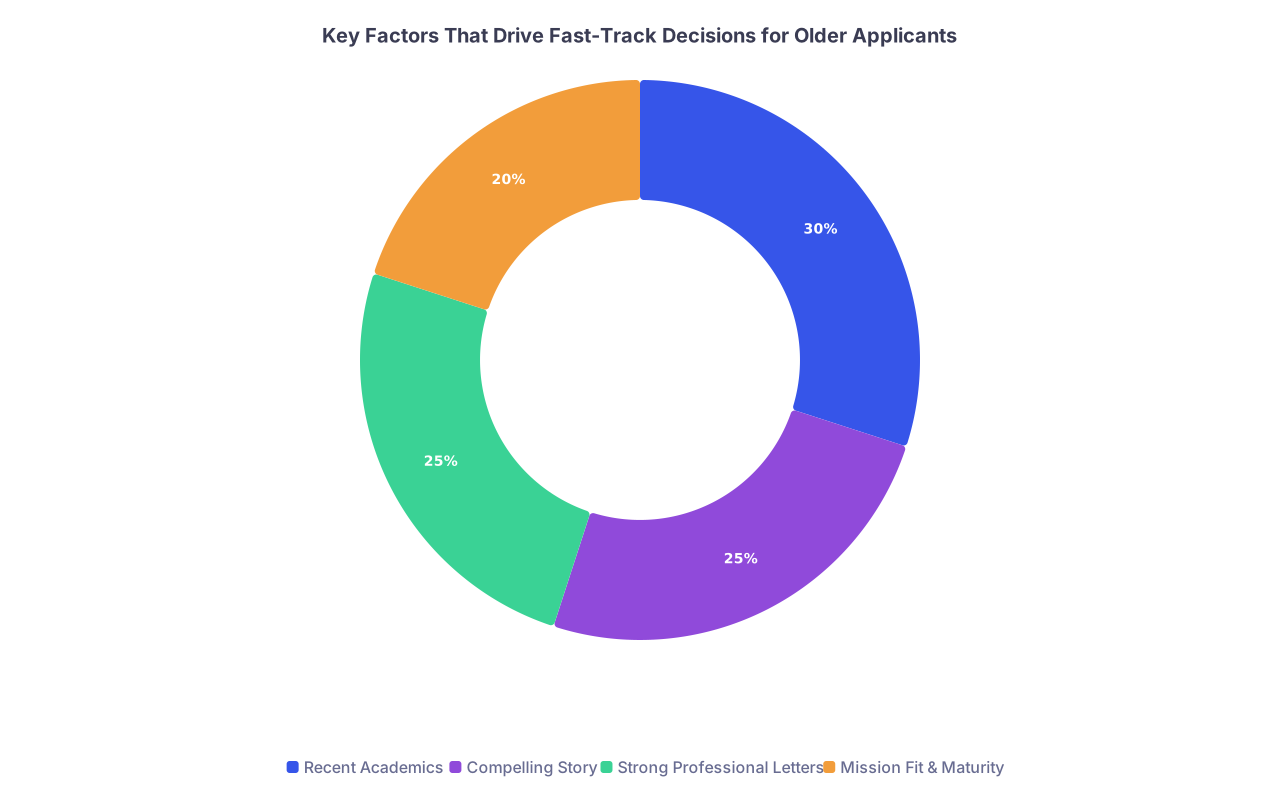
| Category | Value |
|---|---|
| Recent Academics | 30 |
| Compelling Story | 25 |
| Strong Professional Letters | 25 |
| Mission Fit & Maturity | 20 |
FAQ (Older Applicants Edition)
1. I’m 35 with an old low GPA but a strong MCAT. Do I still need a post‑bacc?
If the old GPA is weak (sub‑3.3) and most of it is 7–10+ years old, yes, you probably do. A strong MCAT proves you can test well. It does not prove you can grind through months of dense content, group work, and exams while juggling life. Committees use recent coursework to reduce their anxiety about older applicants struggling in M1/M2. If you want to be fast‑tracked, you want them to look at your transcript and say, “We’re done worrying.”
2. How much clinical experience is “enough” for a non‑traditional applicant?
For an older applicant, I get nervous when I see less than 150–200 hours of sustained clinical exposure where you were around real patients repeatedly over time. Shadowing alone is weak. Longitudinal roles—scribing, CNA, MA, EMT, hospice volunteer, clinic assistant—carry more weight. The key is not the raw hour count but the depth and continuity. Committee discussions sound a lot more positive when someone can say, “She’s been in the clinic every week for the last two years.”
3. Will taking longer to complete prerequisites (because of work/family) hurt me?
Not if the performance is strong and the pattern is coherent. In fact, committees often respect older applicants who carry real responsibilities while doing well academically. What hurts you is chaos: sporadic classes with withdrawals, inconsistent grades, and no clear explanation. If your prereqs took 3–4 years because you were working full‑time and parenting and you still pulled mostly A’s, that supports your case. Just make sure you frame it clearly in your application and, if needed, in secondaries.
4. I keep getting waitlisted but rarely rejected outright. What does that usually signal for an older applicant?
For older applicants, repeated waitlists usually mean you’re in the “compelling but slightly risky” bucket. Something about your application is holding committees back from spending a seat on you early. Common culprits: borderline MCAT for the schools you’re targeting, insufficient recent science, a story that doesn’t feel fully “tested” in real clinical settings, or letters that are supportive but not glowing. If you see a pattern of waitlists, do not just reapply with cosmetic tweaks. Identify the risk signal and crush it—increase academic proof, deepen clinical work, or secure stronger, more concrete letters—then reapply as a clearly improved, lower‑risk version of yourself.
If you remember nothing else, remember this:
Older applicants get fast‑tracked when they remove doubt, not when they beg for exceptions.
Your age isn’t the problem. Unanswered questions are.
Build an application that makes the committee say, “We’d be stupid to lose this one,” and the fast‑track takes care of itself.