
The real reason adcoms ask, “Why didn’t you apply to med school earlier?” is simple: they’re not curious, they’re suspicious.
They’re probing for risk. Not your passion, not your inspirational backstory. They want to know: What went wrong, who caused it, and is it going to bite us if we admit you?
Let me walk you through what faculty and program directors actually say behind closed doors when your “late start” comes up.
What That Question Really Signals
Internally, that question is code for: “Explain your delay, and convince us you’re not going to crash and burn when this gets hard.”
On paper, you look like one of several things:
- Older than the traditional 21–23 year-old applicant
- Graduated years ago and now circling back
- Career changer
- Big GPA turnaround late in college
- Long gaps with no obvious academic or clinical progression
That flags you for extra scrutiny. Not because nontraditional is bad. Because nontraditional means unknowns, and admissions committees hate unknowns.
They’ve been burned before. I’ve sat in rooms where someone says, “Remember that guy who went into consulting for six years and then flamed out after M1 because he couldn’t handle exams?” Everyone nods. That story is now attached—unfairly—to you and anyone with a similar arc.
So when they ask, “Why didn’t you apply earlier?” they’re actually asking:
- Were you avoiding this because you doubted yourself?
- Were you immature or unfocused when it mattered?
- Are there academic or personal issues hiding underneath this delay?
- Are you chasing a fantasy because you’re unhappy where you are?
- Are we about to invest hundreds of thousands of dollars and four spots on rotations in someone who might walk away?
No one says this to your face. They wrap it in “curiosity about your journey.” But I’ve heard the hallway conversations after interviews. The tone changes based on how you answer that one question.
The Risk Calculation They’re Doing In Their Heads
Medical schools don’t just select “future doctors.” They select low-risk investments.
Every time they look at a late applicant, here’s the mental math:
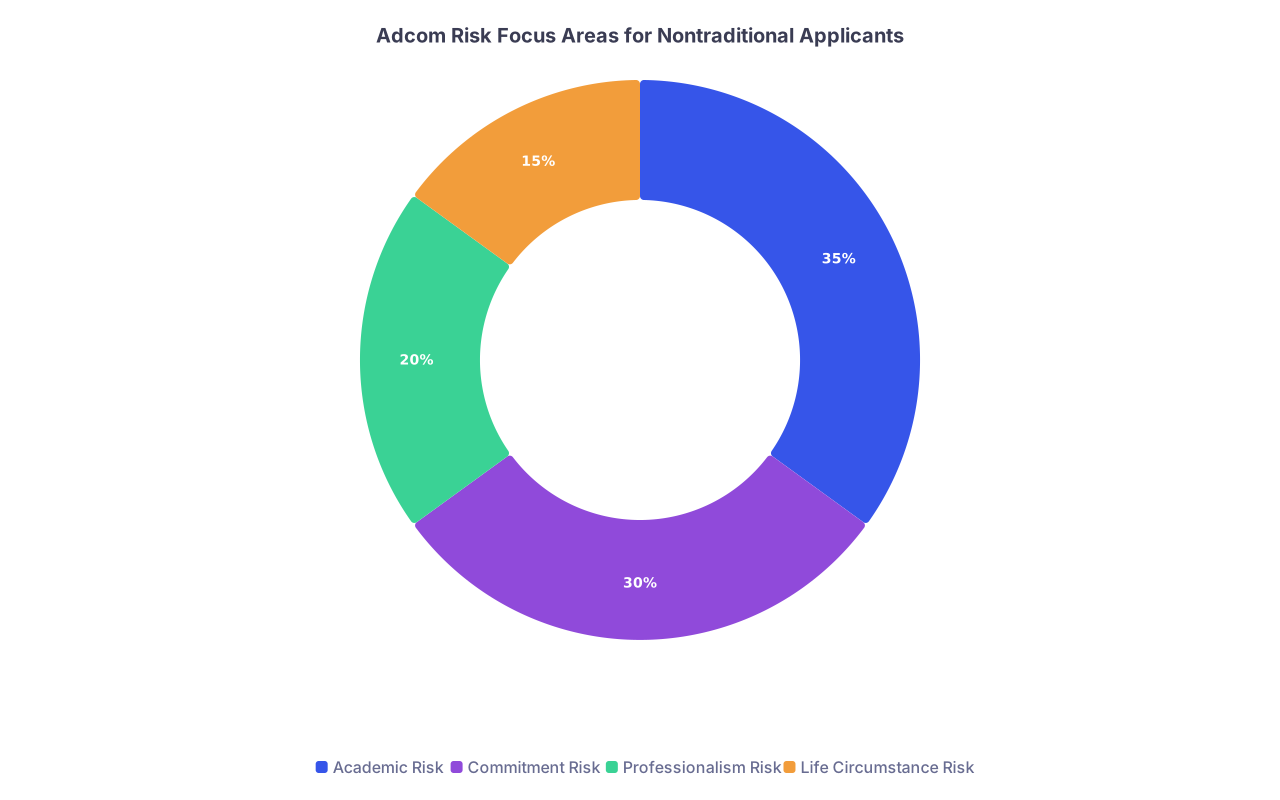
| Category | Value |
|---|---|
| Academic Risk | 35 |
| Commitment Risk | 30 |
| Professionalism Risk | 20 |
| Life Circumstance Risk | 15 |
1. Academic Risk: “Can you still do this at a high level?”
If you’ve been out of school for years, they immediately wonder:
- Can you still grind dense science material?
- Will you keep up with 8-hour study days?
- Did you run from hard sciences in undergrad and only circle back when you “found your calling”?
They look straight at:
- Old science grades vs. recent post-bacc or DIY coursework
- MCAT recency and performance
- Trend lines: did you show you can excel recently, not 8 years ago?
When an interviewer asks, “So what were you doing right after college?” they’re not making small talk. They’re trying to see if you stayed intellectually engaged or if you mentally checked out for five years.
2. Commitment Risk: “Is this a whim or a decision you’ve pressure-tested?”
Every adcom has stories:
- The nurse who thought med school would be a logical “next step” but hated the student role again
- The engineer who liked biology podcasts and then realized he loathed patient contact
- The finance person who wanted “more meaning,” then bailed after Step 1
So your delay raises the question: When did you become serious, and how do we know this won’t change again?
They’re scanning your timeline for:
- Years of consistent shadowing, clinical work, or volunteering
- Increasing responsibility in healthcare roles
- Not just “one dramatic moment” but a long pattern that says: “I’ve seen the ugly parts and still want in.”
3. Professionalism Risk: “Were you a mess before?”
Faculty are blunt when the door closes. Someone will say:
“He only got it together junior year. What was he doing until then?”
Late pivots or academic comebacks trigger this suspicion:
- Did you party away your first years?
- Were you lazy? Entitled?
- Did you lack follow-through in other goals?
- Did you quit things when they got hard?
When they ask why you didn’t apply earlier, they’re also asking, “Who were you before this version of you showed up in front of us?”
If your story sounds like avoidance, drifting, or chaos, you lose them.
4. Life Circumstance Risk: “Will your life blow up mid-training?”
Older applicants come with spouses, kids, mortgages, aging parents. Adcoms do not penalize that. But they do think about:
- Will you be pulled away constantly?
- Are you realistic about the time and geographic demands of training?
- Will competing responsibilities derail you?
They can’t ask, “Are your kids going to be a problem?” so they ask, “Why now?” and listen very carefully to how stable your life sounds.
How Your Answer Gets Picked Apart in the Committee Room
Here’s the part you never see. The closed-door debrief.
You leave the building. They shut the door. Someone says, “Alright, thoughts?”
One faculty member will bring up your timing almost immediately if you’re nontraditional.
Let’s take three example answers I’ve actually seen versions of.
The Sloppy Answer
“I wasn’t really sure what I wanted to do in college, and honestly I don’t think I was mature enough to handle medical school. I worked for a few years, tried different things, and now I’m finally ready.”
How that lands internally:
- “So he was unfocused and only ‘finally’ ready now? What changed?”
- “She admits she wasn’t mature. Is this late ‘maturity’ stable or situational?”
- “This sounds like drifting, not deliberate growth.”
I’ve watched candidates sink themselves with that kind of honesty-without-strategy. True, maybe. But it confirms every risk concern.
The Romantic Answer
“I always loved medicine, but then life took me in another direction. I had a calling moment with a patient, and I realized I had to follow my heart and become a physician.”
This sounds like a Hallmark movie. It triggers:
- “If one moment moved you into this, one bad moment might move you out.”
- “Where’s the sustained pattern of commitment?”
- “Is this person chasing a feeling or a profession?”
Passion without structure or evidence makes people nervous.
The Controlled, Credible Answer
“I was interested in medicine in college but my academic performance in the early years didn’t reflect what’s required to succeed in medical school. I chose not to apply then because I hadn’t yet proven to myself that I could perform at that level. Over the last four years, I’ve completed a full-time post-bacc while working part-time in a clinic, significantly strengthened my science foundation, and confirmed through day-to-day patient care that this is where I want to be long-term. I’m applying now because I can show—with recent grades, my MCAT, and years in clinical roles—that this isn’t a phase; it’s a deliberate transition I’m prepared to sustain.”
In the room, that answer leads to:
- “Okay, they owned the early weaknesses but showed a clear correction.”
- “They didn’t rush; they waited until their metrics and experience matched the goal.”
- “This is lower risk. I’m comfortable ranking them.”
Same basic story. Totally different read.
What They Want to Hear (Even If They Don’t Say It Out Loud)
They’re fishing for a few specific themes when they ask why you didn’t apply earlier. If your answer doesn’t hit these, you’re in trouble.
1. You Made a Conscious, Rational Decision to Wait
They want to hear that you didn’t apply earlier on purpose, not because you were drifting. For example:
- You recognized your grades weren’t competitive and chose to improve before applying.
- You wanted deeper exposure to healthcare before committing to a decade of training.
- You had obligations (family, military, financial) that you chose to honor first, and you can articulate that without sounding resentful or like a victim.
Adcom gold standard: “I chose to wait until I had evidence—academic, experiential, and personal—that I would succeed and persist.”
2. Your Delay Produced Measurable Growth, Not Just Time Passing
If your story is:
- “I worked random jobs for a few years and then decided on medicine,”
that’s weak.
If it’s:
- “Over five years as a respiratory therapist, I saw X, did Y, improved Z, and here’s how that shaped my understanding of medicine,”
that’s strong.
They want receipts:
- Recent A’s in upper-division science courses or post-bacc
- MCAT that shows serious prep
- Longitudinal clinical roles, not just check-the-box shadowing
- Evidence of resilience: work + family + classes managed without collapse
3. You Aren’t Blaming Anyone or Anything
The fastest way to get silently blacklisted in that room is to blame:
- Advisors: “No one told me I could do this earlier.”
- Family: “My parents wouldn’t support me.”
- Circumstance as pure victimhood: “Life just kept happening to me.”
Do personal circumstances matter? Absolutely. Are they valid? Yes. But adcoms are incredibly sensitive to victim narratives because they imagine you doing the same thing in residency: blaming everyone else when you fail an exam or drop a ball.
What plays better:
“I didn’t have mentors who knew this path, and I made some missteps early. I own that. Over the last few years, I sought out physicians, formal advising, and structured coursework to correct that and move forward deliberately.”
Ownership plus correction. That’s what they trust.
Common Late-Applicant Patterns — And How They’re Judged
Let me be blunt about a few archetypes I’ve watched get dissected in committees.

The “Career-Changer Professional”
Ex-consultant, engineer, accountant, tech worker. Good salary, now pivoting.
Adcom reaction: mixed.
Pros they see:
- You can function in adult environments
- You’ve worked in teams, taken feedback, met deadlines
- You likely have decent verbal skills and professionalism
Risks:
- They fear you’re chasing meaning rather than understanding the grind
- They’re skeptical if your only exposure is “shadowed for two weeks and loved it”
The answer they want: “I succeeded in my prior career, but after several years working closely with [clinicians/healthcare teams/patients] in [specific context], I realized my long-term satisfaction depends on direct patient care and long-term relationships that my previous role didn’t offer. I didn’t apply earlier because I was still evaluating that shift and building the clinical foundation to be certain this wasn’t escapism but a sustainable choice.”
The “Rebuilt GPA” Applicant
Started with a 2.7 GPA. Ended with a 3.0-something and a post-bacc with mostly A’s.
Adcoms are very experienced at reading this file.
Behind the scenes, they ask:
- “Is this true academic change or a temporary sprint?”
- “Did they take real sciences or fluff?”
- “Do they understand that med school looks more like their worst semester than their best?”
Your timing explanation should highlight:
- Why you did not apply with weak stats (good—shows judgment)
- How many semesters you’ve now sustained high performance
- What concrete changes you made in study habits, time management, and priorities
“We didn’t apply earlier because we hadn’t proven we could handle it” is one of the safest narratives—if your recent record backs it up.
The “Life Happened” Applicant
Caregiver. Parent. Illness. Financial crisis. Military. It’s real. Adcoms aren’t robots.
What they’re quietly assessing:
- Did you crumble or adapt?
- Is your life now more stable?
- Do you understand how brutal the schedule and debt will be?
Best version of this answer: you acknowledge the real barriers, show what you learned and how you became more capable, and then make it extremely clear that those barriers are now either resolved or sustainably managed.
Not: “I’m still overwhelmed but I hope med school will fix my life.”
How to Actually Answer This Question Without Shooting Yourself in the Foot
Here’s a structure I’ve seen work again and again in interviews and secondaries.

| Step | Description |
|---|---|
| Step 1 | Past Situation |
| Step 2 | Reason for Not Applying Then |
| Step 3 | What You Did Instead |
| Step 4 | What You Learned & How You Grew |
| Step 5 | Evidence Youre Ready Now |
| Step 6 | Why This Timing Makes Sense |
Step 1: Briefly ground them in your past situation
One or two sentences.
“I was the first in my family to attend college, working 30 hours a week, and I didn’t have a clear sense of what medicine actually involved beyond ‘doctors help people.’”
Or:
“I started college planning to go into engineering, and all of my coursework and internships were aligned with that path.”
Step 2: State explicitly why you didn’t apply then
“I didn’t apply to medical school during or right after college because I hadn’t yet demonstrated the academic performance and clinical understanding I believe are necessary to succeed and to make such a large commitment.”
Avoid: “I wasn’t ready.” Too vague. Sounds emotional, not rational.
Step 3: Describe what you did in the interim that’s relevant
This is where weak applicants waffle. Strong applicants are specific.
“I spent four years as a full-time paramedic, working in high-acuity settings. I enrolled in evening post-bacc courses in biology, organic chemistry, and physiology, averaging 20 credits a year while working. I added longitudinal shadowing with an internist and a hospitalist, and I joined a quality improvement project in the ED focused on sepsis protocols.”
Translate: not drifting. Deliberately moving closer.
Step 4: Tie that period to concrete growth
What changed in you?
“I learned to manage complex, high-stakes situations, communicate with frightened families, and collaborate with physicians under pressure. Academically, I replaced my passive cram-style studying with structured spaced repetition, leading to A’s in upper-level sciences and a 515 MCAT. Personally, I proved to myself that I could juggle demanding responsibilities over years, not weeks.”
Now your delay looks like an asset, not a red flag.
Step 5: Close with why now is the right time
“I’m applying now because my academic record, clinical experience, and personal circumstances have aligned. I’ve demonstrated I can excel in recent science coursework, I’ve spent years alongside physicians seeing the realities of the job, and my family and I have deliberately planned for the financial and time commitment of training. Earlier, I would have been guessing. Now I’m making an informed, tested decision.”
You’re not apologizing for your delay. You’re justifying your timing.
What You Should Fix Before Anyone Asks You This
If you’re still early in this process and reading this with a pit in your stomach, good. You can still fix things.
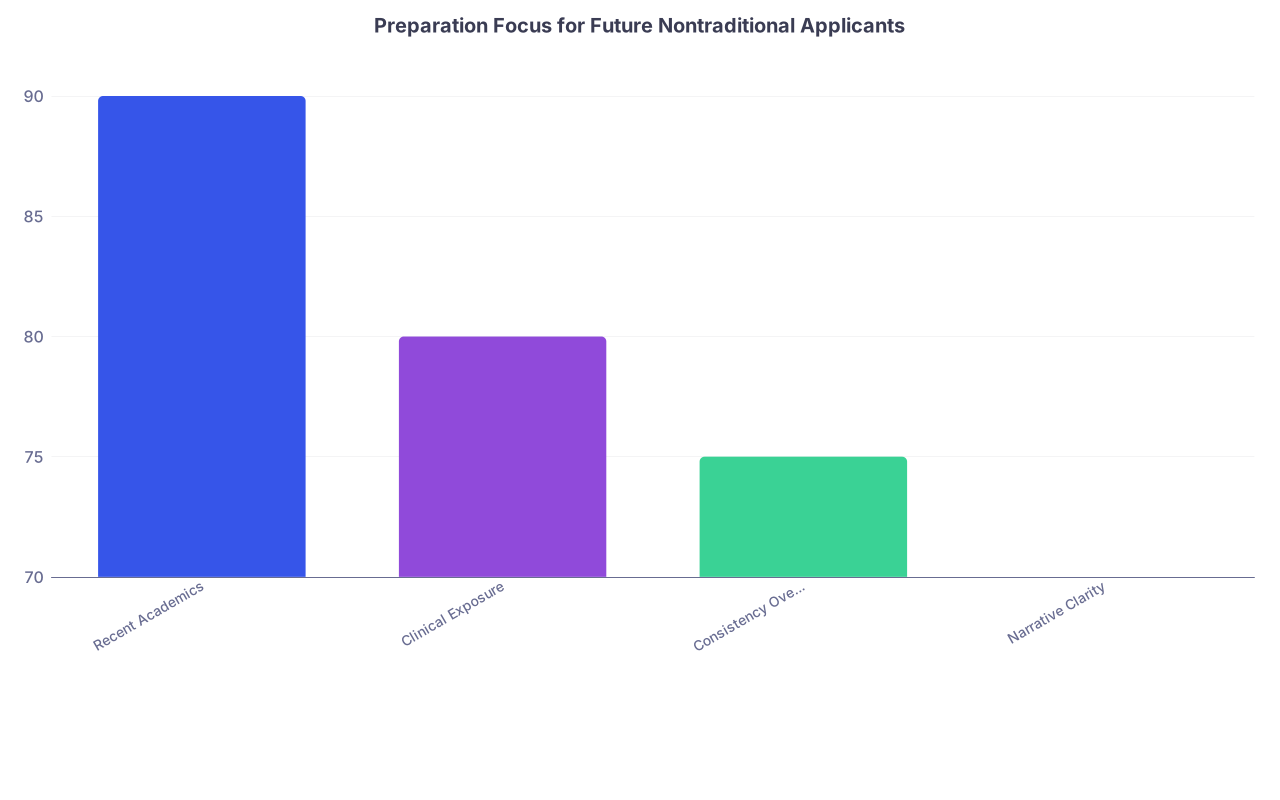
| Category | Value |
|---|---|
| Recent Academics | 90 |
| Clinical Exposure | 80 |
| Consistency Over Time | 75 |
| Narrative Clarity | 70 |
Here’s what adcoms subconsciously weigh heavily in your favor:
- Recent, rigorous coursework with A’s in real sciences
- MCAT within the last 2–3 years that’s competitive for your target schools
- At least 1–2 years of continuous clinical involvement in roles where you do more than bring blankets
- A timeline that makes sense — not random gaps you can’t explain without wincing
- A coherent story where each phase of your life leads logically to the next
You don’t need to be perfect. But you do need to be legible to them.
They need to be able to look at your journey and say, “I see the arc. I see the change. I see the stability now.”
If your arc right now looks like chaos, you’re not ready to apply. Not because you’re unworthy. Because the people in that room won’t be able to defend you when someone says, “I’m worried this person is a risk.”
And make no mistake: they have to defend you. Every admit has a faculty champion arguing why you’re worth a seat. Your job is to give that person ammunition, not excuses.
FAQ (Read This Before You Try to “Wing It”)
1. Can I be too honest about my past immaturity or mistakes?
Yes. Brutal honesty without framing is suicide in this context. You can acknowledge immaturity, poor choices, or aimlessness, but you must immediately pair it with concrete, sustained evidence of change. “I used to blow off deadlines” followed by “For the last four years I’ve taken 12–16 credits a semester while working full-time and haven’t missed a single major deadline” is acceptable. Confession without rehabilitation is just handing them reasons to reject you.
2. What if I truly only discovered medicine recently?
Then you overcompensate on two fronts: depth and duration. You need unusually deep clinical engagement in a relatively short period (scribe, MA, EMT, bedside tech) and a clear connection between your prior life and medicine. “I discovered medicine last year” is less dangerous if it’s “after five years working closely with physician teams as a clinical engineer” and more dangerous if it’s “after watching a YouTube video.” Your answer has to show this is an evolution, not a random pivot.
3. Is it bad to mention burnout from a previous career as a reason?
It’s risky. If you say, “I burned out of consulting because of the hours and stress,” adcoms immediately think, “So you chose medicine?” You can talk about misalignment—lack of purpose, wrong kind of work—but not “I couldn’t handle stress.” Reframe as: “I could perform at a high level, but the content and long-term impact of my work weren’t aligned with my values. In clinical settings, I’ve found that the long hours feel more meaningful and sustainable because…” You’re moving toward something, not running away.
4. How long of a gap or delay is “too long”?
There’s no hard number, but once you’re more than 7–10 years out from undergrad, you’re under a microscope. That doesn’t mean it’s impossible; it means you absolutely need fresh academics and very current clinical experience. If your last science class was 12 years ago and your MCAT is older than the current students, you’re dead in the water at most MD programs. Fix it with post-bacc work, a recent MCAT, and a very clear explanation of why now versus three years ago.
5. Do DO schools or Caribbean schools care less about this timing issue?
They may be somewhat more flexible on nontraditional paths and academic blips, especially DO schools that explicitly value life experience. But the core concerns are the same everywhere: can you handle the academics, and will you stick it out? Caribbean programs often don’t protect you from your own bad decisions—they admit you, take your tuition, and let attrition destroy your class. So no, you don’t “escape” this question by going offshore. You just shift who’s asking it and when. Better to answer it well now.
Key takeaways:
- When adcoms ask why you didn’t apply earlier, they’re not looking for drama; they’re assessing risk—academic, commitment, professionalism, and life stability.
- Your job isn’t to apologize for your timing, but to justify it with a clear, rational narrative backed by recent performance and sustained clinical engagement.
- If your current story reads as drifting, chaotic, or untested, fix the underlying reality before you apply; no clever wording can hide a genuinely unstable trajectory from a room full of people who’ve seen hundreds like you before.