
Why would anyone walk away from a $200K+ job, pay to go to school, and then work 80 hours a week as a trainee? That’s the skeptical question living in the back of a lot of admissions committee minds when they see your story.
If you’re a nontraditional applicant taking a massive salary cut to go into medicine, here’s the blunt truth: if you don’t control that narrative, they will. And their default assumption won’t flatter you.
Let me walk you straight through how to talk about it so you sound thoughtful, realistic, and mission-driven—not impulsive, burned out, or clueless about what you’re getting into.
What Adcoms Are Really Worried About When They See a Big Salary Cut
They’re not obsessed with your money. They’re obsessed with your judgment and staying power.
When they see “former software engineer / consultant / finance / tech sales” with a high prior income, they have a handful of very predictable concerns:
“Is this just an escape from a job they’re unhappy in?”
If you sound like you’re just running away from burnout, toxic bosses, or boredom, it’s a red flag. You’ll be just as miserable in residency.“Do they actually understand what medicine pays and demands?”
If you talk like you’re taking a vow of poverty or like all doctors are rich, you sound naive either way. They need to see you’ve done the math.“Will they bail when things get hard?”
Med school debt, delayed earning, night shifts, residency stress. If money used to matter enough to chase a high salary, why won’t it pull you back out?“Are they chasing status instead of service?”
Trading one prestige field for another without a clear ‘why’ looks shallow.
Your job is to show them three things:
- You know exactly what you’re giving up.
- You know exactly what you’re walking into.
- You still want it—based on values, not vibes.
That’s the bar.
The Core Message: How to Frame a Major Salary Cut Without Sounding Naive
You don’t need a sob story or a TED Talk. You need a clean, grounded narrative that hits four beats:
- You were successful and stable where you were.
- You got sustained, real exposure to medicine.
- You made a deliberate, informed choice to trade money for meaning and impact.
- You’ve already adjusted your life to match that choice.
Here’s the skeleton you can adapt.
1. Acknowledge your prior success without bragging
You want to avoid the vibe of: “I was killing it in finance and got bored so now… doctor time!”
Think something like:
“In my previous role as a senior software engineer, I was well-compensated and on a clear promotion track. I enjoyed the intellectual challenge and the stability it provided.”
That sentence does a lot of work:
- Shows you weren’t running from failure.
- Confirms you understand you’re giving up something real.
- Doesn’t shove numbers in their face.
You don’t need to list your exact salary in essays. If it comes up in secondaries or interviews, be matter-of-fact: “I was making around $X” and move on. No drama.
2. Show the gradual, evidence-based shift—not a whim
Naive sounds like: “One day I realized I wanted to help people, so I decided to become a doctor.”
Grounded sounds like:
“Over several years, I gradually became more involved in healthcare-related projects and volunteer work. I started by mentoring cancer survivors through a nonprofit, then shadowed an oncologist weekly for six months. Those experiences shifted my priorities toward direct patient care.”
Key features:
- “Over several years” or “over time” → not impulsive.
- Specifics: nonprofit name, clinic type, duration of shadowing.
- Clear connection between experiences and your decision.
If you can’t name:
- How many months you shadowed
- What type of clinic/hospital
- What your role was in volunteering or work
…then your story is going to feel thin. Go fix that now before you apply.
3. Explicitly acknowledge the salary cut—with adult perspective
Don’t pretend the money doesn’t matter. That’s exactly what sounds naive.
Use something like this framing:
“I’m very aware that this path means stepping away from a high salary and taking on significant training debt. I sat down with my partner / family and we went through the numbers together. We adjusted our budget, downsized our housing, and built a savings plan to cover at least the first two years. I’m not ignoring the financial cost—I’ve planned for it and still believe the trade-off is worth it for the kind of work I want to do.”
That one paragraph signals:
- You’ve actually done the math.
- You’re not depending on magical future-physician income to save you.
- You’ve already taken concrete steps.
Naive: “I know doctors make good money so it’ll work out.”
Mature: “I know I’m giving up a lot financially. I’ve planned for it anyway.”
4. Make your values crystal clear and specific
This is where most people default to clichés:
- “I want to help people.”
- “I want to give back.”
- “I want a more meaningful career.”
That’s vague and overused. You need to drill down into what kind of meaning, with concrete examples.
Compare:
Vague:
“I wanted more meaningful work, so I chose medicine.”
Specific:
“What stayed with me wasn’t launching another financial product; it was sitting with a patient after their biopsy, answering questions for 45 minutes that wouldn’t fit into the clinic schedule. The combination of scientific problem-solving and being trusted at such a vulnerable moment felt like the kind of work I want to spend my life doing.”
See the difference? You’re not saying “meaningful” and hoping they fill in the gaps. You’re showing it.
What To Actually Say in Essays, Secondaries, and Interviews
Let’s make this practical. You’ll usually see this come up in:
- Personal statement
- “Why medicine?” or “Why now?” essays
- Secondaries for non-traditional applicants
- Interview questions: “Why leave your prior career?” or “How will you handle the financial change?”
In Your Personal Statement
You don’t need a whole section titled “SALARY CUT.” Just weave it in.
Somewhere after you’ve described your previous career and what shifted:
“Transitioning from my current career to medicine isn’t a financial upgrade; it’s a conscious decision to trade a high salary and comfortable routine for years of training, debt, and uncertainty. I don’t see that lightly. But the more time I spent in clinic—learning the language of illness, watching teams manage complex care, and seeing the impact of a physician’s decisions—the more I felt that this was a responsibility I was willing to earn, even at significant personal cost.”
You hit:
- Financial reality acknowledged
- No martyr complex
- Clear-eyed acceptance
In “Why Medicine?” or “Why Now?” Essays
A simple, mature line often works best:
“I reached a point where continued advancement in my current field would primarily mean more income and responsibility without changing the kind of impact I had on people’s lives. Medicine, by contrast, offers work that is intellectually demanding and emotionally costly—but directly aligned with the way I want to serve others.”
No drama, no “calling from the universe,” just priorities and trade-offs.
In Interviews When They Flat-Out Ask About Money
If they say, “You were making a lot of money—why walk away from that?” don’t squirm.
Try something like:
“You’re right, I was compensated very well, and I’m grateful for that. I enjoyed the work and the people. But as I got more involved in patient-facing experiences, I realized I cared more about how I was spending my hours than the pay attached to them. I’ve run the numbers with my family, cut expenses, and built savings. I know this is a financial step down for a long time. I’m choosing it because the work itself matters more to me long-term than the salary does.”
If they push further: “Do you understand what resident life and pay looks like?”:
“Yes. I’ve talked with multiple residents in [specialty] at [hospital], seen their schedules, and heard about the call hours. I know starting salaries are low relative to the hours and debt. It’s not glamorous. But I’m not doing this for the lifestyle; I’m doing it because I’ve seen what it looks like up close and I still want to be in that role.”
That doesn’t sound naive. That sounds like someone who’s done their homework.
Mistakes That Make You Sound Naive (And How to Fix Them)
Let’s be blunt about what doesn’t work.
1. Oversharing your old income to impress them
Wrong move:
“I was making over $300K with bonuses by age 30…”
They don’t care. It risks sounding like you’re used to being the special one.
Fix: Reference success without flexing:
“I was very well-compensated and on track for partnership.”
2. Acting like money is evil now
Wrong move:
“I realized money doesn’t matter at all and I don’t care about it anymore.”
Come on. You’re taking on six figures of debt. Money matters.
Fix:
“Money still matters—it’s how I’ll support myself and my family. But it’s not my primary decision-maker anymore.”
3. Speaking vaguely about the “calling” without concrete experience
Wrong move:
“I just know I’m meant to be a doctor.”
Fix: Anchor your “calling” in actual experiences with patients, clinics, and long-term commitment:
“Spending a year volunteering in the ED every week, and shadowing in primary care, convinced me that I’m willing to accept the sacrifices that come with becoming a physician.”
4. Ignoring the numbers altogether
Wrong move: Never mentioning loans, training length, pay cut, or life adjustments.
Fix: One or two sentences showing you’ve thought about finances and lifestyle is enough.
Concrete Example: Before and After
Here’s a full example of how to tighten this up.
Weak version:
“I worked in investment banking and made a very high salary, but I realized that money doesn’t buy happiness and I wanted to do more meaningful work. I know that doctors don’t make that much in training but they eventually do well and I think it will be worth it because I want to help people.”
Problems:
- Cliché
- Minimizes financial reality
- Sounds uninformed about medicine
- Zero specifics
Stronger version:
“For the last seven years, I’ve worked in investment banking and was well-compensated with a clear path to continued financial growth. A few years ago, I started volunteering at a free clinic on Wednesday nights, initially just helping with intake and paperwork. Over time, I found myself staying late to translate for Spanish-speaking patients and sitting with them while they waited for lab results.
Those hours, unpaid and often past midnight, were the ones I looked forward to the most. They contrasted sharply with my day job, where my success was measured in deal size and quarterly numbers. After shadowing the clinic’s internal medicine physician for six months and speaking with residents about their training, I took a hard look at what it would mean to step away from my current salary, take on debt, and start over. My partner and I simplified our lifestyle, built a savings cushion, and accepted that we’d be living on a trainee salary for many years.
I’m not leaving banking because I failed there; I’m leaving because I’ve found work that aligns better with my values, even though it costs more, financially and personally. Medicine is the only career where the combination of long-term relationships, scientific depth, and responsibility for another person’s life feels like the right use of my time.”
That’s the tone you’re aiming for.
| Element | Naive Version | Strong Version |
|---|---|---|
| Prior Career Description | “I hated my job.” | “I was successful and stable, but misaligned.” |
| Financial Reality | “Money doesn’t matter.” | “I’ve run the numbers and adjusted my life.” |
| Exposure to Medicine | “I’ve always wanted to be a doctor.” | “Here’s what I did, for how long, and what I saw.” |
| Reason for Switch | “More meaningful work.” | Specific values + patient-facing experiences |
| Understanding of Training | “Doctors eventually earn a lot.” | “I understand residency pay, hours, and trade-offs.” |

| Step | Description |
|---|---|
| Step 1 | Stable High-Paying Career |
| Step 2 | Healthcare Exposure |
| Step 3 | Reflect on Values |
| Step 4 | Research Medicine & Training |
| Step 5 | Financial & Lifestyle Planning |
| Step 6 | Consistent Clinical Experience |
| Step 7 | Decision to Apply to Medical School |
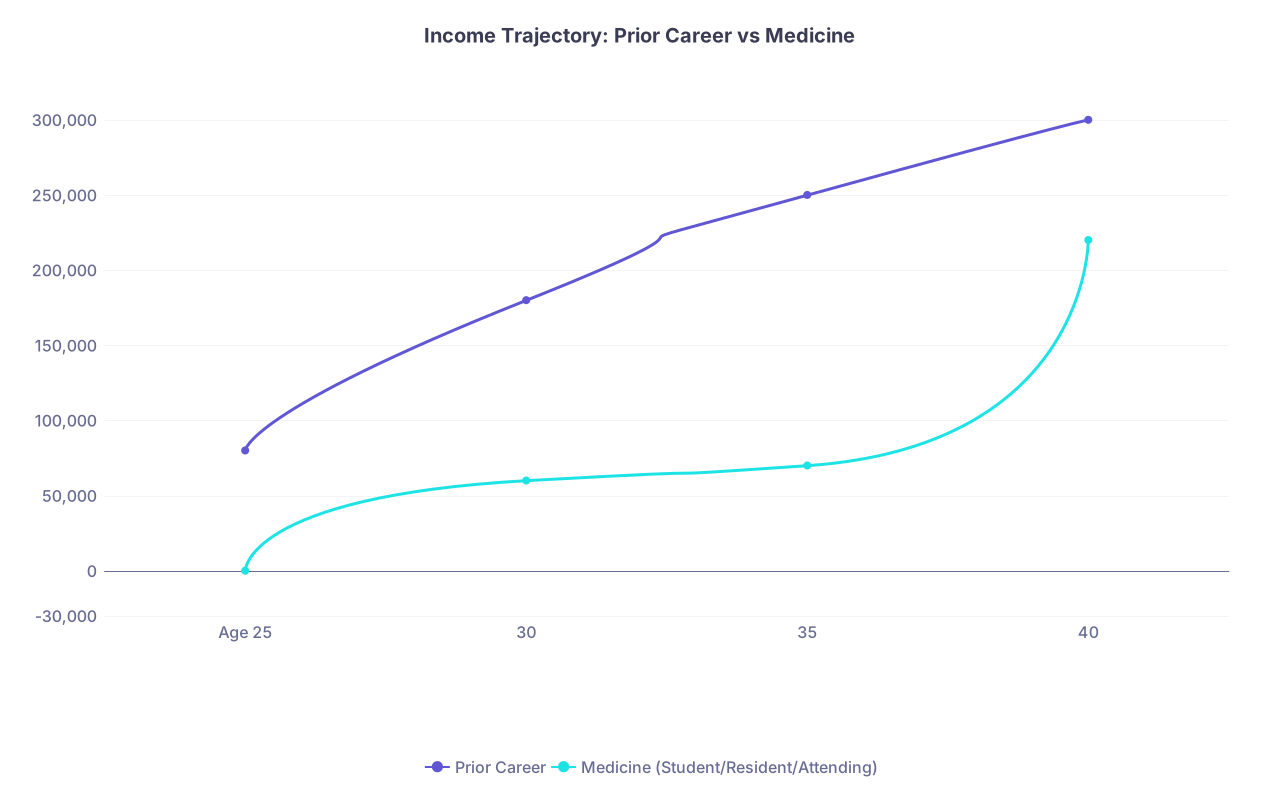
| Category | Prior Career | Medicine (Student/Resident/Attending) |
|---|---|---|
| Age 25 | 80000 | 0 |
| 30 | 180000 | 60000 |
| 35 | 250000 | 70000 |
| 40 | 300000 | 220000 |
What You Should Do Today
Open your personal statement or “Why Medicine” essay draft and find the parts where you talk about:
- Leaving your prior career
- Wanting “more meaning”
- Mentioning finances or sacrifice
Now ruthlessly edit those sections using three questions:
- Did I show specific experiences that pulled me toward medicine, or did I just say “meaningful impact”?
- Did I acknowledge the financial reality in 1–2 grounded sentences?
- Did I sound like I’d made a thoughtful, informed trade-off—not an emotional leap?
If the answer is no to any of those, fix that paragraph today. Don’t wait.
FAQ (Exactly 7 Questions)
1. Should I ever state my exact previous salary in an application?
Only if directly asked (e.g., in an interview conversation). Otherwise, keep it general: “well-compensated,” “high-paying role,” or “six-figure salary.” The goal is to show you’re giving up something significant without turning your application into a flex about past income.
2. What if my previous career was high-status but not actually that high-paying?
You can still frame it in terms of stability, trajectory, and opportunity cost. For example: “I was on a clear partnership track” or “I had strong promotion prospects and job security.” The key is that you’re leaving a viable, rational path—not that you were rich.
3. How much should I talk about debt and loans?
Just enough to show you’ve thought about it. One or two sentences is plenty: mention that you’ve looked at tuition, living costs, loan repayment, and made a budget or plan. You don’t need a full financial breakdown in your essay.
4. What if my family is financially supporting this transition? Does that sound privileged?
Mention it plainly and pair it with your own sacrifices. For example: “I’m fortunate to have some financial support from my family, and I’ve also downsized my lifestyle, saved aggressively, and taken on part-time work to contribute.” Transparency + responsibility beats pretending it’s not there.
5. Will adcoms judge me for leaving a very lucrative field like tech or finance?
They’ll judge you if you leave it for vague, shallow reasons. If you clearly explain: (1) what you learned there, (2) how that experience will help you as a physician, and (3) why medicine aligns better with your values despite the pay cut, they’re more likely to see your background as an asset.
6. Can I say I’m okay making less money because I value work-life balance?
Careful here. Medicine is not a work-life balance paradise, especially in training. You can say you value meaningful work over pure income, but implying medicine is an easier lifestyle will absolutely make you sound naive. Focus on values and type of work, not time off.
7. What if I was burned out and that’s part of why I left—can I say that?
You can, but frame it maturely. Instead of “I was burned out and miserable,” try: “I recognized that the way my previous field measured success—constant availability, short timelines, and financial output—wasn’t sustainable for me long-term. Clinical experiences showed me a different kind of hard work that, while demanding, aligns better with how I want to spend my energy.” Never make medicine sound like your escape hatch; make it your deliberate choice.