You’re 32. Or 42. Your LinkedIn still screams “engineer / teacher / analyst,” but your browser history is just AMCAS requirements and SDN threads. You’ve realized medicine is where you’re headed. Now you’re staring at one question that keeps popping up in every forum:
“What kind of clinical experience do I actually need as a career changer—and what really matters?”
Let me give you the short version up front:
Medical schools care less about the title and far more about the exposure, responsibility, continuity, and insight you gain. Some experiences are efficient, high-yield, and credible. Others are checkbox fluff.
You’re a nontraditional applicant. You don’t have time to waste on fluff.
The 4 Things Admissions Actually Want From Your Clinical Experience
Forget the specific job for a second. Every clinical role is just a vehicle for four core things adcoms are trying to verify:
- You understand what doctors actually do.
- You’ve seen real patients in unfiltered situations.
- You still want to do this despite seeing the messy parts.
- You can function around sick, vulnerable, sometimes very difficult people.
Any experience that hits those four well is “good.” Any experience that misses more than one of them, I’d call weak.
Here’s how I’d rate common options by impact and efficiency for career changers:
| Experience Type | Overall Impact | Time Efficiency | Direct Patient Contact | Good for Nontrads? |
|---|---|---|---|---|
| Scribe (ED / outpatient) | High | High | High | Excellent |
| Medical Assistant (MA) | High | Medium | High | Excellent |
| EMT / ER Tech | High | Medium | High | Strong |
| Hospice / Inpatient Volunteering | Medium-High | High | Medium-High | Strong |
| Shadowing Only | Low-Medium | High | Low | Necessary but Insufficient |
| Overseas / Mission Trips (Short-Term) | Low-Medium | Low | Variable | Often Overrated |
If you’re a career changer, your time is your most valuable currency. Scribing, MA work, and solid hospital/hospice volunteering tend to give you the best return on investment.
What “Clinical” Actually Means (And Common Mistakes Nontrads Make)
Clinical = you’re interacting with patients or directly supporting their care in a healthcare setting.
That includes:
– Taking vitals, rooming patients, helping with mobility
– Sitting with patients, hearing their stories, helping them eat or dress
– Being in the room as clinicians take histories, explain diagnoses, make decisions
– Charting for providers as they work (scribing)
What does not count as meaningful clinical:
– Filing papers in a hospital basement
– Managing a medical office website from home
– Working in a lab without patient interaction
– Doing “quality improvement” work that never brings you to the bedside
If you can do the job without ever smelling antiseptic or hearing a monitor alarm, it’s probably not clinical.
The Gold Standards for Career Changers
1. Medical Scribing: High-Yield, High Credibility
If you want one answer to “What should I do?” for a career changer: scribing is usually it.
You stand next to a provider—ED, outpatient, specialty—and document the patient encounter in real time. You see the history, physical exam, assessment, and plan for hundreds of patients.
Why it’s so strong:
- Constant exposure to physician decision-making
- You learn medical language properly, not just from YouTube
- You see a huge variety of cases quickly—chest pain, vague fatigue, psych crises
- You get to see how different doctors practice differently (and who you do not want to be)
Downsides:
- Pay can be low, hours can be rough, training can be tedious
- Some programs exploit scribes—high turnover, limited mentorship
If you do it for 1–2 years part-time while you do post-bacc work, you walk into med school interviews with hundreds of real patient stories and very realistic expectations.
2. Medical Assistant (MA): Hands-On, Patient-Facing
MA roles can be fantastic if you find the right clinic.
Typical duties:
- Rooming patients, taking vitals
- Doing EKGs, point-of-care tests, maybe basic injections (depending on state/clinic)
- Calling patients, giving instructions, coordinating referrals
Why adcoms like it:
- Shows you can handle responsibility and direct patient care
- Lets you understand outpatient medicine and clinic workflow
- Proves you can handle pressure, multitasking, emotional patients
For career changers, it’s especially nice because:
- You’re clearly taking a pay and status reset to get this experience → signals commitment
- It’s easy to talk about concrete “I helped this patient…” stories in your application
Caution: Some “MA” jobs are basically front desk work. If you’re not regularly with patients, keep looking.
3. EMT / ER Tech: Intense but Powerful
If you want something more acute and you can handle odd hours: EMT or ER Tech can be very strong.
EMT:
- You respond to 911 calls, transfers, etc.
- You learn to manage chaos, communicate under stress, and see people at their worst moments.
- Shows you’re comfortable with blood, emergencies, and unpredictability.
ER Tech:
- Often more stable schedule than EMT
- Very hands-on: vitals, ECGs, assisting procedures, transporting patients
For nontrads, this can be compelling, but be honest:
- It can be physically demanding.
- Burnout is real.
- Training/certification takes time—only do it if it genuinely interests you.
If your long-term plan is emergency medicine, critical care, or you just want to know how you handle acute situations, this is powerful evidence.
The “Good Enough” but Still Valuable Options
4. Hospital or Clinic Volunteering
Volunteering can range from excellent to useless depending on the role.
Good versions:
- Inpatient volunteer actually on the floors: delivering meals, talking to patients, helping transport
- ED volunteer who interacts with patients, restocks rooms, observes flow
- Hospice volunteer who sits with patients and families
Weak versions:
- “Volunteer” who only wipes counters in a lobby or restocks pamphlets
- Someone who never enters a patient room
Hospice deserves its own mention. It’s not flashy, but:
- It shows you can sit with suffering without looking away.
- You see families when grief and medicine collide.
- You learn communication and presence more than procedures.
I’ve seen hospice experiences turn into some of the best personal statement material because they force real reflection.
5. Shadowing: Required, But Not Sufficient
Shadowing is the bare minimum. You need it to answer the question, “Do you know what physicians do all day?” But it’s passive.
Shadowing is watching. Clinical experience is doing.
For career changers, admissions committees already worry:
You had a whole other life. Are you idealizing medicine?
Shadowing alone will not convince them.
Use shadowing to:
- Compare specialties (FM vs IM vs surgery vs EM)
- See how different physicians communicate and cope
- Understand workflow and team structure
Then pair it with something more engaged—scribe, MA, hospice, etc.
How Much Clinical Experience is “Enough” for a Career Changer?
There’s no magic number, but there are clear ranges that signal seriousness.
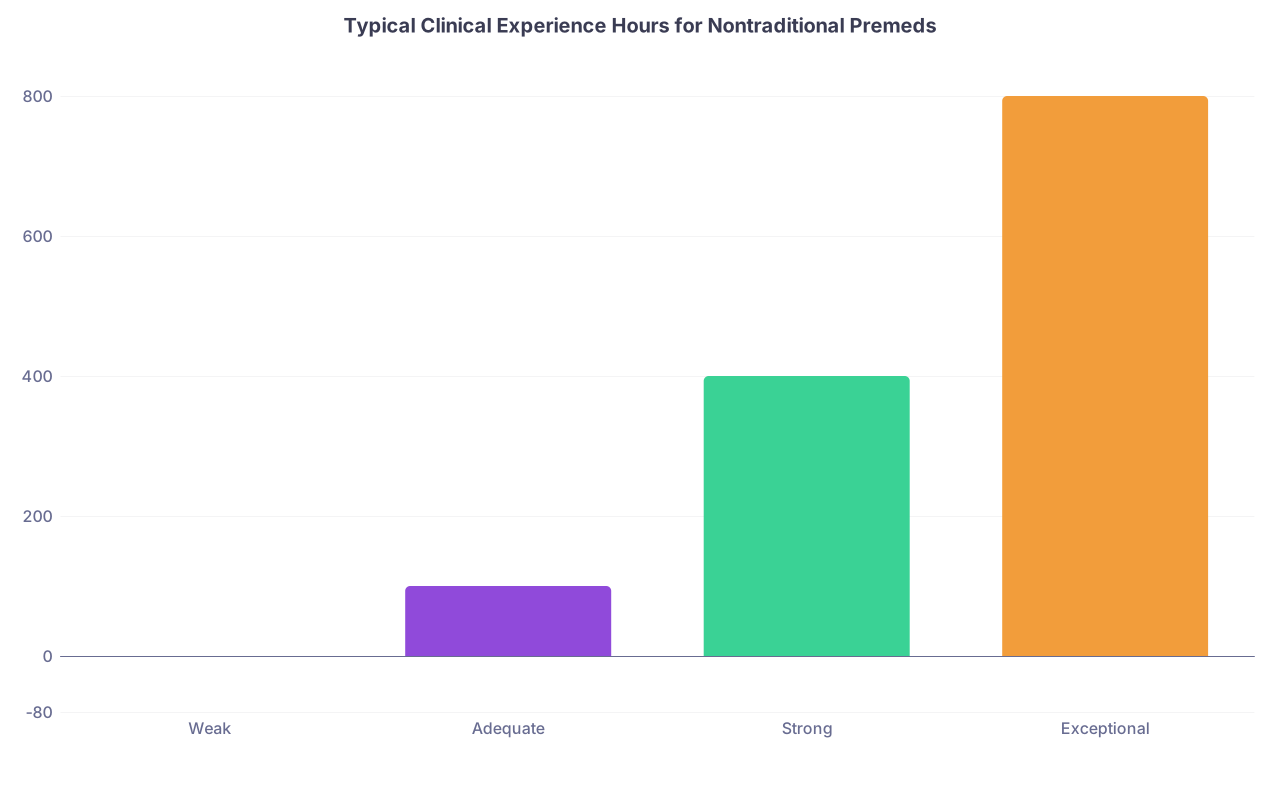
| Category | Value |
|---|---|
| Weak | 0 |
| Adequate | 100 |
| Strong | 400 |
| Exceptional | 800 |
Here’s how I’d frame it:
- Under 50 hours: Red flag. Looks like dabbling.
- 100–200 hours: Bare minimum. You understand the environment, but depth may be questioned.
- 300–500 hours: Solid for a busy career changer, especially paired with strong reflection.
- 500+ hours: Very strong, especially if it’s in one or two sustained roles.
For a full career changer (new post-bacc, leaving a prior field), I like to see:
- At least 200–300 hours of solid, real clinical exposure
- Preferably over at least 6–12 months, not crammed into one summer
Continuity matters. A year of once-a-week hospice > two weeks of full-time “medical mission” abroad.
What Matters Most Specifically for Career Changers
You’re not a 20-year-old who just discovered anatomy. You’re someone who already had a path and is walking away from it. Admissions will look for different things from you:
1. Evidence You Aren’t Romanticizing Medicine
They want to see you’ve watched:
- Insurance fights, prior auth nonsense
- Burned-out residents
- Overbooked clinics running an hour behind
- The emotional cost when bad outcomes happen
Your clinical experience should arm you to say, in an interview: “Yes, I’ve seen the hard parts. I still want this, and here’s why.”
Scribing and MA work shine here because you’re inside the actual grind.
2. A Coherent Story Connecting Old Career → Clinical Work → Medicine
Clinical experience is the bridge between your past life and your future one.
Example:
- Former teacher → MA in pediatrics → MD with interest in peds/adolescent medicine
- Former software engineer → ED scribe with interest in EM workflow → MD with future in EM, QI, or informatics
- Former business professional → hospice volunteer → MD interested in palliative care and system-level change
When your clinical work is aligned with your narrative, it stops being just “checking a box” and becomes: “This is the test drive that confirmed I’m picking the right career.”
3. Signs You Can Function in Hierarchies and Teams
You’re older. You may have led teams, supervised people. Medicine will put you back at the bottom of the hierarchy.
Clinical experiences that show:
- You can take direction from nurses and techs without ego
- You can communicate respectfully with patients, families, staff
- You don’t act like the “smart consultant” in the room before you’ve earned it
Those things will help offset the concern that you’ll be a problem resident later.
What’s Overrated or Problematic
A few things I see nontrads overemphasize:
Short-term overseas “medical mission” trips
- Often ethically gray if you’re doing things you aren’t trained for
- Can look like voluntourism if not framed carefully
- One week abroad does not substitute for sustained, local, real clinical experience
Telehealth “experience” where you never interact with patients
- If you’re just staring at a dashboard from home, it’s not clinical
- Can be great in addition to but not instead of in-person work
Overly administrative “healthcare” jobs
- Insurance, billing, call center roles are healthcare-adjacent
- You still need direct patient contact somewhere in your profile
Use these as supplements, not your main clinical foundation.
How to Choose When You’re Short on Time
If you’re working full-time and doing prereqs, you need something realistic.
Here’s a simple decision flow:

| Step | Description |
|---|---|
| Step 1 | Need Clinical Experience |
| Step 2 | Hospital/Hospice Volunteering Evenings/Weekends |
| Step 3 | MA, EMT, or ER Tech Role |
| Step 4 | Medical Scribe (ED or Outpatient) |
| Step 5 | Target 8-16 hrs/week |
| Step 6 | Target 4-8 hrs/week Long-Term |
| Step 7 | Can reduce work hours? |
| Step 8 | Want direct hands-on care? |
If you can cut back on your main job:
– Scribe or MA 12–20 hours/week = ideal.
If you can’t:
– One solid weekly 4–6 hour volunteer shift in a real clinical setting for a year is absolutely workable. Pair with some shadowing.
How to Present Your Clinical Work on Applications
The experience itself is half the battle. The other half is how you frame it.
Focus your descriptions and essays on:
- Specific patients or moments that changed your understanding
- What you learned about the physician role
- How it confirmed or redirected your interest in medicine
- How you saw your prior skills (teaching, analysis, leadership) show up in a clinical context
Avoid:
- Generic “I like helping people” clichés
- Just listing tasks (took vitals, filed charts) without reflection
- Overdramatizing—adcoms can smell embellishment
Your goal: Show that your clinical experience turned “I think I want to be a doctor” into “I know what I’m signing up for—and I still choose it.”
FAQ: Career Changer Clinical Experience
If I already work in healthcare (RN, PT, PharmD), do I still need separate clinical experience?
Usually not, as long as your current role includes direct patient care. Being an RN in an ICU or a PT in outpatient ortho is very legitimate clinical exposure. You do still need some shadowing of physicians specifically so you can compare your current role to the MD role, but you don’t need to go be a scribe on top of that.Is virtual shadowing or online clinical experience acceptable?
It’s better than nothing, but it’s weak on its own. Virtual shadowing can supplement in-person work, especially during weird times (like COVID surges), but it does not replace actually being around live patients. Use it to add breadth, not to substitute for the real thing.I’m 38 with a family—what’s the minimum I can get away with realistically?
If your story is otherwise strong, I’d aim for at least 150–250 hours of solid, real clinical exposure plus thoughtful reflection. That could be: one 4–6 hour shift per week for a year as a hospice or hospital volunteer, plus a few focused blocks of shadowing. More is better, but I’ve seen people succeed with that level if everything else (academics, narrative, maturity) is strong.Does paid clinical experience look better than unpaid?
Paid vs unpaid matters less than responsibility and depth. A paid scribe with real exposure beats a volunteer who only stocks blankets. But a hospice volunteer who spends hours at the bedside every week can look more meaningful than a “paid” job that’s mostly administrative. Don’t obsess over the paycheck; obsess over how close you are to patients and physicians.How long do I need to stay in one clinical role?
Six months is the absolute minimum where it starts to feel like continuity. Twelve months is better. Switching from job to job every 2–3 months makes you look like you’re sampling instead of committing. For nontrads, one or two sustained roles—e.g., 1 year as a scribe + 1 year of weekly hospice—tell a more convincing story than five short gigs.Should I delay applying a year to build stronger clinical experience?
If your current clinical exposure is basically “some shadowing and a couple of volunteer events,” then yes, I’d delay. Starting late and reapplying wastes more time than taking one extra year now to build a rock-solid foundation. If you’re already at 200–300+ hours of decent experience and the rest of your app is strong, you’re probably fine to apply without a delay.
Key points to walk away with:
- The type of clinical experience matters less than the depth, continuity, and reflection you bring to it—though scribing, MA, EMT/ER tech, and hospice/hospital volunteering are especially strong for career changers.
- As a nontraditional applicant, your clinical work has to prove you aren’t romanticizing medicine and that you understand—and still accept—the realities of the job.
- Aim for sustained, patient-facing roles that fit your life, and use them to build a coherent story connecting who you were, what you’ve seen, and why medicine is your deliberate next step.