It’s 9:45 p.m. Your kids are finally in bed, Slack has gone quiet, and you’re staring at two tabs on your laptop:
- A glossy “Career Changer Post‑Bacc” program page with a horrifying tuition number.
- Your local community college course catalog with Chem 1A for $180.
You’re mid‑30s (or 40s), with a real career, rent or a mortgage, and probably people depending on you. You’ve decided you want to be a physician. Now you’re stuck on the fork in the road:
Do you pay for the formal post‑bacc…or build a DIY route from local colleges and universities?
Let me be direct: both paths can work extremely well. Both can also be a disaster if you pick the wrong one for your situation. The key is matching the path to your actual constraints, not to some idealized version of yourself.
Below is the framework I use when advising late‑career premeds who ask this exact question.
First: What You Actually Need as a Late‑Career Premed
Strip away the marketing. As a late‑career premed, you need four things:
A strong academic record in the sciences
If your prior GPA is weak or ancient, you need fresh, A‑level work in hard science courses. This is your “proof of concept” for adcoms: yes, I can handle med school.MCAT readiness
Your coursework should set you up to crush the MCAT, not just squeak by. The MCAT is one of the only standardized, recent data points you’ll have.Clinical exposure and some service
Shadowing, clinical volunteering/employment, and ideally some longitudinal service that shows commitment and maturity.A narrative that makes sense
Why medicine, why now, and why you’re not just having a midlife crisis. Your choices in coursework, timing, and work transitions feed into that story.
A formal post‑bacc and a DIY route are just two different ways to try to get those four things done.
What a Formal Post‑Bacc Really Buys You (and What It Doesn’t)
When I say “formal post‑bacc,” I mean structured, usually one‑ or two‑year programs for “career changers” or “academic enhancers” at 4‑year colleges or universities. Think places like Goucher, Scripps, Bryn Mawr, Columbia, or state‑school certificates.
The Real Advantages
Here’s what you’re actually paying for when formal post‑baccs are done well:
Cohort and structure
Set curriculum. Sequenced courses. You move through with a group of peers. For people who’ve been out of school for 10–20 years, this scaffolding can be the difference between finishing and flaming out.Premed advising that actually understands nontrads
Someone who’s seen hundreds of paths, can tell you “Do not take Orgo and Physics together your first semester back” and will push back when your plan is unrealistic.Committee letter and institutional backing
A committee letter from a respected program can carry real weight, especially if your undergrad performance was mediocre. It packages your story and vouches for your transformation.Linkage opportunities (if the program has them)
A small number of programs have real linkages—conditional early acceptance—to specific med schools. Hard to get, not guaranteed, but for the right candidate they can shave a year off and reduce uncertainty.Built‑in community and accountability
You’re surrounded by people all trying to do the same thing. Study groups appear on their own. Peer pressure works in your favor.Brand name
Fair or not, “completed a rigorous structured program at X” sometimes reads better than random community college classes scattered over years, especially for very competitive MD schools.
The Downsides No One Markets
Cost is often obscene
Tuition for some private post‑baccs is basically a cheap medical school year. Add living expenses plus lost income if you go full‑time. For a late‑career person with dependents, this can be genuinely reckless.Less flexibility
You’re mostly locked into their timeline and course sequence. Want to go slower because you have a full‑time job and kids? Many programs are not built for that.Geographic disruption
You may have to move. Uproot spouse/partner and kids, or live apart. That’s not a small thing in your 30s or 40s.Not all “formal post‑baccs” are good
Some are just rebranded evening classes with a “premed” label slapped on. Minimal advising, no real linkage, no committee letter. You pay a premium for a brochure.
So: a formal program buys structure, support, and sometimes brand, at the cost of money and flexibility. For the right person, totally worth it. For others, a terrible financial decision.
What a DIY Post‑Bacc Looks Like (When Done Right)
DIY means you assemble your own curriculum using local community colleges, state schools, extension programs, or online‑lecture/in‑person‑lab hybrids where allowed. No packaged certificate. No fancy brochure.
This can be brilliant or it can look like academic chaos. The difference is planning.
DIY Done Well Has These Features
Deliberate course selection
You’re not just signing up for whatever fits your schedule. You map out what med schools want:
– 1 year Gen Chem + lab
– 1 year Bio + lab
– 1 year Physics + lab
– 1 year Organic Chem (or 1 sem orgo + 1 sem biochem, depending on schools)
– Some upper‑division science (e.g., physiology, cell bio, genetics) if your prior GPA needs evidence of rigor.Known‑strong instructors
You talk to other students, read detailed reviews, and find the sections where people actually learn rather than just survive. MCAT‑relevant teaching matters.Conscious mix of institutions
Maybe you do Gen Chem and Bio at community college (cheaper, more flexible) and upper‑division coursework at a 4‑year university to show you can hang with university‑level rigor.You create your own “advising structure”
That means using forums, current med students, school‑specific websites, and sometimes paying for a few targeted hours with a private advisor who knows nontrads.
Where DIY Bites People
Weak or fragmented narrative
Random classes over six years at three different schools, with gaps and withdrawals, no clear progression. It reads as “unfocused” unless you can clearly explain the constraints.No committee letter
You’ll be applying with individual letters only. That’s fine—plenty of people do—but you need strong, specific letters from science faculty and supervisors.Self‑discipline burden
Nobody is scheduling your chem lab around your job or warning you before you overload yourself. If you chronically overestimate what you can do, DIY becomes a minefield.Adcom skepticism if done sloppily
Community college science is not “worthless,” but if all your work is at an open‑admissions CC and your old GPA is bad, some competitive MD schools will quietly move your file to the bottom. DO schools are often more forgiving, but you still want some higher‑level evidence.
Bottom line: DIY is powerful for late‑career people because it’s flexible, local, and affordable. But only if you treat it like a real program you are intentionally designing.
How Med Schools Actually View Formal vs DIY
Let’s cut through mythology. Do most med schools “prefer” a formal post‑bacc over DIY? No—what they prefer is clear evidence you can handle the academic load.
Here’s how they tend to think:
| Path Type | General Perception* | When It Helps Most |
|---|---|---|
| Strong formal post‑bacc | Structured, vetted, serious | Weak/old GPA, aiming at competitive MD |
| DIY at 4‑year university | Solid if grades & rigor are strong | Career changer with decent prior GPA |
| Mixed CC + 4‑year upper‑level | Fine if planned and explained clearly | Budget‑constrained nontrads |
| All community college DIY | Acceptable but lower “rigor” signal | More DO‑leaning or regional MD targets |
*There are exceptions. Individual schools vary.
Key reality: a 3.9 science GPA in solid courses will beat a 3.3 in a fancy post‑bacc program. Rigor matters, but performance matters more.
Decision Framework: Which Route Should You Take?
Here’s the honest way to decide, as a late‑career premed.
1. Look at Your Academic Past
If your undergrad GPA is 3.5+ with decent rigor, and it’s not from 25 years ago, you do not “need” a fancy post‑bacc to prove yourself. DIY with strong grades is usually enough.
If your undergrad GPA is <3.0, or very weak in sciences, and you’re aiming for MD (not just DO), a structured, rigorous program (formal post‑bacc or a deliberate, full‑time university‑based DIY with upper‑division classes) is almost always better.
If your GPA is ancient (e.g., you graduated 18+ years ago), schools will focus more on your recent work. In that case, the label “post‑bacc” matters less than the last 40–60 science credits you’ve done and how you performed.
2. Be Brutally Honest About Finances
Ask yourself:
- Can you pay $30–60k+ in tuition plus likely reduced income without wrecking your family’s financial stability?
- Do you already have significant undergraduate or graduate debt?
If the answer is “this would be really tight,” then in most cases, I’d tell you: a high‑quality DIY route is smarter. Medical training will give you more than enough debt opportunities later.
3. Reality‑Check Your Life Obligations
If you have:
- Young kids
- A partner who cannot relocate
- Elderly parents you support locally
- A career you can’t just pause for two years
Then a rigid, full‑time formal post‑bacc may simply not be feasible—or if you force it, everything else falls apart.
DIY excels here because you can:
- Take 1–2 classes/semester while working
- Stack summers more heavily when childcare is easier
- Build in MCAT prep at a pace that doesn’t detonate your life
4. Consider Your Target Schools and Level of Risk
If your dream list is full of places like UCSF, Columbia, Harvard, and Penn, and you’re trying to climb out of a 2.8 undergrad GPA, then yes, you’re in “I need maximum academic rehabilitation” territory. A known rigorous formal program can help.
If you’re mostly targeting:
- Your state MD schools
- A range of DO programs
- Regional mid‑tier MD schools
Then an excellent DIY record is absolutely enough. I’ve seen plenty of 30‑ and 40‑something DIY post‑bacc students get into solid MD and DO schools.
Practical Scenarios: Which One Fits You?
Let me give you a few profiles. Find the one that looks most like you.
Scenario A: Mid‑30s, family, mortgage, 3.4 undergrad non‑science GPA
You’ve been an engineer for 10 years. Decent GPA, rigorous major, but almost no bio/chem. Two kids, spouse works locally. You cannot move.
Answer: High‑quality DIY.
Plan: Do pre‑reqs at local community college or state school, then some upper‑division biology/biochem at a 4‑year. Aim for 20–40 recent science credits at 3.7+ and a strong MCAT. No reason to torch your finances with a private formal program.
Scenario B: Early 40s, prior 2.7 GPA with failed science courses, wants MD if possible
Your past academic record is genuinely bad, especially in sciences. It’s been 15 years, and you’ve been successful in your career since. You’re willing to move for a year or two if needed.
Answer: Consider a strong formal post‑bacc or a structured university-based DIY with upper‑division rigor.
You need a clean, concentrated block of A‑level, high‑rigor science work to override the old record. A post‑bacc that adcoms trust can make your story more believable: “Yes, I was immature at 20; here’s who I am at 40.”
Scenario C: Late 30s, 3.8 humanities GPA but all from 12 years ago, decent savings
You crushed college in humanities, no science, then did something totally different for a decade. No kids, partner can move.
Answer: Either can work; lean toward whichever fits your learning style and risk tolerance.
If you want maximum hand‑holding and a faster, tight timeline, a formal career‑changer post‑bacc could make sense. If you’re self‑directed and want to preserve cash, DIY with some upper‑division university science is likely enough.
How To Make a DIY Path Look “Formal” (Without Paying Formal Prices)
If you decide DIY is your route, treat it like a program:
Write your own “curriculum plan”
Literally in a document. List each semester, what you’ll take, where, and why. Update it as life happens, but start with a plan.Anchor yourself at one primary institution when possible
If you can, do the majority of your sciences at one 4‑year school or one community college. Supplement elsewhere only when necessary.Build relationships with 2–3 science professors
You need letters. That means office hours, being engaged, maybe doing a small project or extra work so they actually know you beyond your exam scores.Track your “recent science GPA”
Admissions will informally do this. You should know it better than they do.Document your constraints and choices
When you later explain in secondaries or interviews why you did CC at night, you want a coherent narrative: “I was supporting a family while retraining, so I used local affordable options but intentionally challenged myself with upper‑division X and Y once I had the base.”
Quick Comparison: Formal vs DIY for Late‑Career Premeds
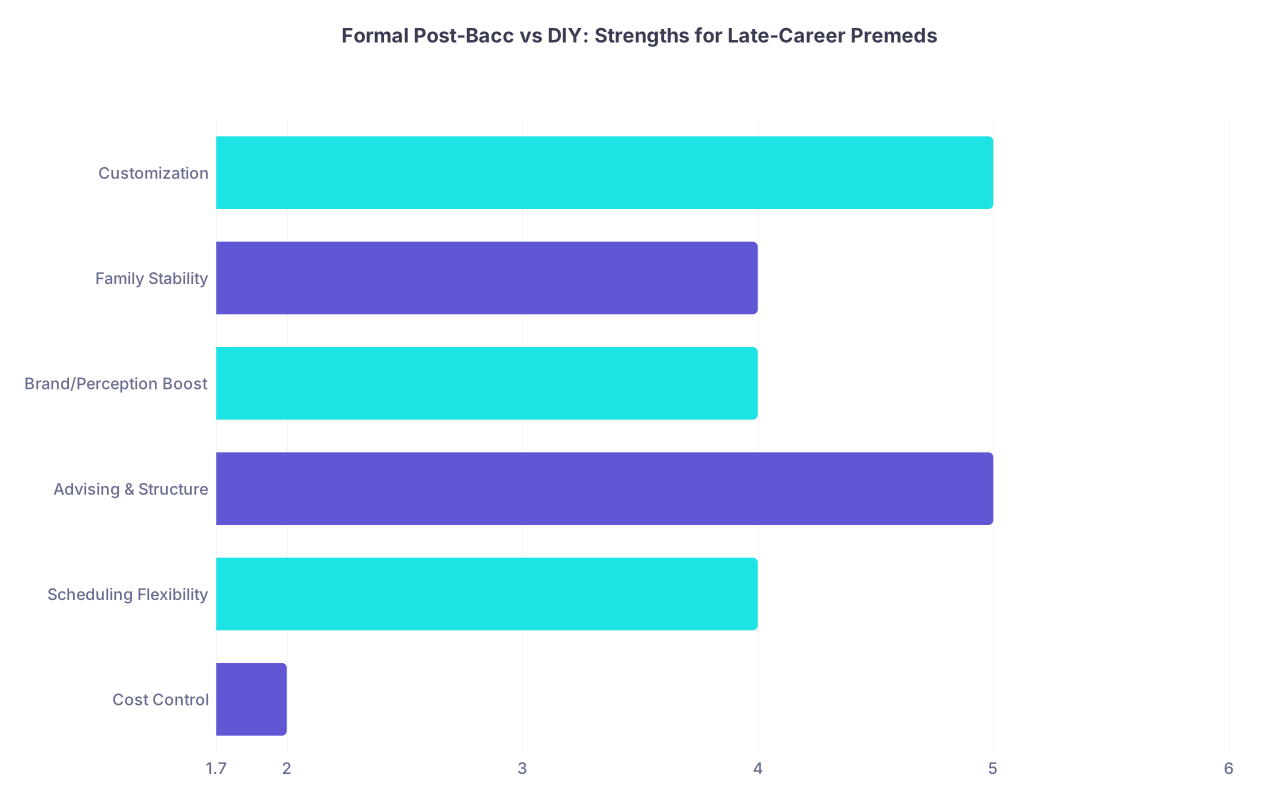
| Category | Value |
|---|---|
| Cost Control | 2 |
| Scheduling Flexibility | 4 |
| Advising & Structure | 5 |
| Brand/Perception Boost | 4 |
| Family Stability | 4 |
| Customization | 5 |
Scale 1–5: higher is stronger for that attribute
(2 cost control for formal post‑bacc = worse; 5 customization for DIY = stronger ability to tailor.)
Step‑By‑Step If You’re Still Unsure
If you’re on the fence, do this over the next 2–4 weeks:

| Step | Description |
|---|---|
| Step 1 | List Constraints & Goals |
| Step 2 | Research 3-5 Strong Formal Programs |
| Step 3 | Design DIY Curriculum Draft |
| Step 4 | Apply to Selected Formal Programs |
| Step 5 | Meet with Local Premed Advisor or Med Student |
| Step 6 | Refine Plan & Course Sequence |
| Step 7 | Start with 1-2 Science Courses Next Term |
| Step 8 | Old GPA < 3.0? |
| Step 9 | Cost & Relocation Feasible? |
Notice the structure: you don’t decide in the abstract. You:
- Map your constraints.
- Look at your real GPA.
- Price out programs vs a DIY plan.
- Talk to at least one human who’s done this recently.
- Start small (1–2 courses) and assess how it feels with your actual life.
FAQ: Formal Post‑Bacc vs DIY for Late‑Career Premeds
1. Will med schools “look down” on community college courses for premeds?
They won’t automatically reject you for them, but many MD programs do see CC as somewhat lower‑rigor than a 4‑year university. For a late‑career, budget‑constrained premed, CC for early pre‑reqs is fine, especially if you later show A‑level work in some upper‑division courses at a 4‑year school. If all your science is at CC and your old GPA is weak, your MD odds drop; DO schools tend to be more CC‑friendly.
2. If I do a DIY path, do I need a certain number of upper‑division science credits?
There’s no magic number, but for someone with a shaky or old record, I like to see at least 15–20 credits (5–6 courses) of upper‑division bio/biochem/physiology/etc with A-/A grades. That communicates “I can handle med‑school‑adjacent material,” not just intro‑level work. If your undergrad GPA is already strong, you can get away with fewer.
3. Are formal linkage programs really worth it?
Sometimes. If you’re a very strong applicant, willing to attend the specific linked med school, and you genuinely meet their metrics, a linkage can save you a glide year and application stress. But many people in these programs do not successfully link and end up applying normally anyway. Never choose an expensive post‑bacc solely for the hope of linkage; it should stand on its own merits.
4. I’m 38 with kids. Is a full‑time formal post‑bacc a bad idea?
Not automatically, but it’s riskier. You need brutally honest budgeting, partner buy‑in, and a plan for childcare and emergencies. If losing your income or taking on big debt would destabilize your family, I’d lean toward a slower, part‑time DIY or local university route. Med schools will not penalize you for taking longer if your record is strong and your responsibilities are clear.
5. How do I explain a DIY route in my personal statement or interviews?
You explain it like a deliberate choice, not a consolation prize. For example: “Given my family and financial responsibilities, I designed a flexible post‑baccalaureate plan through X College and Y University, prioritizing rigorous courses while continuing to work. This allowed me to demonstrate current academic strength, support my family, and build sustained clinical experience.” Own the decision and connect it to your maturity and priorities.
6. What’s one early sign I picked the wrong path?
If you’re in a formal post‑bacc and you’re so financially stressed you’re considering cutting back on MCAT prep or clinical experiences, that’s a red flag. If you’re in DIY and constantly dropping or withdrawing from courses because your schedule is chaos, that’s another. In both cases, the sign you chose poorly is simple: your grades or health are suffering because the program you chose doesn’t fit your life.
Open a blank document right now and write two headings: “Formal Post‑Bacc Plan” and “DIY Plan.” Under each, sketch what the next 2–3 years would realistically look like—courses, cost, work, family logistics. When you see those side by side in plain language, your gut will usually tell you which one actually fits your life.