
Most mid‑career premeds should take community college courses—but only if they use them strategically.
Let me be blunt: community college can absolutely work in your favor, or it can quietly sink your application. The idea that “community college = automatic rejection” is lazy and wrong. But the idea that “it doesn’t matter where I take my prereqs” is also wrong.
Here’s how to think about it like a grown adult making a big career move, not a scared undergrad chasing Reddit rumors.
The Real Question: What Problem Are You Trying to Solve?
Do not start with “Is community college bad?” Start with: “What’s my actual constraint?”
Typical mid‑career constraints:
- You’ve got a full‑time job and/or family
- Your old GPA is mediocre and you need an academic comeback
- You’re rusty on science and need a gentle ramp
- Money is tight; you can’t casually drop $20k+ at a private university
- You live far from a 4‑year campus or can’t attend daytime classes
Community college can help with:
- Cost
- Schedule flexibility (evenings, part‑time)
- Reentry into academics after years away
- Building up from basic math/chem to real premed work
But it’s not magic, and for some goals it’s the wrong tool.
Here’s the clean way to decide.
| Goal/Constraint | Community College is… |
|---|---|
| First time taking basic prereqs | Often a good starting point |
| Repairing a weak GPA | Useful, but not sufficient |
| Showing you can handle *rigor* | Usually need 4‑year or post‑bacc too |
| Working full‑time, limited schedule | Often the most realistic option |
| Already have many 4‑year sciences | Use sparingly / selectively |
How Medical Schools Actually View Community College Coursework
Here’s the part people overcomplicate. Most med schools do not have a blanket policy that “CC credits don’t count.” They almost all accept them to meet prereqs. The question is not “Will they accept it?” The question is “What story does it tell about my abilities?”
General patterns I’ve seen:
MD (allopathic) schools
- Will accept community college prereqs.
- Often prefer to see upper‑level science at a 4‑year school.
- Competitive MD programs look harder at rigor and recent performance.
DO (osteopathic) schools
- Generally more flexible and CC‑friendly.
- Still like to see strong recent science, but are often more forgiving about where it came from.
State vs. private
- Many state schools are fine with CC coursework, especially for in‑state, nontraditional, older students.
- Some top‑tier privates will quietly favor applicants with more 4‑year or post‑bacc science.
Here’s the translation: community college classes are not disqualifying. But if all your science, or your “comeback GPA,” lives only at a community college, your academic story is incomplete.
You want a transcript that says:
“I used community college strategically to restart, then proved I could handle university‑level rigor.”
Not:
“I stayed at the easiest place available and never tested myself beyond that.”
When Community College is a Smart Move (and When It’s Not)
Smart uses of community college as a mid‑career premed
- Academic Warm‑Up After a Long Gap
If you haven’t seen a periodic table in 15 years, jumping straight into university organic chemistry at night after work is a nice way to fail and burn out.
Strategy that works:
- Start with college algebra → pre‑calc → gen chem I at a community college if you’re rusty.
- Use these courses to rebuild habits: studying, exams, time management.
- Once you’re pulling consistent A’s, move some of your later coursework to a 4‑year.
- Cost‑Controlled First Pass at Prereqs
If you need all the classics:
- General Chemistry I & II
- Biology I & II
- Physics I & II
- Organic Chemistry I & II
Doing some of these at a community college can save thousands. Just don’t hide there forever.
A common pattern that works well:
- Gen Chem I–II and Bio I–II at community college
- Then upper‑level Bio, Biochem, Genetics, Physiology, etc. at a 4‑year
- Working Full‑Time or Handling Childcare
Evening CC classes are a lifeline if you’re juggling a job, partner, kids, and aging parents.
Med schools actually get this. If you explain in your application that:
- You were working 40–50 hours/week
- You returned to school after a long gap
- You performed at a high level in that context
…that’s not a “weakness.” That’s evidence of discipline.
When leaning too heavily on community college backfires
- You’re Trying to Erase a Low Undergrad GPA
If your original GPA from a 4‑year school is 2.8 and now you’ve got 40 community college credits at 3.9, that’s better than nothing. But adcoms know the difference in rigor, grading culture, and selectivity.
If you need to prove you’re now an “A student,” you almost always need:
- A solid run of A’s in upper‑division sciences at a 4‑year (or a formal post‑bacc, or an SMP)
- You Already Have Strong 4‑Year Science Credit
If your old transcript already shows A’s in Calc, Gen Chem, and Physics from a respectable university, going back to community college for more basic science just to “pad GPA” isn’t impressive. It looks like gaming the system.
You’re better off with:
- Targeted upper‑level coursework at a 4‑year
- Or a structured post‑bacc
- You’re Aiming Only at the Most Competitive MD Programs
If your dream list is UCSF, Harvard, Columbia, Stanford—and nothing else—then no, you shouldn’t rely on community college for most of your science. They’re drowning in applicants who excelled at rigorous 4‑year institutions. You’d be fighting an uphill brand battle.
How to Use Community College Strategically (Not Desperately)
Let’s talk tactics. You’re mid‑career, you don’t have time to redo this twice.
1. Map your endgame before enrolling
Do this in writing, not in your head:
- What’s my current undergrad GPA and science GPA?
- How many science credits do I already have, and at what level?
- Where do I realistically sit: aiming MD+DO, DO‑focused, or extremely competitive MD only?
- What is my weekly time budget for school, work, family?
From there, build a sequence. For many mid‑career folks, something like this makes sense:
Year 1 (at community college):
- Math/algebra refresh if needed
- Gen Chem I & II
- Intro Bio I & II
Year 2 (transition to 4‑year or post‑bacc):
- Organic Chemistry I & II
- Biochem
- One or two upper‑level bios (e.g., Physiology, Cell Bio)
You modify that based on what you’ve already taken.
2. Avoid this common trap: “I’ll do everything at CC, then worry later”
This is how people paint themselves into a corner. They spend 2–3 years doing all the science at a community college, then discover that:
- Their GPA improved, but adcoms still question rigor.
- They now need more upper‑level work at a 4‑year anyway.
- They’ve burned years and money on a path they didn’t check against their goals.
You don’t need perfection. You just need to show a credible upward trajectory and evidence you can function at a higher level.
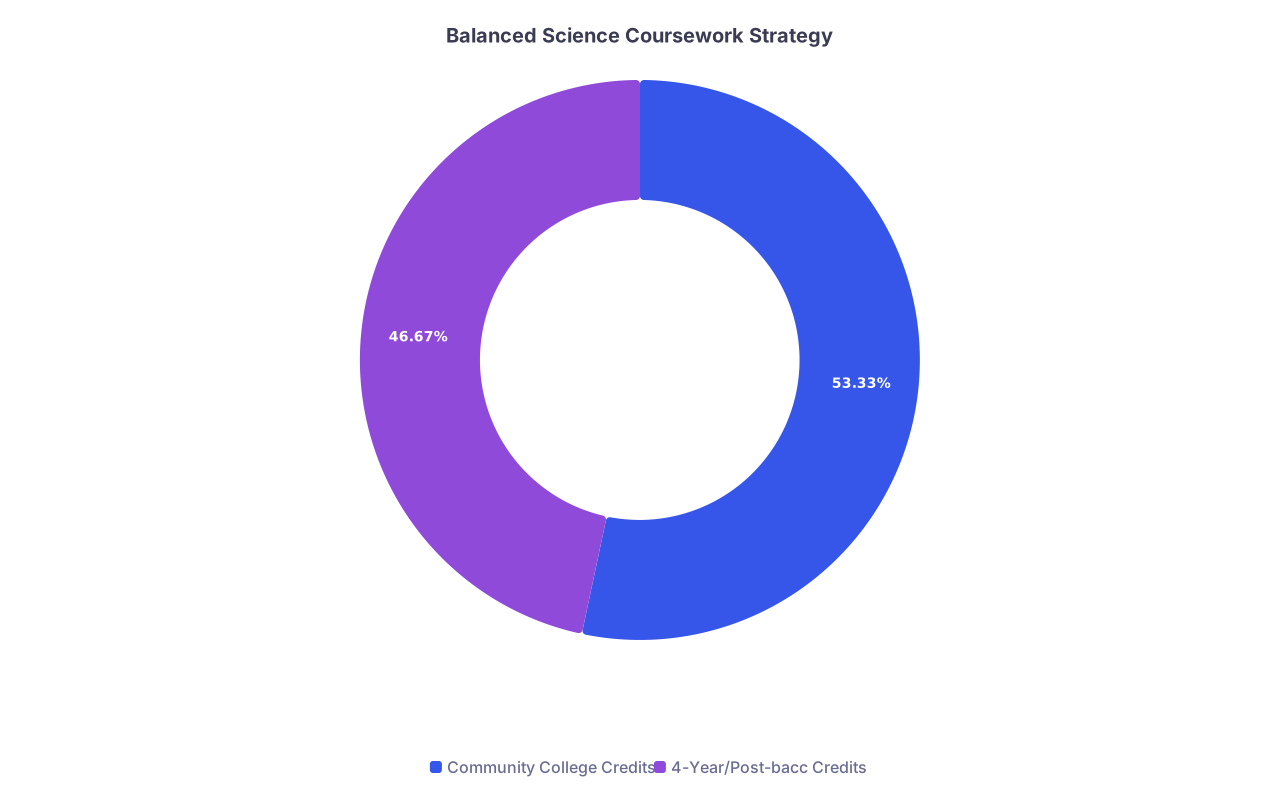
| Category | Value |
|---|---|
| Community College Credits | 40 |
| 4-Year/Post-bacc Credits | 35 |
3. Make your community college record bulletproof
If you’re going to use community college, you don’t get to be average there. The whole point is to prove you’re a different student than you were at 20.
Non‑negotiables:
- Aim for A’s. Not “B+ is fine.” You’re competing with younger applicants who got A’s at strong 4‑year schools.
- Take full sequences with the same institution when possible (Gen Chem I & II, not just one random semester).
- Avoid scattershot online-only, asynchronous everything if possible. One or two is fine. A degree’s worth looks weak.
And yes, people do notice trends. Night classes after work with A’s look impressive. A lightweight daytime schedule plus mediocre grades at a CC? Not so much.
How This Plays with the MCAT and Your Narrative
Community college isn’t judged in a vacuum. It’s judged alongside:
- MCAT performance
- 4‑year coursework
- Overall academic trend
- Your age, work history, and story
MCAT: Your great equalizer
Rock‑solid MCAT scores will do more to neutralize “community college stigma” than anything else.
If you did most of your prereqs at a CC and then score a 515+ (MD‑competitive) or a 508–510 (strong DO / many MD), you’re sending a clear signal: “I can handle the material.” If you pair CC work with a weak MCAT, it reinforces the worry.
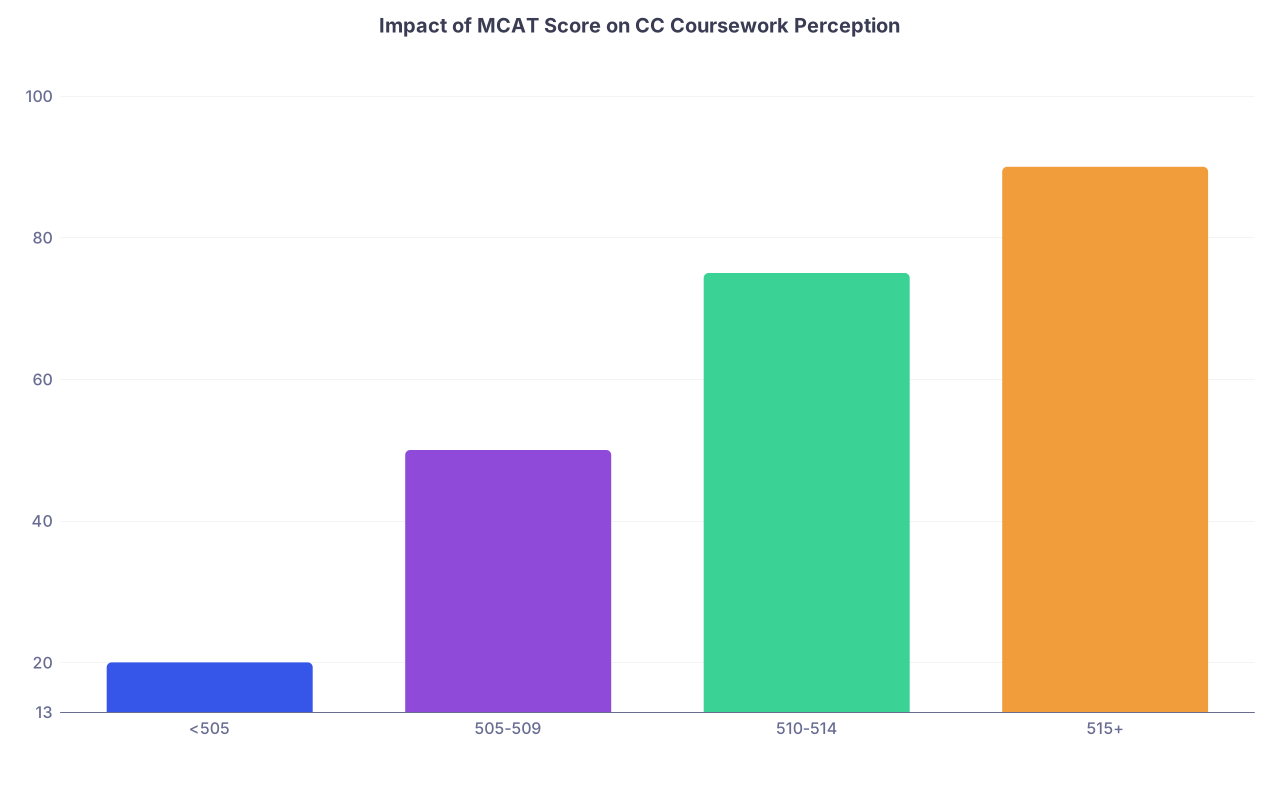
| Category | Value |
|---|---|
| <505 | 20 |
| 505-509 | 50 |
| 510-514 | 75 |
| 515+ | 90 |
Your story: Make the logic obvious
Admissions committees read threads of your life, not just lists of classes.
For example, this is a coherent story:
- “I left undergrad with a 2.9 in 2010. I worked in IT for 10 years. When I decided on medicine, I started at community college nights to rebuild my foundation and confidence while working and supporting a family. Once I was consistently earning A’s, I enrolled in upper‑level biology and biochemistry at State University and continued to excel. Here’s my MCAT that reflects that growth.”
That makes sense. It shows growth, self‑awareness, and realistic planning.
What doesn’t work is the “I kept taking the easiest available route and never pushed up in rigor, but trust me, I’m ready for med school.”
How to Check Specific Schools Without Losing Your Mind
You do not need to hunt down 50 websites reading every micro‑policy, but you should sanity‑check a handful of likely targets.
Simple approach:
Make a rough target list:
- 5–8 MD schools (if MCAT/GPA support this)
- 5–8 DO schools
- Your in‑state options first
For each, search:
- “[School Name] community college prerequisite policy”
- “[School Name] nontraditional applicants prerequisites”
You’re looking for:
- Any statement explicitly discouraging or limiting CC credits
- Preference for “upper‑division coursework at a 4‑year institution”
- Or a clear statement that CC credits are fine, especially for nontraditional students
If an individual top‑tier school strongly prefers 4‑year science and you’ve done mostly CC, that doesn’t mean you’re doomed. It means: don’t build your entire future around that one outlier.

| Step | Description |
|---|---|
| Step 1 | Start: Mid-career, considering medicine |
| Step 2 | Use CC to rebuild basics & GPA |
| Step 3 | Take targeted upper-level at 4-year |
| Step 4 | Mix CC refreshers with some 4-year |
| Step 5 | Transition to 4-year/post-bacc after success |
| Step 6 | Prepare for MCAT |
| Step 7 | Apply MD/DO with balanced transcript |
| Step 8 | Old GPA strong? |
| Step 9 | Science background recent? |
Quick Scenarios: What Should You Do?
Here are a few composites I’ve seen over and over.
Scenario 1: 38-year-old teacher, 3.4 old GPA, no sciences
- Full‑time job, two kids, limited savings.
- Needs all core prereqs from scratch.
Smart path:
- Start at community college for Gen Chem, Bio, and maybe Physics while working.
- Absolutely crush these courses (A’s only, or close to it).
- Then do Organic + Biochem + 1–2 upper‑level bios at a 4‑year or structured post‑bacc.
- Take MCAT after finishing Biochem.
Scenario 2: 32-year-old engineer, 3.2 GPA, heavy math/physics already
- Took Calc I–III, Physics I–II, maybe some Chem during engineering.
- Works 50+ hours/week.
Smart path:
- Skip redoing easy stuff at a CC.
- Take Bio I–II (OK at CC if needed for schedule) but prioritize Biochem and upper‑level bio at a 4‑year.
- Focus on MCAT content + strong recent science performance.
Scenario 3: 45-year-old, 2.6 undergrad GPA, long gap, limited funds
- Massive GPA repair needed.
- Little to no prior science.
Smart path:
- Start at community college to prove you’re not the 2.6 student anymore.
- Build 30–40 credits of near‑perfect CC work while working.
- Then do 20–30 credits of solid 4‑year upper‑level science (or an affordable post‑bacc you can access).
- Strongly consider DO programs, but keep open MD options that are friendly to reinvention.

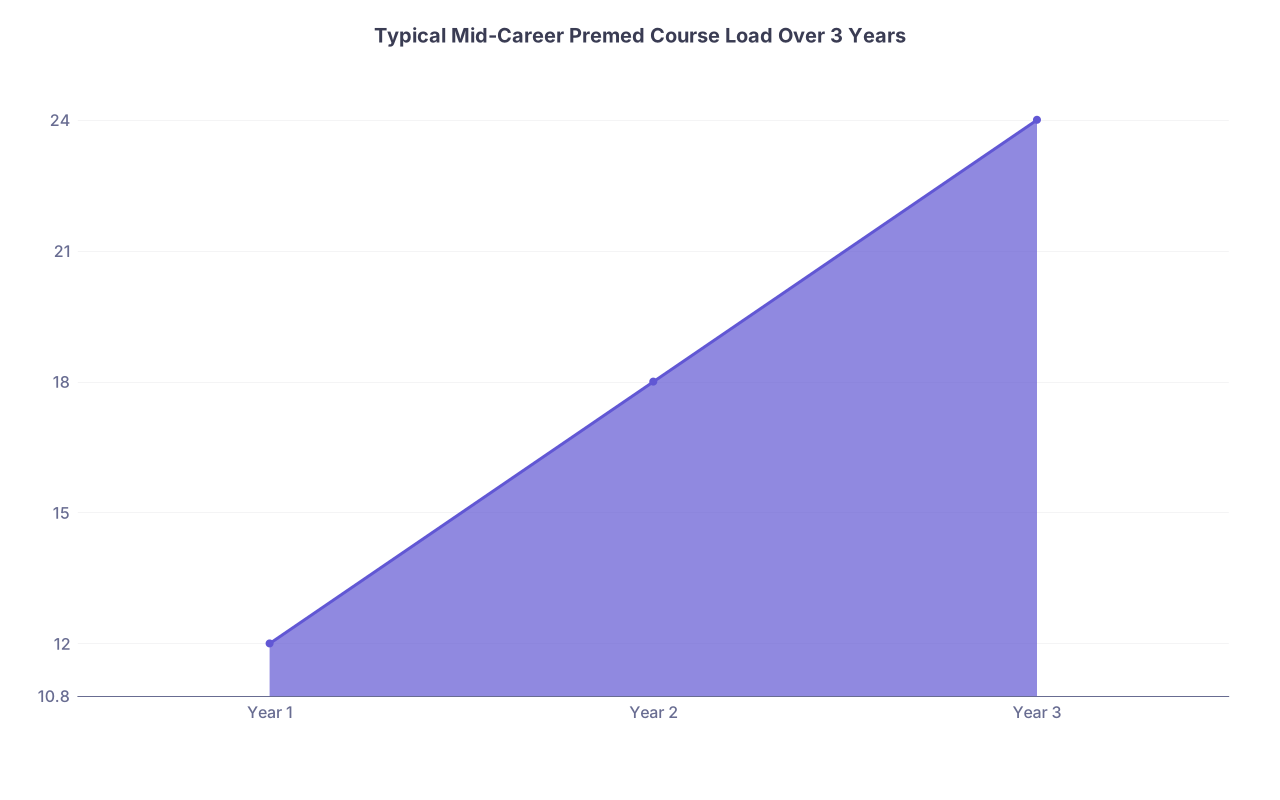
| Category | Value |
|---|---|
| Year 1 | 12 |
| Year 2 | 18 |
| Year 3 | 24 |


FAQ: Community College Courses as a Mid‑Career Premed
1. Will medical schools “penalize” me for taking prerequisites at a community college?
Not automatically. Most will accept them. What they want to see is that you can handle rigorous, upper‑level science somewhere. If all your sciences are at a CC and you never step up to a 4‑year level, especially with a weak MCAT, then yes, you’ll face skepticism.
2. Can I do all my prerequisites at a community college and still get into medical school?
It’s possible, and it has been done. It’s just a harder sell, especially for competitive MD schools. If you go this route, you’ll need excellent grades and a strong MCAT. Many mid‑career applicants do better with a mix: some prereqs at CC, then upper‑level work at a 4‑year.
3. Is taking online community college science courses a problem?
A few is fine, especially if they were your only realistic option while working. An entire science record that’s online, asynchronous, and lab‑lite is more problematic. When possible, choose in‑person or high‑quality hybrid courses with real lab components.
4. I had a low GPA years ago. Will A’s at a community college fix it?
They help, but they do not fully “erase” a low GPA, especially on the MD side. They show a positive trend, which is critical, but you almost always need some strong performance at a 4‑year level or in a formal post‑bacc/SMP to fully convince adcoms you’ve turned the corner.
5. Should I retake basic sciences I already did at a 4‑year, but with B’s, at a CC for A’s?
Usually no. That looks like cherry‑picking easier environments rather than advancing your level. You’re better off taking more advanced courses and doing well there. Use your energy to move forward, not sideways or backwards.
6. How many credits should I aim to do at a 4‑year if I start at a community college?
There’s no magic number, but as a rule of thumb: at least 20–30 credits of solid upper‑level science at a 4‑year (or structured post‑bacc) gives committees something substantial to judge. Enough that they can see a pattern, not a one‑off semester.
7. If I’m planning for DO schools primarily, can I lean more heavily on community college?
You have a bit more flexibility. DO schools tend to be more accepting of CC coursework and nontraditional pathways. But the core expectations don’t vanish: strong grades, recent science success, and a solid MCAT still matter. A mixed record (CC + some 4‑year science) is still safer than CC‑only.
Here’s what you should walk away with:
- Community college is a tool, not a red flag. Use it to solve real constraints—cost, time, academic rust—not to dodge rigor forever.
- A strong mid‑career premed record usually combines A‑level CC work, serious upper‑level science at a 4‑year or post‑bacc, and a solid MCAT.
- Your goal isn’t to impress Reddit. It’s to build a believable academic story that says: “I know what I’m doing, I’ve grown, and I can handle medical school now.”