
The blunt truth: You do not owe your employer full transparency about your med school plans—at least not early on, and not in the way most people feel pressured to share.
You owe them good work, reasonable notice, and basic professionalism. Not a running commentary on your career dreams.
Let’s walk through how honest you should be, when to say something, what to say, and how to avoid blowing up your job before you even get an interview.
The Core Principle: Protect Your Future First
Here’s the decision rule I use with non-traditional applicants who ask me this question:
If telling your employer today could reasonably:
- Get you fired
- Get you sidelined, passed over, or frozen out
- Make your life miserable at work
…then you keep your plans to yourself for now.
You are allowed to prioritize:
- Your MCAT study time
- Your application timeline
- Your income stability
over your boss’s desire to “be in the loop.”
You are not lying by omission when you don’t announce hypothetical future plans that might not even happen. You’re simply not broadcasting them.
So the default answer is:
Be strategically honest, not emotionally honest.
Emotional honesty = “I want them to know my heart and my dreams.”
Strategic honesty = “I’ll share what’s true, necessary, and safe for me to share—at the right time.”
Step 1: Figure Out What Kind of Workplace You’re In
Before you decide how honest to be, you need to understand the environment you’re dealing with. Rough mental checklist:
- Have you seen coworkers punished after saying they were applying to grad school, residencies, or other jobs?
- Does your boss take departures personally? “After everything I’ve done for you…”
- Is your company already understaffed and panicky about people leaving?
- Is your role critical enough that your departure will cause real disruption?
- Is this a place that values professional growth, or a place that hoards talent?
If you’re checking yes on those first few, you really should keep your plans quiet until you have something concrete: an acceptance, at minimum; sometimes even a start date.
On the other hand, some employers (tech, research, academic hospitals, universities) are used to people going on to grad school, med school, PhDs. I’ve seen managers proudly write recommendation letters and flex schedules for MCAT prep.
But don’t idealize your workplace. I’ve also seen:
- A clinic manager cut hours once she found out an MA was applying to med school.
- A lab PI “restructure” someone out after learning they’d be leaving in 9 months.
- A mid-level manager stop giving projects to someone who was open about applying.
So, no, you don’t just “tell them early so they can plan.” That’s great in theory—and sometimes career suicide in practice.
Step 2: Decide Your Timing Window
You’ve got three realistic timeframes where this question comes up.
| Stage | What’s Happening | Recommended Disclosure Level |
|---|---|---|
| Early premed (prereqs/MCAT) | Still figuring it out | Usually keep it vague/general |
| Applying (AMCAS submitted) | Uncertain outcome | Only tell if employer is strongly supportive & you trust them |
| Accepted (have an offer) | Concrete plan & timeline | This is when you *must* start being explicit |
1. Early Premed (Classes + MCAT)
This is when you’re:
- Taking night classes
- Requesting occasional schedule tweaks
- Studying after work or on weekends
Here, your goal is: protect your bandwidth without triggering alarms.
What you can say:
- “I’m taking some science classes on the side to keep career options open.”
- “I’m exploring a possible transition into healthcare longer term.”
- “I’ve enrolled in some evening courses, so I may need a little predictability with my schedule on those days.”
You’re being honest. You’re just not providing a detailed PowerPoint on your 5-year plan.
Avoid:
- “I’m definitely going to medical school.”
- “I’ll probably leave in a year or two.”
That just creates problems you don’t need.
2. Application Year
You’ve got:
- MCAT score (hopefully)
- Primary in, secondaries flying, maybe interviews coming
This phase is very unstable. You don’t know:
- If you’ll get in
- Where you’ll be
- When exactly you’ll leave
I rarely recommend telling your employer broadly at this point unless:
- They’re unusually supportive of grad/med transitions
- You need significant schedule changes for interviews
- You trust your direct supervisor not to punish you
Even then, phrase it carefully. For example:
“I’m applying to professional graduate programs next cycle, including some in healthcare. It’s competitive, so I have no idea yet whether it will work out. If I get interviews, I may need some flexibility with a few days off, but I’m committed to doing my job well while I’m here.”
Notice:
- No over-promising (“I’ll 100% be gone by August”)
- No specific “I’m abandoning you” language
- You’re emphasizing professionalism and uncertainty
If HR asks why you need a random Friday off for a “personal appointment”—you’re allowed to say exactly that: “personal appointment.” You’re not lying. And they’re not entitled to more.
3. After Acceptance
This is where honesty goes up a level.
Once you have:
- A written acceptance
- A tentative or firm start date
You need to start planning your exit.
Here, it’s completely reasonable to say:
“I’ve been accepted to medical school and will be starting in August. I wanted to give you as much notice as possible, and I’m happy to help plan a transition or train a replacement.”
When to say this? My usual rule:
- 2–3 months’ notice for most jobs
- Up to 4–6 months if you’re in a specialized or hard-to-replace role and you want to preserve that relationship
You do not need to tell them the same week you’re accepted in October for an August start. That’s 10 months of potentially being treated like a lame duck.
What If They Ask You Directly?
This scares people the most: the boss who says,
“So… are you planning to leave for med school or something?”
Here’s how to handle it without lying and without torpedoing yourself.
If You’re Early and Still Unsure
“I’m exploring a few long-term options, healthcare included, but I don’t have any concrete plans or timelines yet. Right now, my focus is doing my job well and figuring out what’s realistically possible.”
This is true. Medical school is competitive. Until you’re accepted, nothing is concrete.
If You’re Actively Applying but Not Accepted
“I am applying to some professional programs as a possible next step, but those processes are very unpredictable. I don’t have a timeline yet and don’t want to make any promises one way or the other until I know more. While I’m here, I intend to keep doing my job well.”
Again: true, measured, doesn’t invite them to treat you like you already quit.
If You’re Accepted But Not Ready to Announce
At this stage, you’re on thinner ice ethically if you dodge too much. If you’ve signed an acceptance and know you’re leaving in six weeks, you can’t pretend you’re settled long-term.
But if you’re months out and still sorting logistics, you can say:
“I’m seriously considering some next steps and still working through timing and details. When I have firm information and dates, you’ll be one of the first to know so we can plan appropriately.”
Then actually do that. Don’t drop a 2-weeks notice for an August start you knew about in January.
How to Ask for Time Off for Interviews and the MCAT
Here’s where people accidentally overshare.
You do not need to say:
- “I need two days off for my MCAT.”
- “I have a medical school interview at X University.”
You can simply say:
- “I have a personal commitment and need to request [date] off.”
- “I’ll be out of town for a few days for a prior obligation.”
If pushed aggressively in an inappropriate way (“What exactly is it?”), you can say:
- “It’s a personal appointment I’d rather not get into, but I can assure you it won’t affect my performance here.”
Most HR policies do not entitle your employer to detailed explanations about every day off. Use that.
For especially inflexible jobs, batch things:
- Use PTO for interviews
- Stack MCAT on a Friday and study Saturday/Sunday
- If you absolutely must explain, default to “professional exam” or “graduate program interview” without specifying med school
When Full Honesty Helps You
There are cases where being open early is a clear win:
- You work in a hospital, clinic, research lab, or university where med school is a normal next step
- Your supervisor has a history of helping others apply to grad, PA, NP, or med programs
- You need letters of recommendation from physicians, supervisors, or PIs
- You’re trying to transition your role to something more clinically relevant
In these environments, saying:
“I’m planning to apply to medical school in the next cycle. I’d love your advice on getting more clinical responsibility and, if things go well, possibly a letter down the line”
can actually unlock opportunities: more responsibility, shadowing, publications, leadership roles.
But this is context-dependent. Do not assume your random corporate manager will react the same way a teaching hospital PI would.
Ethical Line: Are You “Lying” by Not Telling?
No.
You are not obligated to:
- Forecast your career 2–3 years in advance
- Tell your manager about every application you submit
- Announce tentative plans that may never happen
You are obligated to:
- Perform your job honestly while you’re there
- Give reasonable notice once you have a firm departure date
- Not actively mislead when directly asked in a way that materially affects planning (“Are you committing to lead this 2-year project?” when you know you’ll be gone in 6 months)
The key distinction:
Withholding speculative plans = fine.
Making clear promises you know you can’t keep = not fine.
Simple Decision Framework
Use this quick mental flow:
Do I have a firm acceptance and start date?
- No → I’m not announcing concrete plans.
- Yes → Go to 2.
How far out is my start date?
- Less than 1–2 months → Tell them now and give as much notice as possible.
- 3–6 months → Pick a reasonable notice period (usually 2–3 months) and plan the conversation.
- 9–10+ months → You can wait a bit, especially if you’ll be penalized for being a “short-timer.”
Is my workplace historically supportive of career transitions like this?
- Yes → Consider earlier, more open conversations to gain support.
- No / unsure → Default to later disclosure once plans are firm.
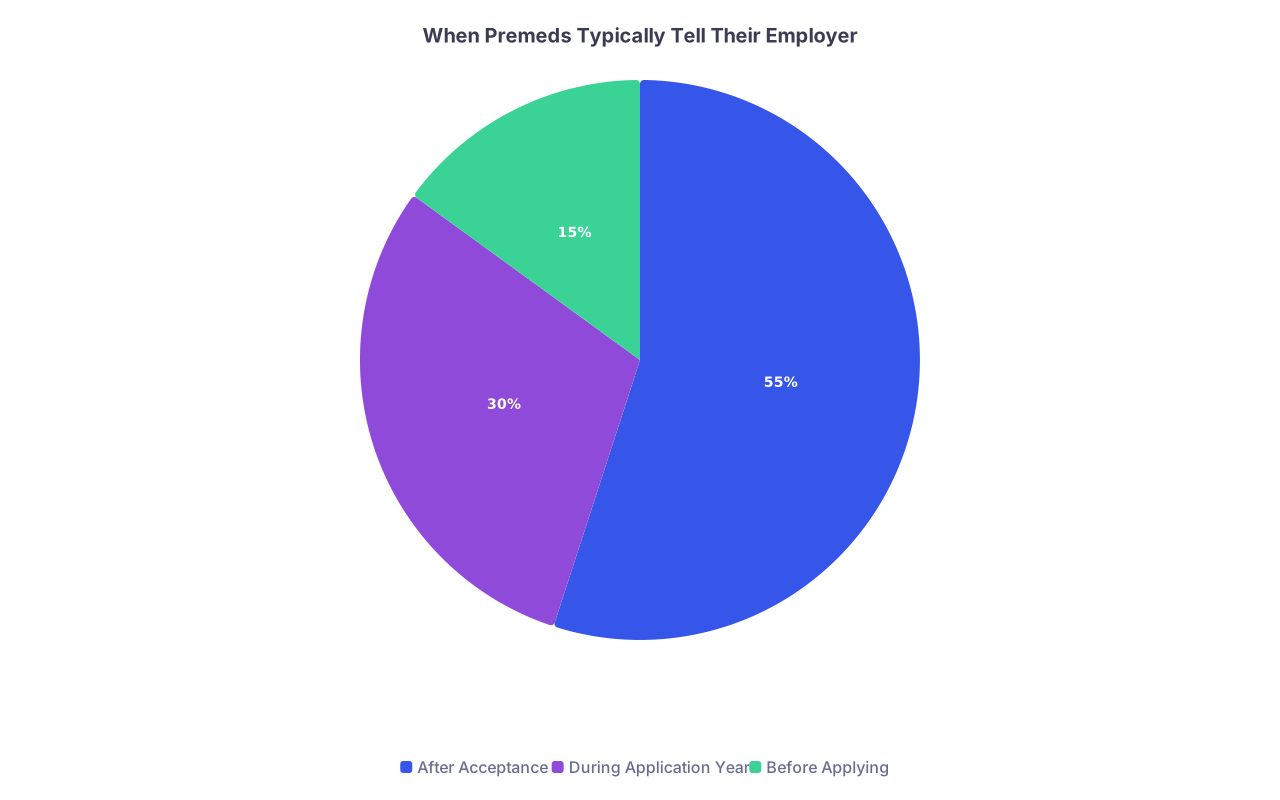
| Category | Value |
|---|---|
| After Acceptance | 55 |
| During Application Year | 30 |
| Before Applying | 15 |

| Step | Description |
|---|---|
| Step 1 | Thinking about med school |
| Step 2 | Share general plans if helpful |
| Step 3 | Keep plans private |
| Step 4 | Tell employer & plan transition |
| Step 5 | Wait, then give 2-3 months notice |
| Step 6 | Share earlier & coordinate |
| Step 7 | Accepted yet? |
| Step 8 | Supportive workplace? |
| Step 9 | Start < 3 months away? |
| Step 10 | Penalized for early notice? |

How to Actually Say It (Scripts)
Use these almost verbatim and tweak for your situation.
Early Phase / Taking Classes
“I’ve enrolled in some evening science classes to explore potential long-term options in healthcare. It shouldn’t affect my work here, but I might ask for a little predictability on class days.”
Applying, Supportive Workplace
“I’m planning to apply to medical school this upcoming cycle. It’s highly competitive, so I have no guarantees, but I wanted you to know it’s on my radar. While I’m here, I’m committed to doing strong work and giving you reasonable notice if my plans solidify.”
Accepted, Time to Tell
“I wanted to share some news. I’ve been accepted to medical school and will be starting in August. My plan is to stay through [date], which gives us about [X months] to plan a transition. I’m happy to help document my responsibilities and train someone new.”
If You Need a Recommendation
“I’m applying to medical school this cycle, and your perspective on my work would be incredibly valuable. Would you be comfortable writing a letter of recommendation focusing on [specific attributes]? I’d be glad to provide a CV and bullet points to make it easier.”

FAQ (Exactly 7 Questions)
Should I tell my employer I’m studying for the MCAT?
Usually no. You can simply say you’re taking some evening classes or preparing for a professional exam if you need to explain schedule changes. There’s no advantage to announcing “I’m taking the MCAT” unless you know they’re supportive of med school paths.Do I have to tell my employer when I start applying to medical school?
No. Applying is not a guaranteed outcome. You can keep your applications private and only disclose once you have an acceptance and a defined timeline. The exception is if you need letters, special scheduling, or work adjustments that practically require their cooperation.Is it dishonest not to tell my boss I plan to leave for med school next year?
It’s not dishonest to withhold speculative plans. It becomes unethical when you knowingly commit to long-term projects you’ll abandon or misrepresent your availability. You should give reasonable notice once your plans are firm, but you’re not obligated to broadcast early-stage intentions.When is the latest I can tell my employer I’m leaving for medical school?
For most jobs, 4–8 weeks is standard. For highly specialized roles, 2–3 months is considerate. What you should avoid is dropping last-minute notice when you’ve known for many months. If you’re starting in August, telling them in June is usually reasonable.What if my employer reacts badly after I tell them about med school?
It happens. They might cut your hours, exclude you from projects, or treat you as disloyal. That’s exactly why I recommend delaying disclosure until your plans are firm and your timeline is short enough that you can tolerate some fallout if it happens.Can I say ‘personal reasons’ when taking time off for interviews or the MCAT?
Yes. “Personal reasons,” “personal appointment,” or “prior commitment” are standard and acceptable. HR does not usually need, nor are they entitled to, a detailed explanation for each PTO day, as long as you follow policy.Should I tell coworkers I’m applying to med school even if I do not tell my boss?
Be careful. Offices leak like sieves. If you tell one coworker, assume your boss may eventually hear. If you must confide in someone, choose the least gossip-prone, most trustworthy person you know—but understand there’s always risk. Many people regret how widely they shared this too early.
Key Takeaways:
- You don’t owe your employer early, detailed disclosure of speculative med school plans; you do owe good work and reasonable notice once plans are firm.
- Adjust your honesty level to your workplace: guarded in punitive environments, more open in truly supportive ones.
- Use strategic, measured language, give notice once accepted and within a reasonable timeframe, and protect your future first.