
The idea that you must quit your job to be a competitive premed is wrong for most people.
Let me be very clear: working while preparing for med school is not a liability by default. Handled badly, it can tank your grades and MCAT. Handled well, it can become one of the strongest parts of your story.
This isn’t about whether you can quit; it’s about whether you should, and under what conditions it actually helps you.
The Core Question: Do You Need to Quit?
No, you don’t automatically need to quit your job to be a competitive applicant.
Here’s the real rule: you need enough evidence that you can handle the academic workload, understand medicine, and are moving toward the field deliberately. How you arrange your employment around that is a means to an end, not the end itself.
You should seriously consider quitting or cutting way back only if:
- Your grades are slipping or you’re doing mediocre in key prereqs
- Your MCAT prep is going nowhere and practice scores are flat or low
- You have essentially zero clinical exposure, shadowing, or service
- You’re chronically exhausted and functioning at 60–70% everywhere
If none of those are true, your job is probably not your enemy. In fact, it may be one of your best assets.
Let’s break down how to make that call the right way.
What Admissions Committees Actually Care About
Med schools don’t have a checkbox for “Quit job: Yes/No.” They care about outcomes and trajectory.
Here’s what carries weight:
- Academic performance (recent, rigorous, upward trend if needed)
- MCAT score (within or near target range for your schools)
- Sustained clinical exposure and patient contact
- Evidence of service/commitment to others
- Maturity, resilience, and real-world responsibility
- A coherent story that explains why medicine and why now
Your employment sits under that last group: maturity, resilience, responsibility, and narrative.
Working as a scribe, MA, EMT, CNA, or nurse? That’s directly additive.
Working in finance, IT, teaching, trades, or military? Still very valuable, if you connect the dots.
The Trade-Offs: Work vs. Competitiveness
You’re really balancing three buckets:
- Academics (GPA, post-bacc, prereqs)
- MCAT
- Experiences (clinical, shadowing, volunteering, leadership)
Your job either supports or sabotages these. The decision framework is straightforward.
Step 1: Check Your Academics
If you’re still taking prereqs or a post-bacc, ask yourself:
- Are you consistently getting A/A- in science courses?
- Do you have time to actually learn, not just cram?
- Do you walk into exams underprepared because you had shifts?
If your recent science GPA is below ~3.5 and heading the wrong way, and work hours are a big reason, that’s a problem. You won’t fix a weak record by “showing how hard you work.” You fix it by getting A’s.
In that scenario, I’d tell you bluntly: cut hours or step away temporarily if you can. A strong upward academic trend is more important than preserving full-time status.
Step 2: Be Honest About the MCAT
MCAT doesn’t care how noble your job is. It cares if you know the content and can think under pressure.
Ask:
- How many real study hours are you getting per week? (Not “sitting near a book.”)
- Are your full-length practice scores moving up or stuck?
- Are you constantly pushing your test date because of work?
If you’re working 40–60 hours/week and getting 5–8 tired hours of MCAT studying, you’re likely capping your ceiling. I’ve watched plenty of smart nontrads stay stuck in the 500–505 range because they never created protected time.
If you need a massive score jump (e.g., from 500 practice to 512+ goal), you either:
- Reduce work hours significantly for 3–4 months, or
- Extend your timeline deliberately and accept a longer runway
What you don’t do is try to “power through” forever at half-speed.
Step 3: Look at Your Experiences
You need:
- Real clinical contact (not just hospital IT in the basement)
- Some shadowing (to show you’ve seen the physician role up close)
- Ideally, some longitudinal service experience
If your job is already clinical or patient-facing, great. That’s doing a lot of lifting for you.
If your job is not clinical and also eats all your time, now you’ve got a problem. You can’t write a convincing “Why medicine?” essay based on a couple of one-off hospital volunteer shifts squeezed in once a month.
This is the situation where I often recommend:
- Moving to a part-time role
- Switching jobs to something clinical, even if hours/pay change
- Or biting the bullet and taking 6–12 months in a lower-paid but higher-yield role
When Keeping Your Job Is Actually an Advantage
Here’s the part people don’t hear enough: many nontraditional applicants become more competitive precisely because they keep working.
Why?
- It proves you can function as an adult. Balancing work, school, and family looks a lot like balancing patients, notes, and studying as a resident. Committees like that.
- It gives you a sharp story. “I worked full-time in X while taking night classes and raising a kid. Here’s what I learned” will stand out more than “I lived in the library for 3 years.”
- It often is your clinical experience. Night-shift CNA, ED tech, hospice worker—those are gold.
What you have to avoid is the martyr narrative: “I worked 80 hours/week, took five classes, volunteered, and slept 3 hours a night.” That doesn’t impress physicians who know burnout destroys careers. They want to see good judgment, not self-destruction.
A Simple Framework: Reduce, Switch, or Quit?
Here’s a decision tool you can use.
| Situation | Recommended Action | Priority Protected Area |
|---|---|---|
| Weak GPA, strong job | Cut hours or quit temporarily | Grades/post-bacc |
| Strong GPA, weak MCAT | Reduce to PT or switch flex schedule | MCAT study time |
| Strong academics, zero clinical | Switch to clinical job or add clinical PT | Clinical exposure |
| Burning out in all areas | Consider full reset or major reduction | Health + 1 key area |
And a process view of how to apply that:

| Step | Description |
|---|---|
| Step 1 | Current Job + Premed |
| Step 2 | Cut hours or quit to fix GPA |
| Step 3 | Reduce work or delay test |
| Step 4 | Switch to clinical PT/FT job |
| Step 5 | Keep job, maintain balance |
| Step 6 | Grades solid? |
| Step 7 | MCAT on track? |
| Step 8 | Enough clinical exposure? |
If you walk through that honestly, you’ll know pretty quickly whether your job is:
- A booster
- Neutral
- Or an anchor around your ankle
Practical Timelines That Actually Work
Nontraditional paths are slower. That’s not a failure. That’s the feature.
Here’s a realistic model for someone working:
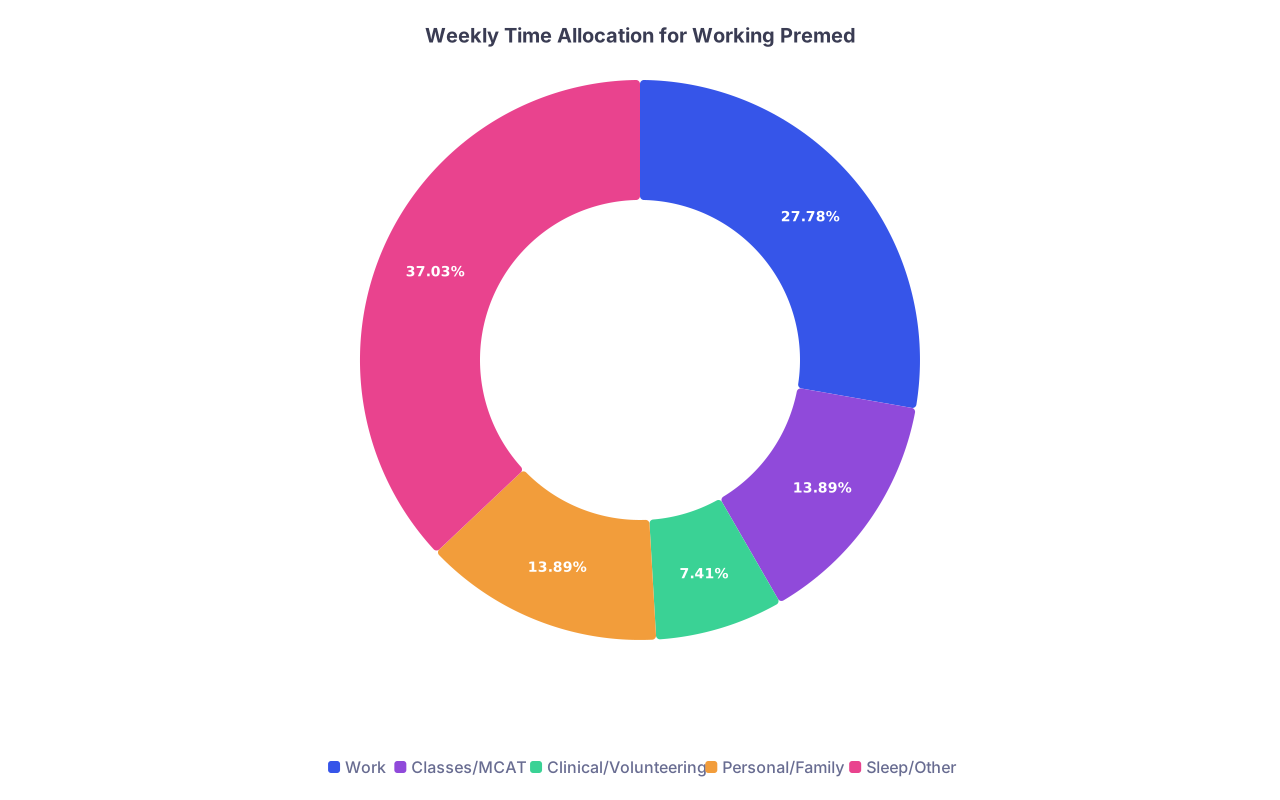
| Category | Value |
|---|---|
| Work | 30 |
| Classes/MCAT | 15 |
| Clinical/Volunteering | 8 |
| Personal/Family | 15 |
| Sleep/Other | 40 |
Total: 108 hours/week. That’s tight but doable if you’re ruthless about priorities and say no a lot.
A typical nontraditional pacing that works:
- Year 1: Keep working. Finish prereqs/post-bacc. Minimal MCAT beyond light review. Start low-intensity clinical if possible.
- Year 2: Reduce hours as finances allow. Add robust clinical work and MCAT prep.
- Year 3: Heaviest MCAT phase during a lower-work season, then apply. Possibly increase work again after MCAT while apps are pending.
If you try to compress that into 12–18 months while working full-time, you’re usually setting yourself up for mid-range metrics and reapplication.
Dealing With Money and Insurance (The Unsexy Part)
Here’s the adult reality: quitting a job is not just about time, it’s about money, insurance, and family.
Before you quit or cut back significantly, answer:
- How many months of expenses do you have saved?
- What’s your health insurance plan if you lose employer coverage?
- Are you supporting kids/partner/parents who rely on your income?
- Can you take on some debt for 6–12 months strategically without blowing up your future?
Sometimes the answer is: you can’t quit now without creating a bigger problem. That’s okay. The fix is slower progress, not magical thinking.
In that case, I’d rather see you:
- Stretch your prep timeline
- Take fewer classes per term but ace them
- Plan MCAT for a less intense work season
- Apply one cycle later with stronger everything
Than burn out, bomb a post-bacc and MCAT, and then have to climb out of a hole.
How to Talk About Your Job in Your Application
If you keep working, you’d better use it.
Here’s how to frame it in your essays and interviews:
- Emphasize progression: promotions, increased responsibility, training others.
- Draw explicit parallels to medicine: teamwork, high-stakes decisions, difficult conversations, vulnerable populations.
- Show time management and boundaries: not “I never sleep.” Instead: “I had to ruthlessly prioritize and learn when to say no.”
- Tie to your why medicine: “Seeing X at work made it impossible to ignore that I wanted to be the one responsible for care decisions, not just implementing them.”
And if you did quit or cut down substantially, own it:
- “I intentionally reduced my hours so I could fully commit to mastering rigorous science coursework and the MCAT. The results—[specific GPA/MCAT]—reflect that choice.”
That reads as strategic, not flaky.
Sample Scenarios: Who Should Quit, Who Shouldn’t
Let’s run a few real-world composites I’ve seen.
Scenario 1: The Burned-Out Nurse
- Full-time night-shift RN, 3×12’s per week
- Wants to apply in 1 year
- No recent science coursework, last degree 8 years ago
- Drained physically and emotionally
Should they quit? Probably not completely. But I’d push for:
- Move to per-diem or 0.6–0.8 FTE
- Take 1–2 rigorous upper-level science classes and crush them
- Start light MCAT review
- Push application 2–3 years out to build a rock-solid record
Keeping some clinical work maintains income and a strong narrative. Total quit with no clear plan or coursework? Risky.
Scenario 2: The 9–5 Software Engineer
- Stable 40–45 hr/week job, remote-friendly
- Strong undergrad GPA in non-science field, minimal sciences
- Plenty of savings
- No clinical experience yet
I wouldn’t tell them to quit immediately. I’d suggest:
- Keep working Year 1, knock out prereqs part-time at night/weekends
- Start weekend clinical volunteering or per-diem CNA work
- After they prove they can get A’s while working, then consider dropping to 0.6–0.8 FTE when MCAT ramps up
Quitting at the start just to “go all in” without a tested track record is how you get people who burn a year and don’t actually produce results.
Scenario 3: The Struggling Post-Bacc Student
- Taking 12 credits of hardcore science
- Working 30 hours/week as a barista
- Pulling B-/C+ in orgo and physics
- Exhausted, already on second attempt at some classes
This is the one where I say: you probably do need to quit or radically cut back, if at all possible. Your job is directly harming your competitiveness. Better to:
- Drop to 5–10 hours/week or stop working for 1–2 semesters
- Focus purely on getting A’s and rebuilding academic credibility
- Delay MCAT and applications until your transcript looks like someone med schools can trust
This is not about pride. It’s about fixing the single biggest red flag now, not later.
FAQs
1. Will med schools think I’m less committed if I keep working instead of quitting to study full-time?
No. They’ll think you’re an adult with responsibilities. What they care about is whether your outcomes (GPA, MCAT, experiences) are strong. If you can show those while working, it’s a net positive, not a negative.
2. Is it realistic to study for the MCAT while working full-time?
Yes—if you stretch the timeline or reduce other commitments. It’s usually not realistic to aim for a big score jump in 8–10 weeks while working 40+ hours. Many successful nontrads prep over 6–12 months with 10–15 focused hours per week.
3. Should I switch from a non-clinical job to a low-paying clinical job just for my application?
Sometimes, yes. If you have no clinical exposure and your current job blocks you from getting any, switching to something like CNA, scribe, MA, ED tech, or hospice work can be worth the lower pay. But do the math. Don’t torch your financial stability without a plan.
4. How many hours per week is “too much” work during a heavy science/post-bacc term?
There’s no magic number, but once you’re consistently above ~25–30 hours/week and taking a full course load, most people start to see grades suffer. If your transcript is fragile, err on the side of fewer work hours and stronger grades.
5. If I quit my job to study and take classes, will schools worry about my financial judgment?
Only if your story looks irresponsible. If you can explain, “I saved for this, planned it, and used the time to produce X GPA and Y MCAT,” that reads as calculated, not reckless. Quitting with no savings, bouncing between plans, and not producing much—that’s what worries people.
6. Does part-time work “count less” than full-time on my application?
No. What matters is what you did, for how long, and what you learned. A meaningful 15–20 hour/week role sustained over years can be more impressive than a full-time job you left in 6 months. Depth and continuity beat raw hours.
7. If I’m already behind in life, shouldn’t I rush and just push through working and applying ASAP?
That’s how people end up reapplying, which costs you more time. You’re not behind; you’re on a different track. Rushing a weak application because you feel late is a bad trade. Build the strongest application you can the first time, even if that means taking another year.
Here’s the bottom line:
- You don’t need to quit your job by default; you need to protect your GPA, MCAT, and clinical exposure.
- Your job is either helping those goals or hurting them—adjust hours, roles, or timelines accordingly.
- Admissions committees respect deliberate, adult decisions. Make one on purpose, not out of panic.