
The timeline people quote for becoming an attending is usually wrong for nontraditional students. It is almost always longer than the neat “4 years med school + 3 years residency” fantasy.
You’re not a 20‑year‑old sophomore with perfect prerequisites and parents paying the bills. Your clock looks different. Let me lay it out without sugarcoating.
The Real Answer: A Simple Formula
Here’s the clean version:
**Total years to become an attending =
Years until you start med school
- 4 years of medical school
- Residency length (3–7 years, usually)
- Optional fellowship (0–3 years)**
If you’re nontraditional, the only flexible part is the “years until you start med school.” That’s where people lose time.
Let’s build realistic timelines you can actually compare.
Step 1: How Many Years Until You Start Medical School?
Start here: Where are you right now?
I’ll break it into a few common starting points.
Scenario A: You already have a bachelor’s with solid GPA and some sciences
You might be here if:
- You majored in something semi‑science (psych, kinesiology, public health)
- You have chem or bio already but not the full premed set
- Your GPA is 3.3–3.8ish and not a complete mess
Typical steps:
- Finish/repair prereqs
- Study for and take MCAT
- Apply, then wait a year (the “gap”/application year)
Realistic time:
- Prereqs: 1–2 years (depending on how much you lack and whether you go part‑time)
- MCAT prep + test: 6–12 months (often overlapping with last prereqs)
- Application cycle wait: 1 year between applying and starting
If you move efficiently and plan backward from your MCAT and application target:
Fast but realistic: 2 years until matriculation
(e.g., 1 year of prereqs + MCAT, apply at the end of that year, start med school the next year)Typical nontraditional: 3 years until matriculation
(working, family, part‑time classes stretch the timeline)
Scenario B: You have a non‑science degree and almost no prerequisites
You’re the English major / business major / former teacher / ex‑military with a totally different academic background.
You likely need:
- 2 semesters each: Gen Chem, Organic Chem, Biology, Physics
- Math (stats and sometimes calc)
- Psych & Soc (for MCAT)
- Possibly biochem, upper‑level bio
Options:
- DIY postbac at a local university/community college
- Formal postbac program
Realistic time:
- Core science sequence: 2 years minimum if done in order (since many are sequential: Chem → Ochem → Biochem)
- MCAT prep: 6–12 months (often after 1–1.5 years of science so you actually understand the content)
- Application gap year: 1 year
So:
Aggressive but possible: 3 years until matriculation
(You start sciences this fall, keep a heavy load, prep for MCAT during year 2, apply at end of year 2, start med school in year 3)More common: 4 years until matriculation
(Especially if you’re working, parenting, or fixing GPA)
Scenario C: Your GPA is rough (sub‑3.0 or a long academic gap)
If your GPA is weak, the best advice is blunt: you’re signing up for more years. Not because committees are cruel, but because you have to prove you can handle med‑school level work.
You may need:
- An extensive DIY postbac to raise your science GPA
- An SMP (special master’s program) to show med‑school rigor
- Time to string together 30+ credits of A‑level science
Typical path:
- 1–2 years of postbac work
- Optional 1–2 years of SMP if postbac doesn’t fully fix issues
- Then MCAT + application year
So:
- Realistic: 3–5 years until matriculation, depending how deep the hole is and whether you work while doing this.
If you’re older (say, 32–38), this is where you need to ask, very directly: Am I willing to invest these years just to get to the starting line? Many are. Some are not. Both are fine answers, but you need an honest one.
Step 2: Medical School = 4 Years (You Don’t Control This)
Med school itself is the most predictable chunk.
Standard U.S. MD/DO program:
- Year 1–2: Preclinical (classroom, small‑group, some early clinical)
- Year 3: Core clinical rotations
- Year 4: Advanced rotations + residency applications
There are 3‑year med schools (NYU, CUSM, some DO programs), and combined programs, but for a nontraditional applicant, those are niche and highly competitive. Do not plan your entire life around getting into a 3‑year program. Assume 4 years.
So now your running total:
- Years until matriculation: 2–5+
- Plus med school: 4
You’re now 6–9+ years out from being an attending, and you still have residency left.
Step 3: Residency Length by Specialty
Here’s where your choice starts stretching or shortening your timeline.
| Pathway | Residency Length | Typical Total (Med School + Residency) |
|---|---|---|
| Family Medicine | 3 years | 7 years |
| Internal Medicine | 3 years | 7 years |
| Pediatrics | 3 years | 7 years |
| Psychiatry | 4 years | 8 years |
| Emergency Medicine | 3–4 years | 7–8 years |
| General Surgery | 5 years | 9 years |
| OB/GYN | 4 years | 8 years |
| Anesthesiology | 4 years | 8 years |
| Neurology | 4 years | 8 years |
| Orthopedic Surgery | 5 years | 9 years |
| Neurosurgery | 7 years | 11 years |
You are an attending when:
- You’ve finished residency
- You’re practicing independently (or as junior attending), with or without fellowship
With or without fellowship?
Many fields are fine with no fellowship:
- Family med
- EM (though fellowships are growing)
- General IM (hospitalist / outpatient)
- Pediatrics (general peds)
- Psychiatry (for general psych jobs)
Others are heavily fellowship‑driven if you want certain jobs:
- Cardiology, GI, heme/onc after IM (add 2–3 years)
- NICU, PICU after peds
- Hand, sports, spine after ortho
- MFM, Gyn Onc after OB/GYN
If you love subspecialty work, add 1–3 years to your timeline.
Step 4: Put It Together – Real Nontraditional Timelines
Let’s run through concrete examples. Assume you’re 28 now.
Example 1: 28‑year‑old with a decent GPA and some science
- Age 28–30: Finish prereqs & MCAT, apply
- Age 30–34: Med school (4 years)
- Age 34–37: Family medicine residency (3 years)
You’re an attending at 37, roughly 9 years from now.
If you choose:
- Internal medicine + 3‑year fellowship (e.g., cards):
Age 34–37: IM residency
Age 37–40: Fellowship
→ Attending at 40 (12 years from now)
Example 2: 32‑year‑old English major, no science, working full‑time
- Age 32–34: Part‑time prereqs, MCAT prep (probably 2 years)
- Age 34–35: Finish classes, take MCAT, apply
- Age 35–39: Med school
- Age 39–43: Psychiatry residency (4 years)
You’re an attending at 43, about 11 years from now.
If you tighten this by going heavier on coursework or cutting work hours, maybe you shave 1 year. But with kids, mortgage, and life? 11 years is more realistic than 7.
Example 3: 35‑year‑old with a 2.7 GPA and old coursework
You’ll likely need real GPA repair.
- Age 35–37: 2 years of strong postbac work (science A’s)
- Age 37–38: SMP (optional but common in this profile)
- Age 37–38/39: MCAT + apply
- Age 39–43: Med school
- Age 43–46: Internal medicine residency
Best‑case attending around 46, roughly 11 years (if you skip SMP and crush your postbac).
More cautious path: 13–14 years.
Is that “too old”? No. I’ve worked with brand‑new attendings at 45–50. They exist. Many are excellent. But you must decide whether that tradeoff fits your life.
Step 5: Age Considerations That Actually Matter
Let’s be blunt. Age raises a few real issues:
- Stamina and lifestyle: Residency at 40 with small kids is different from residency at 28. Doable? Yes. Easy? No.
- Retirement horizon: If you finish training at 45 and work to 70, that’s 25 years of attending life. Many consider that completely worth it.
- Loans and financial runway: You’ll probably have less time to pay back big debt and save for retirement. You must run the numbers, not just vibes.
- Bias: Some programs quietly prefer younger applicants, though officially they cannot discriminate by age. Your job is to present as energetic, resilient, and clearly committed.
But here’s what age is not: an automatic disqualifier. Schools admit 30s and early 40s every year. The question is not “Will they let me?” but “Will I grind through the years it takes?”
Where Nontradition Usually Eats Up Time (and How to Avoid It)
The mistakes I see nontraditional applicants make that add YEARS:
Taking random classes without a concrete plan.
They do a class here, a class there, never sit with a premed advisor, and realize 3 years later they still don’t have all prerequisites.Delaying the MCAT endlessly.
“I’ll take it when I feel ready” = “I will lose another year.” You set a target test date, then you work backward. Non‑negotiable.Applying with a weak application “just to see.”
You waste an entire cycle and a lot of money. Better to delay 1 year, strengthen the app, then apply once with a competitive profile.Underestimating the application calendar.
You don’t apply in January and start school in August. You apply almost 14–15 months before you matriculate.
Here’s the rough application timeline so you stop losing hidden years:
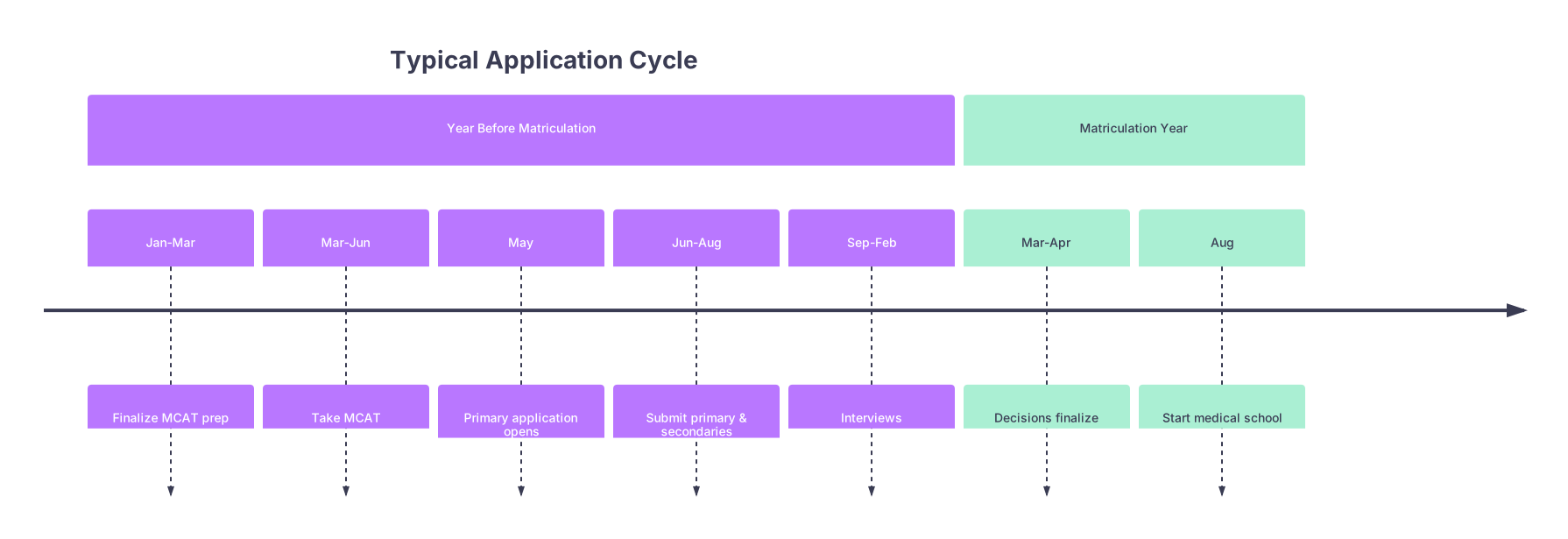
| Period | Event |
|---|---|
| Year Before Matriculation - Jan-Mar | Finalize MCAT prep |
| Year Before Matriculation - Mar-Jun | Take MCAT |
| Year Before Matriculation - May | Primary application opens |
| Year Before Matriculation - Jun-Aug | Submit primary & secondaries |
| Year Before Matriculation - Sep-Feb | Interviews |
| Matriculation Year - Mar-Apr | Decisions finalize |
| Matriculation Year - Aug | Start medical school |
If you want to start med school in August 2029, you are applying in June 2028 and likely taking the MCAT by spring 2028. Work backward from that.
Financial Reality: Time = Money
Nontraditional students often ignore this until it hurts.
You’re trading:
- Current income (for school and lower residency pay)
- Years of compounding retirement savings
- Taking on 200–400k of debt in many cases
But you’re gaining:
- 200–500k+ per year attending income (depending on specialty and location)
- Career satisfaction (if this is truly what you want)
- Stability in the long run
You must actually do a simple projection:
“If I stay in my current field: income until 65.
If I switch to medicine: years of $0, years of resident pay, then attending pay until 65.”
Often, even with a late start (say, attending at 42–45), the financial picture is still net positive. But do not skip the math.
Visual: Total Timeline From Today to Attending
Here’s a rough distribution for a very common nontraditional path: 3 years to matriculation, 4 years med school, 3 years residency.
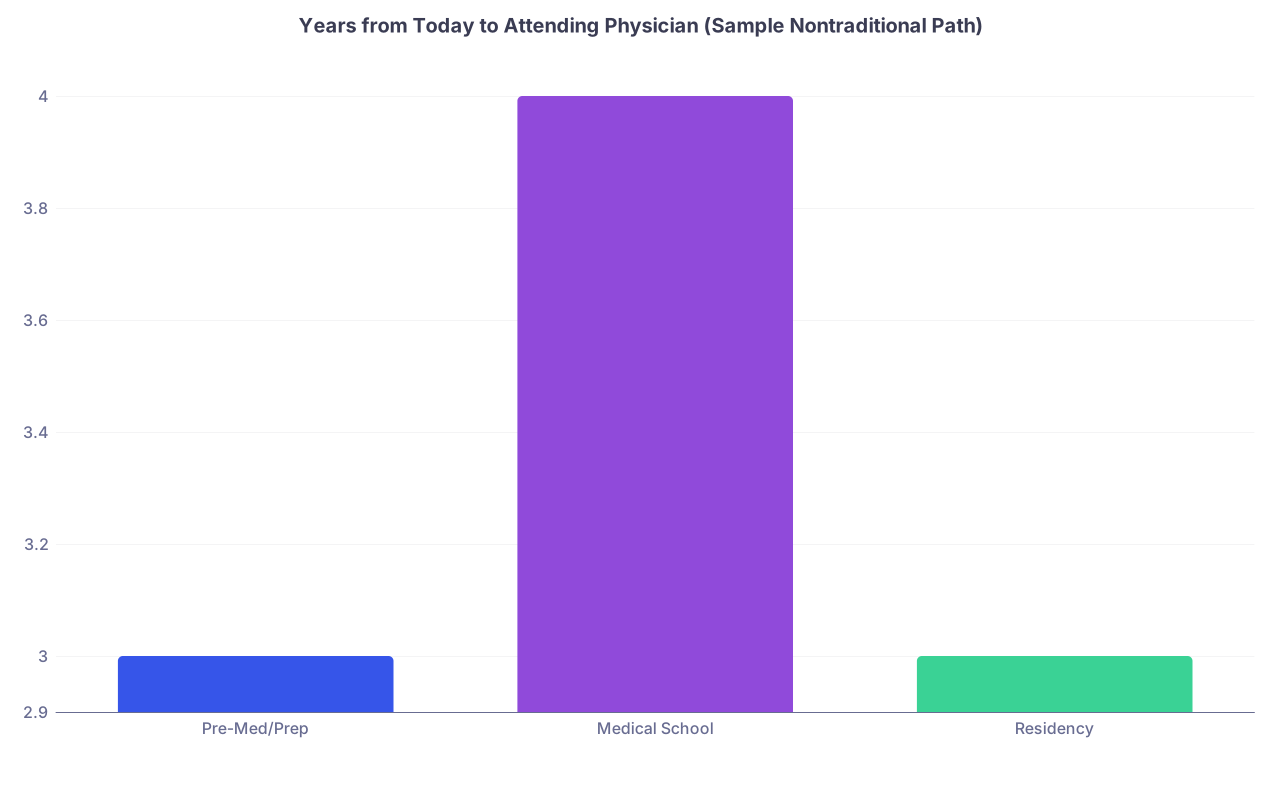
| Category | Value |
|---|---|
| Pre-Med/Prep | 3 |
| Medical School | 4 |
| Residency | 3 |
That’s 10 years. If you start at 30, you’re an attending at 40.
Shift that prep period longer or choose a longer residency, and you’re looking at 11–13 years.
How to Decide if This Timeline Is “Worth It”
Here’s the hard truth: no one can answer that for you.
What I can do is give you a quick gut‑check framework.
Ask yourself:
- If I woke up at 42 still doing my current career, how would I feel?
- If I woke up at 42 as a PGY‑3 (senior resident) after a brutal decade of training, would that feel like a meaningful life?
- Am I okay with being in formal training until mid‑40s while my peers are peaking in their careers?
- Can my family/partner realistically tolerate 10 lean, chaotic years?
If imagining yourself as a 45‑year‑old attending makes you feel relieved and proud, the long timeline is probably acceptable. If it mostly fills you with dread, consider adjacent paths (PA, NP, clinical research, public health, etc.).
What You Should Do Right Now
Do not stay in the fog.
Here’s your immediate, concrete next step:
Write your age at the top of a page, then build two timelines: “Fast realistic” and “Slow realistic,” all the way to attending for the specialty you’re currently most drawn to. Count the exact years.
Once you see that number in front of you—“I’d be 39 at the earliest, 43 at the latest”—you can make an adult decision instead of chasing a vague dream.
FAQ: Nontraditional Timelines to Attending
1. Am I too old to become an attending if I’m starting this path in my mid‑30s?
No, you’re not automatically too old. Many people start this process at 30–38 and become attendings in their early to mid‑40s. The real question is whether the tradeoffs—years of training, debt, lower early income, strain on family—fit the life you want. Programs do admit older applicants, but you’ll need a strong academic record, clear narrative, and evidence you understand the demands.
2. Can I speed things up with a 3‑year medical school program?
Technically yes, practically not by much and not for most people. Three‑year MD programs are limited, often tied to a specific specialty commitment (like primary care), and extremely competitive. You should plan on a 4‑year med school. If you later get into a 3‑year track, great—that’s a bonus year, not your baseline plan.
3. Will doing a postbac or SMP add too many years to make this worthwhile?
A postbac or SMP typically adds 1–3 years before med school. That can feel huge, but if your GPA is weak, skipping academic repair often means never getting in at all. Think of those years as the price of admission. If that extra time pushes your attending age into a range you’re not okay with (for example, starting independent practice at 50), then medicine may not be the right path. But for many in their late 20s/early 30s, those extra years are still very workable.
4. Do I have to do a fellowship, or can I be an attending right after residency?
For many specialties, you can work as an attending right after residency. Family medicine, general internal medicine (hospitalist or clinic), pediatrics, general psychiatry, and many EM programs place you straight into attending roles after residency. Fellowships are needed if you want subspecialty practice (cardiology, GI, heme/onc, many surgical subspecialties) but they’re optional for a lot of generalist career paths.
5. What’s the single biggest thing I can do to avoid wasting years on this path?
Decide on a target matriculation year and lock your MCAT date and application cycle to that. Then build everything backward: which classes you need by when, when you’ll shadow, when you’ll get clinical hours, when you’ll take the MCAT. Vagueness kills timelines. A concrete year—“I’m applying June 2027 to start August 2028”—forces your schedule into focus and prevents the aimless “I’m premed someday” drift that eats 3–5 years for a lot of nontraditional students.
Open a blank page right now and write: “If I start working seriously this year, I’ll likely become an attending in YEAR ____.” Then build the steps that get you from here to there, line by line.