
The brutal truth: switching to medicine at 35, 40, or 45 is usually a bad financial move—but it can still be the right life decision.
If you want a clear, numbers-based answer instead of vague “follow your passion” fluff, keep reading. I’ll walk through what actually happens to your money, time, and options if you start this path mid‑career.
I’m going to be direct: for most mid‑career professionals, medicine is a values decision, not a financially rational one. It can work financially, but only if you understand the tradeoffs upfront and accept them on purpose.
The Core Question: What Are You Giving Up vs What You Gain?
You’re not 22. This isn’t “should I go straight to med school or work for 2 years?” It’s:
- You already have an income, maybe savings, maybe kids, maybe a mortgage
- You’ll be taking a massive pay cut (or zero income) for years
- You’ll likely start attending-level income in your mid‑40s or 50s
So the real financial question is:
“Does giving up 8–12 years of current and future earnings still make sense, given what I’d earn as a physician and for how long?”
Let’s anchor this with a typical path for a nontraditional student.
Typical Timeline If You Start Late
Assume you’re just starting prerequisite work and have no MCAT yet.
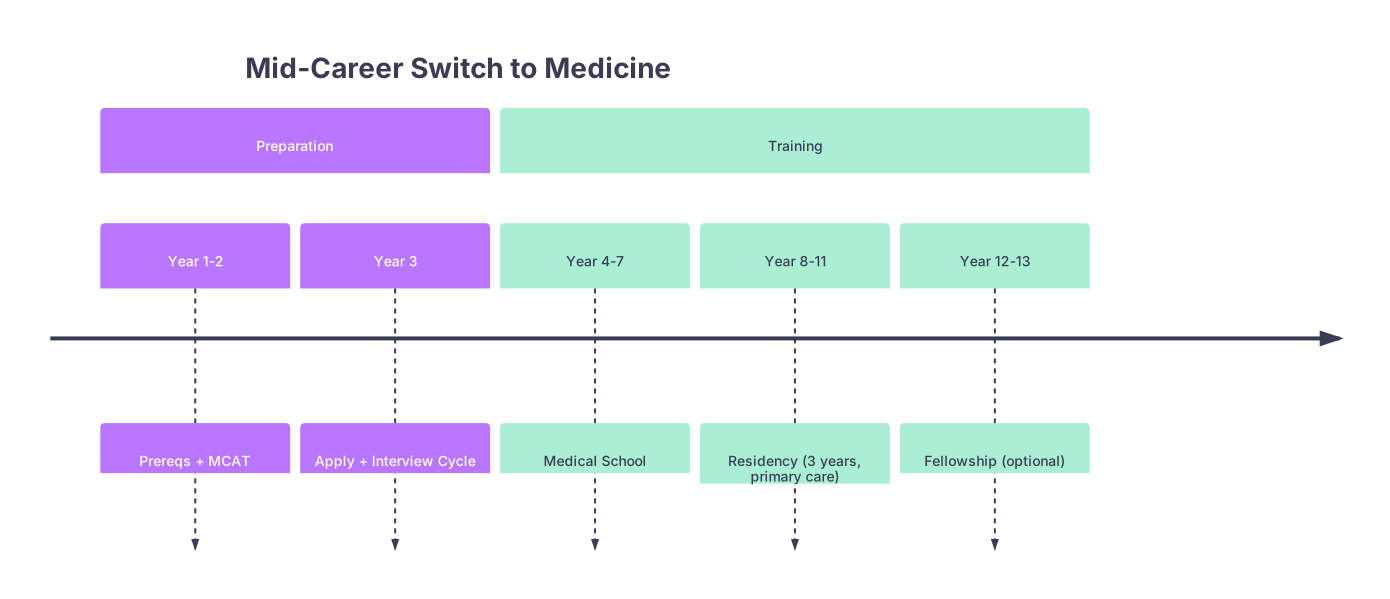
| Period | Event |
|---|---|
| Preparation - Year 1-2 | Prereqs + MCAT |
| Preparation - Year 3 | Apply + Interview Cycle |
| Training - Year 4-7 | Medical School |
| Training - Year 8-11 | Residency (3 years, primary care) |
| Training - Year 12-13 | Fellowship (optional) |
If you start at:
- 35 → You’re an attending ~age 45–47
- 40 → Attending ~50
- 45 → Attending ~55
This is the first uncomfortable reality: your peak-earning years as a physician will be shorter and later.
The Hard Numbers: Income, Debt, and Opportunity Cost
Let’s put some simple, realistic numbers on the table. I’ll generalize to make this usable; your specifics will vary.
Baseline Assumptions
Let’s assume:
- Current job income: $90k–$150k (a common range for mid‑career professionals considering medicine)
- Med school cost (tuition + living): ~$60k–$90k per year
- Med school duration: 4 years
- Residency salary: ~$60k–$75k per year (varies by location and PGY level)
- Attending income:
- Primary care: ~$200k–$260k
- Hospital-based / procedural but not ultra-competitive (anesthesia, EM, radiology in some markets): ~$300k–$450k
- Highly competitive / high paying (orthopedics, derm, some surgical subspecialties): $500k+ but harder to match, especially as a nontrad
Here’s a simplified snapshot.
| Stage | Age if Start at 35 | Income Range (Yearly) | Typical Net Cash Flow |
|---|---|---|---|
| Working Now | 35–37 | $90k–$150k | Positive, saving |
| Med School | 38–41 | $0 | -$60k to -$90k (loans) |
| Residency | 42–45 | $60k–$75k | Barely positive |
| Attending (PC) | 46+ | $200k–$260k | Strongly positive |
You are not just “taking on debt.” You’re:
- Losing 4 years of full income outright
- Replacing 3–7 more years of mid‑career income with low residency income
- Adding hundreds of thousands in student debt that needs to be repaid late in life
Rough Opportunity Cost Example (Start at 35)
Let’s keep it high‑level and conservative.
You earn $120k now with 3% annual raises and could keep working to 65. Rough estimate (ignoring taxes and investment growth):
- 30 years x ~$120k–$190k average late-career → ballpark $4–5M gross lifetime earnings
Now the med path:
- Age 35–37: pre-reqs/MCAT – assume minimal income or reduced hours
- Age 38–41: $0 income, -$80k/year expenses → -$320k (loans)
- Age 42–45: residency at ~$70k/year → $280k total
- Age 46–65: 20 years as attending, let’s say $250k/year average (primary care level)
Total gross attending-era earnings:
- 20 x $250k = $5M
Subtract the med school hole: - Minus ~$320k principal (which with interest may be $450k+ by payoff)
So yes, on paper you might still come out roughly comparable or even ahead if:
- You practice to at least 65–67
- You stay healthy
- You don’t get derailed during training
- You match into at least a mid-paying specialty
- You manage debt aggressively
But here’s the key: you’re compressing your financial runway. You have fewer years to compound investments, less margin for health problems or disability, and much more pressure not to burn out or cut hours.
At 40 or 45, the math gets worse because you have fewer attending years to amortize the cost.
Age 35 vs 40 vs 45: Financial Reality Check
The older you are, the higher the bar you need to clear to justify this financially.
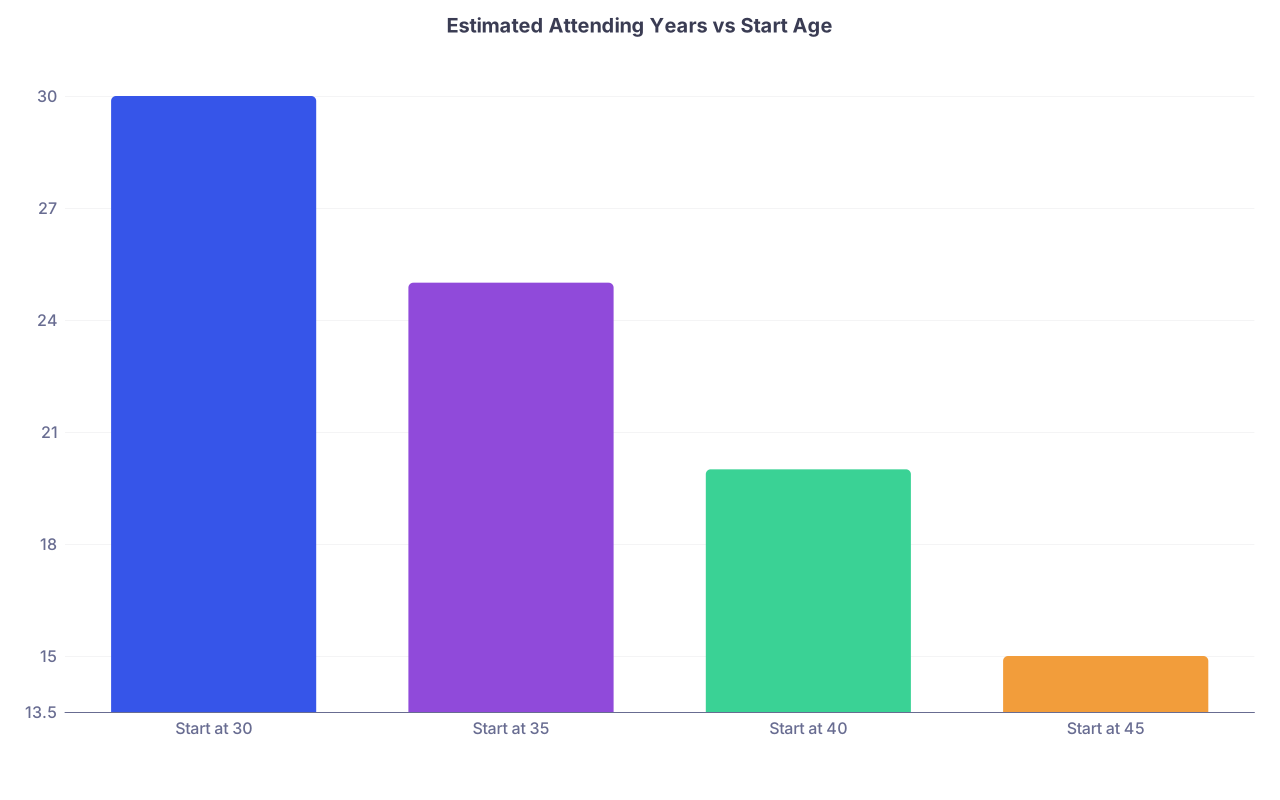
| Category | Value |
|---|---|
| Start at 30 | 30 |
| Start at 35 | 25 |
| Start at 40 | 20 |
| Start at 45 | 15 |
Assuming you retire at 65 and finish residency at ~age 35 for a traditional student:
- Start at 30 → ~30 years as attending
- Start at 35 → ~25 years
- Start at 40 → ~20 years
- Start at 45 → ~15 years
Shorter attending career = less time to:
- Pay off debt
- Build retirement accounts
- Recover from financial shocks
- Scale back work without crushing your retirement savings
My blunt take by age band:
At 35
Financially viable if:
- You already live relatively modestly
- You’re willing to choose a solid but maybe less sexy specialty
- You can handle 10+ years of constrained lifestyle
- You prioritize aggressive debt payoff once attending
At 40
Borderline financially rational. Works best if:
- You’re currently under-earning your potential (e.g., $60k social work to $250k family medicine)
- You have a spouse/partner with stable income and benefits
- You plan to work well into your late 60s
- You’re okay that you’ll be “behind” peers financially forever and accept that trade
At 45
Usually poor financially unless:
- You’re extremely mission-driven and money is secondary
- You are okay with working into your 70s
- You have meaningful savings already (e.g., $300k+ in retirement, no major debt beyond mortgage)
- You target a shorter training pathway (e.g., 3-year FM/IM, maybe hospitalist, no long fellowships)
Other Financial Landmines Nontrads Ignore (Until Too Late)
People obsess about tuition. That’s not the only problem.
1. Health, Energy, and Burnout Risk
You’re not just older at the start—you’re older at every high-stress point:
- Clinical rotations at 40+
- Residency 60–80 hour weeks at 45
- Night shifts, call, and chronic sleep deprivation
If that leads to cutting back hours in your mid‑50s, your fancy financial projections blow up quickly. The spreadsheets assume full FTE. Your body might not.
2. Family and Caregiving Costs
If you have kids—or aging parents—prepare for:
- Childcare expenses during med school and residency
- Lost time that might have been spent with family during crucial years
- Potential geographic moves away from support systems during residency
This isn’t just emotional. It’s financial: more childcare, more travel, more complexity, sometimes divorce.
3. Geographic Inflexibility
Physician jobs pay more in certain places (Midwest, rural). Many nontrads are deeply rooted in a high cost-of-living city.
If you insist on:
- Staying in a high COL metro
- Working fewer hours to “protect balance”
- Only doing the “dream” specialty in your expensive city
Your ROI drops. Fast.
When Switching to Medicine Does Make Financial Sense
Let me be clear: I’m not saying it’s always a bad financial move. I’ve seen it work in some patterns:
Current career is low-paid and capped
Teacher making $50k, social worker making $55k, especially with 20+ working years ahead. Going to $220k+ for 20 years can be a big jump even with debt—if you manage it tightly.You have a strong financial base already
- Paid-off house or close to it
- $200k+ in retirement savings
- No consumer debt
Here, medicine becomes a pivot, not a rescue mission.
Partner/Spouse carries the financial load during training
Dual-income households where one can largely cover living costs. You still take loans, but not as much. Massive difference.You’re content with a “good enough” specialty
If you’re open to internal medicine, family medicine, psych, anesthesia, EM in reasonable markets—your odds of both matching and earning a solid income are much higher than if you insist you’ll “definitely” become a dermatologist.
When It’s Probably a Financial Mistake
I’d seriously question the move if:
- You’re 40+ with no savings and existing debt
- You’re supporting dependents as the main earner
- You hate the idea of debt or delayed gratification
- You’re banking on a single, specific ultra-competitive specialty to “make the math work”
- Your primary motivation is “I’m bored” or “I want more prestige/pay”
Medicine is a brutal way to chase money or status, especially when you start late. There are faster, saner ways to increase income (tech skills, management roles, consulting, niche expertise in your current field).
How to Decide: A Simple Framework
Here’s the decision filter I’d actually use with someone in front of me.
Step 1: Do a Personal Financial Inventory
List out:
- Current income and spouse/partner’s income
- Savings (retirement + non-retirement)
- Debts (student, car, credit, personal loans, etc.)
- Fixed monthly obligations (rent/mortgage, childcare, etc.)
If you’re 35–40 and:
- Net worth negative by >$50k
- No retirement savings at all
- High fixed monthly costs
You’re trying to jump to a very expensive path from a weak starting position. That doesn’t mean “no,” but it does mean your financial risk is high.
Step 2: Build a Rough Timeline with Real Numbers
Not fantasy. Realistic.
- How many years of prereqs?
- Are you working part-time or not at all then?
- Med school cost at schools you’re actually likely to attend (in-state vs private)
- Residency length of your most likely specialties
Then, build two crude scenarios:
- Stay in current field, improve modestly (promotions, new job)
- Go medicine, as realistically as you can model it
You do not need perfect precision. You want the shape of the tradeoff, not second-decimal accuracy.
Step 3: Ask the Non-Financial Question Honestly
Because here’s the reality: if money is your main driver, medicine starting at 35–45 is rarely the optimal solution.
So ask yourself:
- “Would I still do this if my lifetime earnings ended up about the same or even slightly worse than staying put?”
- “Would I still do this knowing I’ll be in training when my peers are peaking in their careers?”
- “Would I still do this if I end up in family medicine in a mid-sized city, not in my dream specialty in my dream city?”
If the answer is no, you are chasing an idealized version of medicine, not the real thing.
Some Practical Moves If You’re Seriously Considering It
I’m not just here to talk you out of it. If you’re leaning yes, here’s how to not wreck yourself financially:
- Spend 6–12 months shadowing and working in healthcare (scribe, MA, hospital admin). Confirm you want the real job, not the TV version.
- During that same period, aggressively:
- Pay down high-interest debt
- Cut fixed lifestyle costs
- Build an emergency fund to cover gaps in prereq/MCAT years
- Apply smart:
- In-state schools first
- DO programs if they increase your chances without blowing up debt
- Avoid expensive offshore or for-profit programs unless you fully understand the risks
- Choose strategy over ego:
- Don’t chase ultra-long, ultra-competitive paths if your clock and finances are tight
- Think about lifestyle specialties that allow part-time later if you plan to work longer (e.g., psych, some IM fields)
The Bottom Line: Is It Worth It Financially?
Here’s the clearest way I can say it.
- At 35: Financially possible, sometimes reasonable, if you’re disciplined, realistic about specialty and location, and prepared to sacrifice a decade of comfort.
- At 40: Financially marginal. It can work, but only with strong intentional planning, good health, and a willingness to work longer and live below your means as an attending.
- At 45: Usually not “worth it” on pure financial grounds. If you do it, do it because you cannot imagine another life, not because of money.
Three core ideas to remember:
- You’re not only taking on med school debt—you’re giving up the best compounding years of your current career and investments.
- The math can work, but only if you assume realistic specialty outcomes, work longer, and live like a resident after residency for a while.
- If you would only do this for money, don’t. If you’d do it even if the money barely breaks even, then we can talk seriously.