
The idea that “MD is always better than DO” is outdated—and especially wrong for late‑career switchers.
If you’re coming to medicine from another career, the MD vs DO decision is less about prestige and more about fit, timeline, risk tolerance, and what kind of training and lifestyle you actually want. Let’s cut through the noise.
Big Picture: MD vs DO For Late‑Career Switchers
If you want the short version:
- If you’re aiming for the most competitive specialties (derm, ortho, plastics, ENT, some surgical subspecialties) and you’re willing to optimize everything—GPA, MCAT, research—MD usually gives you a smoother path.
- If you’re open to a wider range of specialties (especially primary care, IM, psych, EM, PM&R, some community surgery) and you value extra flexibility in admissions and a somewhat more holistic education, DO can be a very smart, lower‑friction choice.
- Age itself isn’t your main enemy. Time, debt, and realistic competitiveness are.
The good news: both MD and DO now train in the same residency system (ACGME). DOs and MDs match into the same programs, take the same USMLE exams if they choose, and work side by side as attendings. The difference is less “good vs bad” and more “which path matches your goals and constraints.”
Key Structural Differences That Actually Matter
You don’t need a philosophy lecture. You need the operational differences.
| Factor | MD Path | DO Path |
|---|---|---|
| Admissions Flexibility | Generally more competitive | Slightly more forgiving, more holistic |
| Average MCAT/GPA | Higher | Slightly lower on average |
| Approach to Medicine | Allopathic | Allopathic + OMM/OMT emphasis |
| Residency Competitiveness | Stronger for top specialties & academic programs | Strong for many fields; harder for ultra-competitive specialties |
| International Practice | Widely recognized globally | Some countries limited or extra hurdles |
| Nontraditional-Friendly? | Depends on school | Many DO schools strongly welcome nontrads |
1. Admissions Profile
Typical pattern in the US (and yes, there are exceptions):
- MD schools: higher average stats, more applications per seat, more traditional applicant pool, more research focus especially at “big name” schools.
- DO schools: slightly lower GPA/MCAT averages, often more open to nontraditional backgrounds, sometimes friendlier to re‑applicants, often emphasize “whole person” and service.
If your GPA is imperfect, your MCAT is good but not amazing, or your story is strong but non‑linear, DO can give you more realistic odds, faster.
2. Philosophical & Training Differences
Reality on the ground:
- MD curriculum: standard biomedical + clinical training.
- DO curriculum: the same core medical curriculum plus osteopathic principles and OMM/OMT (hands‑on manual therapy and a more explicit focus on musculoskeletal and “whole person” care).
In practice, many DO grads work indistinguishably from MDs, especially in hospital‑based specialties. Some lean heavily into OMT in outpatient practice (family med, sports med, PM&R).
If you hate the idea of learning and being tested on manual techniques, DO will be extra work you resent. If you like musculoskeletal, sports, physical medicine, or hands‑on care, that training can be an asset.
3. Residency and Competitiveness
Old advice (“DOs can’t match into X”) is outdated but not completely dead.
Here’s the current reality for late‑career folks:
- For most primary care fields (FM, IM, peds), psych, neurology, PM&R, many EM programs, and a good chunk of community general surgery, MD vs DO matters far less than your board scores, clinical performance, letters, and fit.
- For hyper‑competitive fields (derm, plastics, urology, ENT, some ortho, neurosurgery), being DO still adds friction. You’ll need stellar boards, research, networking, and often a strong home program to offset that.
If you’re entering medicine at 30+ and absolutely dead‑set on derm or plastics and nothing else, I’ll be blunt: you’re signing up for a very high‑risk path. MD doesn’t guarantee it, but it does reduce some structural barriers and bias.
Nontraditional‑Specific Factors: Where MD and DO Really Diverge
This is where being a late‑career switcher actually changes which path is “better.”
Age & Time Horizon
- Prereqs + glide year + 4 years med school + 3–7 years residency = a lot of time.
- Every extra year before you start residency is a year of lost attending income and more opportunity cost.
Here’s how MD vs DO fits in:
- If your current stats make you borderline for MD and quite competitive for DO, applying heavily DO can mean:
- Fewer application cycles.
- Less time waiting + reapplying.
- Earlier start to medical school and residency.
- Chasing an MD at all costs, reapplying 2–3 times, doing expensive SMPs or extra degrees just to “upgrade” to MD often isn’t worth it financially or emotionally for a 30‑ or 35‑year‑old.
Flexibility on Academic Blemishes
I’ve watched plenty of people with:
- Rough early undergrad years
- Career changes from business, arts, military, etc.
- Community college coursework and a later post‑bacc
…get traction faster with DO schools than MD.
MD schools can be rigid about:
- Old prereq coursework
- Multiple withdrawals or repeated courses
- Lower early GPAs even if you’ve improved dramatically
DO schools, on average, are more willing to see an upward trend and adult responsibilities as part of the picture. Not always—but often enough that it’s a real difference.
Practical Decision Framework: How To Choose MD vs DO As a Late‑Career Switcher
Let me make this as operational as possible.
Step 1: Clarify Your Endgame
Ask yourself three questions and answer them honestly:
- Do you have a short list of must‑have specialties, or are you fairly open?
- Do you care about working in:
- Big‑name academic hospitals doing heavy research?
- Or are you fine with strong community hospitals and teaching programs?
- Do you need the option to practice abroad (Europe, some parts of Asia, etc.)?
If your answers are:
- “I want the option for highly competitive surgical subspecialties,”
- “I want a research‑heavy academic career,” and
- “I might want to work in Europe someday,”
→ You should strongly lean MD, even if it takes an extra year of prep.
If your answers are:
- “I’m open to things like FM, IM, EM, psych, neuro, anesthesia, PM&R, maybe surgery but not hyper‑narrow prestige targets,”
- “I care more about being a good doctor than academic titles,” and
- “I expect to practice in the US for my career,”
→ DO becomes a solid, often more efficient choice.
Step 2: Look at Your Current Competitiveness
Be harsh and honest with your data:
- Science GPA
- Overall GPA
- MCAT (diagnostics if you haven’t taken it yet)
- Recent academic performance (post‑bacc, grad work)
Rough rule of thumb (US context):
- If after realistic prep you’re likely in the 515+ MCAT / 3.7+ GPA world with strong experiences, you’re absolutely in MD territory and can be selective about DO.
- If you’re more 505–512 range with a 3.3–3.6 and a strong upward trend and good life/career experiences, DO schools might value your profile more than many MD programs.
- Below that, you’ll need to do serious repair (post‑bacc, SMP) regardless. DO still might be more attainable, but you’re in rebuilding mode.
Step 3: Financial and Life Constraints
You’re not deciding this in a vacuum. Think:
- Do you have dependents or a partner with a fixed location?
- How much educational debt can you reasonably shoulder, given a later start?
- Can you afford 1–2 extra “gap” years to chase a marginally more competitive MD application?
I’ve seen mid‑30s applicants sink two extra years and tens of thousands into strengthening for MD when they could’ve started DO a cycle or two earlier and wound up practicing in the same kind of IM or EM job.
Sometimes chasing MD is ego, not strategy.
My Candid Take: When Each Path Is Usually Better
MD is usually the better path if:
- You’re academically strong by any objective measure.
- You legitimately want options for:
- Highly competitive specialties
- Research‑heavy academic careers
- International practice in places where DO is less recognized
- You can afford the time and effort to optimize for MD admissions without breaking your finances, your relationship, or your sanity.
DO is usually the better path if:
- You’re a bit below typical MD stats but still capable and motivated.
- You’re older (late 20s, 30s, 40s) and want to minimize lost years from extra reapplications and SMPs.
- You’re genuinely open to a wide range of specialties that are DO‑friendly.
- You have a strong nontraditional story—work history, service, military, caregiving—that DO admissions committees often appreciate.
Neither is a consolation prize if it lines up with what you actually want your life to look like.
Concrete Preparation Tips For Late‑Career Switchers (Applies to Both)
A few targeted moves that matter more than the letters after your name:
- Get recent, rigorous science coursework. Med schools want proof you can handle upper‑level bio/chem now, not 12 years ago.
- Crush the MCAT once. A solid MCAT can partially offset a rocky early transcript. Don’t “wing it” because you’re busy with work—you’ll pay with extra years.
- Get real clinical exposure. Shadowing and, ideally, paid clinical work (scribe, MA, EMT, CNA) to show you understand the day‑to‑day reality.
- Own your narrative. Late‑career switchers who do well explain:
- Why they’re changing now.
- Why this isn’t a midlife crisis.
- What they bring from their prior career that will make them better clinicians.
The MD vs DO question sits on top of this foundation. It doesn’t replace it.
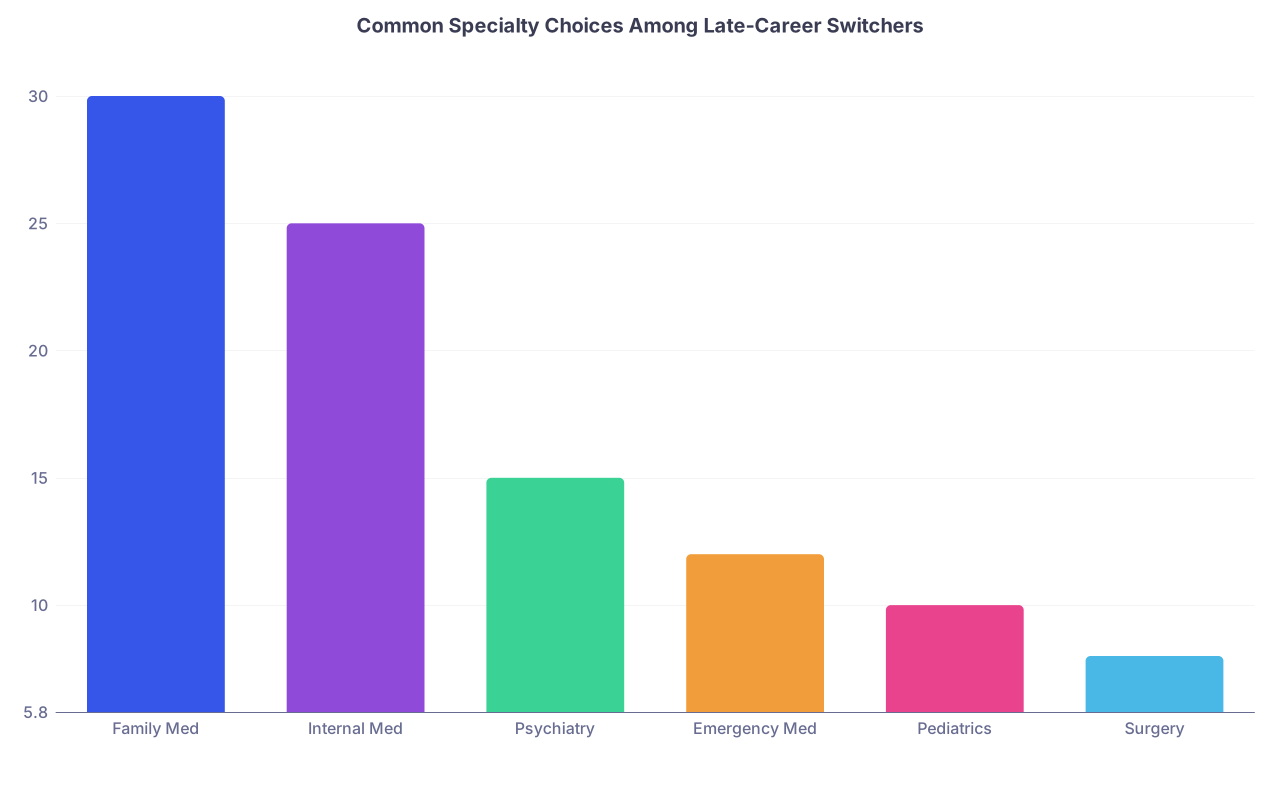
| Category | Value |
|---|---|
| Family Med | 30 |
| Internal Med | 25 |
| Psychiatry | 15 |
| Emergency Med | 12 |
| Pediatrics | 10 |
| Surgery | 8 |

| Step | Description |
|---|---|
| Step 1 | Nontraditional Applicant |
| Step 2 | Lean DO-heavy school list |
| Step 3 | Prioritize MD, apply broadly |
| Step 4 | Mix of MD and DO applications |
| Step 5 | Start earlier, minimize reapplications |
| Step 6 | Stronger research and mentorship |
| Step 7 | Stats near MD averages? |
| Step 8 | Want ultra-competitive specialty or academia? |
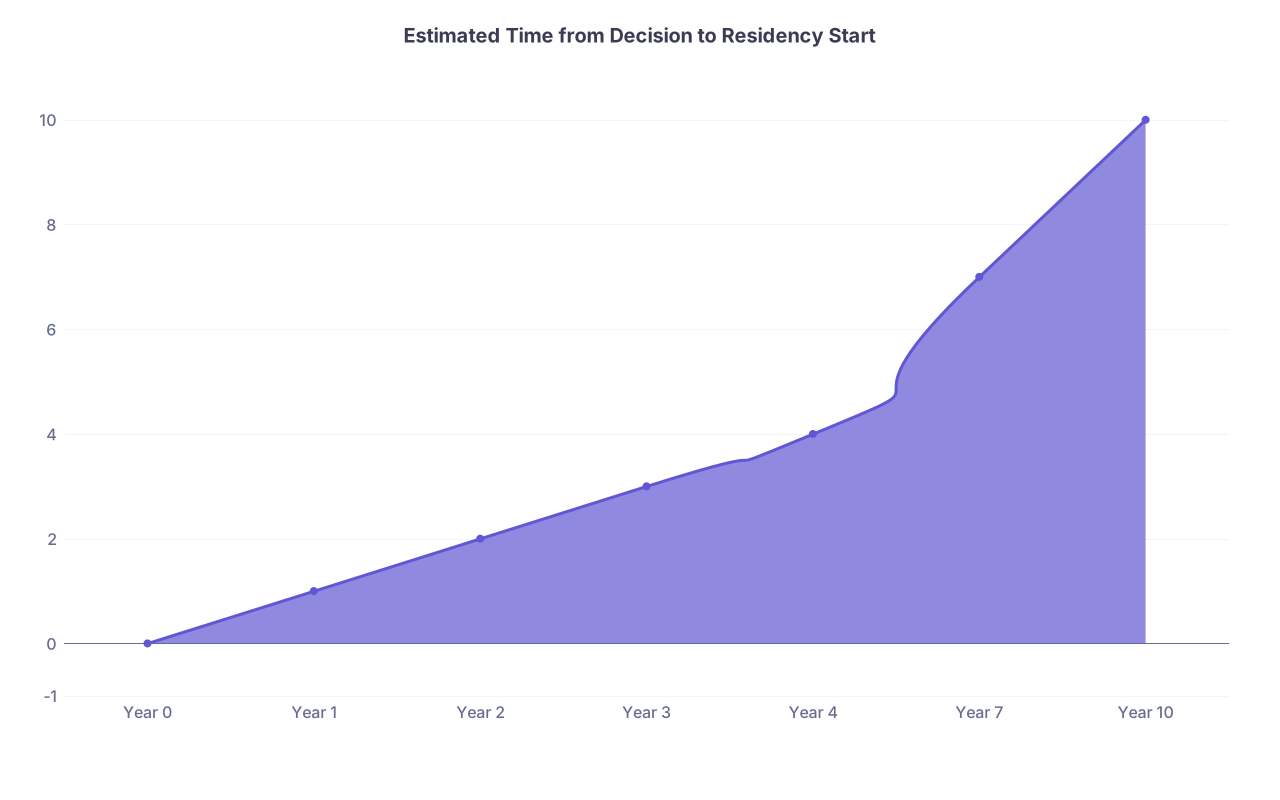
| Category | Value |
|---|---|
| Year 0 | 0 |
| Year 1 | 1 |
| Year 2 | 2 |
| Year 3 | 3 |
| Year 4 | 4 |
| Year 7 | 7 |
| Year 10 | 10 |


FAQs: MD vs DO For Late‑Career Switchers
Is it harder to get into MD or DO programs as an older applicant?
Age itself is rarely the main problem. For MD, the issue is usually competitiveness—GPA, MCAT, research—relative to a younger, traditional pool. For DO, committees are often more comfortable with older students and nontraditional paths, as long as your academics now prove you can handle medical school. If your recent performance is strong and your story is coherent, either path is possible.Will being a DO limit my ability to match into residency as a nontraditional student?
For most mainstream specialties—FM, IM, psych, EM, peds, neurology, anesthesia, PM&R—a strong DO applicant will match very well. Where DO still faces bias is ultra‑competitive subspecialties and some high‑end academic programs. As a late‑career applicant, the bigger risk is going after fields where even MDs with stellar stats struggle, regardless of degree. Choose your target range intelligently.Does DO take longer or cost more than MD for a career changer?
The program length is the same: 4 years. Cost varies by school, not degree type. The real time difference often comes from admissions trajectory: if your profile easily fits DO now but is marginal for MD, you might spend extra years “repairing” for MD when you could start a DO program sooner. That lost time usually matters more financially than the MD/DO tuition difference.If I start as a DO, can I still take USMLE and compete for MD-heavy residencies?
Yes. Many DO students take USMLE Step 1 and Step 2 in addition to COMLEX. Strong USMLE scores plus good clinical performance, letters, and (for some fields) research can make you competitive at many MD‑heavy residency programs. You will still face some bias at the very top or in hyper‑competitive fields, but it’s not a hard wall the way people think it is.How do international practice options differ between MD and DO?
US MD grads are broadly recognized in most countries, though details vary. DO recognition is more patchy: some countries accept US DOs fully, some treat them as limited, some don’t recognize them at all without extra hurdles. If overseas practice is a serious, likely goal—not a vague “maybe someday”—MD is usually the safer move. If your career will almost certainly be US‑based, this matters less.If I’m on the fence, should I apply to both MD and DO schools?
Usually, yes. Build a school list that’s realistic and diversified: some MDs where your stats are within range and your story fits, plus a solid set of DO programs, especially ones known to welcome nontraditional students. Let the admissions results guide you. If you get multiple DO acceptances and no MD offers, that’s a very clear signal about where you’re most competitively valued—and it’s often the right answer for late‑career applicants.
Bottom line:
- MD vs DO isn’t “good vs bad”; it’s “which fits your goals, constraints, and risk tolerance.”
- As a late‑career switcher, minimizing wasted years and aligning with realistic specialty goals matters more than chasing three letters for their own sake.