Educational disclaimer: This article is for educational purposes only and is not financial, legal, tax, or admissions advice. Tuition, debt, repayment strategy, employment contracts, and licensing rules vary by school, state, and personal circumstances, so consult qualified financial, legal, tax, and premedical advisors before making decisions.
Is MD or DO the better path if you're coming to medicine later? Here's the straight answer: for older career changers, this isn't mainly a prestige question. It's a fit question. A risk question. A "what gives me the best chance to get in, get through, match well, and still have a life" question.
That's the frame I want you to use.
Both MD and DO degrees lead to becoming a fully licensed physician in the U.S. Both can get you into primary care, hospital medicine, emergency medicine, psychiatry, and a long list of other careers. But the route isn't identical. The differences show up in places older applicants care about more than 22-year-olds usually do:
- How selective admissions are
- Whether schools are open to nontraditional stories
- Location and relocation flexibility
- Total cost and debt load
- School culture and support
- Specialty access later on
If you're 35, 42, or 50, you don't have infinite runway. That changes the math. You need the path that is realistic, sustainable, and aligned with your actual goals. Not your ego. Not somebody else's hot take on internet forums. Real life.
What older career changers actually want to know: Is MD or DO the better path?
Here's the practical answer.
If you want the broadest traditional brand recognition and often the strongest positioning for very competitive specialties, MD is the cleaner default.
If you want a path that may be more accessible in admissions and you're fully comfortable with osteopathic training, DO is absolutely a serious option.
That's it in one sentence.
The mistake older applicants make is turning this into a philosophical debate. It isn't. You're not choosing a personality type. You're choosing a training path.
What matters most:
- Admissions likelihood: Can you realistically get accepted?
- Academic fit: Are your GPA, science record, and MCAT competitive enough?
- Geographic fit: Can you live where the school is?
- Life fit: Will the schedule work with children, caregiving, or a spouse's job?
- Career fit: Are you aiming for primary care, community medicine, or something highly competitive?
- Financial fit: Will the debt make sense at this stage of life?
Subtle differences matter. A lot. Especially later. Both degrees lead to physician licensure, but they don't always create exactly the same downstream options with the same ease. Older applicants need to think three moves ahead.
If you're still early in the process, it also helps to understand how schools assess risk in older applicants before you build your list.
What the data says about admissions odds, applicant fit, and age
The hard truth: older applicants don't get a free pass because they're mature. Medical schools still screen heavily on academics. If your science GPA is weak, your MCAT is unready, or your prerequisites are ancient and unsupported by recent coursework, your life story won't rescue you.
But older applicants do have real advantages. I've seen this over and over. The strongest nontraditional candidates usually bring:
- Better interview presence
- Clearer motivation
- More resilience under pressure
- Stronger professional behavior
- A believable reason for pursuing medicine
That last one matters a lot. "I've always wanted to help people" is useless. Every applicant says that. A compelling older applicant can explain why medicine, why now, and why this is sustainable. Cleanly. Convincingly. No rambling midlife-crisis energy.
In broad admissions terms, MD programs are usually more selective overall. That's not an insult to DO schools. It's just the landscape. Average metrics tend to run higher at many MD programs, and the competition is denser. DO programs often provide broader entry points for nontraditional applicants, especially those with strong recent academic repair, meaningful clinical exposure, and a mission-aligned story.
That doesn't mean DO schools are "easy." They aren't. Bad applicants get rejected there too.
Age itself usually isn't the formal barrier. Schools generally won't reject you just for being older. What they do worry about is everything wrapped around age:
- Have you proven current academic readiness?
- Are your prerequisites too old?
- Can you handle the pace?
- Do you understand how long training lasts?
- Are you likely to follow through?
That's what they're really asking.
A few patterns are worth knowing:
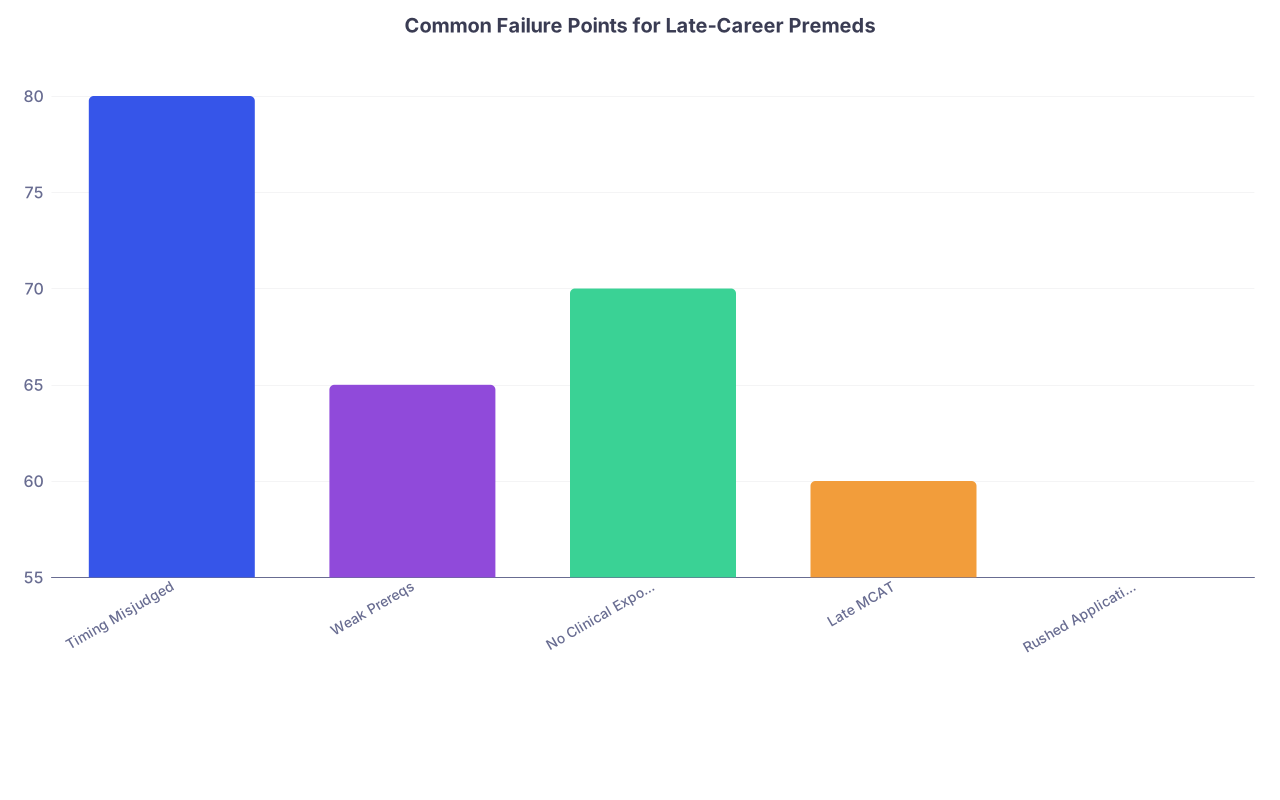
Recent coursework helps older applicants a lot.
If your prerequisites are 10 or 15 years old, don't act surprised when schools hesitate. A recent post-bacc or upper-level science record can calm those concerns fast.The MCAT still matters.
Experience doesn't substitute for test readiness. Plenty of smart professionals get blindsided by the MCAT because they assume maturity equals preparedness. It doesn't.Your story must hold together.
I've seen applicants sink interviews because they gave three different reasons for switching careers. Schools don't want confusion. They want conviction backed by evidence.Demonstrated exposure to medicine is non-negotiable.
Shadowing, patient-facing work, volunteering, or clinical employment. You need proof that you know what you're signing up for.
If you need to shore up academics first, a realistic plan for post-bacc or DIY academic repair can matter more than endlessly debating MD versus DO.
My position is simple: if you're older and your academic metrics are truly strong, apply broadly and include MD if it fits your goals. If your metrics are respectable but not elite, and your nontraditional story is strong, DO should be on the table early, not as some backup you resent.
Training, rotations, and lifestyle: what changes after you get in
Once you're accepted, the letters matter less day to day than people think.
Both MD and DO school are brutal in the same basic way: huge information load, relentless exams, clinical expectations, and not enough time. If you're older, you feel the logistical stress more sharply because you usually have more going on. Mortgage. Kids. Aging parents. A spouse with a fixed job. Real stuff.
The main curricular difference is straightforward:
- MD programs follow allopathic training
- DO programs include that plus osteopathic manipulative medicine, or OMM
For some students, OMM is a meaningful part of the training identity. For others, it's one more thing to study on top of an already overloaded curriculum. Be honest with yourself. If you dislike the idea and are only picking DO because you think it's easier to get in, that's not ideal. Not fatal. But not ideal.
Clinical rotations can matter enormously for older students. Why?
- Commute burden can become crushing
- Rotation sites may be spread across regions
- Third- and fourth-year schedules can be chaotic
- Family obligations don't pause because you're on surgery
This is where school-specific details matter more than degree label. I've seen students choose a "better name" school and then get wrecked by travel-heavy rotations and weak support. Dumb move. A school with stable clinical sites, good advising, and reasonable logistics can be the smarter pick.
What should you look for after acceptance?
- Rotation stability
- Geographic consistency
- Nontraditional student support
- Academic remediation resources
- Mental health services
- Family-friendliness in scheduling culture
- Strong deans and specialty advisors
School culture matters. A lot. Older students usually don't need hand-holding, but they do need institutions that aren't chaotic.
Specialty access, residency, and long-term career goals
Here's the no-spin version: both MD and DO graduates can enter most specialties, but if you're aiming at the most competitive fields, MD often gives you an easier runway. Not a guaranteed one. Just an easier one.
That difference isn't because DO physicians are less capable. It's because residency selection still reflects reputation, network effects, advising quality, research infrastructure, and old-fashioned bias in certain corners of medicine. That's reality. Pretending otherwise doesn't help you.
Residency placement depends on your full file:
- Board scores
- Clinical grades
- Letters of recommendation
- Research
- Audition rotations
- Professionalism
- Networking
- School support
Older applicants should be strategic, not sentimental. If you think you may want dermatology, orthopedic surgery, plastic surgery, or another highly competitive specialty, don't casually ignore the possible advantage of stronger MD pipelines. On the other hand, if your goals are primary care, psychiatry, internal medicine, pediatrics, family medicine, or rural practice, both paths can work very well.
Choose schools that have:
- Strong match outcomes in your target specialty
- Good advising early, not just in fourth year
- Alumni networks in the region where you want to live
- Solid hospital affiliations
- A track record of supporting nontraditional students
If you're trying to map competitiveness honestly, compare your goals against broader residency match dynamics for nontraditional applicants rather than assuming age alone will define your outcome.

A school's match list isn't everything, but it tells you something. Read it carefully. If a program talks big and matches thin, believe the match list, not the brochure.
Cost, debt, and return on investment for late starters
Older career changers can't afford magical thinking about money. You're not 21 with decades to absorb bad financial choices. Debt hits differently when you're also thinking about retirement catch-up, child care, college savings, or supporting family.
The best school is not automatically the one with the shinier label. It's the one that creates the best balance of:
- Acceptance probability
- Graduation probability
- Match probability
- Total cost
- Family stability
Opportunity cost is real. Every year in school and residency is a year you're not earning your prior salary, not building retirement the same way, and not fully controlling your schedule. That's not a reason to avoid medicine. It's a reason to choose with open eyes.
A simple framework I like:
Estimate total training burden, not just tuition.
Include fees, living costs, travel for rotations, board prep, relocation, and lost earnings.Prioritize in-state or lower-cost options when quality is solid.
Prestige is expensive. Sometimes pointlessly so.Don't overpay for a weak-fit school just to say you got in somewhere.
That's desperation, and desperation is expensive.Pay for advantage only when it's real.
If a school gives you meaningfully better support, location, or specialty access, fine. If it's just vibes, skip it.
One more blunt point: the MD vs DO label often matters less financially than the specific school package. A lower-cost school near your support system may beat a more prestigious school that forces constant relocation and higher borrowing. That's not glamorous. It's smart.
Bottom line: how to decide, plus what to do next
Here's the decision rule.
- Choose MD if you have the academic profile for it and want the broadest traditional competitiveness, especially if highly selective specialties remain possible goals.
- Choose DO if it offers a more realistic admissions path, better school fit, or a stronger life setup—and you're fully on board with the training model.
- Choose the specific school, not the letters alone, based on cost, location, rotations, support, and match outcomes.
For older career changers, ideology is overrated. Logistics win. Fit wins. Good advising wins. Financial sanity wins.
What to do next:
- Build a balanced school list with both realism and ambition.
- Compare each school's match lists and rotation structure.
- Talk to current students, especially nontraditional ones.
- Audit your finances honestly.
- Decide based on the best odds of finishing strong and matching where you want.
That's the real answer. Not glamorous. But useful.