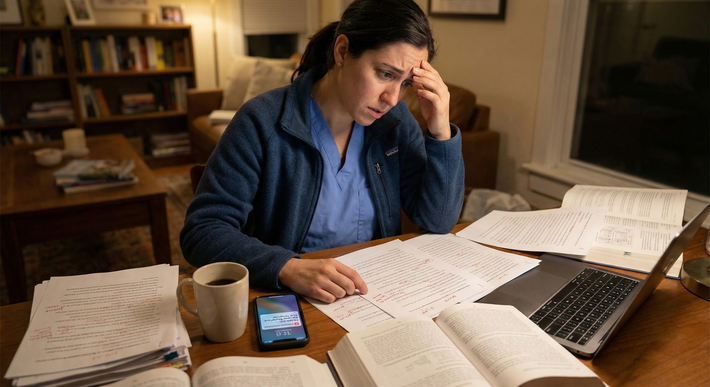
Let me tell you what really happens to your personal statement. It's mid-October. An associate program director at a mid-sized internal medicine program has 900 files in her queue and a coffee going cold. She clicks yours open. First line: "Ever since I was six years old, I knew I wanted to be a doctor." She sighs, skims past the paragraph without reading it, and starts hunting for the part that predicts whether you can survive intern year.
That's the scene. I've watched it play out for years, on both sides of the admissions table, and the biggest myth I have to beat out of applicants every cycle is this one: that you need a childhood origin story, some cinematic "spark", to be compelling. You don't. In most cases, it actively hurts you. Here's why, and here's what actually works.
The Death of the 'Toy Doctor' Narrative
If you are worried about the effectiveness of your opening, check out Mastering the First 3 Sentences: Crafting a High-Impact Personal Statement Hook to ensure you are starting on the right foot.
Program directors roll their eyes at the childhood opener. Not figuratively. I sat in a rank-list meeting one February where a faculty member read an applicant's first line out loud, "I received my first toy stethoscope at age four", and the room laughed. Not kindly. That applicant's statement never recovered, and afterward nobody in the room could recall a single other thing it said. The opener didn't just bore them. It erased the rest of the file.
There's a deeper shift happening that applicants keep missing. Medical education has spent the last fifteen years moving toward what's called professional identity formation, the idea that becoming a physician is an adult developmental process, built through supervised clinical experience, feedback, and reflection. Programs are literally evaluated on how well they develop this in residents. So when your statement opens with a story from before you could ride a bike, you're leading with evidence that is, by definition, pre-professional. You're telling the reader the most important thing about your candidacy happened before you knew what medicine actually is.
Understand the difference between a story and a statement of purpose. Your medical school essay was closer to a story, prove you have a pulse, a reason, some humanity. The residency personal statement is a cover letter for a job. A story entertains. A statement of purpose argues: here is the work, here is evidence I can do it, here is why I fit your program specifically. Nobody hires a PGY-1 because of a touching memory. They hire the person they trust at 3 a.m.
And that's the real problem with "I played with a stethoscope in my basement." It signals a lack of perspective. It tells me your mental model of this profession hasn't been updated since childhood, even if it has. Worse, it burns your most valuable real estate. Your opening paragraph is the only paragraph every reader will definitely see. Spending it on information that predicts nothing about your clinical performance is a strategic error, full stop.
The Hierarchy of Evidence: What Actually Moves the Needle
Before finalizing your draft, review Personal Statement Clichés That Instantly Weaken Your Application to avoid common pitfalls that make PDs lose interest.
So what replaces the spark? Evidence. And you already have it, you're just narrating it wrong.
Take the clinical rotation "aha" moment. Most applicants butcher these. The bad version reads: "During my surgery rotation, I watched a patient crash and realized medicine was truly my calling." That's a feeling, not evidence. The good version sounds like this: you were on night float, you noticed a post-op patient's heart rate trending up before anyone flagged it, you rechecked the vitals yourself, you escalated to the senior despite being "just the student," and it turned out to be a bleed. Then, this is the part everyone skips, you extract the competency out loud. Pattern recognition. Willingness to escalate. Calm under pressure. The event is the evidence. The competency is the claim. You need both, explicitly, on the page.
Now the insider truth that will save you years of agonizing: faculty value grit, problem-solving, and team-based success over poetic epiphanies. In every rank meeting I've attended, the words that move an applicant up the list are "reliable," "coachable," "took feedback well," "the residents wanted to work with them." I have never once heard a program director say "beautifully written origin story." Not once. We are hiring a colleague, not casting a protagonist. A resident who recognized a problem, fixed what they could, escalated what they couldn't, and made the team better, that's the person who gets ranked. Passion is cheap. Reliability is rare.
Don't neglect your non-clinical experiences, either, they're competency proof in disguise. Research means you tolerated ambiguity, finished a long project, and survived critique. That's practice-based learning and improvement. Leadership means you ran a team under constraints, which is exactly what running a patient list feels like. Service means mission alignment, but only if you show up with receipts, what you built, how long you stayed, what changed. "I volunteered at a free clinic" is wallpaper. "I built the clinic's hypertension follow-up protocol and no-show rates dropped" is evidence.
Here's the exercise I make my advisees do. I call it competency mapping. Print your draft. Next to every paragraph, write which of the six ACGME competencies it demonstrates: patient care, medical knowledge, practice-based learning and improvement, interpersonal and communication skills, professionalism, systems-based practice. Any paragraph that maps to nothing gets cut, no matter how pretty it is. Any competency with zero paragraphs is a hole in your candidacy, and you either fill it or accept that another applicant will. This one exercise transforms more statements than any writing workshop I've ever run.
Metrics vs. Motivation: The Truth About Screening
Here's the part nobody tells you publicly. At most programs, your personal statement isn't even read until after the filters do their work, scores, school, visa status, graduation year. The statement doesn't get you past the screen; it gets you ranked after the interview. And when a human finally does read it, they're skimming. Sixty to ninety seconds, sometimes less. Some screeners are effectively keyword-matching: continuity clinic, quality improvement, procedures, sign-out, escalation of care, feedback. They're pattern-matching for two things, evidence of genuine specialty commitment, and red flags. Unexplained gaps. Generic mass-mail language. Vague melodrama. A thematic arc about your childhood doesn't register in a ninety-second skim. A concrete clinical detail does.
Which brings me to the boredom factor. When the overwhelming majority of statements open with a childhood epiphany or a grandparent's illness, they stop being separate documents. They blur into one long, beige file. I watched a screener go through forty statements in one sitting last cycle, and afterward she could recall exactly two. Not the two best-written ones. The two most specific ones. Sameness is the real killer in this process. You don't need to be flashy, you need to be the file someone remembers at 5 p.m.
Your job is to build what I call a signature story: one real clinical encounter, told with enough diagnostic reasoning that nobody else on earth could have written it. The skeleton is simple. What the patient presented with. What you noticed. What you did. What it taught you about the actual work. What it means for how you'll show up on July 1. Notice there's no childhood in that skeleton. The drama comes from the medicine, not from your feelings about the medicine.
Then there's the "Why us?" paragraph, where most applicants torch their credibility. "Your program's excellent reputation and strong clinical training" tells me you sent the same paragraph to forty programs, because you did. Program directors talk to each other, and they know their own boilerplate. Instead, name something real: the street medicine track, the dedicated QI curriculum with a mentored project, the specific patient population their clinic serves. Two sentences of genuine homework outweigh a page of flattery. Alignment with institutional priorities is a signal. Flattery is noise.
Crafting the Anti-Narrative
Ready to write? Start with the problem, not the memory. Compare these two openers. "When I was seven, my pediatrician let me listen to my own heartbeat, and I was hooked." Versus: "The night float pager went off at 3:40 a.m., and for the first time, the nurse was asking me what we should do." One of those applicants sounds like a residency candidate. The other sounds like they're auditioning for a greeting card. Open at the moment of professional consequence, a decision, a mistake you owned, a patient who changed how you practice. That's a person I want to interview.
Now run the insider test, and be honest with yourself. Delete your name and the patient's name from every paragraph, then ask: could a hundred other applicants have written this? I make applicants do this in my office, and it's brutal. Watch them go quiet as they realize their entire second paragraph, the one about "the fragility of life", is interchangeable with half the applicant pool. If the paragraph survives the test, keep it. If it doesn't, it dies, no matter how long you spent on it.
For the final polish, cut adjectives and keep verbs. Every sentence should carry a skill you'll actually use as a PGY-1: triaging a list, writing a clean note, giving a tight sign-out, recognizing the edge of your competence and picking up the phone. Read the thing out loud. If a sentence sounds like it belongs in a wedding toast, rewrite it. Concrete beats lyrical every single time.
And close forward, not backward. The weak ending reflects: "This journey has taught me so much, and I am grateful." Gratitude doesn't staff a ward. The strong ending contributes: "I'll arrive on July 1 already comfortable with overnight cross-cover, fluent in your EMR's order sets, and ready to be the intern who makes the senior's life easier." Programs hire futures, not pasts. Give them the future version of you, the one who's useful on day one.

Key Takeaways
- Program directors are hiring a colleague, not a storybook protagonist.
- Childhood stories lack the professional weight to justify a residency spot, and they waste your best paragraph.
- Focus on your value add: the concrete skills and perspectives you bring to the team.
- If your opening paragraph could have been written by a high schooler, delete it immediately.
- Alignment with a program's mission beats a sentimental journey every time.
Here's what I'd leave you with, after years of sitting in those rooms. The applicants who get ranked highly aren't the ones with the most moving stories. They're the ones whose statements made some tired faculty member think, "I could hand this person my patient list." That's the whole game. Medicine is a profession of trust under pressure, and your statement is your first chance to demonstrate you understand that. Write to the colleague you want to become, not the child you used to be.