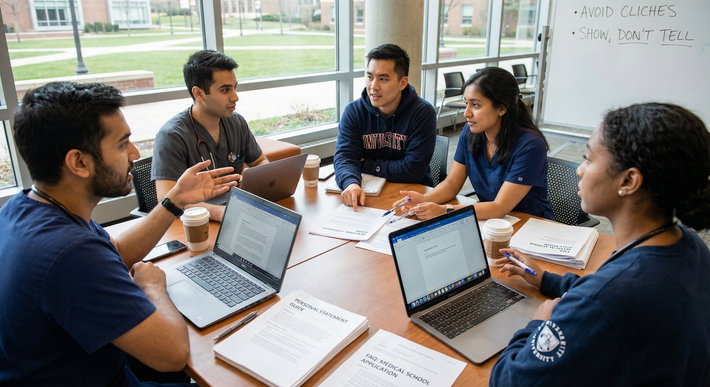
The idea that one bad paragraph can destroy your entire residency application is a lie we tell ourselves when we’re exhausted and terrified.
But I get why you believe it. I do the same thing.
You stare at that one clunky paragraph in your personal statement, the one that feels off. The transition’s weird. The story sounds forced. You’re not even sure what you were trying to say anymore. And now your brain is screaming:
“If this sounds dumb, they’ll assume I’m dumb. If they think I’m dumb, I don’t match. If I don’t match, I’m screwed.”
Let’s walk through this like adults who are low-key panicking.
How Programs Actually Read Your Personal Statement
Let me cut through the fantasy version first: no one is sitting there with a red pen diagramming your sentences like it’s AP English.
Most faculty reading your statement are:
- Half-tired after a full clinic day
- Skimming 30+ statements in a sitting
- Trying to get a “sense of you,” not grade you like a paper
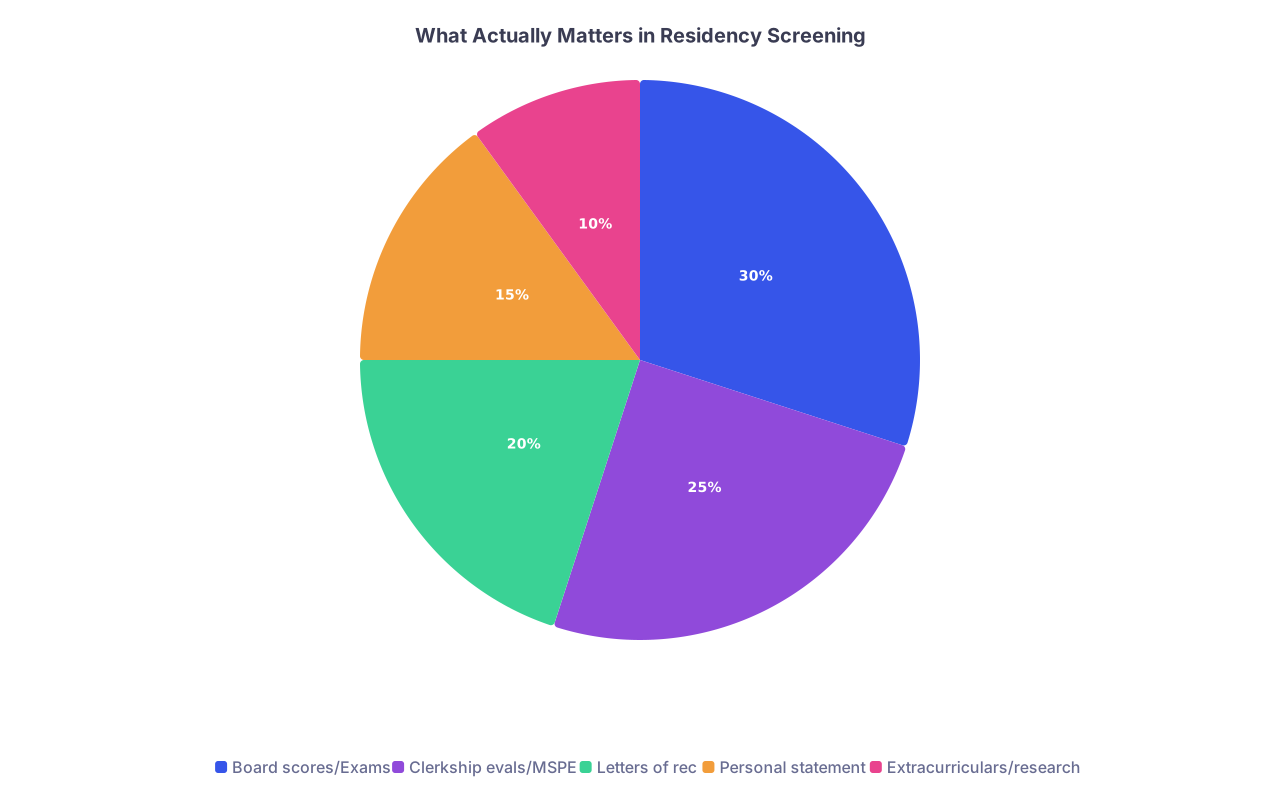
| Category | Value |
|---|---|
| Board scores/Exams | 30 |
| Clerkship evals/MSPE | 25 |
| Letters of rec | 20 |
| Personal statement | 15 |
| Extracurriculars/research | 10 |
Is this exact data? No. But this is roughly how programs behave in the real world:
- Scores and transcripts get you past the filter.
- MSPE and letters tell them how you function on the wards.
- The personal statement is usually there to answer one question:
“Does this person make sense for our specialty and seem normal enough that I’d want them on my team at 3 a.m.?”
They are not looking for perfection. They are screening for red flags and looking for a bit of fit.
That means:
One awkward paragraph?
Annoying, maybe. But not fatal.
One unhinged paragraph that makes you sound arrogant, unethical, unprofessional, or unstable?
Yeah, that can hurt. A lot.
The difference is huge.
What a “Bad Paragraph” Actually Looks Like to a Reader
Here’s what you and I mean by “bad paragraph” at 1 a.m.:
- It’s wordy.
- It repeats something you already said.
- The story doesn’t land.
- The transition is clunky.
- You used a cliché you swore you’d never use (“I want to give back to the community…”).
Here’s how that usually registers to a faculty reader:
- “Okay, a little rambly here.”
- Skims faster for the next interesting bit.
- Moves on.
I’ve watched attendings read applications. Literally seen this:
They read the first paragraph carefully.
Skim the middle.
Slow down at the last paragraph.
Glance back at your CV if something catches their eye.
Done.
The middle is not where your application lives or dies unless you do something truly alarming.

Here’s the brutal truth: they don’t care enough about your writing to nitpick every paragraph. Not because you’re not important, but because they’re drowning in applications.
To them, your “disaster paragraph” is just a slightly less polished patch of text in a sea of similar statements.
What Can Actually Sink You in a Personal Statement
If you’re going to obsess (and let’s be real, we are), at least obsess about the right risks.
Things that legitimately can hurt you:
Huge professionalism red flags
- Trashing other specialties or colleagues (“Surgeons don’t care about patients the way we do in [X]”).
- Sounding like you think you’re better than residents/attendings already.
- Casual mention of illegal or wildly unethical behavior as a “fun story.”
Boundary-violating or inappropriate patient stories
- Too much graphic detail.
- Stories that make it clear you don’t get consent/privacy issues.
- Writing like patients exist as props for your savior narrative.
Unhinged tone
- Extremely bitter (“After being repeatedly wronged by the system…”).
- Very unstable vibe (“Medicine is all I have, without it I am nothing.” Programs don’t want someone who might break under stress.)
Obvious plagiarism / AI-generated nonsense
- If it reads like a canned template the PD has seen 40 times that week, they’ll roll their eyes.
- If it somehow matches something they’ve seen before word-for-word, that’s bad.
Flat-out incomprehensible writing
- I’m not talking about ESL-level imperfection. That’s fine.
- I’m talking about sentences that literally do not make sense, over and over.
Everything else? Mildly suboptimal, not application-ending.
| Type of Issue | Harmless Annoyance | Real Red Flag |
|---|---|---|
| One clunky paragraph | ✔️ | |
| Minor grammar mistakes | ✔️ | |
| Slightly cliché story | ✔️ | |
| Attacking other fields | ✔️ | |
| Graphic patient details | ✔️ | |
| Aggressively arrogant | ✔️ |
If your “bad paragraph” is basically “too cliché, a bit awkward, slightly repetitive”… that’s not the thing that decides whether you match.
How Much Do They Actually Read? (And Where the Bad Paragraph Fits)
Let’s be honest: the way we imagine PDs reading our statement is delusional. We picture them in a quiet office, tea in hand, reading every word like it’s literature.
Reality is closer to: quick skim between meetings.

| Step | Description |
|---|---|
| Step 1 | Opens Application |
| Step 2 | Glances at scores, CV |
| Step 3 | Starts Personal Statement |
| Step 4 | Reads Intro Carefully |
| Step 5 | Skims Middle Paragraphs |
| Step 6 | Reads Final Paragraph More Closely |
| Step 7 | Checks Letters/MSPE for consistency |
| Step 8 | Makes Quick Overall Impression |
That “skims middle paragraphs” box?
That’s where your “bad paragraph” usually lives.
And if your intro is decent and your closing is solid, you’ve already done most of the work to protect yourself.
You know what actually gets remembered?
- A weirdly angry rant mid-way through.
- A long paragraph that feels like a martyr speech.
- A bizarre joke that doesn’t land and makes you sound insensitive.
Not “I used ‘passion’ three times” or “this metaphor is kind of cringe.”
What to Do If You Hate One Paragraph (But You’re Out of Time)
So you’re days from submission. You’ve re-read this paragraph 37 times and now everything looks wrong.
Here’s the triage approach I wish someone had given me.
Step 1: Ask the only question that matters
Not “Is this elegant?”
Not “Would my undergrad English professor be proud?”
Ask:
“Does this make me sound normal, safe, and genuinely interested in this specialty?”
If yes → it’s fine.
If not → fix that part, not every comma.
Step 2: Run the red-flag test
Look at the paragraph and ask:
- Am I accidentally insulting another field, patient, or colleague?
- Do I sound resentful, bitter, or like I hate medicine?
- Do I sound like I think I’m God’s gift to the specialty?
- Is there anything here that would worry someone about my judgment?
If no → you’re probably overreacting.
If yes → tweak the tone, not the entire story.
Step 3: Simplify without overhauling
If it feels clunky, don’t rewrite from scratch at 2 a.m. Just simplify.
Take a paragraph like:
“This experience taught me the value of multidisciplinary collaboration in ensuring that holistic and patient-centered care is delivered in an efficient and compassionate manner.”
Make it human:
“That day, I saw how much good happens when everyone on the team trusts each other and shows up for the patient.”
Same idea. Less cringe. 10x safer.

The Obsession With Perfection (And Why It’s Misleading)
You know what’s twisted? The people most likely to obsess about one bad paragraph are usually the people with overall strong applications.
Because that’s who we are. We hyper-fixate on details. We catastrophize. We assume the worst-case scenario:
“One phrase sounds off → they hate me → no interviews → no match → my life is over.”
Let me say this clearly:
Residency applications are not graded like exam essays. They are judged like stacks of human profiles.
The question is not, “Is this paragraph flawless?”
It’s, “Does this applicant seem like someone we can trust to take care of patients and not be a nightmare to work with?”
A slightly boring or awkward paragraph doesn’t touch that.
I’ve seen people match with:
- Boring statements.
- Repetitive statements.
- Generic “ever since I was a child” statements.
What they didn’t have were red flags screaming “Do not hire me.”
When You Should Rewrite That Paragraph
There are a few times when your gut feeling that “this could sink me” might actually be right. Not because of polish—but because of message.
You should seriously consider rewriting if:
- You’re oversharing personal trauma in graphic detail and it overshadows everything else.
- You’re using a patient’s tragedy as an emotional prop in a way that feels icky, even to you.
- You’re loudly framing medicine as a sacrifice you’re making for others, like they owe you something.
- You’re coming off as if you’re judging certain patient groups (obesity, addiction, etc.).
If you read the paragraph and think, “If someone didn’t know me and only saw this, they might question my judgment”… trust that.
Otherwise? The bar you’re trying to clear is “clear, coherent, decent human.” Not “Pulitzer-winning essayist.”
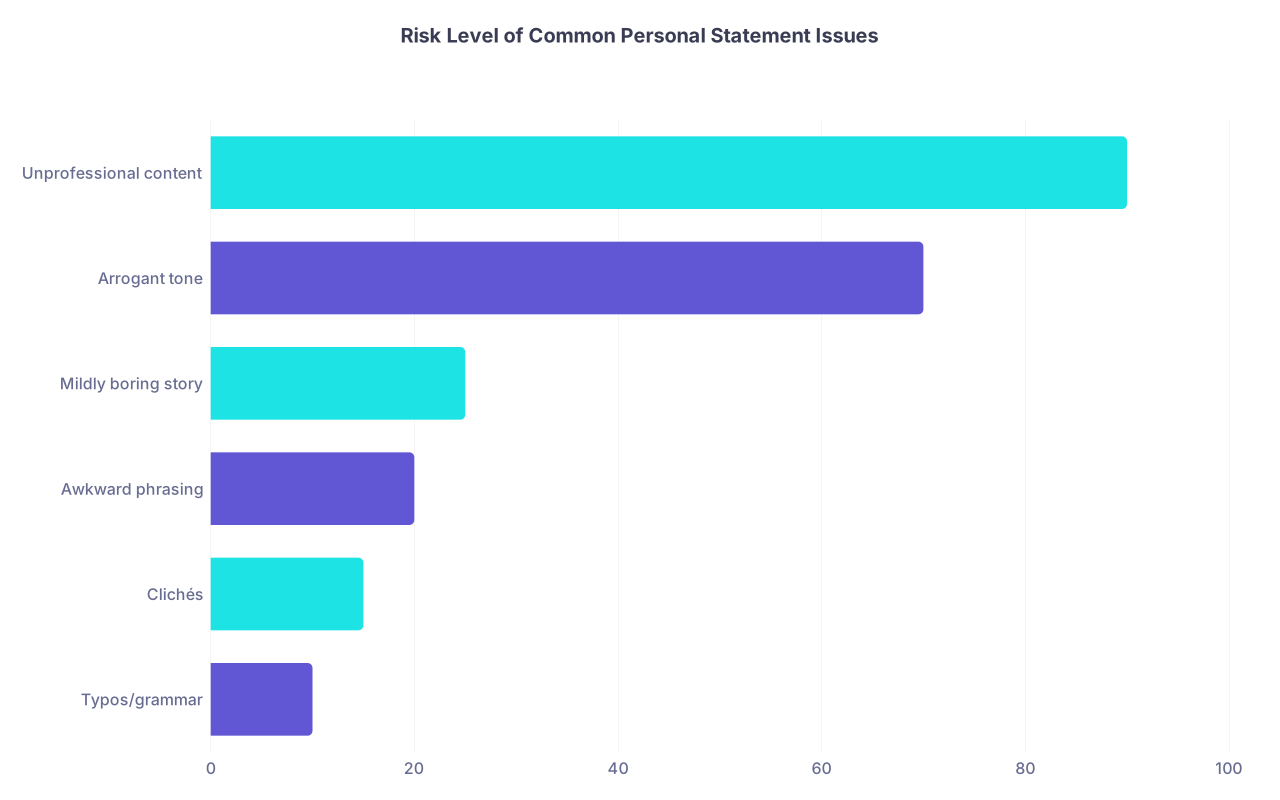
| Category | Value |
|---|---|
| Typos/grammar | 10 |
| Clichés | 15 |
| Awkward phrasing | 20 |
| Mildly boring story | 25 |
| Arrogant tone | 70 |
| Unprofessional content | 90 |
The Part No One Tells You: They’re Looking for Reasons to Say Yes
It doesn’t feel like this, but a lot of PDs and faculty want to like you.
They want to build a team of residents who:
- Show up for patients
- Aren’t toxic
- Actually want their specialty for real reasons
Your personal statement is one data point among many. If your scores are decent, letters are solid, and you don’t sound like a walking HR complaint, they’re not hunting for the one mediocre sentence to torch you.
They’re asking, “Does this person add up?”
If the answer is yes, your one bad paragraph is just background noise.

Quick Sanity Checklist Before You Submit
If you’re about to submit and spiraling, run your whole statement (including the “bad” paragraph) through this:
- Do I clearly state why this specialty?
- Do I come across as someone who cares about patients and teams?
- Do I avoid obvious red flags (anger, arrogance, unprofessional content)?
- Does my intro make sense and my ending feel like a real human wrote it?
- Are there at least a couple of specific, real experiences that ground it?
If all that is true, your messy paragraph isn’t the saboteur your brain thinks it is.
FAQs
1. What if my bad paragraph is in the first part of the statement?
If your opening is confusing, that’s more of a problem than an awkward middle paragraph. But that still doesn’t mean “you’re done.” Fix clarity first: make sure they can tell early on who you are and what specialty you want. You don’t need a dramatic hook. You need a clean one. If they understand you and don’t feel weirded out, you’re okay.
2. Can a single cringe sentence actually turn off a program?
It can mildly annoy them. It almost never single-handedly kills your chances unless it reveals something bigger—like you trivialize patients, brag about yourself in a gross way, or throw another specialty under the bus. Most of the time, they just skim past and forget it 5 seconds later. You’re the only one replaying it in your head on a loop.
3. I found a small typo after submitting. Am I doomed?
No. People match every single year with typos in their personal statements. Is it ideal? No. Is it a death sentence? Absolutely not. Faculty are doctors, not copyeditors. Unless your statement is filled with errors to the point of unreadability, one typo makes you human, not unemployable.
4. Should I scrap my whole statement because of one weak paragraph?
Almost never. The panic to “burn it all down and start over” is usually anxiety talking. Scrapping everything days or hours before submission leads to rushed, generic writing. It’s usually better to lightly revise the questionable paragraph for clarity and tone rather than redo the whole thing from scratch.
5. How do I know if my paragraph sounds arrogant vs confident?
Ask someone who doesn’t idolize you—classmate, resident, advisor—to read it and answer one question: “Do I sound like someone you’d actually want on your team?” Arrogant paragraphs often over-focus on how brilliant you are, how much you “deserve” things, or how incompetent others are. Confident ones talk about growth, teamwork, and owning mistakes without dramatics.
6. Could a bad paragraph matter more in super competitive specialties?
It can matter slightly more only because in hyper-competitive fields (like derm, ortho, plastics), every detail gets a bit more weight when they’re splitting hairs between very similar applicants. But even there, it’s patterns that hurt you, not one clunky paragraph. A statement that’s consistently tone-deaf or arrogant is a problem. One awkward section in an otherwise solid statement? Annoying at worst, not a fatal flaw.
Bottom line:
One bad paragraph doesn’t sink a fundamentally solid application. Red flags do. Tone does. Patterns do.
If your statement makes you look like a real, decent human who actually wants the specialty you’re applying to—and your “bad” paragraph is just a little awkward—you’re fine. Hit submit. Stop giving that paragraph more power than it actually has.