It’s 1:12 a.m. Your ERAS personal statement is open in one tab, an AI chat window in the other. You told yourself you’d only use it to “brainstorm,” but now half the essay sitting in front of you came from some version of “can you rewrite this to sound better?”
And now the panic hits:
Did I just ruin my application?
Can programs tell?
Are they going to run this through some AI detector and blacklist me?
Is this… cheating?
Let me cut straight through the noise: you’re not the only one who has done this. Not even close. The question isn’t “did you ever touch AI,” it’s how you used it and whether the final product sounds like a human who actually lived your life.
Let’s unpack the fear first, then I’ll tell you what I’ve actually seen and what’s likely to happen to you.
What Programs Actually See When They Read Your Statement
No residency PD is opening your personal statement and thinking, “Let me run this through three AI detectors.” They’re thinking, “Can I learn anything real about this person in the 60 seconds I’ll spend on this?”
Here’s the reality:
Most programs see this:
- A wall of text that sounds vaguely professional
- The same “lifelong passion for medicine” clichés
- A few specific stories that either land or don’t
- Some awkward phrasing that reminds them you’re human
That’s it.
What they don’t see:
- A little glowing red “AI used here” banner
- A secret overlay that tells them “48% chance ChatGPT”
- Your full chat history at 12:37 a.m. where you wrote “make this sound more impressive”
The scary part is your brain is filling in all the unknowns with the worst-case scenario. The boring truth: programs care about whether your statement is honest, coherent, and consistent with the rest of your application. They are not running an AI witch hunt.
Can Programs Tell If I Used AI?
Here’s the part your anxiety keeps chewing on.
Could they theoretically try? Yes.
Are most of them doing that right now? No.
And the “AI detectors” everyone talks about? They’re a mess.
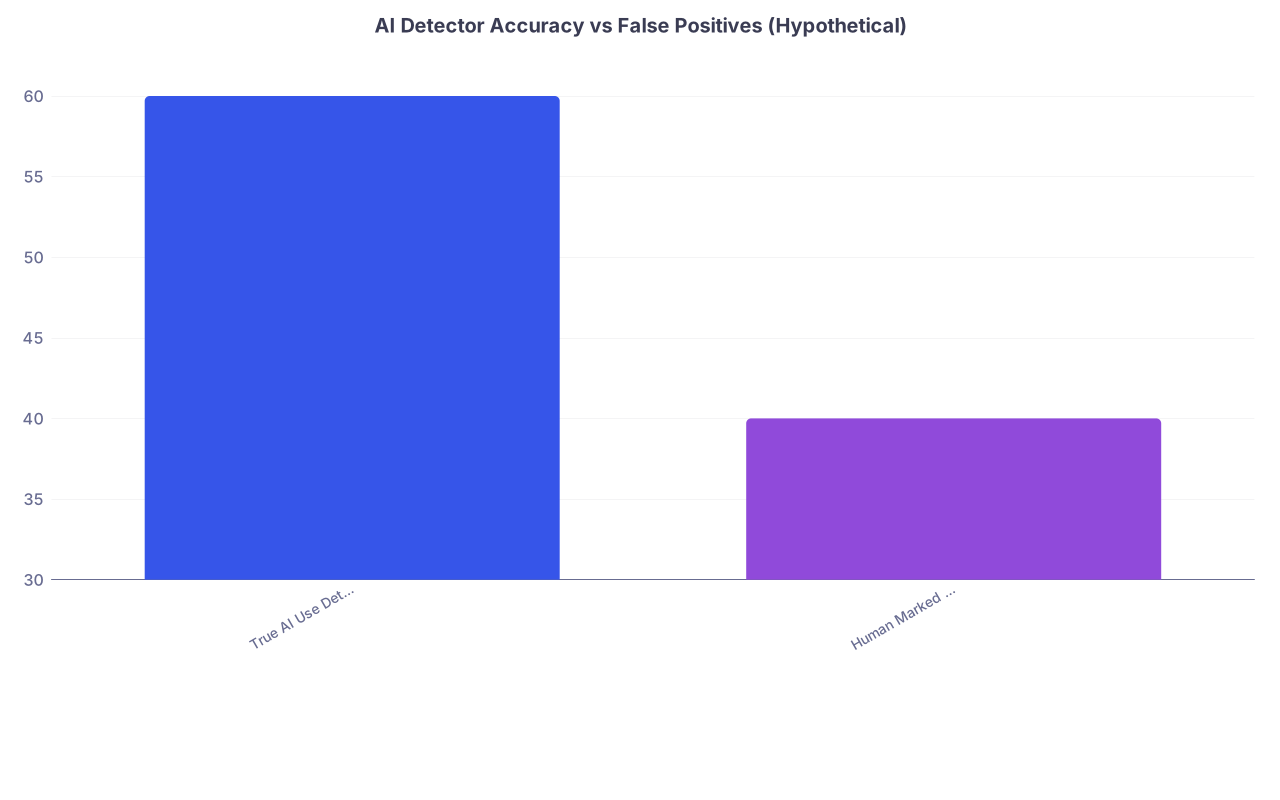
| Category | Value |
|---|---|
| True AI Use Detected | 60 |
| Human Marked as AI | 40 |
Those numbers aren’t from a specific study, but they’re in the ballpark of what’s been shown: these tools flag tons of human writing as “AI-generated.” International students. People with simpler vocab. Very polished writers. It’s chaos.
Program directors are not dumb. They know this. The second you introduce a tool that can falsely label a perfectly normal essay as “AI,” it becomes legally and ethically radioactive.
The more real risk is this:
Your statement reads so generic, polished, and soulless that it might as well be AI, whether you actually used it or not.
I’ve read statements like this:
“From an early age, I have been fascinated by the intricate complexities of the human body and the resilience of the human spirit…”
You can feel your eyes glazing over, right? That’s what scares PDs. Not “AI,” but “this could be anyone.”
What Actually Raises Red Flags
If a program gets suspicious, it’s almost never “we ran this through a detector.” It’s:
Something in your personal statement doesn’t match the rest of who you are.
The voice mismatch
Your PS is polished, lyrical, borderline poetic, and then your emails, interview responses, and ERAS entries sound completely different. Humans can write well, sure—but they don’t usually jump three reading levels between documents overnight.Weirdly generic, nothing-specific content
It reads like a template. No concrete details, no real moments, no timestamps, no names, no specific patients (de-identified). Just “I learned the importance of empathy and teamwork” over and over.Inconsistent facts
Your PS says you did years of research at Institution X… that don’t appear anywhere else. Or it implies responsibilities that don’t match your LORs or experiences. Sometimes AI “help” gets creative and you don’t catch it.Perfect grammar, zero personality
There’s a difference between “I revised this a lot” and “this sounds like a corporate press release.”

The biggest one, honestly, is the voice mismatch. If your interview answers sound like a different person wrote your essay—especially if English isn’t your first language and your PS reads like Harvard Admissions—people notice.
They might not say “this is AI.”
They will say “I don’t trust this.”
Did I Cross a Line? Different Ways People Use AI
Let me be blunt: there’s a spectrum here. And you probably know where you fall.
| Use Case | How Risky It Really Is |
|---|---|
| Brainstorming topics | Low |
| Outlining structure | Low |
| Grammar and clarity edits | Low |
| Heavy rewriting of your text | Medium |
| Generating full paragraphs | Medium–High |
| Letting AI write the full draft | High |
If you:
- Used AI to brainstorm ideas
- Asked it for “better transitions”
- Had it clean up grammar or tighten sentences
You’re fine. This is basically a fancier Grammarly. Ethically gray? Maybe. Catastrophic? No.
If you:
- Pasted in bullet points and said “turn this into a personal statement”
- Took big chunks it wrote and only lightly tweaked them
- Let it create the “patient story” or reflection for you
Then yeah, you’ve wandered into “this doesn’t really sound like you” territory.
If you:
- Said “write me a full internal medicine personal statement from scratch,” changed a few adjectives, and uploaded that…
That’s where I’d say you need to fix this. Not because there’s a magical AI-detection SWAT team, but because you probably can’t own that essay in an interview. And that will hurt you.
Will They Reject Me Just for Using AI?
Programs care about three big things with your PS:
- Is it honest?
- Is it consistent with the rest of your file?
- Does it help me understand you at all?
They are not sitting around crafting policy about whether asking a chatbot to improve your transitions violates the purity of the Match.
Are some institutions putting language like “you must write your own statement” in their policies? Yes. It’s starting. Mostly at med school level, not residency, but it’s trickling up.
Are they going to mass-interrogate applicants over whether they ever used an AI suggestion? No. They don’t have the time, leverage, or reliable tools.
What will actually hurt you more immediately:
- Submitting something bland, generic, and obviously templated
- Submitting something that doesn’t sound like the person who shows up on interview day
- Submitting something that doesn’t say… anything
If you used AI as a starting point but then deeply rewrote it into your own words, grounded in real events from your life? I don’t lose sleep over that. If you haven’t touched it since the bot produced it, you should.
Okay, I Already Used AI. What Do I Do Now?
Let’s be practical instead of spiraling.
Here’s a rough “self-audit” you can do on your current statement:
Print it or change the font
Make it look unfamiliar. Your eyes catch more issues when it doesn’t look like the same screen you’ve been staring at for three days.Highlight every sentence that could’ve come from anyone
Stuff like “I am drawn to internal medicine because of the continuity of care and the opportunity to form long-term relationships with patients.”
Is it wrong? No. Is it generic? Yes. You need balance.Circle every concrete, specific detail
“On my third overnight call at County, I watched our senior calmly lead a code on a patient with undiagnosed cardiomyopathy while my hands shook holding the compressions.”
That’s you. That’s human.
If the page looks like: 80% yellow highlighter (generic) and almost no circled text (specific)… you’ve got work to do. AI loves generic. You need to fight that.
Now, here’s the non-negotiable part:
Read your personal statement out loud.
You’ll hear it immediately if something sounds off. Too polished, too stiff, too “not you.” When you trip over a sentence or feel weird saying it, that’s usually an AI-ish or overedited fragment.
How to “Humanize” a Statement You Drafted with AI
You don’t have to start from scratch. You do need to reclaim it.
Take each major paragraph and ask yourself:
- What actually happened? Where was I? What time of year? What rotation?
- What did I feel in the moment—not what sounds good?
- What changed for me after that experience, in a way I can show, not preach?
Then rewrite it like you’re telling one of your classmates about your day over hospital cafeteria coffee. Messy first, then clean it up.
Strip out phrases you’d never naturally say. Things like:
- “indelibly shaped my journey”
- “I have been privileged to bear witness”
- “harbored a deep-seated passion”
That’s AI + premed brain stew. Replace it with how you actually talk:
- “I still think about that night when…”
- “I didn’t expect to feel…”
- “That was the first time I realized…”

| Step | Description |
|---|---|
| Step 1 | Current AI-heavy draft |
| Step 2 | Print/change font |
| Step 3 | Mark generic vs specific |
| Step 4 | Rewrite stories in your own words |
| Step 5 | Polish language, keep voice |
| Step 6 | Read out loud |
| Step 7 | Final human, consistent statement |
| Step 8 | Too generic? |
If you do that honestly, by the end the essay will be yours—even if AI helped you get unstuck at the beginning.
The One Thing You Should Be Worried About (That Has Nothing to Do with AI)
Here’s the part nobody wants to admit: PDs don’t like being lied to.
The AI panic is really about trust.
If your statement:
- Claims motivations you don’t actually have
- Overstates experiences you barely touched
- Leans heavily on “profound impact” moments you don’t even remember clearly
- Or feels like a performance more than a reflection
Then AI or not, that’s what will sink you.
They don’t want a perfect essay. They want something that sounds like a real person they could stand to work with at 3 a.m. when the ED just paged you about three admissions at once.
I’ve seen people match at competitive programs with statements that were pretty rough grammatically but felt real. I’ve also seen shiny, flawless essays from people who then bombed interviews because they couldn’t live up to their own writing.
If AI helped you line up your thoughts but the story is true and the voice is yours? You’re okay. Nervous, but okay.
FAQ: The Stuff You’re Still Stressing About
1. Should I rewrite my entire statement from scratch if AI touched it at all?
No. That’s overkill. You should rewrite any part that doesn’t sound like you or isn’t rooted in a real experience you had. If the skeleton came from AI but you’ve reworked every sentence and infused your stories, you don’t need to burn it down.
2. What if a program straight-up asks, “Did you use AI on your application?”
If they’re that direct, answer honestly and specifically: “I used AI early on to help brainstorm and then I rewrote the statement myself based on my actual experiences.” The key is: you own the content. Lying about it is worse than admitting limited, reasonable use.
3. Is using AI to fix grammar as an IMG or ESL applicant risky?
Honestly? This is the least of your problems. Tons of international applicants use editors, mentors, and tools to polish language. The danger is when the voice suddenly becomes native-level literary while your other writing doesn’t match. Focus on consistency, not perfection.
4. Could NRMP or ERAS ever ban AI use entirely?
They could try to write policies, sure. Enforcement would be a nightmare. They can’t reliably prove who used what. The more realistic future is schools saying “you are responsible for the content and truthfulness of what you submit”—which is already the rule.
5. My school said “you must write your own statement.” Did I violate that?
If you copied AI text wholesale, yeah, you’re probably technically outside that. If you used AI as a tool and then heavily rewrote, the final content is yours. Either way, fix it now: revise until every sentence is something you’d comfortably say out loud and defend.
6. What’s the single biggest test that my statement is “safe” to submit?
Hand it to someone who knows you well—friend, mentor, partner—and ask them: “Does this sound like me?” If they say, “It’s good, but I don’t really hear you in it,” that’s your sign to rewrite. Your goal isn’t “undetectable AI.” It’s “undeniably me.”
Here’s your next step:
Open your personal statement, copy the whole thing into a new document, change the font to something ugly like Courier, and read it out loud—every word. As you go, mark every sentence that makes you think, “I’d never actually say this.”
Then tonight, just fix those sentences. Not the whole thing. Just those. That’s how you start pulling your essay back from “AI-ish” to actually yours.