The brutal truth: most residency personal statements are boring.
Not bad. Not offensive. Just… forgettable. And that’s exactly what you’re scared of, right? Not that your statement will get you blacklisted, but that an overworked PD will read it, shrug, and never think of you again.
So now you’re sitting there wondering: Is mine one of those? Did I just write 700 words of “I like helping people” fluff that could belong to literally anyone?
Let’s walk straight into the anxiety instead of dancing around it.
How “Boring” Actually Shows Up On The Page
Let me be very clear: “boring” doesn’t mean you didn’t climb Everest while curing cancer and teaching orphans to code. It usually means this:
The reader finishes and can’t answer three basic questions:
- Who specifically are you?
- Why this specialty for you, not in general?
- What will you actually be like as a resident?
If they can’t answer those, they may say, “Decent statement.” Then never think about you again.
Here’s what boring tends to look like in residency essays:
You open with something like:
“I have always been fascinated by the human body…”
or
“My passion for medicine began when…”
Then you move into:
“During my third-year rotations, I was drawn to the continuity of care in internal medicine…”
or
“Surgery combines manual dexterity with critical thinking…”
Then you close with:
“I am excited to continue my training in [specialty] where I can provide compassionate, patient-centered care as part of a multidisciplinary team.”
Nothing “wrong.” Nothing special. It reads like 200 other statements on the same day.
If those phrases are in your draft, yeah, that’s why you’re worried. Because somewhere in your brain you know you’ve heard them before. Over and over.
A Quick Reality Check: Is Your Statement Actually That Bad?
Let me give you a more clinical way to test the “boring” fear instead of just spiraling.
Do this little audit. Be honest, even if it stings.
| Test | If Your Answer Is... | Boring-Risk |
|---|---|---|
| Can a friend summarize your statement in 1 sentence about *you*? | “Uh… you like patients?” | High |
| Number of sentences that could be copy-pasted into someone else’s PS | 5+ | High |
| First sentence originality | Sounds like something from Reddit or Google | High |
| Number of specific, concrete patient or rotation moments | 0–1 | High |
| Does your last paragraph sound like a mission statement? | Yes | High |
If you’re reading that and feeling your stomach sink, that doesn’t mean you’ve ruined everything. It means you wrote a perfectly normal first or second draft.
Residency personal statements don’t get good by accident. They get good because someone goes back and ruthlessly replaces the generic with the specific.
The Worst-Case Scenario You’re Imagining (And What Actually Happens)
You: “If my personal statement is boring, I won’t match.”
Reality: That’s not how it works.
Here’s what usually happens with a boring-but-competent statement:
- If your scores, letters, and experiences are solid, a boring PS won’t kill you. It just won’t be the thing that helps you when you’re on the line.
- If you’re borderline for a program, a generic PS can be the difference between “Eh, pass” and “Okay, invite them. Sounds like they fit.”
- If something in your app needs explaining (red flag, leave of absence, low Step), a boring PS is a missed chance to control the narrative.
The nightmare in your head is:
They read your PS, slam the laptop shut, call their colleagues and say, “We must never rank this person.”
That’s not how they operate. They’re skimming at 11 PM with 200 more files to go. They’re mostly thinking: “Do I get a sense of this person? Are there any red flags? Do they sound like they want this specialty and not ten others?”
A boring statement = missed opportunity, not automatic rejection.
But. It is something you can fix. Right now. Before you submit.
How To Tell If Your Statement Is Generic vs. Actually You
Let’s do something concrete. Open your draft mentally while you read this.
Test 1: The “Find-Replace” Game
Anywhere you’ve written your specialty, imagine replacing it with a different one.
“I’m drawn to the mix of continuity of care and problem-solving in internal medicine”
→ Replace with “family medicine,” “pediatrics,” “neurology.”
If the sentence still mostly works, that’s a problem. You haven’t actually explained why this field and not its close cousins.
You want sentences that break if you swap the specialty. For example:
- EM: “The controlled chaos of a full ED board, deciding which of ten sick patients I have to see first, is when I feel most focused.”
- Pathology: “I loved the moment when the gross specimen and slide findings finally made sense of a patient’s confusing symptom constellation.”
- Psychiatry: “Sitting in a 45-minute interview, trying to decide if this was psychosis, trauma, or substance use felt less like ‘work’ and more like a puzzle I wanted to keep solving.”
If your sentences survive the swap test? Too vague.
Test 2: The “Could This Be Anyone?” Highlight Pass
Take your draft (on paper if you can) and highlight every sentence that:
- Doesn’t mention a specific person, place, or moment.
- Uses words like “passionate,” “fascinated,” “rewarding,” “calling,” “fulfilling,” “it was then that I realized…”
Now look at your page. If 80% is neon, your statement lives in Emotion Land, not Memory Land. Emotion alone is boring because everyone feels some version of “I liked this and it mattered to me.”
The stuff that sticks is: “Oh, that happened to you.”
How To Un-Boring Your Statement Without Turning It Into Cringe
Let’s talk about what to actually do right now if your gut is screaming, “This sucks.”
Step 1: Strip Out the Filler Openings
If your first paragraph sounds like a TED Talk intro, kill it.
Delete your first two sentences entirely and see what you’re left with. I’m serious. Most people clear their throat for a paragraph before they say anything useful.
Bad opening:
“Medicine has always been a central part of my life. From a young age, I was fascinated by the human body and its ability to heal. During medical school, my experiences on the wards deepened my passion for internal medicine.”
Try this instead: jump straight into a specific moment.
Better:
“On call during my second week of medicine, I spent two hours trying to convince a 67-year-old with decompensated heart failure to stay in the hospital.”
We’re in a scene now. The reader has to keep going just to see where it goes.
Step 2: Pick One or Two Real Moments. Actually Describe Them.
Right now your statement probably reads like a vague highlight reel. “On my rotation, I saw how important X is…” and “I learned the value of Y…”
Pick one or two patient encounters or experiences that:
- Actually stuck with you
- Actually changed your thinking, behavior, or goals
- You can remember in sensory detail (where were you, what did it sound like, what did you feel physically?)
And no, it doesn’t have to be some dramatic “code blue, child died in my arms” story. In fact, those are often written badly and feel manipulative.
Here’s the key: Don’t just describe what happened. Show what changed in you.
Generic:
“I learned the importance of communication with families.”
Specific:
“I stopped rushing through family updates after realizing I had just spent seven minutes talking about labs and imaging and zero asking what the patient’s wife actually understood.”
The first is a poster slogan. The second sounds like a human being who noticed their own flaw and adjusted.
Step 3: Make Yourself a Character, Not Just a Narrator
Boring statements often describe the field, the patients, the attendings… but not you as an actual person in the middle of it.
Ask yourself:
- Where did you mess up and then get better?
- What do you actually enjoy on a random Tuesday at 3 AM in this specialty?
- What do your co-interns/friends joke about with you? (e.g., “You’re the only one who likes night float,” “You’re weirdly excited about discharge summaries,” “You always volunteer to call family.”)
Work one or two of those traits into a concrete example.
Not:
“I am hardworking, detail-oriented, and a team player.”
No one believes that line anymore. Everyone writes it.
Try:
“My co-students started texting me their discharge summaries to proofread after my attending joked that I was the only one who seemed to enjoy reconciling meds.”
Same idea, but now it’s a visual. I can see you doing something.
Step 4: Fix the Ending So It Doesn’t Sound Like a Brochure
Most endings are some form of:
“I am excited to bring my compassion, work ethic, and dedication to lifelong learning to your program.”
That line might as well be lorem ipsum.
A better ending usually does one of two things:
- Echoes something from earlier in the statement (a patient, a trait, an insight) and ties it forward to residency.
- Gets very clear about the kind of resident/physician you’re trying to become.
For example:
“Mrs. L. probably won’t remember me, but I still think about how close I came to missing her story because I was too focused on note templates. As a resident, I want to be the person who can manage the service and still slow down enough to catch what matters to the patient sitting in front of me.”
or
“I’m not the loudest person on the team, but I’m the one still in the workroom at the end of the day checking that the last set of discharge meds make sense. In residency, I want to keep being that reliable, calm person in the background who makes sure the details don’t get dropped.”
That’s specific. It sounds like someone, not “Applicant #1473.”
How Much Can You Change This Late? (You’re Wondering About That Too.)
Let’s say you’re late in the cycle and panicking. You’re thinking, “Is it even safe to touch this now? What if I break it?”
Here’s my take, and I’m not going to sugarcoat it:
- Swapping out a few generic phrases? Not enough to transform a boring statement.
- Rewriting your intro and one core paragraph with a real moment and a clearer voice? That can absolutely shift how you land.
- Completely burning it down and rewriting from scratch the night before submission? Risky. You’ll probably create new problems (typos, incoherence).
If you’re close to the deadline, aim for targeted surgery, not total reconstruction:
- Fix the first paragraph so it starts with a real moment, not a thesis about your passion.
- Replace 2–3 generic sentences with specific, concrete ones that only you could write.
- Clean up the ending so it sounds like a human being reflecting, not a brochure.
Those three changes alone take you from “background noise” to “at least mildly memorable.”
Visualizing What Actually Matters
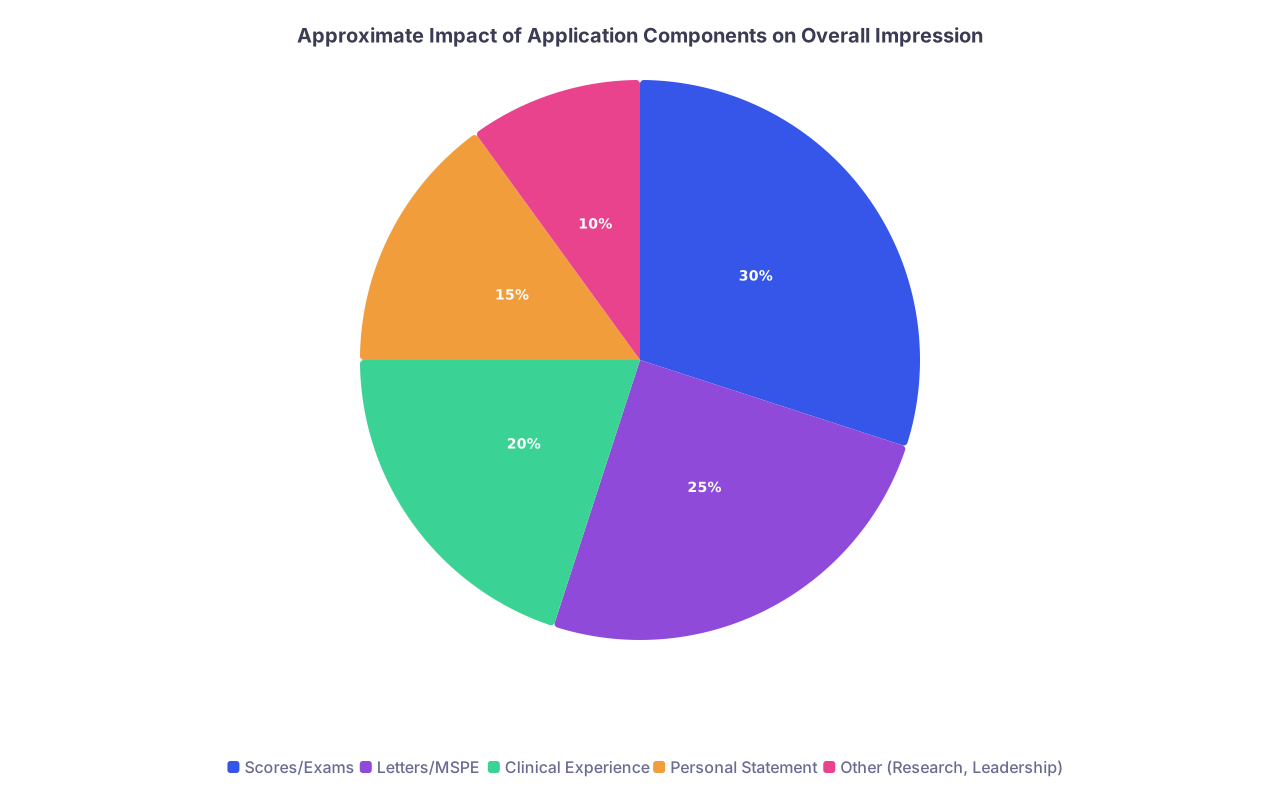
Let me show you how programs actually weight things in their heads. Not official percentages, but the vibes after reading hundreds of apps.
| Category | Value |
|---|---|
| Scores/Exams | 30 |
| Letters/MSPE | 25 |
| Clinical Experience | 20 |
| Personal Statement | 15 |
| Other (Research, Leadership) | 10 |
That 15% for personal statement? It’s not everything. But when your scores are average, your letters are decent, and your experiences are similar to everyone else’s, that slice of the pie suddenly matters more.
Not because they’re looking for poetic genius. Because they’re desperate for any signal of: “Will I want to be on night float with this person for 12 hours?”
FAQ: Four Things You’re Still Worried About
1. What if I don’t have a dramatic story? Is my personal statement doomed to be boring?
No. Dramatic stories are overrated and often badly written. You do not need trauma, tragedy, or some heroic save. Honestly, a simple, specific story about a normal day that changed how you practice is far more believable and compelling.
Example: realizing halfway through third year that you were avoiding difficult family conversations and then slowly forcing yourself to volunteer for them. That’s growth. That’s real. And it’s far more memorable than “I saw a code and realized life is fragile.”
2. Can a boring personal statement actually hurt my chances of matching?
Rarely by itself. But it can absolutely fail to help you where you need it most: at the margins.
If you’re a strong applicant on paper, a generic PS won’t tank you. If you’re middle-of-the-pack or have red flags, then yes, a bland statement that doesn’t explain or humanize you can be the reason a program passes when they could’ve been pulled in.
Think of it this way: it’s less “harmful” and more “wasted potential.” And in a competitive specialty or location, wasted potential matters.
3. How do I know I’ve revised enough and I’m not just making it worse?
You’re going to hit a point where every change starts to feel like musical chairs with adjectives. That’s your sign.
Practical test: Give your “second to last draft” and your “final draft” to someone who doesn’t know which is which and ask a very specific question:
“After reading this, what 3 words would you use to describe me as a future resident?”
If they can answer quickly with words that actually sound like you (“calm, reliable, observant” or “curious, persistent, detail-oriented”), you’re good. If they say, “Uh… compassionate? Hardworking?” you may still be in generic territory.
4. What if I’m scared to show my real self because what if they don’t like it?
This is the quiet fear under everything: “If I sound too much like me, what if that’s not what they want?”
Here’s the uncomfortable truth: the point of this is not to trick every program into liking you. It’s to help the right programs recognize you as their kind of person.
If you’re a quieter, thoughtful, detail person and you try to sound like a swaggering “I love the adrenaline!” stereotype because you think that’s what surgery/EM/whoever wants, you might get an interview… and then feel completely out of place.
A slightly less “polished,” more honest statement that shows your real approach will turn off some programs. Good. Those weren’t your programs. The ones who read it and think, “Yes, we want that type of resident”? Those are where you actually want to train.
Two things to walk away with:
- “Boring” in residency personal statements almost always means “generic and nonspecific,” not “you’re a bad applicant.” That’s fixable.
- The fastest path out of boring is painfully simple: cut the clichés, add one or two real moments, and make it possible to answer, “Who are you as a future resident?” after reading.
If your draft doesn’t do that yet, it’s not a disaster. It’s just not done.