What if the typo you just noticed in your personal statement is the exact line the program director reads out loud in the selection meeting?
Because that’s the nightmare running through your head, right?
You hit submit. You felt that weird mix of relief and nausea. Then you went back “just to look” at your ERAS personal statement or the PDF you saved… and there it is.
A typo. Or a wrong date. Or you accidentally wrote the wrong program name. Or you left an entire sentence hanging. Or you reused a med school essay line that sounds off in residency context.
And now you’re spiraling: Did I just ruin my whole application year over this one stupid mistake?
Let me walk through this like someone who’s lost sleep over way smaller things than you’re probably dealing with. Because I have. And I’ve also seen people match very well with essays that were… not exactly works of literary art.
First: How Bad Is the “Error” Really?
You’re probably treating every flaw like a catastrophe. I do that too. But not all “errors” are equal.
Let’s bucket this.
| Error Type | Realistic Impact |
|---|---|
| Minor typo / grammar error | Almost zero |
| Awkward wording / clunky sentence | Very low |
| Wrong program name | Low–moderate, context dependent |
| Wrong specialty mentioned | Moderate–high, but survivable |
| Mild factual slip (date, term) | Very low |
| Misrepresentation / big factual lie | Extremely high |
Category 1: The Normal Human Stuff
This is:
- A missing comma
- “Residncy” instead of “residency”
- “Its” vs “it’s”
- A repeated word: “I I learned…”
- One long run-on sentence
Programs see this constantly. People are tired. People apply in bulk. English isn’t everyone’s first language. No one is sitting there saying, “Wow, I liked this candidate, but that missing comma in paragraph three… immediate rejection.”
It might annoy a very picky reader a little. But ruin your cycle? No.
Category 2: Cringe but Not Fatal
- You wrote “Thank you for your consideration” like it’s a cover letter
- You used one cliché too many
- You overdid the trauma story
- You sound a bit stiff or robotic in parts
- There’s an awkward phrase like “I believe medicine is my calling and my destiny” that now makes you want to hide
Programs don’t love cheesy writing, but they’re not grading you like a creative writing professor. They’re asking: Does this person seem decently thoughtful? Not arrogant? Not wildly inappropriate? Interested in this field? Able to string sentences together?
Cringe won’t tank you. It just won’t help you.
Category 3: The “Oh No” Stuff
- Wrong program name: “I am excited to train at [Another Hospital].”
- Wrong specialty name: applying Internal Medicine but wrote “my passion for Pediatrics” in one sentence
- You mention a city that’s not where that program is
- You slightly distort a detail and now feel like you “lied” (even if probably no one will cross-check it)
These feel horrifying. You imagine a PD pulling it up in a committee: “They wrote the wrong program name. Next.” But that’s not usually how it plays out.
If it’s a program-specific statement, and the only thing wrong is the name, it’s embarrassing. It may slightly hurt at extremely competitive places, especially if they’re looking for reasons to thin the pile. But tons of applicants do this every year. Most programs know that people reuse or tweak personal statements.
Here’s the key: a single error almost never disqualifies you alone. It matters in context of the rest of your app.
What Programs Actually Care About (vs What You’re Catastrophizing)
You’re imagining a red blinking light over your file: “HAS TYPO.” That’s not what’s happening.
Most programs are screening like this:
- USMLE/COMLEX scores (or pass/fail status plus clinical record)
- Class ranking / MSPE
- Specialty-specific experiences, letters, sub-Is, research maybe
- Obvious red flags (SOAP, professionalism issues, major gaps)
- Then: personal statement and the “vibe check”
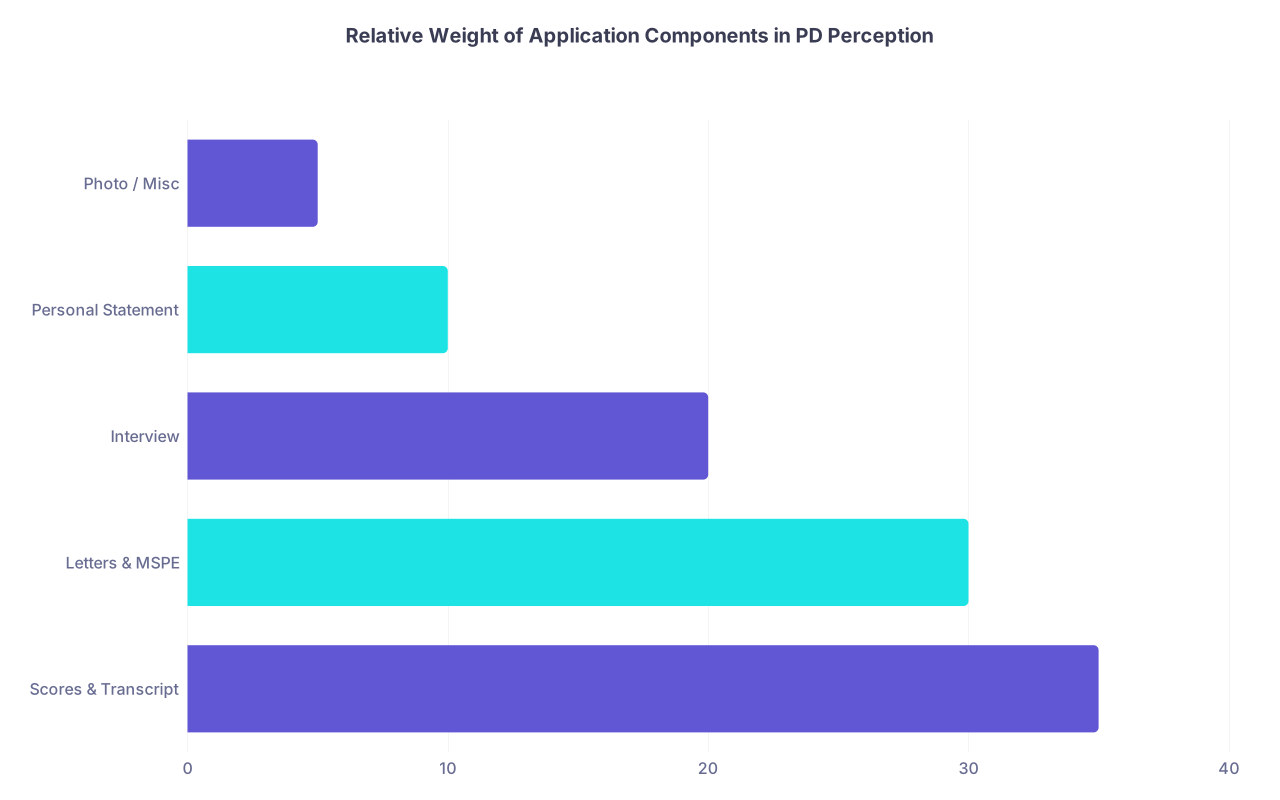
| Category | Value |
|---|---|
| Scores & Transcript | 35 |
| Letters & MSPE | 30 |
| Interview | 20 |
| Personal Statement | 10 |
| Photo / Misc | 5 |
Is this exact? No. But it’s directionally right. The personal statement is rarely the star of the show.
Most PDs use it to:
- Confirm you’re actually interested in their specialty
- Make sure you don’t sound unprofessional or unhinged
- See if you’re able to express yourself reasonably clearly
- Sometimes get a story to remember you by
They are not reading with a red pen and crying over a comma splice.
I’ve watched PDs skim statements in 30–60 seconds. They’re not reading like you reread your own at 1 a.m. zoomed in to 175%.
Can You Fix It After Submission?
Short answer: Usually no, not in ERAS, once it’s attached and sent.
Longer answer: it depends what you mean by “fix.”
ERAS Reality Check
Once you’ve assigned and submitted a personal statement to programs in ERAS, you can’t pull it back and swap in a new one for those already-submitted applications.
You can:
- Create a new, corrected version of your personal statement in ERAS
- Assign the FIXED one to programs you apply to after you notice the error
- Use the corrected one for any future applications or any additional programs
But no, you can’t silently alter what’s already in their system. It’s not a Google Doc. It’s a PDF snapshot.
So the real question becomes: Do you try to reach out to programs individually or just live with it?
Should You Email Programs About the Error?
This is the part that makes everyone’s anxiety explode.
You imagine two paths:
- You say nothing → They see the error → They think you’re careless → Immediate reject
- You email them → They think you’re neurotic and can’t handle stress → Immediate reject
So you feel like you’re choosing between “careless” and “crazy.”
Let’s be blunt: for anything small, do not email.
When NOT to Email
Do not contact programs if your error is:
- A grammar/typo issue
- A clunky sentence
- A tiny factual detail no one cares about (you said “second year” instead of “third year”)
- Overly dramatic word choice
- Something only you would ever notice reading it five times in a row
All emailing does there is spotlight the problem and add a new one: you seem high-maintenance and unable to tolerate normal imperfection. That’s worse than a typo.
When You Might Consider Reaching Out
The very narrow cases where I’d even think about it:
- You mentioned the completely wrong specialty in a statement clearly meant to be specialty-specific (e.g., applying to EM and you wrote “I am excited to pursue a career in Anesthesiology”).
- You wrote another program’s name in a line that’s front-and-center.
- There’s a genuinely misleading factual statement that could affect how they read your file (for example, you said you’re planning to pursue a specific fellowship that you absolutely are not, and it conflicts with their mission in an obvious way).
Even then, you don’t send an essay apologizing for existing.
You send something short, controlled, and not self-destructive. For example:
Subject: Brief Clarification – Personal Statement
Dear [Program Coordinator/Program Director],
I recently reviewed the personal statement I submitted with my ERAS application and noticed an error in one sentence where I [brief description – e.g., referenced the wrong specialty name].
I wanted to clarify that I am fully committed to [correct specialty] and am very interested in [Program Name] specifically. I apologize for the oversight and appreciate your understanding.
Sincerely,
[Name], AAMC ID: [ID]
That’s it. No dramatics. No five-paragraph self-flagellation.
If you’re sitting here thinking, “But my problem is just a typo, should I still email?” — no. You should not.
What This Actually Looks Like from the Program Side
Let me tell you what I’ve actually seen:
- Applicant had two obvious typos and slightly weird formatting. They matched at a strong university IM program because their letters and rotations were excellent. No one ever mentioned the typos.
- Applicant wrote the wrong program name in their PS for one big-name place. They got no interview there. But they got interviews elsewhere and matched at another solid program. It was not fatal to the whole cycle.
- Applicant had a really stiff, kind of boring PS with a few ESL-type grammar things. They matched into a competitive specialty because their performance and letters screamed “excellent resident.”
- Applicant had a “perfect” personal statement but poor clinical comments and an iffy MSPE. They got far fewer interviews than they expected. The essay didn’t save them.
The pattern? The personal statement is rarely the thing that makes you. Or breaks you. It nudges perception. That’s all.
How to Stop Obsessing (Enough to Function)
You’re still going to think about this. I know. But you need to decide how much of your remaining time and mental energy you’re going to burn on a mistake that’s already locked in.
Here’s the brutal truth: at this point, your best move is almost always to shift focus instead of trying to undo the past.
Focus on things you can still influence:
- Interview prep: if they do invite you, you can absolutely redeem a mediocre personal statement by being a strong, grounded, thoughtful interviewer.
- Supplemental questions / emails: some programs have additional questions or fields — you can show clarity and polish there.
- Future communications: every email, thank-you note, and interaction can reinforce that you’re careful, respectful, and not a chaos person.
And quietly, in the background: fix the statement for any future use. If you’re still sending applications to more programs, make sure the version going out now is cleaned up.
A Quick Flowchart for Your Situation

| Step | Description |
|---|---|
| Step 1 | Found Error After Submission |
| Step 2 | Minor typo / grammar |
| Step 3 | Awkward wording / cringe |
| Step 4 | Wrong program or specialty name |
| Step 5 | Serious misrepresentation |
| Step 6 | Do NOT email |
| Step 7 | Fix for future apps only |
| Step 8 | Yes: Consider brief clarification email |
| Step 9 | No: Accept and move on |
| Step 10 | Seek advisor/legal guidance ASAP |
| Step 11 | Type of Error? |
| Step 12 | Clearly misleading? |
If you’re not in the “serious misrepresentation” group (and most people aren’t), you’re in damage-control-lite mode, not “my career is over” mode.
Reality Check on Your Worst-Case Scenario
Let’s say the absolute worst plays out at a single program:
- They notice the mistake.
- They’re mildly annoyed or raise an eyebrow.
- Your app is otherwise borderline.
- The error tips you from “maybe interview” to “no interview.”
That sucks. Truly. But there are dozens of programs. Hundreds, depending on specialty.
Your brain is turning one possible ding into “no one anywhere will rank me.” That’s not how the Match works.
Residents match every year with:
- Boring essays
- Essays with typos
- Essays that are too long or too short
- Essays they deeply regret rereading
You are not uniquely doomed.
FAQs
1. What if I realize the error right after submitting — can I withdraw and resubmit?
No. Once a personal statement is attached and the application is submitted to a program, that version is what they have. You can’t “withdraw and resend” a corrected essay to that same program through ERAS. You can only fix it for programs you haven’t applied to yet.
2. Will programs think I don’t care if I leave a typo in my personal statement?
Most won’t think anything at all. A stray typo is usually read as “normal human imperfection,” not “this person doesn’t care.” They care far more about patterns of unprofessionalism or sloppiness across the whole application than one isolated grammar slip.
3. Is writing the wrong program name an automatic rejection?
No, not automatic. It’s not great, and at a very competitive program it might hurt you, especially if your application was borderline anyway. But people have done this and still matched well elsewhere. It’s embarrassing, not career-ending.
4. Should I ask my dean’s office or advisor to contact programs about my error?
Only if the issue is truly serious — like a misrepresentation or something that could be interpreted as dishonest. For normal mistakes (typos, wrong word, cringey phrasing, even most wrong-name moments), dragging in the dean’s office just makes it bigger and more dramatic than it needs to be.
5. Can I talk about the error in an interview to “clear it up”?
Only if the interviewer directly asks about it or it’s a genuinely confusing specialty/program name mistake that they mention. Volunteering it unprompted usually just makes it awkward and refocuses their attention on something they might not have even noticed. If they do bring it up, own it briefly: “Yes, that was an embarrassing oversight. I corrected it in my other applications and I’ve triple-checked things since.” Then move on.
Key points to hang onto:
- A small mistake in your personal statement is almost never the thing that destroys your Match chances.
- Don’t email programs over minor errors; fix it for future apps and focus on interviews and overall professionalism.
- This feels huge because it’s yours, but to them, it’s one tiny piece of a very large application pile — you’re allowed to be imperfect and still match.