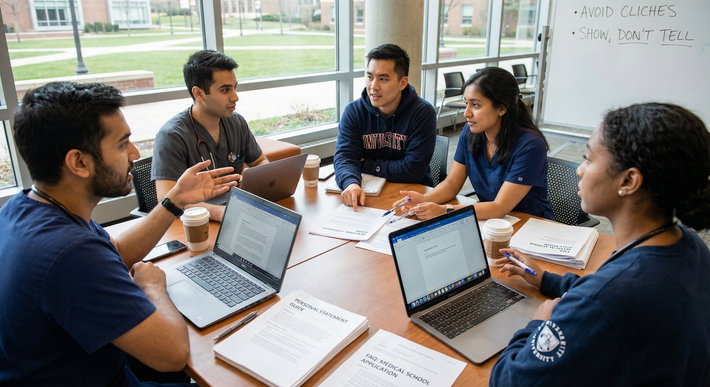
You are on your third revision.
Microsoft Word is a graveyard of tracked changes. Your “personal statement – final REVISED v7 REAL FINAL” document is open, and you are staring at the first paragraph thinking: This sounds like every other applicant.
You know you need a hook. You have heard you need a “story arc.” You have no idea how to end without sounding cheesy or desperate. And the clock is ticking before ERAS opens.
Let’s fix that.
This is a how-to manual for structuring your residency personal statement with a clear hook, a clean narrative arc, and a closing that actually lands. Not theory. A structure you can literally map onto your current draft tonight.
Step 1: Decide What This Statement Is For (Before You Write a Single Word)
Residency personal statements are not creative writing contests. They are decision tools.
Program directors and faculty read your statement for three things:
- Who you are to work with.
- Why you chose this specialty.
- Whether your story is coherent with the rest of your application.
Your structure must serve these three jobs. If a beautiful sentence does not help with one of them, it is clutter.
So before you touch structure:
- Write down, in plain language, answers to:
- “Why this specialty, in one sentence?”
- “What are 2–3 defining traits as a future resident (e.g., meticulous, calm in chaos, great with families)?”
- “What 1–2 experiences best show those traits?”
This becomes the backbone of your arc. Not your entire life story. Not every hardship. Two or three anchored points.
Now we build the structure around them.
Step 2: Build a Hook That Does Not Sound Like Everyone Else’s
Your hook is the first 2–4 sentences. Its only job: get them to read the next paragraph and give them a clear signal that you are not generic.
The most common bad openings I see:
- “I have always wanted to be a doctor…”
- “Medicine is a field that combines science and humanism…”
- “During my third-year rotation in [specialty], I realized…”
These are résumé intros disguised as prose. Program directors skim right past them.
You want a hook that drops the reader straight into a moment.
Three reliable hook templates (pick one and adapt)
In-medias-res clinical moment (most effective if done tightly)
Start in the middle of a specific encounter, but keep it short and focused.Example skeleton:
- Sentence 1–2: One concrete moment.
- Sentence 3: Your internal reaction.
- Sentence 4: Tie to what this reveals about you or your fit for the specialty.
Example (for EM):
“The trauma pager went off just as I was finishing a discharge summary. Minutes later I was at the foot of a bay where a teenager, pale and silent, was being transferred from the EMS stretcher. My hands were mostly useless at first—pressing the blood pressure cuff, fetching supplies—but my eyes were glued to the attending orchestrating chaos into order. I realized I was drawn not just to the adrenaline, but to the calm, structured thinking that emergency medicine demands.”Short, surprising contrast or tension
Show a conflict between expectations and reality, then set up your arc.Example skeleton:
- Sentence 1: Contrast (what you thought vs what you found).
- Sentence 2–3: Brief clarification.
- Sentence 4: How this tension led you toward this specialty.
Example (for Psychiatry):
“I did not go into third year planning to enjoy psychiatry. I liked lab data, imaging, and procedures, and psychiatry seemed like the opposite. But sitting with a patient who had not left her apartment for months and watching her engage, slowly, over repeated visits forced me to reconsider what ‘treatment’ meant. That shift in perspective is what ultimately pulled me toward psychiatry.”Identity or background lens that immediately connects to the specialty
This is not a trauma dump. It is a sharp link between a piece of who you are and what you want to do.Example (for Pediatrics):
“I grew up translating at appointments for my younger brother, who has autism, long before I knew what a residency was. I watched my parents brace themselves before each visit, unsure if they would be heard or rushed. On my pediatrics rotation, sitting on the floor to examine a child while speaking directly to his anxious mother, I recognized the kind of clinician I wanted to become.”
Hook rules that will keep you out of trouble
- 1 short paragraph. No more than 5–6 lines.
- One scene, one idea. Do not stack three experiences in your first paragraph.
- Avoid melodrama: if it reads like a Netflix monologue, pull it back.
- End the hook with a line that clearly points to the specialty and to your internal motivation, not just the external event.
If your current first paragraph is generic, your fix tonight is simple:
- Strip it down to one moment.
- Rewrite it using one of the templates above.
- Make the last line of the paragraph answer: “And this is why I am pulled toward [specialty].”
Step 3: Design the Arc: From Hook to “This Is Who You Get If You Match Me”
The “arc” is just a fancy term for: where you start, what changes or deepens, and where you land.
A residency personal statement does not need a movie-level plot. It needs a logical, progressive path:
- Here is the moment or lens that shows you something about me.
- Here is how my training and experiences deepened that into a genuine specialty choice.
- Here is what that means for how I will function as a resident.
The simplest, cleanest arc that works for 90% of applicants:
Paragraph 1: The Hook
We already covered this. Clinical moment / contrast / identity lens.
Paragraph 2–3: Development – Why this specialty, with evidence
This is where many statements collapse into bullet-list-in-prose. They start listing every rotation, every leadership role, every research project.
Do not do that. ERAS already has your bullet points.
You want 2–3 core themes that match what the specialty actually values. Then 1–2 experiences each, used as evidence, not as more story for story’s sake.
Example themes by specialty:
| Specialty | Good Core Themes |
|---|---|
| Internal Med | Curiosity, complex problem-solving |
| Surgery | Precision, ownership, persistence |
| Pediatrics | Communication, patience, advocacy |
| Psychiatry | Listening, pattern recognition |
| EM | Calm in chaos, triage, teamwork |
Pick 2–3 themes that are honest for you.
Then structure paragraphs like this:
Paragraph 2: First core theme + concrete example
- Opening sentence: Topic sentence that states the trait or insight clearly.
- 2–3 sentences: Short example that proves it.
- 1–2 sentences: Reflection tying it to the specialty and how you work.
Example (for IM, theme = curiosity + complexity):
“Internal medicine appeals to my inclination to understand complex systems rather than treat isolated problems. On the wards, I was consistently drawn to patients with multiple comorbidities—the septic patient with cirrhosis and diabetes, the elderly woman with heart failure and renal dysfunction—because each decision required weighing competing risks and benefits. I enjoyed tracing each abnormal lab back to its pathophysiologic origin and discussing with my team how a change in one medication might ripple through the rest of the regimen. That process of deliberate, analytic thinking is where I feel most engaged.”
Paragraph 3: Second core theme + example
Same skeleton, different theme.
Maybe for IM: continuity and teaching. For EM: rapid decision-making and teamwork. For Surgery: attention to detail and comfort with responsibility.
Key point: each paragraph should move you forward. Not repeat “and then I saw another patient and realized again that I like [specialty].”
Where do you put research, leadership, and “red flag explanations”?
Research:
Only if:- It genuinely shaped how you think in ways that fit the specialty, or
- It is substantial enough that program directors will care (e.g., multiple projects, publications, a research year).
Then give it its own short paragraph, focused on:
- What you learned (e.g., persistence, critical appraisal).
- How that will make you a better clinician in this field.
Leadership / volunteering:
Use selectively, as evidence of traits (ownership, advocacy, work ethic). Not just as another line from your CV.Red flags (leave of absence, score issues, career change):
If you need to explain, do it once, in 2–3 honest, factual sentences, ideally mid-body.Example:
“During my second year, I took a leave of absence to address a health issue that has since resolved. Returning to school, I adopted more structured study habits and sought mentorship that helped me improve my clinical performance. This period reinforced my resilience and my awareness of how to sustain myself to care for others.”
Notice: no oversharing, no drama, no excuses. Own it, show growth, move on.
Step 4: Closing Strategy – How to Land the Plane Without Clichés
The last paragraph is where many otherwise solid statements self-sabotage.
They suddenly switch to:
- “I know I will be an excellent [specialty] resident…”
- “I am confident that I will be an asset to your program…”
- “I look forward to the opportunity to grow and learn…”
Empty calories. Everyone says some version of this.
Your closing has three jobs:
- Synthesize: remind the reader of your core identity and fit.
- Look forward: show how you see yourself in residency and beyond.
- Sound like a human, not a brochure.
Aim for 4–6 sentences, one paragraph.
A reliable closing template
- Sentence 1: Return to a core theme or your opening lens.
- Sentence 2–3: Name 2–3 concrete things you are looking for in training that align with your specialty and your traits.
- Sentence 4–5: State the kind of resident/physician you aim to be, anchored in behaviors, not adjectives.
- Optional final line: A simple, grounded statement of readiness.
Example (for EM):
“Returning to that trauma bay, what continues to draw me to emergency medicine is the combination of rapid problem-solving and clear-headed teamwork in moments that matter most to patients. I am seeking a residency that will push me to refine my clinical judgment under pressure, strengthen my procedural skills, and learn from faculty who balance efficiency with compassion. As a resident, I hope to be the colleague who stays calm, takes ownership of difficult tasks, and supports the team when the department is stretched. I am ready to bring my energy, humility, and curiosity to an emergency medicine program that will challenge me to grow into that physician.”
Notice what is missing:
- No “your esteemed program.”
- No begging.
- No guarantee of greatness.
Just a clear picture: “If you match me, this is what you get and what I am seeking.”
Phrases that weaken your closing (delete them)
- “I believe that I will…” – just state it.
- “I am confident that I will be an excellent resident…” – everyone writes this; it means nothing.
- “I know that [specialty] is the right field for me because…” – you should have proven that already.
Replace those with specifics:
- What skills you want to sharpen.
- How you see your role on the team.
- The type of physician you envision becoming, with one eye on the future (community practice, academic, underserved populations, etc., if you actually have a lean).
Step 5: Put It All Together – A Working Outline You Can Use Tonight
You need a concrete map. Here it is.
Target length and structure
- Total: ~650–850 words.
- 5–7 paragraphs.
Suggested layout:
Paragraph 1 (Hook, 4–6 sentences)
- Focused clinical moment / identity lens + link to specialty.
Paragraph 2 (Theme 1: core fit, 5–7 sentences)
- Topic sentence: trait or draw to specialty.
- Short example from rotations.
- Reflection tying it to how you think / work.
Paragraph 3 (Theme 2: another dimension of fit, 5–7 sentences)
- Different trait or aspect of specialty.
- One or two specific examples (clinical, leadership, etc.).
- Tie back to residency role.
Paragraph 4 (Optional: research, red flag, or additional theme, 4–6 sentences)
- Only if needed.
- Tight, purposeful, no wandering.
Paragraph 5 (Closing, 4–6 sentences)
- Synthesize core identity + what you want in training + the colleague you will be.
Here is that flow as a visual if you are a “see the map” person:

| Step | Description |
|---|---|
| Step 1 | Hook Paragraph |
| Step 2 | Theme 1 Paragraph |
| Step 3 | Theme 2 Paragraph |
| Step 4 | Optional Extra Paragraph Research/Red Flags/Theme 3 |
| Step 5 | Closing Paragraph |
If your current draft exists, do this:
- Copy-paste it into a new document.
- Mark each paragraph with its intended role (hook, theme 1, etc.).
- If two paragraphs do the same job, merge or delete one.
- If a paragraph has more than one job, cut it in half and make each do one thing well.
Step 6: Fixing Common Structural Problems (Triage for Messy Drafts)
You might already have 1,200 words of stream-of-consciousness. That is fine. Here is how to salvage it.
Problem 1: “My statement is just a list of everything I have ever done.”
Symptom:
Every paragraph starts with “During…” or “I also participated in…” or “Additionally…”
Fix:
- Print it or use the comment tool.
- Next to each sentence, write what job it does:
- H = Hook / interest
- F = Shows Fit / trait
- E = Explanation / background
- CV = Just repeats your CV
- Delete as many “CV” sentences as you can. You should feel a little anxious doing this. That is normal.
- Group the remaining “F” sentences by theme (curiosity, teamwork, etc.). Those groups become paragraphs 2 and 3.
Problem 2: “My hook is long and I get to the point in paragraph 3.”
Symptom:
First two paragraphs are extended childhood stories, high school experiences, or multi-page patient narratives.
Fix:
- Limit your hook story to one scene that connects to your current self as a medical student, not childhood.
- Anything that happened before medical school should be in there only if:
- It clearly shapes your professional identity now, and
- You can explain that link in 1–2 sentences.
If it takes you until the third paragraph to say “I am applying to general surgery because…”, compress paragraphs 1–2 into a single hook and move up the specialty statement.
Problem 3: “I sound like every other applicant.”
Symptom:
Buzzwords everywhere: “lifelong learner”, “compassionate care”, “multidisciplinary team”, “cutting-edge research.”
Fix:
- Read each sentence out loud while imagining 100 other people reading the same line. If it could be true for most applicants, re-write or delete it.
- Replace abstract words with concrete, observable behavior.
Instead of: “I am passionate about patient-centered care.”
Try: “I make a point of sitting down when I talk to patients, even when the list is long, because it changes how they talk to me.”
This is where your personality actually shows up.
Step 7: Editing Passes with a Clear Purpose (Do Not Edit Everything at Once)
Trying to fix content, structure, and wording in one sitting is how you end up stuck.
Do three short, focused passes:
Pass 1: Structure only
- Check your outline: Hook → Theme 1 → Theme 2 → (Optional) Extra → Closing.
- Make sure each paragraph has:
- One main idea.
- A first sentence that signals that idea.
- Move or cut sentences that drift.
Pass 2: Clarity and specificity
- Replace vague nouns with specific ones (“a patient” → “a young man with uncontrolled diabetes”).
- Cut any sentence you have to read twice to understand. Program directors are skimming at 11 p.m.; do not make them work.
Pass 3: Tone and polish
- Remove arrogance (“I will be an outstanding resident”) and self-deprecation (“I am not the smartest but…”).
- Check transitions between paragraphs: you do not need fancy phrases, just logical flow. “Beyond the ICU, I also found…” is plenty.
To give you a feel for readability, here is roughly how readers’ mental energy drops across your statement:
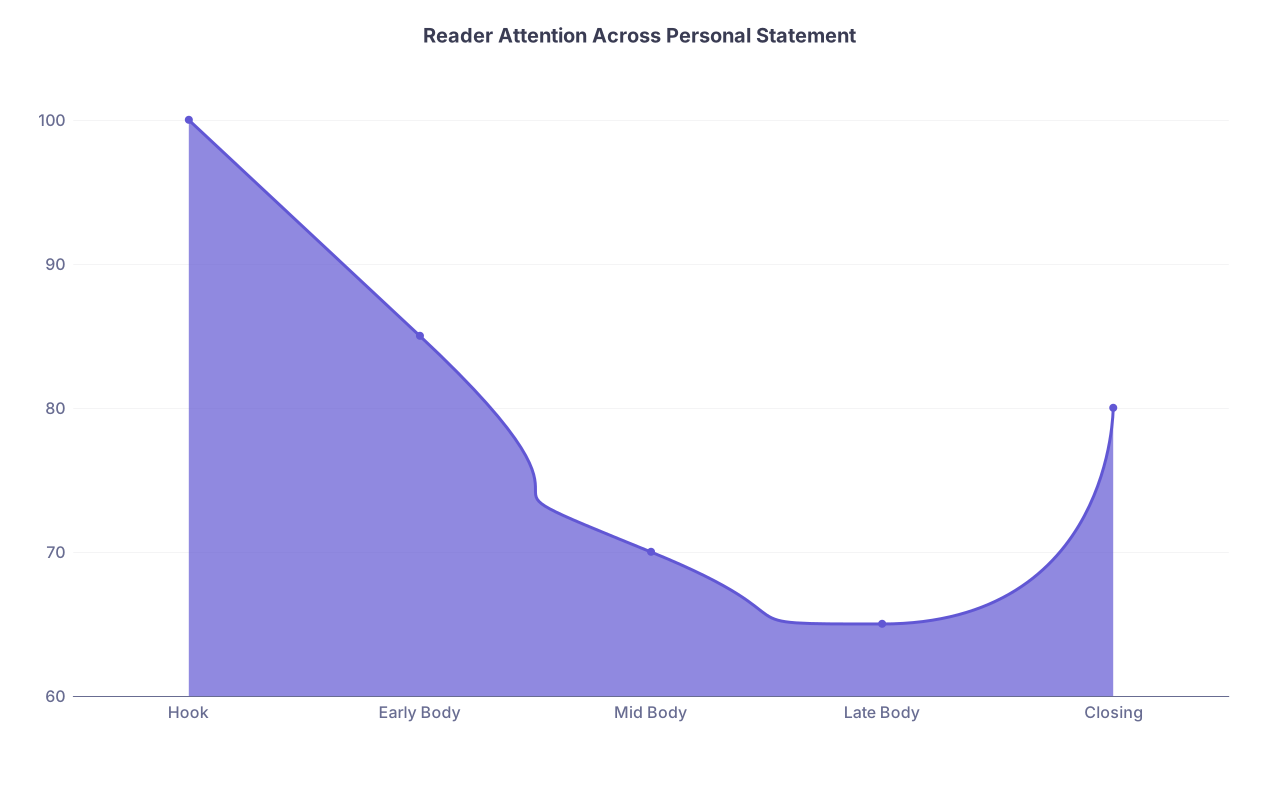
| Category | Value |
|---|---|
| Hook | 100 |
| Early Body | 85 |
| Mid Body | 70 |
| Late Body | 65 |
| Closing | 80 |
Hook and closing carry disproportionate weight. Make them carry it well.
Step 8: Sanity-Check Against What Programs Actually Care About
You are not writing into the void. You are writing to people who have maybe 2–3 minutes per statement, often less.
What they scan for:
| Element | What They Want to See |
|---|---|
| Specialty fit | Clear, coherent reasons |
| Professionalism | Mature, no drama, no boundary issues |
| Communication | Clear writing, organized structure |
| Signal of problems | Brief, honest explanations if needed |
| Future direction | Basic sense of where you are heading |
Ask someone you trust (ideally a resident or faculty in the field) to answer these questions after reading your draft:
- In one sentence, why do I say I want this specialty?
- What 2–3 traits or themes describe me as a future resident?
- Would anything in this statement make you worry about working with me?
- Do the beginning and end match the same person?
If they cannot answer #1 and #2 quickly, your arc is muddy. Rework paragraphs 2–3.
A Quick Example: Turning a Bad Structure into a Functional One
Let me give you the “before vs after” at the structural level.
Before (typical structure):
- P1: Vague childhood story about grandfather’s illness.
- P2: “I have always been drawn to helping people…”
- P3: I liked every rotation, then on my [specialty] rotation I realized…
- P4: List of research, tutoring, volunteering.
- P5: “I am confident I will be a great resident and look forward to the opportunity…”
After (fixed with the framework):
- P1 (Hook): One focused clinical moment on [specialty] that shows a real reaction and points to the field.
- P2 (Theme 1): Curiosity/analytic thinking shown through specific cases from that rotation.
- P3 (Theme 2): Teamwork/communication story that shows you on the team (and actually interacting, not just observing).
- P4 (Research/extra): Single research thread or brief red-flag explanation tied to how you think and work now.
- P5 (Closing): Synthesis of who you are + what you are seeking in residency + picture of you as a colleague.
Same life. Different architecture. Much stronger impact.
Here is that comparison in simple visual form:
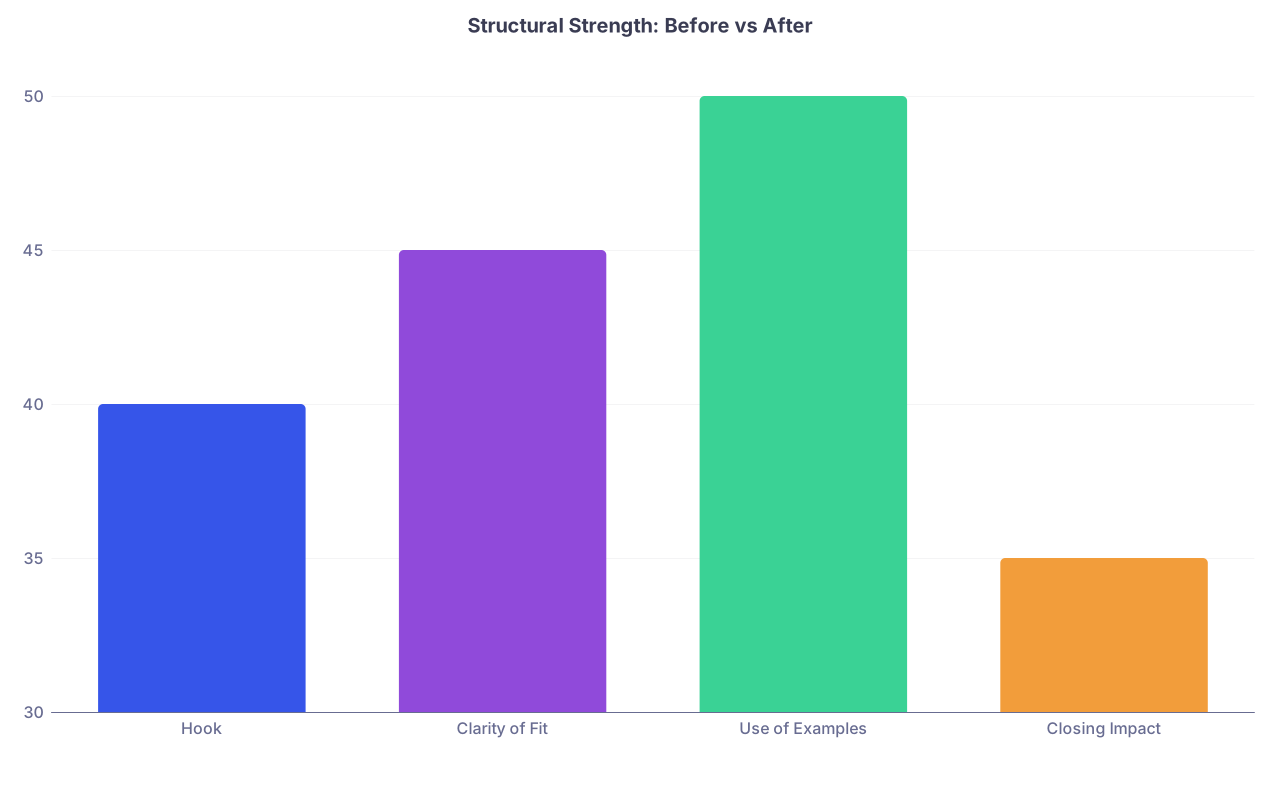
| Category | Value |
|---|---|
| Hook | 40 |
| Clarity of Fit | 45 |
| Use of Examples | 50 |
| Closing Impact | 35 |
(Think of those numbers as “percent of potential” — the fixed version pushes these much closer to 90–100.)
Final Check: A 10-Minute Self-Audit
Before you upload to ERAS, run this quick audit:
First paragraph:
- Does it start in a specific moment or tension?
- Does the last sentence clearly connect you to the specialty?
Middle:
- Can you underline 2–3 different traits/themes, each with its own mini-example?
- Are you telling, not re-listing your CV?
Closing:
- If someone read only your last paragraph, would they have a sense of:
- What you want from residency?
- What kind of teammate you will be?
- If someone read only your last paragraph, would they have a sense of:
Word count:
- Under ~850 words. If not, cut repetition, not substance.
Key Points
- Structure is not decoration. A clear hook → focused middle themes → grounded closing will do more for you than any fancy sentence.
- Use your experiences as evidence for 2–3 core traits that fit the specialty, not as a life chronicle.
- End with a specific, forward-looking picture of yourself as a resident, not vague flattery or generic promises.