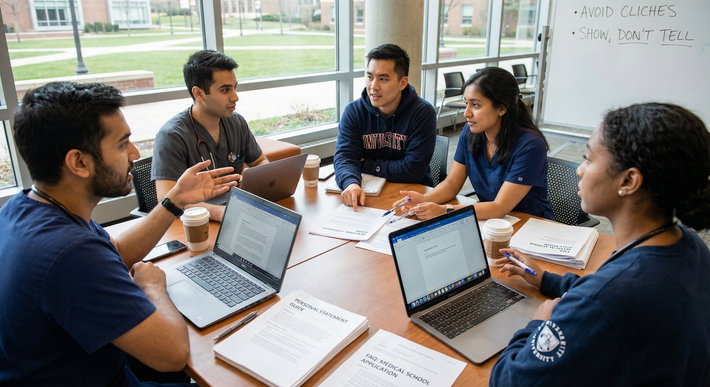
The worst personal statements are not the bad ones. They are the almost good ones that no one bothered to fix in the last 48 hours.
You have 2 days. That is enough time to turn a generic, “I have always wanted to help people” essay into something a serious PD can actually remember. But you must be ruthless and systematic.
This is your 48‑hour, no‑nonsense upgrade protocol.
The 48‑Hour Game Plan (Overview)
You are not “polishing.” You are rebuilding the parts that matter most and ignoring everything else.
Here is the high‑yield structure for your 2 days:
| Time Block | Primary Goal |
|---|---|
| Hour 0–2 | Diagnose: brutal audit of current draft |
| Hour 2–8 | Rebuild intro and conclusion |
| Hour 8–16 | Fix body structure and content |
| Hour 16–24 | Sharpen specialty fit and voice |
| Hour 24–36 | Line edit: clarity, power, and length |
| Hour 36–44 | External review + targeted revisions |
| Hour 44–48 | Final QA pass and submission prep |
You will not follow this minute‑by‑minute. Life happens. Shifts happen. But you will hit each step in order.
Step 1: Brutal 20‑Minute Diagnostic (Hour 0–2)
Print the statement or view it in a different format (phone instead of laptop). You want your brain to see it as “new.”
Now do this, with a pen or comment tool:
- Highlight in yellow: Any specific, concrete story (patient, rotation, project, specific challenge).
- Underline in red: Any cliché or generic phrase. Examples I see every single year:
- “I have always wanted to be a doctor.”
- “I am passionate about helping others.”
- “This experience solidified my desire to pursue [specialty].”
- “Medicine is both an art and a science.”
- Circle: Every time you mention the specialty name. Count them.
After that, answer these five questions in writing, on a separate page:
- What is the one sentence that sums up who you are as an applicant for this specialty?
- Can someone tell, from this statement alone, why this specialty and not another?
- Is there one memorable story that could make someone say, “Oh yeah, that applicant”?
- Do you sound like every other applicant, or like yourself?
- Are there any red flags you are ignoring that probably need a sentence or two of context? (LOA, low Step, failed exam, extended time.)
If you cannot answer these cleanly, that is your problem list.
Step 2: Replace the Weakest Part First – Your Opening (Hour 2–4)
Most personal statements die in the first 5 lines. PDs have told me straight to my face: “If the first paragraph is generic, I skim the rest.”
So we fix that first.
Kill these opening types immediately
If your first paragraph does any of this, delete it:
- Starts with, “I have wanted to be a physician since…”
- Starts with, “Growing up, I saw disparities in healthcare…”
- Starts with a dramatic patient scene that has nothing to do with you
- Starts with your childhood illness, unless it ties directly and concretely to your current behavior and career choices
Build a stronger opening in 15–20 minutes
Use this three‑sentence template as a spine:
- Hook with a moment that reveals something about you, not just the patient.
- Name what that moment crystallized about how you practice / think / show up.
- Tie it explicitly to the specialty.
Example before (weak):
I have always been passionate about internal medicine. During my rotations, I enjoyed following patients and learning about their conditions. These experiences solidified my desire to pursue internal medicine.
Example after (stronger):
On my third call night of wards, I realized my sign‑out list looked more like a puzzle than a to‑do list. A septic patient whose cultures never grew an organism, a CHF exacerbation that kept coming back, a “failure to thrive” no one had fully defined. I liked that internal medicine demanded that I stay curious when the pattern did not fit.
Short, specific, and clearly internal medicine. No drama. Actual thought process.
Write 2–3 different openings. Do not polish. Just get options down. Then pick the one that:
- Has something only you could reasonably say
- Names the specialty or clearly implies it
- Makes you want to read sentence 4
That becomes your new first paragraph.
Step 3: Force a Clear Structure Onto the Middle (Hour 4–10)
Most mid‑sections are bloated. Random stories, list of experiences, “then I did this, then I did that.” PDs do not care.
You need a spine. For residency personal statements, this 3‑part core structure works almost every time:
- Why this specialty (specific reasoning)
- How your experiences show you will function well in this specialty
- What you want to do in this field (even if broadly)
3–Box index card method (30–45 minutes)
Take 3 index cards (or 3 headers in a doc):
- Card A: “Why [Specialty]”
- Card B: “How I work” (strengths with evidence)
- Card C: “Future direction / what I am looking for”
Now, go through your statement and copy/paste (or literally rewrite) each paragraph onto the right “card.” If a paragraph does not clearly fit any, it is probably filler. Cut it.
You should end with:
- 1–2 short paragraphs for “Why [Specialty]”
- 2–3 paragraphs for “How I work”
- 1 paragraph for “Future direction / what I want from residency”
If you have more, compress. You are aiming for 650–800 words total for residency. 900 is almost always too long.
Turn experiences into evidence, not a CV recap
Look at each paragraph under “How I work.” For each one, ask:
- Does this show a skill or trait that matters in this specialty?
- Is it obvious what I learned or how I changed?
- Could someone else plug in their name and it would still read the same?
If the answer to #3 is yes, it is generic. Fix it with specificity:
Bad:
On surgery, I learned the value of teamwork and communication in the OR.
Better:
On surgery, I learned that “no surprises” is not just an attending mantra but a survival skill. I started pre‑charting my cases the night before and running through anticipated complications with my residents so my checklist was not just sponge counts, but also, “What will we do if this patient crashes when they hit the table?”
Now you sound like someone who has actually been there, not someone writing for a college essay contest.
Step 4: Make Your Specialty Fit Unmistakable (Hour 10–16)
Your reader should never think: “This could easily be rewritten for another specialty with search‑and‑replace.” That is the kiss of death.
Quick specialty specificity audit
Do a search (Ctrl+F) for:
- The specialty name (“internal medicine”, “neurology”, “EM”)
- Generic words like “field,” “this discipline,” “the specialty I have chosen”
You want:
- The specialty referenced 3–5 times in a 750‑word statement
- Concrete features of the specialty mentioned (continuity of care, acute decision making, procedural focus, etc.)
Now add 2–3 specialty‑specific sentences that show you understand the actual daily work:
Examples:
Pediatrics:
“I enjoy the puzzle of figuring out a history from a 3‑year‑old who will not look at me, and parents who are exhausted and scared but still notice tiny changes before anyone else.”Emergency Medicine:
“I like that EM forces me to make decisions with incomplete data and then own them, while still knowing when a patient needs time and admission rather than a clever diagnosis in the ED.”Psychiatry:
“What drew me most to psychiatry was the way a single, well‑timed question could shift a patient from guarded to engaged, and how much of the work happens in that space, not in the prescription pad.”
You are not doing a romance letter to the specialty. You are showing you understand the job.
Step 5: Decide What To Do With Red Flags (Hour 16–18)
You do not have much space. But ignoring obvious issues is worse.
Here is a clear rule set:
- Low Step 1 / Step 2, single fail, or extended time: 1–2 sentences if you can show a change in behavior or improvement.
- LOA for health / personal reasons: Usually needs 1–3 sentences, factual, calm, no drama.
- Significant professionalism issue: Talk with a mentor; this might belong more in your MSPE or advisor letter than your PS.
Use this 3‑sentence structure when you need to address something:
- Name the issue plainly, without excuses.
- Briefly state the cause or context, only if it adds clarity.
- Emphasize what you changed and how your subsequent performance reflects that.
Example:
During my second year, I failed Step 1 on my first attempt. This reflected inadequate structure in my study approach rather than a lack of effort. I met regularly with faculty advisors, built a disciplined study schedule, and on my second attempt I improved my score by 30 points; since then, I have honored on my medicine and neurology clerkships.
Short, factual, owning it. Then move on. Do not end the personal statement on a red flag explanation.
Step 6: Rewrite Your Conclusion So It Actually Does Something (Hour 18–20)
Most conclusions are a graveyard of clichés: “I am excited to continue my journey…” “I am confident that I will be a compassionate and hardworking resident…”
Delete that.
Your conclusion has three jobs:
- Echo your core identity as an applicant.
- Reaffirm specialty fit.
- Hint at your future direction and what kind of program you seek.
Use this 4‑sentence backbone:
- One sentence restating the version of you they should remember.
- One sentence tying that to the specialty.
- One sentence about how you hope to contribute or grow.
- One clean closing sentence (no begging).
Example:
I bring curiosity, steady work habits, and a bias toward preparation to the patients I care for. These traits have made internal medicine feel less like a series of rotations and more like a long apprenticeship in thinking carefully about complex problems. In residency, I hope to deepen my skills in inpatient medicine while building a foundation for a future in medical education. I look forward to training in a program that values thoughtful patient care and teaching as much as I do.
No “thank you for your consideration.” This is not a cover letter.
Step 7: Make Every Line Pull Its Weight (Hour 20–30)
Now you have the architecture. Time to cut the dead weight and sharpen the language.
30‑minute ruthless cut
Goal: Shrink by 15–25% without losing meaning.
- Delete any sentence that repeats an idea.
- Cut adverbs and filler (“very,” “really,” “quite,” “truly,” “deeply”).
- Replace wordy phrases:
- “Due to the fact that” → “Because”
- “In order to” → “To”
- “I believe that I will” → “I will” (or better: show, do not tell)
Target word count: 650–800.
Use a readability check (Flesch‑Kincaid) if you like, but do not obsess. If a smart co‑resident can read it once and tell you what they remember, you are fine.
Verb and subject audit
Scan each paragraph and underline verbs. You want:
- Strong, specific verbs: “led,” “organized,” “implemented,” “advocated,” “studied,” “analyzed,” “taught,” “followed up”
- Fewer weak verbs: “was,” “did,” “helped,” “got,” “had”
Change:
I was able to help improve…
To:
I helped improve…
Or better:
I redesigned the sign‑out template so cross‑cover notes were clearer and nurses stopped paging for the same issues twice.
You sound more like a functioning adult and less like a premed.
Step 8: Gut‑Check for Voice and Authenticity (Hour 30–34)
Now read the whole thing out loud. Non‑negotiable.
You are listening for:
- Where you run out of breath → sentence too long.
- Where you stumble → wording awkward or fake.
- Where you cringe → something sounds like brochure copy.
Any sentence you would never say in a real conversation with an attending? Rewrite it.
Example cringe:
“This experience solidified my passion for patient advocacy and interdisciplinary collaboration.”
Rewritten:
“After watching a non‑English‑speaking patient get discharged without clear follow‑up, I started staying a few minutes later to call families myself and make sure our instructions made sense.”
Same idea. 10x more believable.
Step 9: Get One Targeted External Review (Hour 34–44)
Not five people. One or two max. Too many cooks will ruin this.
Who to ask
Ranked in order of usefulness:
- Someone in your chosen specialty (resident or faculty) who has read applications.
- An advisor who works on residency applications regularly.
- A co‑resident / MS4 with strong writing skills who will tell you the truth.
Send them:
- Your current draft
- Your CV or ERAS experiences list
- 3 quick questions:
- What 2–3 traits do you remember about me after reading this?
- Does this sound like me in real life?
- Is there anything that bothers you or sounds off?
Give them permission to be blunt. “Feel free to destroy this; I have time to fix it.”
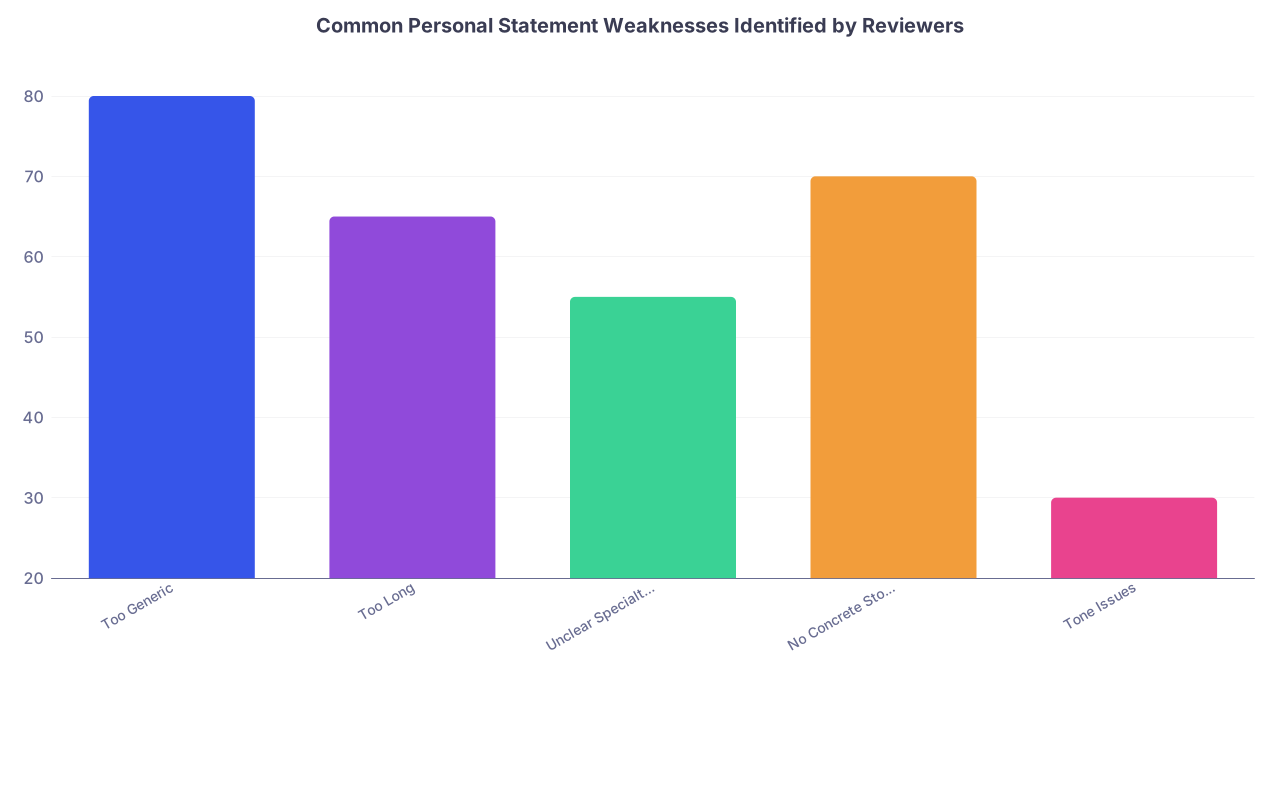
| Category | Value |
|---|---|
| Too Generic | 80 |
| Too Long | 65 |
| Unclear Specialty Fit | 55 |
| No Concrete Stories | 70 |
| Tone Issues | 30 |
When you get feedback, do not argue. Decide:
- What is clearly right → fix it.
- What is style preference → ignore unless it appears from more than one person.
- What conflicts with your sense of self → rework, but do not become someone else.
Step 10: Final QA Checklist – Before You Upload (Hour 44–48)
Last pass. Pretend you are the PD on your 70th app of the night.
Walk through this checklist point by point:
Content check
- Clear, specific reason for choosing this specialty
- At least one memorable patient / project / rotation story
- Demonstrated traits that matter for this specialty (not just stated)
- Word count 650–800
- No obvious CV recitation (no long lists of activities)
Tone + professionalism
- No trash talk about other specialties, programs, or colleagues
- No excessive self‑deprecation or apology tour
- Confident without being arrogant
- No jokes that could fall flat or be misinterpreted
Technical
- No spelling or grammar errors (run spellcheck + one human read)
- Your name not in the body of the statement (ERAS attaches it for you)
- Specialty name spelled correctly every time (yes, I have seen “otolayrngology”)
- Saved in a plain text‑friendly format; pasted into ERAS and rechecked for spacing
Cross‑document consistency
- The tone matches the rest of your application (letters, MSPE, CV)
- No new unexplained surprises that are not mentioned anywhere else
- The strengths you highlight align with what your best letter writer would say
At this point, stop. Do not tinker for another 6 hours and introduce new errors.
A Concrete 48‑Hour Example Schedule
If you like things ultra practical, here is a sample breakdown you can roughly follow, assuming you have normal life demands plus some clinical work.
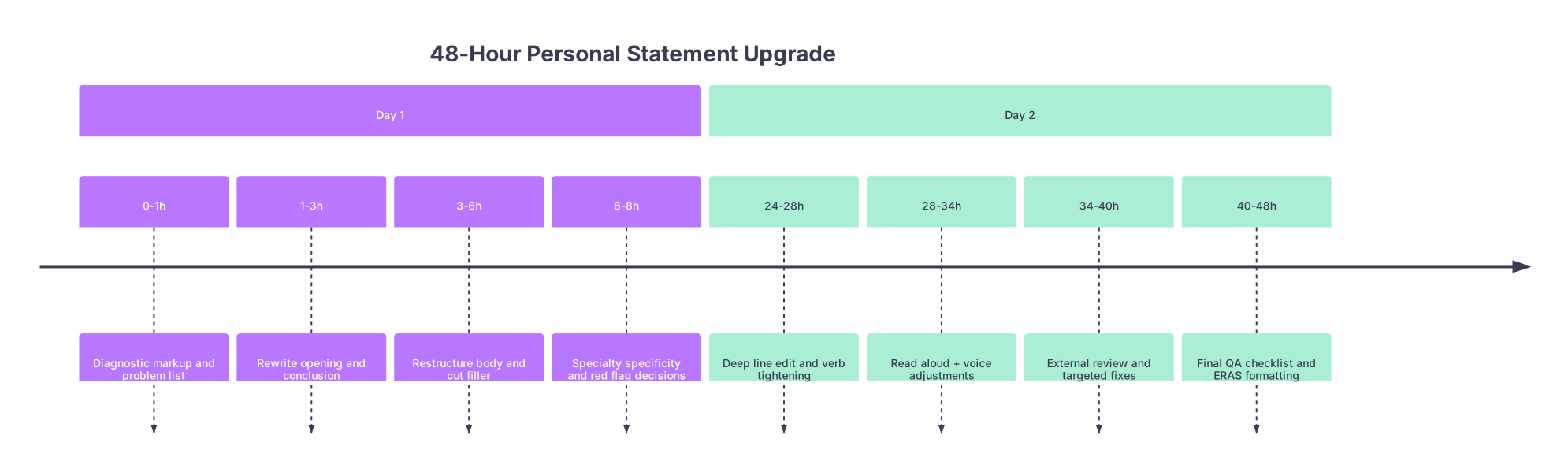
| Period | Event |
|---|---|
| Day 1 - 0-1h | Diagnostic markup and problem list |
| Day 1 - 1-3h | Rewrite opening and conclusion |
| Day 1 - 3-6h | Restructure body and cut filler |
| Day 1 - 6-8h | Specialty specificity and red flag decisions |
| Day 2 - 24-28h | Deep line edit and verb tightening |
| Day 2 - 28-34h | Read aloud + voice adjustments |
| Day 2 - 34-40h | External review and targeted fixes |
| Day 2 - 40-48h | Final QA checklist and ERAS formatting |
You will not hit it perfectly. That is fine. The point is sequence, not perfection.
What To Absolutely Stop Doing In These 48 Hours
Let me save you from three massive time‑wasters.
Do not read 20 sample personal statements online.
You will end up copying tone and clichés. Read 1–2 max for structure ideas if you must, then close the tab.Do not obsess over one poetic sentence.
PDs want clarity. They are not grading literary style. If you have one nice image and the rest is clean, you are done.Do not try to be “different” for the sake of standing out.
Stand out by being specific and honest, not by writing in second person, starting with a quote, or doing some weird gimmick format.
Your goal is not to be the most creative statement. Your goal is to be the one that makes the PD think: “I trust this person to take care of patients in my hospital.”
Quick Reality Check: What “Good Enough” Actually Looks Like
A “good enough” residency personal statement is:
- Clear
- Specific
- Professional
- Mildly memorable
It is not:
- Your entire life story
- A justification for your existence
- The thing that will magically overcome a catastrophic application
But here is what a strong 48‑hour upgrade can do:
- Push a borderline “maybe” file into the “interview” pile
- Prevent your statement from hurting you
- Reinforce what your letters and CV already suggest about you
If by the end of this 48‑hour process you can answer “yes” to these 5 questions, you are fine:
- Could a stranger tell why I picked this specialty, and does it make sense?
- Would someone who has worked with me recognize me in this statement?
- Is there at least one concrete example that shows how I think or work?
- Do I sound like a future colleague, not a college applicant?
- Can I read this without cringing or feeling like I am pretending?
If yes, upload the thing. Then go take a nap before your next shift.
FAQ (Exactly 3)
1. Is it a mistake to use the same personal statement for all programs in a specialty?
For almost everyone, no. You do not need a different statement for every program. You need one strong, honest, specialty‑specific statement. If you are truly applying to very different tracks (e.g., categorical IM and physician‑scientist track), you can tweak 2–3 sentences to highlight research more heavily for the latter. But do not build 10 versions. That time is better spent on your ERAS experiences and interview prep.
2. How do I handle applying to two specialties in the same cycle?
Write separate statements. Each one must read like you are fully committed to that field. Do not try to write a hybrid “medicine/neurology” or “FM/psych” statement. Programs can smell hedging. If you are dual‑applying because of competitiveness, own that reality privately, but give each specialty a clean, self‑contained narrative that fits their world.
3. Can I recycle parts of my medical school personal statement?
You can recycle facts, not phrases. If a core story (family member’s illness, your own health journey) still genuinely drives your choices and you can show how it shaped your behavior in med school, you may reuse the concept. But if you copy‑paste entire sentences from your med school PS, it will sound immature and out of sync with who you are now. Rewrite from your current perspective as a near‑resident, not as the idealistic premed you were four years ago.
Key takeaways:
- In 48 hours, focus on architecture first: sharp opening, clear structure, credible conclusion.
- Cut every generic line and replace it with specific, specialty‑relevant evidence of how you think and work.
- Stop when it is clear, honest, and professional; “perfect” is not the goal—getting read and taken seriously is.