
The fastest way to tank an interview is to have a personal statement that does not match your ERAS experiences.
Programs read these side by side. If the story in your statement and the story in your CV feel like two different people, your file gets mentally downgraded before you ever walk in the door.
Let me show you how to fix that.
Step 1: Accept How Program Directors Actually Read Your File
Program directors and faculty do not read your personal statement in isolation. They cross-check it against your ERAS experiences in real time.
Here is what usually happens:
- They open your ERAS application.
- They skim your:
- Medical school
- Scores (or pass/fail status)
- Class rank / AOA (if available)
- Publications and leadership headers
- Then they flip between:
- Your “Experience” and “Publications” sections
- Your personal statement
If your statement says you are “deeply passionate about research” but you have:
- One poster from MS1 and zero ongoing projects
they notice.
If your statement centers on underserved medicine but:
- You have minimal longitudinal community work
they notice.
Misalignment does three things:
- Signals lack of insight or honesty.
- Makes you harder to “pitch” to their colleagues.
- Raises the quiet question: “What is this person actually about?”
Your job is to make all parts of your application tell the same coherent story. Same character. Same motivations. Same trajectory.
Step 2: Audit Your ERAS Experiences Before You Write Anything
Do not start your personal statement in a vacuum. Start in ERAS.
Open your application and actually look at what you have already told them about yourself.
2.1. Pull Out Your Raw Data
List your experiences in a simple table or structured notes. Include:
- Clinical experiences (including sub-I’s, externships)
- Research
- Leadership
- Teaching/tutoring
- Volunteer/service
- Work/employment
- Significant hobbies or long-term activities
Then pull out three details from each:
- Your role
- What you actually did (not just the title)
- Any outcome, deliverable, or growth point
You want a bird’s-eye view of “who you already are on paper.”
| Category | Experience Title | Time Span | Intensity (hrs/wk) |
|---|---|---|---|
| Clinical | Sub-I in Internal Med | 4th year, 4 weeks | 60 |
| Research | Cardiology Outcomes Lab | MS2–MS4 | 5–8 |
| Teaching | Peer USMLE Tutor | MS3–MS4 | 2–3 |
| Service | Student-Run Free Clinic | MS1–MS4 | 2–4 |
| Leadership | IM Interest Group Co-Chair | MS2–MS3 | 2 |
You cannot align a statement with your ERAS experiences if you have not looked at them as a whole story.
2.2. Identify the Dominant Themes Already in ERAS
Now categorize what your actual history says about you.
Look for clusters like:
- Longitudinal service vs. one-off volunteering
- Heavy research vs. minimal research
- Leadership-heavy vs. observer in many settings
- Strong teaching vs. none
- Breadth of clinical exposure vs. narrow
Ask yourself:
- Where have I consistently shown up over time?
(Not one-shift wonders. Real consistency.) - What did I keep coming back to even when I was busy?
- If someone saw only this ERAS list, what story would they tell about me?
Write down 2–3 themes you actually demonstrate, such as:
- “Long-term commitment to underserved care”
- “Progressive leadership and teaching roles”
- “Outcomes research with real clinical questions”
- “Strong interest in acute care and procedures”
- “Team-focused collaborator who steps into coordination roles”
These themes are your raw material. Your statement will fail if it tries to create new themes that are not present here.
Step 3: Decide Who You Are As an Applicant (And Own It)
Your personal statement needs a clear identity, not a vague list of good traits.
You are not trying to be “well-rounded” on paper. You are trying to be legible.
3.1. Pick 1–2 Core Identities
Examples:
For Internal Medicine:
- “Clinician-educator track with interest in medical education”
- “Research-focused applicant with outcomes/quality background”
- “Primary care and health equity–focused”
For General Surgery:
- “Operative, team-oriented resident who loves acute care”
- “Academic surgeon-in-training interested in surgical outcomes research”
For Pediatrics:
- “Longitudinal primary care for underserved kids”
- “Advocate for children with chronic disease and complex needs”
Commit to one or two. Not five. You will not be credible if your statement tries to be:
- Research heavy
- Service oriented
- Procedure hungry
- Global health focused
- And obsessed with medical education
all in 750 words.
Pick the ones your ERAS already supports.
3.2. Sanity Check Your Chosen Identity Against ERAS
Say you want to position yourself as “clinician-educator.”
Your ERAS must show at least some of the following:
- Peer tutoring, TA roles, or review sessions
- Curriculum committee, OSCE coaching, or mentoring
- Feedback from faculty noting your teaching / explaining skills
If ERAS shows:
- No teaching
- No leadership
- Minimal longitudinal commitment
you cannot plausibly claim clinician-educator as your main lane. You can say you are interested in teaching, but you cannot build your entire statement around it.
This is the kind of alignment problem that gets people in trouble.
Step 4: Turn Your ERAS Themes into a Statement Outline
Now we move from raw material to structure.
Your goal: a personal statement where every major claim is backed by at least one ERAS-listed experience.
4.1. Use a Simple 4-Part Structure That Actually Works
Forget clever literary experiments. You are not writing for The New Yorker. You are writing for tired faculty at 10 p.m.
Use this:
- Hook and Motivation (1–2 short paragraphs)
- Evidence of Fit and Growth (2–3 paragraphs)
- What You Want in Residency (1 paragraph)
- What You Bring to a Program (1 paragraph, closing)
Now line up ERAS with this structure.
1. Hook and Motivation
Your opening should:
- Give a clear reason you were drawn to the specialty
- Avoid melodrama and excessive childhood stories
- Set up the themes you will prove later
Check alignment:
- If you describe a key MS3 rotation that changed you, make sure that rotation shows up in ERAS as a meaningful experience (e.g., “Subinternship in Internal Medicine – 4th Year” or at least noted in your transcript / MSPE narrative).
- If you reference a multi-year free clinic, verify it is entered as a 3–4 year experience, not “1 month, 4 hours.”
2. Evidence of Fit and Growth
This is where most people go off the rails. They write generic fluff.
Your job is to select 2–3 specific ERAS experiences that support your chosen identity and dig into:
- What you actually did
- What you learned about the specialty
- How you grew
Examples of alignment:
- Claim: “I value continuity with patients.”
- ERAS support: 3-year student-run free clinic with longitudinal follow-up. Sub-I in continuity clinic.
- Claim: “I am drawn to the intellectual rigor of internal medicine.”
- ERAS support: Case conferences you led. Complex inpatient rotations where you followed difficult patients. Research in diagnostic reasoning or outcomes.
- Claim: “I want a career in academic surgery.”
- ERAS support: Multiple surgical research projects, abstracts, or manuscripts. Participation in morbidity and mortality conferences, resident education days, or interest group leadership.
If your statement describes:
- “Countless nights reflecting on the privilege of patient care”
but your ERAS experiences are a scattered list of short-term activities, the reader will not buy it.
Tie each paragraph to something they can see on ERAS.
3. What You Want in Residency
This section should be boring in a good way: specific, grounded, realistic.
Examples:
- “I am looking for a residency that offers strong ambulatory training, diverse patient populations, and early opportunities to teach medical students.”
- “I hope to train in a program with high operative volume, graduated responsibility, and structured research mentorship.”
Cross-check with ERAS:
- If you claim you want heavy research and protected time, but have not done any research, you look naïve.
- If you say you want strong underserved care exposure, but have no history of underserved work, it feels performative.
Align your future goals with your actual past behavior, not your fantasy self.
4. What You Bring to a Program
This is where many people drift into adjectives: hardworking, compassionate, team player.
Adjectives do nothing unless they are supported by ERAS-based evidence.
You want statements like:
- “Years of working at our student-run free clinic have trained me to handle high patient volumes while still staying focused on each individual’s story.”
- “My experience coordinating a 40-student tutoring program taught me how to manage teams, give feedback, and ask for help when needed.”
Again: check these against ERAS. If you mention it here and it is not in your application, fix that.
Step 5: Do a Line-by-Line Alignment Check
Now you have a draft. Time to be ruthless.
Print your statement and have your ERAS experiences open on screen next to you.
For every claim in the statement, ask: “Where would a program director see proof of this in ERAS?”
Mark it. Literally in the margin:
- “Free clinic – Experience #4”
- “Cardiology research – Experience #7 + Pub #2”
- “Peer tutor – Experience #10”
If you cannot point to a specific ERAS entry, that sentence is suspect.
5.1. Fix the Four Classic Misalignment Problems
The “I love research” overstatement
- Problem: One research experience, very recent, minimal output; statement centers on academic researcher identity.
- Fix: Reframe to: “exposed to research,” “interested in incorporating scholarly work,” and spend fewer words on it. Move your main identity to something your ERAS supports (e.g., clinical care, teaching, QI).
The “lifelong commitment to underserved populations” with no record
- Problem: One global health trip or one month at a free clinic; statement leans hard into underserved passion.
- Fix: Narrow your claim. You can say you “value working with underserved communities and hope to expand this interest,” but you cannot present it as your defining identity unless ERAS backs it.
The “leader” who has only titles
- Problem: A couple of club positions, but you never specify what you did; statement claims strong leadership identity.
- Fix: Use specific examples of actions and outcomes from these roles that are listed in ERAS. “Coordinated X,” “built Y,” “implemented Z.” If you cannot, tone down the leadership framing.
The “procedural junkie” with no consistent procedural exposure
- Problem: Loves procedures, but ERAS shows minimal or generic clinical work, no electives geared toward procedural fields, no evidence of that focus.
- Fix: Rebalance. You can describe enjoying procedures, but anchor your identity more in teamwork, acute care, or patient ownership, if that is what ERAS actually shows.
Step 6: Use Your Weaker Areas Strategically, Not Defensively
You also need to think about what is missing or “soft” in your ERAS and how your statement interacts with that.
6.1. If You Are Light on Research
Do not write a “future physician-scientist” manifesto. Programs hate that mismatch.
Instead:
- Show that you know how to think critically.
- Mention any QI, case reports, or data-driven projects you do have.
- Frame research as a skill you are open to building, not your only career goal.
6.2. If You Lack Longitudinal Service
You cannot fake continuity.
Instead of pretending you are committed for life to a cause you touched twice, you can:
- Focus on what you learned from shorter, acute experiences.
- Emphasize adaptability, communication, and team function.
- Be honest: “While most of my service work has been short-term and project-based, it has pushed me to…”
6.3. If You Have No Formal Leadership Titles
Leadership can be informal, but then you must be extra precise.
Describe:
- Times you started or fixed a process (e.g., reorganized sign-out).
- Situations where you coordinated a team or took point.
- How attending or resident feedback (sometimes in MSPE) echoes this.
But do not claim to be “heavily involved in leadership” if ERAS is bare in that area.
Step 7: Cross-Check Against Letters and MSPE (If You Know Them)
You do not fully control your letters, but you often have a decent idea what your letter writers emphasize.
You want triangulation:
- Your ERAS experiences
- Your personal statement
- Your letters / MSPE narrative
all telling the same story.
For example:
- If your Sub-I attending praised your ownership and follow-up:
- Emphasize these same qualities when describing that sub-I in your statement.
- If your research mentor is likely to highlight your persistence through setbacks:
- Echo that in your research paragraph.
The point is coherence. The more the same themes repeat in different sections, the more believable they become.
Step 8: Sanity-Test Your Application Like a Program Director
Last step. Pretend you are reviewing your own file for 90 seconds between clinic patients.
You have:
- ERAS open
- Personal statement next tab
- Limited patience
You skim:
- Education
- Scores
- Experiences (just titles, mostly)
- Statement (first 2–3 paragraphs and then you jump)
Ask yourself:
- Do I immediately understand who this applicant is and what they want?
- Does the personal statement match the flavor of the experiences?
- If I had to “sell” this applicant in one sentence in a rank meeting, what would I say?
If you cannot give a crisp answer, your alignment is off.
You want things like:
- “This is the student who basically lived at the free clinic and wants to do primary care in underserved communities.”
- “This is the surgery applicant with a track record in QI and a clear interest in academic outcomes research.”
- “This is the medicine applicant who has been teaching since MS1 and wants to be a clinician-educator.”
If your one-line summary is “Nice enough, generic, wants everything,” that is a problem.
Visual: From Raw ERAS to Aligned Statement

| Step | Description |
|---|---|
| Step 1 | List ERAS Experiences |
| Step 2 | Identify Real Themes |
| Step 3 | Choose 1-2 Applicant Identities |
| Step 4 | Draft Statement Around Identities |
| Step 5 | Line-by-Line ERAS Cross-Check |
| Step 6 | Revise Claims to Match Evidence |
| Step 7 | Final Sanity Test as Program Director |
Example: How This Looks in Practice
Let me walk through a quick synthetic example.
ERAS Snapshot – “Alex,” IM Applicant
- 3 years at student-run free clinic (MS1–MS4), 3 hrs/week
- Research assistant in cardiology outcomes lab (MS2–MS4), 1 poster, 1 co-authored paper
- Peer-tutor for MS2 students (USMLE Step prep)
- IM interest group co-chair
- Solid but not stellar scores, middle of the class
Actual themes:
- Longitudinal underserved care
- Outcomes research exposure
- Teaching/mentoring
- Consistent interest in IM
Reasonable applicant identity:
- Clinician-educator with interest in underserved populations and quality of care.
Aligned statement choices:
- Opening: A brief story from the free clinic, focused on continuity and diagnostic thinking.
- Middle paragraphs:
- One paragraph about the free clinic (continuity, systems issues, equity).
- One about cardiology outcomes research (how it shaped thinking about evidence and guidelines).
- One about peer tutoring (love of teaching and explaining complex ideas).
- What they want:
- A residency with strong ambulatory training, diverse patient base, chances to teach.
- What they bring:
- History of showing up over time, comfort with complex psychosocial contexts, interest in contributing to teaching and QI projects.
Everything stated is backed by ERAS. No invented lifelong calling. No “physician-scientist” branding without the record to match.
Quick Reality Check: What Not To Do
Just to hammer home the point, these are common mistakes that break alignment:
- Writing a research-forward statement when your ERAS shows a single retrospective chart review with no products.
- Declaring a passion for “working with diverse populations” when all your clinical experiences are at one homogenous private hospital and you have no service work.
- Calling yourself a “natural leader” without a single leadership or organizing role in ERAS.
- Claiming you want a “heavily academic program” but your track record shows zero involvement in scholarly work, conferences, or journal clubs beyond basic requirements.
Program directors see right through this. They have seen thousands of applications. You are not the first person to try to “essay your way” into a different identity than the one your CV shows.
Stop fighting your record. Build on it.
Useful Quick-View: Matching Common Identities with ERAS Evidence
| Identity Claim | Minimum ERAS Evidence Needed |
|---|---|
| Clinician-Educator | Tutoring, TA roles, mentorship, teaching QI |
| Academic Researcher | Multi-year research + posters/pubs |
| Underserved-Focused | Longitudinal clinic/service, not 1–2 weeks |
| Procedural/Acute Care | ED/ICU electives, procedural notes, letters |
| Leader/Organizer | Clear leadership roles with concrete outcomes |
Keep this in mind as you draft.
Optional: Self-Assessment Chart of Your Own Alignment
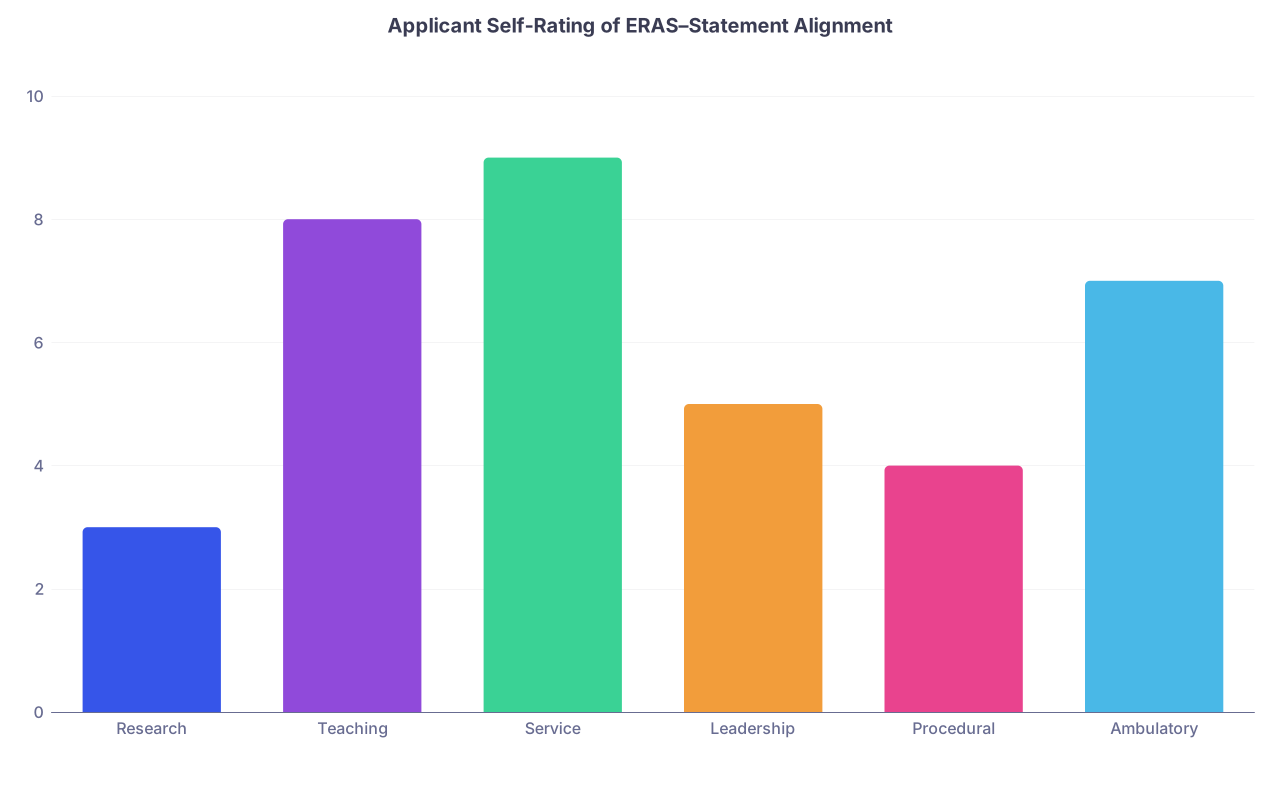
Use a simple scorecard to see where you stand before writing.
| Category | Value |
|---|---|
| Research | 3 |
| Teaching | 8 |
| Service | 9 |
| Leadership | 5 |
| Procedural | 4 |
| Ambulatory | 7 |
Pretend 0–10 is your strength in each area based on ERAS alone. Your main statement themes should come from the 7–10 zones, not the 2–3 zones.
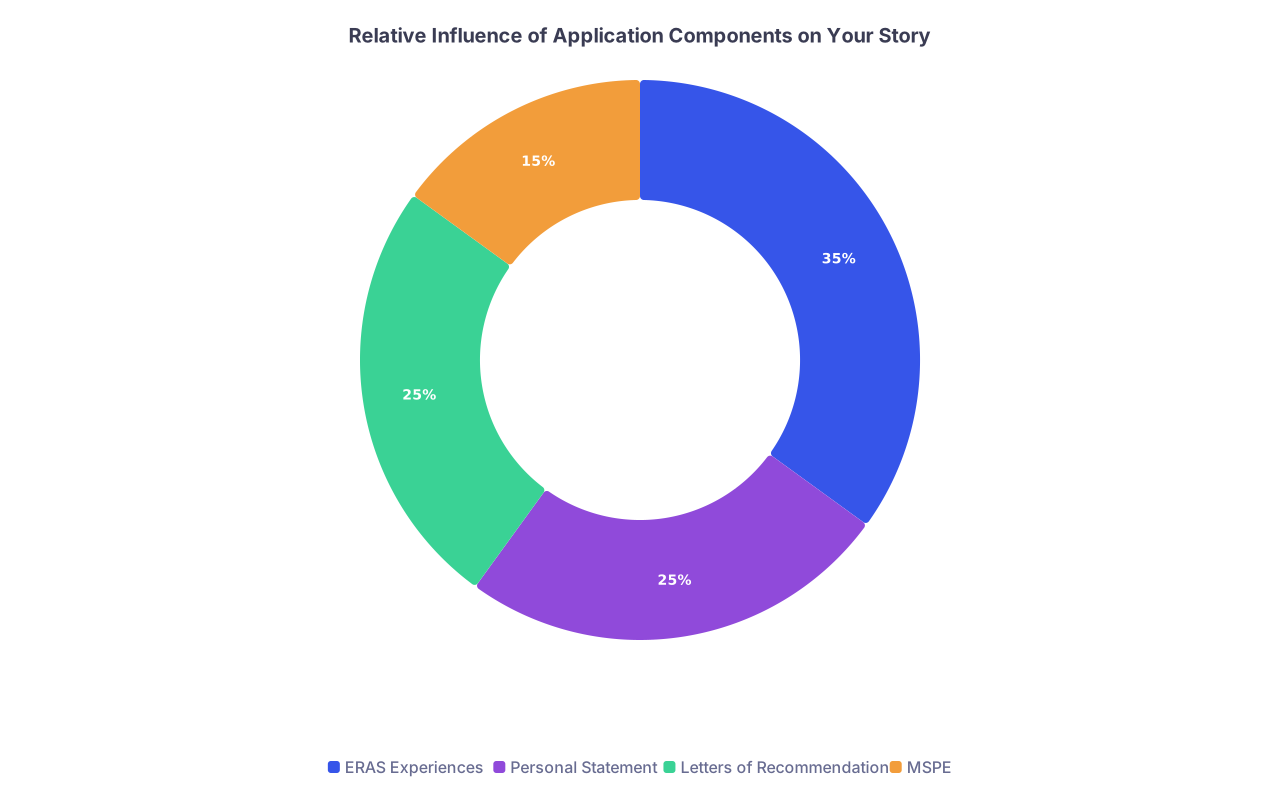
Final Visual: Application Components Reinforcing Each Other
| Category | Value |
|---|---|
| ERAS Experiences | 35 |
| Personal Statement | 25 |
| Letters of Recommendation | 25 |
| MSPE | 15 |
You control 60% of this story directly (ERAS + statement). Use it intelligently.
Key Takeaways
- Your personal statement must follow your ERAS experiences, not fight them. Every major claim should have visible support somewhere in your application.
- Choose 1–2 clear applicant identities and build your statement around the themes your ERAS already proves: longitudinal commitment, research, teaching, service, or acute care.
- Do a ruthless, line-by-line cross-check: if a sentence in your statement is not anchored to an ERAS entry, revise or delete it. Coherent, aligned applications are easier for programs to trust and to rank.
FAQ (Exactly 4 Questions)
1. Can I talk about something in my personal statement that is not listed as an ERAS experience?
Yes, if it is minor or more personal (family background, a single patient interaction, a brief early experience). However, anything you present as a major ongoing commitment or role should appear somewhere in ERAS. If it shaped your path significantly, find a way to list it (job, activity, award) or clearly frame it as a short, past event.
2. What if my true main interest (for example, research) is not well represented in my ERAS yet?
Then you should not market yourself as primarily research-focused. You can say you are “interested in developing research skills” or “excited to build on early exposure to research,” but your main identity should be grounded in what you have actually done so far. Programs trust demonstrated patterns more than stated intentions.
3. Should I write different personal statements for community vs academic programs to match their focus?
You can have slight variations, but your core identity must stay consistent. Do not pretend to be a future physician-scientist for academic programs and a pure clinician for community programs. Instead, adjust emphasis: the same “clinician-educator with underserved interest” can highlight teaching and scholarly QI for academic places and continuity and patient relationships for community-heavy programs.
4. How long should my personal statement be for ERAS, practically speaking?
Aim for around 650–750 words. Long enough to develop 2–3 experiences with depth, short enough that a busy reader will actually finish. Cutting fluff is often the best way to improve alignment, because it forces you to keep only claims that your ERAS can actually back up.