
It is late. You are on your third cup of coffee, ERAS is open, and your cursor is blinking in the middle of a half‑finished sentence:
“…during my leave of absence, I learned the importance of…”
And you hate it. It sounds defensive, vague, and a little desperate. You know you have to mention:
- A failed exam or a low Step score
- A LOA or extended graduation
- A professionalism write‑up
- A bad semester that everyone can see on your transcript
…but you have no idea how to put it into words without tanking your application.
You are in the exact space where most applicants with “red flags” get stuck. They either:
- Ignore the issue and hope programs will not care (they will)
- Over‑apologize and sound like a walking liability
- Or write something so generic it might as well be lorem ipsum
Let me show you a better way.
This is a practical, step‑by‑step template for turning red flags into credible, specific growth stories in your personal statement. Not fluff. Not spin. Just a clear framework that program directors have actually responded well to.
Step 1: Identify the Real Red Flag (Not Just the Symptom)
Before you write anything, you need precision. “My Step 1 is low” is not a red flag. It is a data point. Programs care about what it means.
The real questions in a PD’s head:
- Is this pattern going to repeat in residency?
- Will this person crumble when things get hard?
- Are they coachable or blame‑shifters?
So first: define your actual issue.
Common categories:
Academic performance
- Step 1/2 failure or low score
- Shelf or block failures
- Repeated courses or delayed graduation
Professionalism / conduct
- Formal professionalism concern
- Lapses in communication, attendance, or documentation
- Conflict with staff/faculty that was escalated
Personal / health‑related
- Medical leave of absence
- Mental health crisis
- Family emergency with impact on performance
Trajectory / commitment
- Multiple specialty changes late in training
- Large gap years with unclear activities
- Limited clinical exposure in chosen specialty
Write your primary red flag out in one sentence, like you are explaining it to a blunt senior resident:
- “I failed Step 1 on my first attempt.”
- “I took a one‑year leave of absence for depression.”
- “I received a professionalism citation for chronic lateness third year.”
That sentence is for you, not the final PS. It forces you to stop dodging and name the problem. Everything else will build around that.
Step 2: Decide If the Personal Statement Is the Right Place
Not every red flag belongs in your main personal statement paragraph.
Rough rules:
Must address in the PS (or dedicated essay if available):
- Step failures (especially if you passed on re‑take)
- LOA for any reason (it will raise questions if ignored)
- Major professionalism issues that are likely to be mentioned elsewhere
Better in MSPE / advisor / interviews, maybe NOT in PS:
- One bad block grade with no pattern
- Slight Step under the average but pass on first attempt
- Old minor issues clearly explained in MSPE already
Your PS is not your confession booth. It is a sales document with a section for risk management.
If your issue is obviously visible (LOA, failure, gap), you should address it. Briefly and surgically. If it is subtle and already contextualized elsewhere, you can focus the PS on your strengths and growth through other experiences.
Step 3: The 4‑Part Red Flag Paragraph Template
Here is the backbone you will use every time.
- Fact: Clear, brief description without drama
- Cause: Honest but non‑self‑pitying context
- Action: Concrete steps you took to fix it
- Outcome: Objective improvement + what changed in you
If you remember nothing else, remember this order: Fact → Cause → Action → Outcome.
You do not start by apologizing. You do not over‑explain. You state what happened, show that you understand why, then show what you did and how you are different now.
Let us build this out.
Step 4: Pick the Right Spot in the Personal Statement
Do not open your personal statement with your red flag. That is like starting an H&P with “I screwed up labs yesterday.”
Better placements:
Middle section after you have:
- Established motivation for the specialty
- Shown some strengths / clinical experiences
Late section, if:
- Your red flag is significant but already improving (e.g., early academic struggle, later strong performance)
- You want to end more on your current readiness than on the problem
One structure that works well:
- Opening: Why this specialty + key clinical moment
- Body 1: Strengths / experiences that fit the field
- Body 2: Red flag growth story (the template we are building)
- Closing: Who you are now + what you bring to residency
That way, the flag is part of your story, not the headline.
Step 5: Translate the Template into Real Words (By Scenario)
I will walk through common red flag scenarios and give you adaptable language.
A. Step Failure or Low Score
Programs want one thing here: evidence you have fixed the underlying problem and will pass boards.
1. Fact (1–2 sentences)
Keep it clean.
During my second year, I failed Step 1 on my first attempt.
No qualifiers. No “unfortunately” or “due to personal reasons” yet.
2. Cause (2–3 sentences)
You must show insight without sounding like a victim or an excuse‑machine.
Bad:
I had too much going on and the exam was unfairly weighted toward content I had not studied.
Good:
I underestimated the volume and depth of material and relied too heavily on passive review. I also struggled to balance question practice with content consolidation, and I did not seek help early when I saw my practice scores were lagging.
You are owning the process failure.
3. Action (3–4 sentences, very specific)
This is where most applicants get vague. Do not.
Include concrete changes:
- Study schedule
- Resources used
- Accountability / coaching
- Practice test data
Example:
After failing, I treated my retake as a full‑time job. I met weekly with our learning specialist to redesign my approach, switched to active recall strategies (Anki, teaching material to peers), and increased my question bank use from 20–30 to 80–100 questions daily with detailed review. I tracked my NBME scores on a shared plan with my advisor and adjusted weekly based on weak areas.
4. Outcome (2–3 sentences)
Use numbers if you have them. Then connect to residency.
On my second attempt I passed Step 1 comfortably, and the same habits helped me improve my performance on clerkship exams and Step 2. More importantly, I left the process with a realistic sense of my limits, a structured approach to large volumes of information, and the humility to ask for help early—habits I have already applied on the wards and will carry into residency.
Now put it together as a compact paragraph in the middle of your PS.
B. Leave of Absence (LOA) – Mental Health or Medical
Programs do not need your full psychiatric history. They need to know:
- You are stable now
- You built systems to stay that way
- You functioned well after returning
1. Fact
During my third year, I took a one‑year leave of absence to address a major depressive episode.
Clear. Direct. No euphemisms like “personal reasons” (those raise more suspicion than clarity).
2. Cause
Do not overshare, but acknowledge what led there.
By the end of my core clerkships, I was exhausted and isolated, and I ignored early signs of burnout and depression. I tried to “push through” without treatment until my functioning and reliability were affected.
3. Action
This is about treatment and structure, not suffering.
During my leave, I worked closely with a psychiatrist and therapist, started evidence‑based treatment, and rebuilt basic routines around sleep, exercise, and social support. With my dean and treating team, I developed a concrete plan for returning to school that included regular follow‑up, clear boundaries around work hours, and early communication if symptoms recurred.
4. Outcome
Tie it to specific performance after return.
Since returning from leave, I have completed my remaining clerkships and sub‑internships without interruption, while maintaining treatment and healthy routines. Faculty evaluations consistently mention reliability, steady mood, and strong teamwork. The experience forced me to become proactive about my mental health and communication, and it has made me more attuned to patients’ and colleagues’ vulnerabilities as well.
That answers the real PD question: “Is this going to blow up during intern year?”
C. Professionalism Concern (Lateness, Communication, Conflict)
These are uncomfortable. They are also fixable—if you show real behavioral change.
1. Fact
Early in my third year, I received a professionalism citation for repeated lateness to morning rounds.
Own it. No “alleged” or shade at the evaluator.
2. Cause
Name the behavior and your blind spot.
I was consistently cutting it too close with my commute and pre‑rounding, and I rationalized my behavior as “only a few minutes late.” I did not appreciate how this affected the team’s workflow and trust in me until it was formally addressed.
3. Action
Concrete behavior changes, not just “I reflected.”
After that feedback, I met with my clerkship director to outline expectations and created a morning routine that built in a 30‑minute buffer before rounds. I started arriving early enough to review charts and see patients before the team, and I asked senior residents to give me direct feedback if they saw any future concerns. I also began using a task list and shared sign‑out to improve my reliability with follow‑through.
4. Outcome
Point to a changed pattern.
I have had no further professionalism issues, and subsequent evaluations highlight punctuality and dependability. That early misstep forced me to recalibrate my standards to those of the team, not my own perception, and it made me more receptive to direct feedback—even when it is uncomfortable.
You are showing that you are not a chronic problem. You are a person who got feedback, fixed it, and improved.
D. Extended Time / Delayed Graduation Without LOA
This is often due to remediation, dual degrees, or personal responsibilities.
Your goal: show this is a deliberate trajectory, not drifting or chaos.
Example frame:
I completed medical school over five years rather than four. After struggling in my first year and remediating two courses, I worked with our academic support office to redesign my study schedule and ultimately chose to extend my pre‑clinical curriculum by one semester. The additional time allowed me to solidify foundational knowledge and ultimately perform well in my clinical clerkships, where I consistently scored at or above the class average on shelf exams. That experience taught me that adjusting my pace strategically can be a strength rather than a failure, as long as it is paired with honest self‑assessment and sustained effort.
Again—Fact → Cause → Action → Outcome.
Step 6: Show a Real Arc, Not a Single Defensive Paragraph
Your red flag paragraph is not an isolated island. It should fit into a broader narrative of growth.
Think in before / inflection point / after:
- Before: Who you were and how you approached work
- Inflection point: The red flag event and its consequences
- After: How your behaviors, mindset, and performance changed
You can build that arc subtly across the statement.
Example structure for someone with early academic failure then strong shelves and Step 2:
- Opening: A clinical moment showing you as engaged and thoughtful on the wards now
- Early paragraph: You mention that your initial academic transition was tough
- Middle paragraph: Red flag paragraph (Step failure, early struggles, what you changed)
- Later paragraph: Concrete examples of you performing well in sub‑I, managing complex patients, using your improved study and organization systems
- Closing: Emphasize readiness for residency with the habits you built through that process
Programs care less about the “crime” and more about the “trajectory.” You are showing that slope.
Step 7: The Template You Can Plug Your Story Into
Here is a generic skeleton you can literally paste into a document and fill in. Do not submit it as‑is (obviously), but use it as a scaffold.
[Context sentence to transition into the red flag]
“Early in medical school, my performance did not match my commitment to medicine.”
Fact (1–2 sentences)
“In my [year/semester], I [failed Step 1 / failed two pre‑clinical courses / took a leave of absence / received a professionalism citation for X].”
Cause (2–3 sentences)
“At the time, I [briefly state what you misunderstood/misjudged/handled poorly].
I relied too much on [ineffective habit], and I [missed/did not seek] [help/opportunities/feedback] when it would have made a difference.”
Action (3–4 sentences, very specific)
“After this, I [who did you meet with, what plans were made].
I changed my approach by [specific changes: scheduling, study strategies, communication habits, support systems].
I built in [accountability measure], and I monitored my progress by [practice exams, feedback meetings, check‑ins].”
Outcome (2–3 sentences)
“As a result, my [subsequent performance data: exams, clerkships, evaluations] improved to [specific indicators if possible].
More importantly, I gained [self‑knowledge, habits, mindset shifts] that now shape how I approach clinical work: [brief examples—asking for help, being proactive, structuring time, maintaining wellness].”
Transition back to strengths and current readiness (1–2 sentences)
“These experiences have made me a more [reliable / self‑aware / coachable / resilient] trainee, and they are central to why I feel prepared to take on the demands of residency.”
Step 8: What to Avoid (Stuff That Gets You Red‑Flagged Twice)
Some patterns send PDs running. Do not do these.
Blame‑shifting
- “The exam did not reflect what we were taught.”
- “The clerkship director had unrealistic expectations.”
You can mention structural factors, but if the main villain of your story is someone else, you look uncoachable.
Vague language
- “I went through some personal hardships.”
- “I was not in the right headspace.”
Translate vague hardship into concrete impact and action without full life story disclosure.
Over‑sharing sensitive details
- Graphic mental health content
- Family drama in technicolor
Stick to professional level of detail: diagnosis if relevant, treatment, functioning.
Over‑apologizing / self‑flagellation
- “I am deeply ashamed and disappointed in myself.” (Once, maybe.)
- A whole paragraph of guilt.
Acknowledge regret briefly. Then move to what you did.
No evidence of improvement
If your outcome section is empty, you need to think hard:- What has improved?
- Who can vouch for that?
- What systems are in place now?
If you truly have no performance uptick yet, lean heavily on process changes and external accountability (advisors, learning specialists, therapy).
Step 9: Calibrate Length and Emphasis
Rule of thumb:
For a moderate red flag (single Step failure, single LOA, early remediation with later strength):
- 1 tight paragraph, 150–220 words max.
For a major or multiple issues:
- 1–2 paragraphs total, but you still do not let it take over more than ~25–30% of the PS.
If you spend more time talking about your problems than your strengths, you are writing the wrong document. Let the MSPE and your dean’s letter carry some of that water.
Step 10: Cross‑Check with the Rest of Your Application
Your PS story must line up with:
- What your MSPE says
- What your transcript shows
- What your advisor / dean will say if called
Before finalizing:
Show your draft to someone who knows your record (advisor, trusted faculty) and ask:
- “Does this feel accurate?”
- “Is anything missing that programs will expect?”
- “Does anything here raise more questions than it answers?”
Make sure your outcome section mirrors your actual data:
- If you say “my performance improved significantly,” there should be stronger clerkship comments, shelves, or Step 2 to support that.
If there is a mismatch, programs will notice.
Step 11: Quick Rewrite Examples
Let me walk you through one “bad” version and a fixed version.
Original (typical) paragraph:
During my second year, I unfortunately failed Step 1. This was due to a variety of personal issues and the stress of the curriculum. However, I have learned a lot from this experience and have grown as a person and a student. I changed my study habits and worked harder, and I believe this has made me more resilient and determined to succeed in residency.
Problems:
- Vague cause (“variety of personal issues”)
- No concrete actions
- No data on outcome
- Overused clichés: “grown as a person,” “more resilient”
During my second year, I failed Step 1 on my first attempt. I underestimated the breadth of the exam and relied too heavily on passive review, watching videos and rereading notes instead of consistently working through questions. I also ignored early warning signs from my practice exams and did not seek help when I was struggling.
After failing, I met with our learning specialist and my advisor to rebuild my approach. I shifted to a schedule centered around 80–100 UWorld questions per day, daily spaced‑repetition review, and weekly NBME practice tests, which I tracked and analyzed with my advisor. I treated studying like a full‑time job, with specific goals for each block of time and scheduled breaks to avoid burnout. On my second attempt, I passed Step 1 comfortably, and I carried the same structure into my clerkships and Step 2, where my scores were consistently above the national mean. That experience forced me to become more honest about my weaknesses, more systematic in my work, and more willing to ask for guidance—habits that now shape how I prepare for patient care and for the demands of residency.
Same facts, completely different message.
Step 12: Final Polish – Tone Check
Read your red flag section once with these questions:
- Do I sound like I am making excuses?
- Do I sound like I am on trial?
- Would I hire this person based on this paragraph?
You are aiming for:
- Candid
- Self‑aware
- Specific
- Forward‑looking
If something still feels off, it is usually one of three problems:
- You did not give enough concrete action steps
- You did not give any objective sign of improvement
- You are either over‑ or under‑sharing cause details
Fix those, and you are usually in good shape.
A Simple Visual: How Much of My PS Should Be About Red Flags?
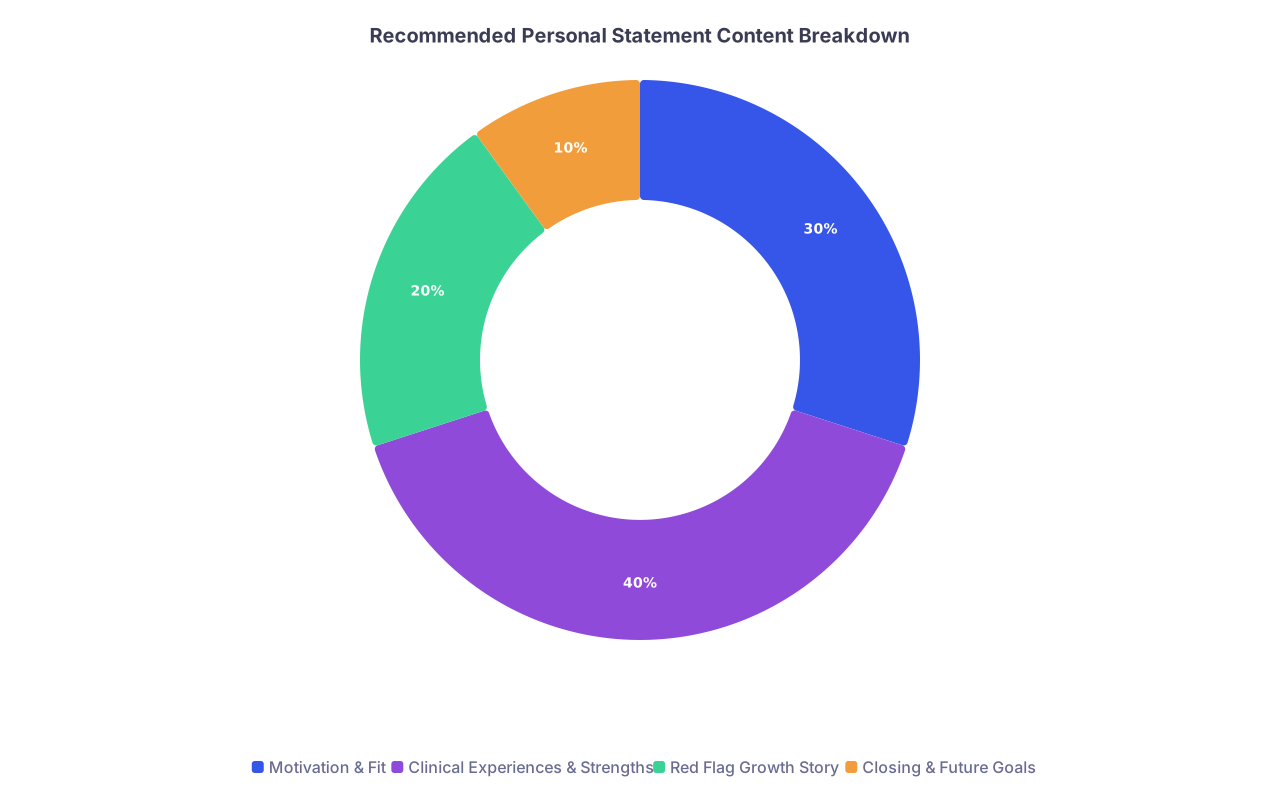
| Category | Value |
|---|---|
| Motivation & Fit | 30 |
| Clinical Experiences & Strengths | 40 |
| Red Flag Growth Story | 20 |
| Closing & Future Goals | 10 |
Aim to keep the red flag portion to roughly 15–25% of the total length. Enough to be accountable. Not enough to define you.
Example Overall Flow with a Red Flag Inserted
Here is a skeleton outline you can adapt:
Paragraph 1 – Hook + Motivation
Brief clinical story or experience that explains why this specialty.Paragraph 2 – Strengths/Skills Aligned with Specialty
Specific rotations, projects, or roles that show you functioning well.Paragraph 3 – Red Flag Growth Story
Use the Fact → Cause → Action → Outcome template.Paragraph 4 – Who You Are Now
Bring it back to present: your current strengths, habits, and what colleagues say about you.Paragraph 5 – Conclusion
What you are looking for in a program, and what you will bring as a resident.
That is it. Simple, clean, and not dominated by your worst moment.
Two Things to Do Tonight
Do not just read this and nod. Do these two concrete tasks:
Write your blunt one‑sentence red flag statement on a separate page.
No spin. Just: “I failed X,” “I took a LOA for Y,” “I had a professionalism concern about Z.”Draft a 4‑part paragraph following:
Fact → Cause → Action → Outcome.
Aim for 180–220 words. Then cut anything that is apology or vague description and replace it with one concrete behavior you changed.
If you do that honestly, you will already be ahead of most applicants with similar issues.
Key Takeaways
- Do not dodge your red flag. Name it briefly, own your part, and show exactly how you changed your behavior and performance afterward.
- Use a tight structure: Fact → Cause → Action → Outcome, and keep the red flag section to about 15–25% of your personal statement.
- Your goal is not to prove you are perfect now. Your goal is to prove you are coachable, improving, and safe to invest a residency spot in.