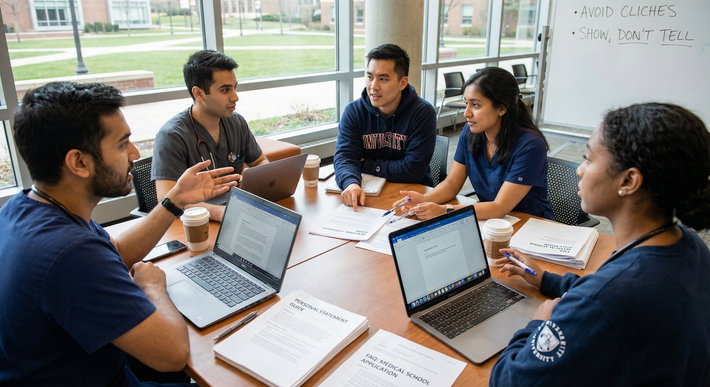
Your personal statement is not “bad.” It is unfocused. That is fixable in one brutally honest, structured session.
Most residency applicants are not suffering from lack of content. They are drowning in it. Random childhood stories. Every volunteer gig. That one shadowing experience from M1 you keep forcing in because it “sounds medical.” The result: a wandering essay with no clear spine.
Let me be blunt: program directors do not have time to decode your life story. If your personal statement is confusing, they will not assume you are deep. They will assume you are disorganized.
The good news? You do not need to rewrite the whole thing from scratch. You need to rebuild the structure and enforce a through-line. One focused 90–120 minute session can take you from messy to coherent if you follow a strict process.
Below is that process.
Step 0: Time-Box the Fixing Session (15 Minutes Setup)
You will not fix this by “tweaking it when you have time.” You need one deliberate block.
Do this:
- Block 2 hours where you will not be interrupted.
- Print your current draft (yes, on paper). If you cannot print, convert to PDF and use annotation tools, but paper is better.
- Get 3 pens or highlighters in different colors.
- Turn off distractions
- Phone in another room
- Browser tabs closed except your document
- No email, no social media
Your only job in this block: fix structure and focus. Not grammar. Not word-smithing. Structure.
Step 1: Diagnose the Problem with a Brutal Read-Through (15–20 Minutes)
Sit down with your printed draft.
Read it once, start to finish, out loud and at normal speed.
As you read, notice when you feel:
- Confused about why you are reading this story
- Bored and tempted to skim your own writing
- Unsure where the paragraph is going
- Unsure what specialty you are applying to (yes, this happens)
Then do this:
- Write a one-sentence diagnosis at the top of the first page
Examples I have seen:- “I am telling everything and committing to nothing.”
- “Stories are fine but do not connect to why I want IM.”
- “Too much ‘I love helping people’ and not enough specific experiences.”
- Circle any sentence that sounds like it could be in ANY applicant’s essay
Sentences like:- “I have always wanted to help people.”
- “Medicine is both an art and a science.”
- “During medical school I have had many clinical experiences.”
If a generic applicant could plausibly write it, circle it. These are weak anchor points.
- Mark the exact point where you would stop reading if you were a time-pressed PD
Draw a big line or “X” in the margin. That is where your structure starts to fail.
You are not fixing yet. You are just honestly marking the damage.
Step 2: Extract Your Core Spine: One Sentence, Four Pillars (15–20 Minutes)
Disorganized personal statements almost always lack a spine. A single clear idea the whole essay is actually about.
You are going to build one.
2.1 Define Your Spine in One Sentence
On a clean sheet of paper, answer this, in one specific sentence:
“I am applying to [SPECIALTY] because [CORE REASON], and I want programs to remember me as the applicant who [DISTINCTIVE QUALITIES / FOCUS].”
Examples:
- “I am applying to Internal Medicine because I like long-term, complex problem-solving with medically vulnerable patients, and I want programs to remember me as the applicant who builds systems to make care safer and more reliable.”
- “I am applying to Emergency Medicine because I thrive in acute, high-stakes situations and decisive team environments, and I want programs to remember me as the calm, prepared resident who runs toward the chaos.”
- “I am applying to Psychiatry because I am drawn to complex narratives and the intersection of biology and lived experience, and I want programs to remember me as the clinician who listens deeply and advocates fiercely.”
If you cannot write this sentence clearly, your personal statement will keep being fuzzy no matter how much you “edit.”
2.2 Define 3–4 Pillars That Support That Spine
Now list 3–4 concrete themes that prove this spine is true about you. Each one will likely become a paragraph.
Examples of strong pillars:
- A specific clinical pattern: “I am drawn to complex, undifferentiated patients.”
- A consistent behavior: “I build systems and improve processes wherever I work.”
- A personal trait with evidence: “I stay calm and organized under pressure.”
- A career direction: “I want to care for underserved, Spanish-speaking populations.”
Bad pillars: vague traits with no teeth.
- “I am hardworking.”
- “I care a lot.”
- “I am passionate about medicine.”
Write down your 3–4 pillars in bullet form, under your spine sentence.
Your essay will now be rebuilt around these.
Step 3: Sort Your Existing Content into Keep / Cut / Salvage (20–25 Minutes)
Now you are going to triage your current essay.
You have your printed draft and your 3 different pens / highlighters. Assign:
- Color 1: DIRECTLY supports a pillar
- Color 2: Indirectly related / could be reframed to support a pillar
- Color 3: Does not support any pillar
Then go through paragraph by paragraph.
For each sentence or small chunk:
Mark with Color 1 if it:
- Clearly shows you acting in a way that fits your spine or pillars
- Provides a memorable, specific example
- Adds concrete detail that makes your story different from others
Mark with Color 2 if it:
- Might be useful but is currently vague
- Could connect to a pillar if reframed
- Has a good idea buried in bad phrasing
Mark with Color 3 if it:
- Could be written by 500 other applicants
- Is background detail no one needs (like childhood illnesses unless truly central)
- Repeats something you already said in different words
Then, draw a big “CUT” in the margin next to any paragraph that is mostly Color 3. Do not hesitate. Padding is not your friend.
You are not editing sentences. You are deciding what survives.
Step 4: Choose and Lock a Simple, Proven Structure (10 Minutes)
Complex structures are how people hide weak thinking. You are going to use a simple, boring structure that works.
For 95% of residency applicants, this 5-part structure is enough:
Hook + Spine (1 short paragraph)
- Specific, recent moment or mini-scene that quickly reveals something about how you think or work
- Ends with a clear sentence pointing toward your spine
Pillar 1 Paragraph – strongest, most defining theme
Pillar 2 Paragraph – complementary strength / pattern
Pillar 3 Paragraph – future direction, career goals, or additional key trait
Conclusion Paragraph – tie back to spine + what you bring to residency
Optional: For people with heavy research, leadership, or non-traditional paths, you might split one pillar into two shorter paragraphs.
The main rule: each paragraph gets ONE job. If your third paragraph is somehow about an M1 anatomy lab memory, a mission trip, and your grandmother’s illness, that is three jobs. And that is why it reads chaotic.
Step 5: Rebuild the Essay from the Spine Up (30–40 Minutes)
You are not “editing” now. You are rewriting with controlled recycling.
Put away your old draft file. Open a new blank document. Keep your printed, color-marked draft next to you.
5.1 Write the New Introduction (5–10 Minutes)
Aim for 4–6 sentences. Do this in order:
Start with a concrete moment, not a life story.
- A night on call when you realized you liked the thinking of internal medicine.
- A critical ED resuscitation where you noticed you felt more focused than anxious.
- A psychiatry interview where you realized you were more interested in the patient’s story than lab values.
Use one or two specific details (not drama for drama’s sake). Show, do not over-tell.
Transition in 1–2 sentences from that moment to your spine:
- “That night crystallized what I had been sensing throughout third year: I am most engaged when…”
- Then your spine sentence (from Step 2.1), trimmed for flow.
Your goal: A program director can answer “Why this specialty?” and “Who are you as a learner?” from your first paragraph.
5.2 Draft Each Pillar Paragraph with a Mini-Pattern (20–25 Minutes)
For each pillar, follow a simple internal structure:
Topic sentence – one clear claim about you
“I am most energized by caring for medically complex patients whose problems are not yet defined.”Specific example – 3–6 sentences that prove that claim
- Brief context (rotation, setting)
- One patient or one situation
- What you did, what you thought, what you learned
Interpretation sentence – connect example to specialty
“Working through that case confirmed how much I enjoy the iterative, hypothesis-driven thinking that is central to internal medicine.”
Then repeat for Pillar 2 and Pillar 3.
Use your Color 1 and Color 2 content from the printed draft as raw material:
- Look at each highlighted section and ask: which pillar does this actually support?
- Copy only the sentences that earn their spot.
- Rewrite them for clarity while you paste. Do not be too precious about preserving exact wording.
Important: One patient per paragraph is usually enough. Do not cram three mini-stories into 8 lines. Shallow and scattered reads worse than one deeper, clear story.
5.3 Write the Conclusion Without Repeating Everything (5–10 Minutes)
Your conclusion is not a summary of what you already said. It is your chance to:
- Name what kind of resident you will be.
- Show self-awareness and direction.
- Tie back to the opening tone or image.
Concrete formula you can follow:
One sentence: Zoom out
“Across my clinical years, certain patterns have become clear.”2–3 sentences: Name your spine + pillars in new words
- “I am drawn to…”
- “I work best when…”
- “I bring a consistent focus on…”
1–2 sentences: Future-looking
- Type of training you seek (teaching hospital, diverse patient population, strong mentorship, etc.).
- What you hope to contribute: “I hope to bring [X traits] to a program that [Y environment].”
Optional: 1 callback to the opening, if it feels natural
- Not cheesy, not forced. Just a subtle echo.
Avoid:
- Thanking them for their time (wasted words).
- Naming specific programs (you will use this across many applications).
- Over-the-top flattery of “your esteemed program” in the statement itself.
Step 6: Run the “One-Sentence-Per-Paragraph” Test (10–15 Minutes)
Now you have a rebuilt draft. Time to ensure it is actually organized.
For each paragraph, on a separate sheet, write ONE sentence:
- “This paragraph shows that I… [clear, specific claim].”
If you cannot write one clean sentence per paragraph, the paragraph is doing too much.
Examples:
- Intro: “This paragraph shows how a specific clinical moment revealed what kind of work energizes me and sets up why I chose pediatrics.”
- Body 1: “This paragraph shows that I thrive in longitudinal relationships with families and enjoy coordinating complex care.”
- Body 2: “This paragraph shows my tendency to build and improve systems around me, through QI and leadership roles.”
- Body 3: “This paragraph shows my commitment to working with underserved populations and using my Spanish skills in clinical care.”
- Conclusion: “This paragraph shows the kind of resident I aim to be and what I hope to contribute to a program.”
If one paragraph generates two or three different sentences, split or cut until it has one job.
Step 7: Eliminate the Generic Filler (10–15 Minutes)
Now you can do a content-level cleanup. You are hunting for fluff.
Search for and axe:
-
- “I have always known…”
- “Since I was a child…” (unless you are talking about something extremely specific and relevant, not just “my grandmother was sick”)
- “Medicine is my calling.”
- “The art and science of medicine…”
Redundant qualifiers
Too many: “very,” “extremely,” “incredibly,” “truly.”
Replace:- “I am very passionate about…” → “I am committed to…” + example.
- “I was extremely grateful to…” → Often unnecessary.
Empty reflections
- “This experience taught me a lot.”
- “This was an invaluable lesson.”
Replace with: what exactly changed in how you think or act?
CV repeats
If a sentence is literally duplicating line items they will see in ERAS, either:- Make it about what you learned / how you behaved, or
- Cut it and gain space for depth elsewhere.
You are aiming for specific, concrete, lean.
Step 8: Alignment Check with Your Application as a Whole (5–10 Minutes)
A “fixed” personal statement that fights with the rest of your application is still a problem.
Do a quick alignment check:
Compare with ERAS experiences section
- Do your highlighted experiences in the statement line up with the most significant entries on your CV?
- Or are you over-focusing on something minor because you like the story?
Compare with letters of recommendation (if you know their themes)
- If your strongest letter is from your Sub-I in IM, mentioning your complex patient care, lean into that theme.
- You want reinforcement, not fragmentation.
Check for specialty clarity
- Does the essay leave any ambiguity about what specialty you are applying to?
- If yes, fix that. Fast.
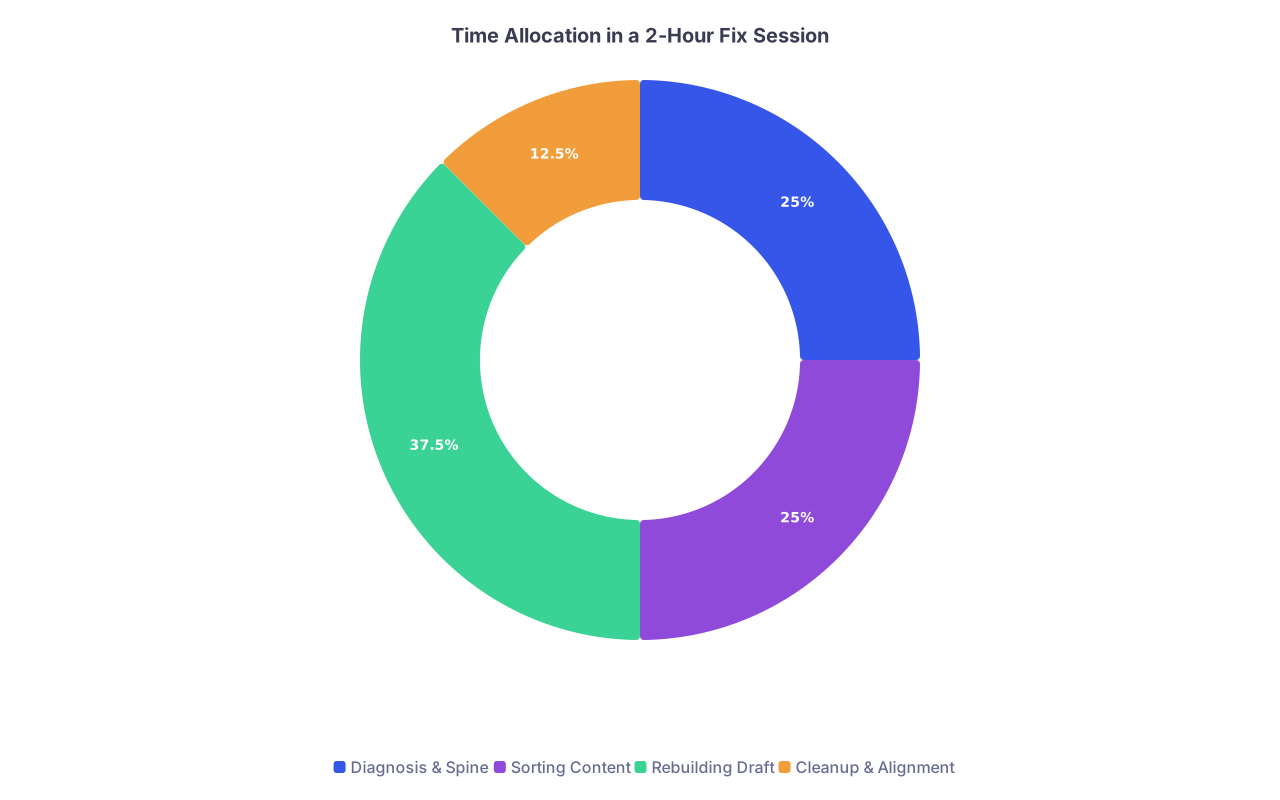
| Category | Value |
|---|---|
| Diagnosis & Spine | 30 |
| Sorting Content | 30 |
| Rebuilding Draft | 45 |
| Cleanup & Alignment | 15 |
If everything points roughly in the same direction—good. If your statement reads like “global health warrior” and your entire CV is bench research and zero underserved work, that mismatch will raise eyebrows. Either adjust your story or your emphasis.
Step 9: One Pass for Clarity, Not Perfection (10–15 Minutes)
Last step in this focused session: a single clarity pass. Not obsessive polishing.
Read it again out loud, slowly. Look for:
- Sentences where you run out of breath → split them.
- Pronouns with unclear references: “This was important…” (what is “this”?).
- Awkward or tangled phrases you stumble over as you read.
Tweaks to make:
- Prefer clear, direct verbs over fancy wording.
“I led a QI project” beats “I was able to take part in leading…” - Make subject and verb show up early in the sentence.
- Ensure every “this/that/it” refers clearly back to something concrete.
Stop yourself from endless tinkering. You want “clear and organized,” not “poetic masterpiece.”
Later, you can do a separate micro-edit session or have someone you trust look only for grammar and typos. Not now.
Example: Before vs. After Structure
To make this tangible, here is how a chaotic draft usually looks versus a fixed version.
| Section | Before (Common Problem) | After (Fixed Structure) |
|---|---|---|
| Intro | Vague childhood story, generic phrases | One concrete clinical moment + clear spine |
| Body 1 | Mix of shadowing, volunteering, research | One pillar + one focused example |
| Body 2 | Random memorable patient anecdote | Second pillar + clear reflection |
| Body 3 | Mission trip + family illness | Third pillar + future direction |
| Conclusion | Summary + thank you + clichés | Who you will be as a resident + tie-back |
You do not need new content to move from Before to After. You need discipline.
A Quick Visual: What You Are Actually Doing

| Step | Description |
|---|---|
| Step 1 | Print Current Draft |
| Step 2 | Diagnose Problems |
| Step 3 | Define Spine & Pillars |
| Step 4 | Highlight Keep/Cut/Salvage |
| Step 5 | Rebuild Using Simple Structure |
| Step 6 | Remove Generic Filler |
| Step 7 | Check Alignment with ERAS |
| Step 8 | Clarity Read-Through |
That is your one-session repair protocol.
FAQ (Exactly 4 Questions)
1. How long should my residency personal statement be after I clean it up?
Aim for 650–800 words for most specialties. Shorter and you risk sounding superficial. Longer and you are probably repeating yourself or padding with fluff. If you are at 1,000+ words, you almost certainly have structural or focus problems. After this process, most strong statements naturally fall in the 700–800 range.
2. Can I use the same personal statement for all programs in the same specialty?
Yes, and you should. Write one strong, specialty-specific core statement. Do not waste time writing 40 slightly different versions. If you must customize, keep it to:
- A single sentence in the conclusion referencing program type (not specific names).
- A separate short “program fit” paragraph you paste into text boxes when programs ask for it.
But your main uploaded statement should be stable and polished.
3. What if I am changing specialties or have a red flag? How does that fit this structure?
You still use the same structure, but you make one pillar explicitly address the concern:
- If changing specialties:
One body paragraph should explain the shift briefly, without drama, focusing on what you learned and why the new field is a better match for how you actually work and think now. - If you have a red flag (failed Step, leave of absence, etc.):
If you are not addressing it in the ERAS “Additional Information” section, you can briefly, factually address it in one paragraph. Own it, explain what changed, and move on. Do not center the entire essay on your worst moment.
4. Who should read my fixed personal statement before I submit?
Choose 1–3 people max, not a committee. Ideal readers:
- One person in your specialty (resident or attending) who can say, “This sounds like someone I would want on my team.”
- One person who knows you well enough to say, “This actually sounds like you,” not a generic applicant.
- If available, a career advisor who has read hundreds of statements.
Tell them specifically:
“I am not asking you to rewrite this. I want to know:
- What 2–3 traits do you remember about me after reading?
- Is anything confusing or unbelievable?”
Then fix only the issues that clearly align with your spine and pillars. Ignore cosmetic comments that dilute your voice.
Key Takeaways
- Your personal statement is not a mystery novel. One clear spine and 3–4 supporting pillars beat a wandering life story every time.
- You can fix a disorganized draft in one focused session by: diagnosing honestly, defining your spine, triaging content, and rebuilding with a simple structure.
- Stop polishing vague paragraphs. Cut, focus, and rebuild around specific, defensible claims about who you are and how you will function as a resident.