
The way most people rewrite their personal statement after going unmatched is a disaster.
They either pretend it never happened (programs see your ERAS history, you’re not fooling anyone) or they trauma-dump about the SOAP like it’s a diary entry. Both approaches get quietly screened out.
If you’re coming off a SOAP or an unmatched cycle, you’re in a specific, high‑risk situation. Your personal statement cannot be “pretty good.” It has one job now:
Convince a skeptical PD that you’ve learned from last cycle, fixed concrete problems, and are now a safe, high-yield bet.
Here’s how to actually do that.
Step 1: Accept the Reality You’re Writing Into
You’re not a blank-slate applicant anymore. Programs will read you differently. Assume this is what they’re thinking before they even open your file:
- Why were they unmatched/SOAPed?
- What have they done since then?
- Are they going to leave my program early, fail boards, or be a professionalism problem?
- Are they applying to me as a backup or because they actually want my specialty?
Your personal statement has to answer those questions implicitly, and sometimes explicitly.
Do not get stuck in the “it wasn’t fair” loop in your writing. Fair or not, the game is what it is. You can either write to that reality or keep repeating the same year.
Step 2: Decide Your Narrative Frame Up Front
Before you type a single sentence, you need to choose the core story you’re telling this cycle.
You have 3 main narrative frames that work well post-unmatch:
“Growth and course-correction”
You misjudged something (specialty choice, applications strategy, timing, exam, geography), learned from it, and have now realigned and strengthened your candidacy.“Delayed match, stronger candidate”
You were already close, didn’t match, and spent the interim year building concrete strengths in the same direction (research, prelim year, observerships, dedicated clinical work).“Clarified commitment to this specialty”
Maybe you SOAPed into something else or did a research/clinical gap year and realized, with data, that this specialty is actually the right fit—and you can prove it.
Pick one. Write the whole statement through that lens. If you try to do all three equally, the essay feels vague and defensive.
Step 3: Understand When (and How) to Mention the Unmatched/SOAP
This is where people blow it.
You have three broad options:
- Address it briefly in the personal statement
- Address it in the ERAS “Education/Training Interruption” or additional comments section
- Let your LORs and MSPE/Dean’s letter contextualize it
If:
- You’ve got a visible gap year
- You did a prelim/transitional year
- You SOAPed into another field and are switching
…then you almost always need a short, direct explanation in the personal statement. Otherwise the disconnect between your timeline and your essay feels evasive.
How to do it right:
- Keep it short (2–5 sentences)
- Neutral tone, no blame, no drama
- Immediately pivot to what you did about it
Example for an unmatched cycle with a research year:
I applied to Internal Medicine last cycle and did not secure a position. Looking back, my application was limited by a late Step 2 CK score and relatively little longitudinal clinical experience in Internal Medicine. Over the past year, I have worked as a full-time research fellow in the [X] cardiology lab at [Institution], completed [Y] months of hospitalist service as a clinical assistant, and strengthened my clinical foundation and scholarship in the field. This experience has confirmed my commitment to Internal Medicine and better prepared me to contribute as an intern from day one.
That’s it. No long emotional paragraphs about Match Day. You’re showing insight, responsibility, and forward motion.
Step 4: Build a Spine for the New Statement (Not Just Add a Paragraph About the SOAP)
You’re not “editing” last year’s statement. You’re rebuilding around a different center of gravity.
Use this structure as your default:
- Hook: Present-day you, in action in this specialty
- Commitment: Why this specialty (now, more maturely articulated)
- Evidence: What you’ve done this year that makes you stronger and safer
- Address the SOAP/unmatched briefly (if needed) and how you responded
- Fit: What kind of resident you’d be and what you bring to a program
- Forward: What you’re working toward in this specialty (realistic goals)
Do not start with “Ever since I was a child…” You don’t have the luxury of a soft open anymore. You need to look like someone already functioning in adult medicine.
Example of a strong, post-unmatch opening for IM:
At 6:45 a.m., I was the one at the whiteboard, leading sign-out rounds for our hospitalist service. As an IM research fellow working closely with the inpatient team this year, I am responsible for tracking overnight events, clarifying outstanding tasks, and anticipating what our attendings will need on pre-rounds. It is not a formal residency role, but it has shown me exactly how Internal Medicine teams function and the pace and precision required to support them.
No mention of the unmatch yet. You start by showing that you’re already in the work.
Step 5: Turn the “Red Flag” into a Competence Story
Programs care less about the fact you went unmatched and more about what that implies:
- Do you crumble under stress?
- Do you blame others?
- Do you repeat mistakes?
- Do you stagnate?
Your statement needs to send the opposite signal.
Use a simple three-part move:
- Name the issue plainly
- Name your responsibility in it
- Show concrete corrective action + result
Example for someone who SOAPed into a prelim surgery spot but is reapplying categorical:
I initially applied directly to categorical General Surgery positions and matched into a one-year preliminary position through the SOAP. In retrospect, I overestimated the strength of my application relative to the competitiveness of the programs on my list and did not cast a sufficiently broad net. During this preliminary year, I have deliberately focused on becoming technically reliable in the OR, efficient and accurate with floor task management, and someone my seniors can trust on call. The feedback from my attendings and my consistent high marks in professionalism and work ethic reassure me that I can contribute positively as a categorical resident.
You’re not just “explaining.” You’re demonstrating growth in the exact dimensions PDs actually care about.
Step 6: Show What You’ve Done With the Extra Time (This Is Where Most People Are Too Vague)
If you had extra months or a full year, you must show that you did something focused and relevant with it. “I did some research and some shadowing” reads as noise.
Break it down into 2–3 specific lanes, max, that directly support your candidacy:
- Clinical work (hospitalist assistant, prelim year, observerships, outpatient clinic work)
- Research/academic productivity (posters, papers, QI projects)
- Exam remediation (if a prior failure/low score was an issue)
- Professionalism and responsibility roles (teaching, coordinating, leadership)
Then be specific. Not: “I worked on several projects.” Instead:
Over the past year, I have:
- Completed 8 months as a full-time clinical research coordinator in the heart failure clinic, where I independently consented patients, coordinated study visits, and presented cases during team huddles.
- Co-authored one accepted manuscript on readmission risk in HFpEF and presented a poster at the [Conference].
- Logged over 400 hours of direct patient contact in an Internal Medicine setting, reinforcing my comfort with complex chronic disease management.
You don’t need actual bullets in the statement, but you need that level of concreteness.
Step 7: If You’re Switching Specialties Post-SOAP, Tread Carefully
Switching specialties after SOAP or a prelim year is a minefield. Programs are asking:
“Are they going to leave us the second they get something ‘better’?”
Your writing must answer: No. I am here on purpose, not by default.
Avoid:
- Trashing the specialty you SOAPed into (“I realized surgery wasn’t for me because the lifestyle was too demanding” – red flag)
- Sounding like you chase prestige or pay
- Vague “I always liked both” narratives with no real proof
Instead, use:
- A concrete trigger for reconsideration (real experience)
- A period of honest uncertainty and data-gathering
- A clear, evidence-based commitment to the new specialty
Example: SOAPed prelim surgery → now applying IM
During my preliminary year in General Surgery, I found myself increasingly drawn to the pre- and post-operative medicine on our service. I looked forward to managing our complex ICU patients, adjusting vasopressors, and discussing long-term management of cirrhosis and diabetes with consultants and families. I began seeking out dedicated time with our hospitalist teams, pre-rounding with them on post-op patients and assisting with admissions to better understand their workflow. Over the year, I recognized that the cognitive breadth and longitudinal relationships in Internal Medicine aligned more closely with the kind of physician I want to be. This was not an impulsive decision; it grew out of a full year of working at the intersection of surgery and medicine and honestly assessing where I added the most value.
You show you tried, you learned, and now you’re choosing intentionally.
Step 8: Rewrite Your “Why This Specialty” With More Maturity
Your old “why X specialty” section is probably too fluffy. After an unmatched cycle, fluff looks worse.
Move from generic:
- “I love working with children.”
- “Surgery combines my love for anatomy and working with my hands.”
- “Psychiatry allows me to connect deeply with patients.”
To operational:
- What parts of the day do you actually enjoy?
- What kinds of patient problems do you find satisfying?
- Where have attendings/residents actually said, “You’re good at this”?
Example for EM after a SOAP gap year doing ED scribe work:
Working as a full-time scribe in a busy community ED this year has clarified why I am committed to Emergency Medicine. I like being the person who takes the first pass at an undifferentiated problem, nursing a rough story into a structured HPI, then narrowing an overwhelming list of possibilities into a focused, testable differential. I enjoy the high-stakes, time-limited conversations: explaining tPA to a stroke patient’s family at 2 a.m., or negotiating realistic discharge plans with patients who do not have stable housing. My attendings have consistently pushed me to think one step ahead—anticipating orders, serial exams, and dispositions—and that forward-leaning mindset fits how I naturally move through a shift.
That’s the kind of specificity that reads as “this person actually knows what the job is.”
Step 9: Protect Yourself From Two Big Tone Mistakes
There are two tones that kill post-unmatch statements:
The victim narrative
Signs: “Due to unfortunate circumstances…”, lots of passive voice, long descriptions of external factors.
Programs read: “Will be exhausting to work with, will blame us if they struggle.”The overcompensation humblebrag
Signs: “I have grown tremendously,” “I am now fully confident I will be an excellent resident,” with no specifics.
Programs read: “Still doesn’t get it. All talk.”
Aim for:
- Understated confidence
- Concrete examples instead of adjectives
- Brief honest acknowledgment of pain, followed by action
One sentence like this is fine:
Not matching was painful and humbling, but it forced me to confront the weaknesses in my application and address them directly.
Then show, don’t linger.
Step 10: Tailor Without Sounding Desperate
You’re probably applying broadly. You do not have time for 80 custom statements, and you don’t need them.
What you do need:
- One core statement per specialty that’s coherent and honest
- Optional micro-tweaks for a small number of high-priority programs (regional ties, true fit)
If you tweak:
- Do not copy-paste program names and features like a brochure.
- Anchor on one real connection: geography, prior rotation, faculty you’ve actually met, type of patient population.
Example of a light program-specific tweak:
Having grown up in [Region] and completed my preliminary year at a similar safety-net hospital, I am especially drawn to programs like yours that serve a high proportion of uninsured and underinsured patients.
Thirty seconds to change the region/program type, and you’re done.
Step 11: Align Your Statement With The Rest of Your Application
Another common post-unmatch flaw: the statement is on one planet, the rest of ERAS on another.
Quick checklist before you submit:
- Does your explanation for the gap/year/SOAP in the statement match the “Education Interruption” or CV entries?
- If you mention specific roles or projects, do they appear in Work/Research/Volunteer sections with consistent dates?
- Are your LOR writers aware of your narrative (growth/resilience/specialty switch) so they can echo it?
- If there was a major academic or professionalism issue, is your tone consistent across PS, MSPE addendum, and advisor statements?
Inconsistency reads as evasiveness. Even if it’s just sloppiness, PDs won’t bother to parse it.
Step 12: A Concrete Before-and-After Example
Let me give you a stripped-down comparison. Same applicant: IMG, SOAPed unmatched, did a research year, reapplying IM.
Weak paragraph:
After unfortunately going unmatched in the 2024 cycle, I felt very disappointed. However, I remained determined. I decided to do research and observerships in Internal Medicine to strengthen my application. Through these experiences, I have grown a lot and learned more about the field. I am now more confident than ever that Internal Medicine is the right specialty for me.
Stronger revision:
I did not match in the 2024 cycle. In reviewing my application with my advisors, it was clear that applying late with no U.S. clinical experience and limited recent letters made my candidacy less competitive, especially as an IMG. Over the past year, I have worked as a full-time research fellow in the [X] lab at [Institution], completed three months of hands-on inpatient observerships on hospitalist and cardiology services, and obtained strong letters from U.S.-trained internists who have seen me present, write notes, and follow patients over time. These experiences have not only strengthened my application on paper, they have confirmed that I am most energized when managing complex chronic illnesses and coordinating care across disciplines, which is why I am committed to training in Internal Medicine.
Same facts. Very different signal.
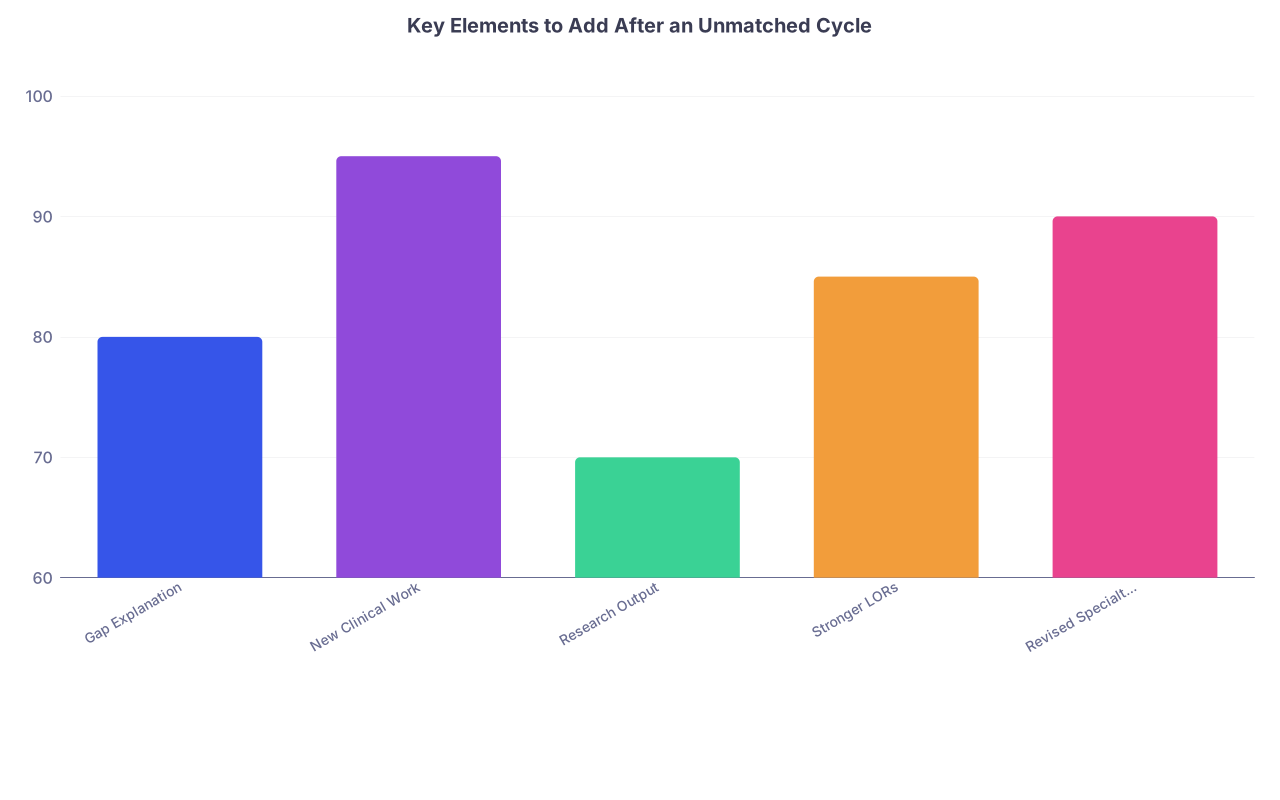
| Category | Value |
|---|---|
| Gap Explanation | 80 |
| New Clinical Work | 95 |
| Research Output | 70 |
| Stronger LORs | 85 |
| Revised Specialty Rationale | 90 |

Quick Troubleshooting: Common Scenarios
1. “I SOAPed into a prelim year and am reapplying categorical to the same specialty”
Your goals:
- Show you used the prelim year to prove you can do the job
- Show you’re not a discipline or remediation problem
- Explain briefly why you’re not staying where you are (if applicable)
You want lines like:
As a preliminary surgery resident, I have independently managed floor patients, taken night call, and assisted in a wide range of procedures from laparoscopic cholecystectomies to emergent laparotomies. My end-of-rotation evaluations consistently highlight my reliability, work ethic, and ability to function at the level of my peers.
And if you’re not staying:
My current program does not have an available categorical position for next year, so I am seeking a categorical General Surgery position where I can continue to grow with the same intensity and commitment I have demonstrated this year.
2. “I went totally unmatched (even in SOAP) and have a non-clinical year”
You have to squeeze everything you can out of what you did:
- Teaching → emphasize communication, organization, accountability
- Non-clinical job → emphasize professionalism, reliability, systems thinking
- Self-study → be specific: questions completed, score improvements, practice exams
You cannot just say “I used the time to study and reflect.”
Example:
While working full-time as a high school science teacher this year, I have been responsible for 150 students across five classes, requiring detailed planning, clear communication, and consistent follow-through. In parallel, I completed over 3,000 Step 2-style questions and raised my practice scores from the low 220s to the mid-240s, which was reflected in my eventual Step 2 CK score of 244. Teaching has sharpened my ability to explain complex concepts clearly and adapt to different learning styles—skills I look forward to bringing into patient education and team communication as an Internal Medicine resident.
3. “I failed Step 1 or 2, then went unmatched”
You cannot ignore this. Your statement doesn’t need to dwell on it, but it should show:
- You understand what went wrong (specific, not just “stress”)
- You changed your preparation method
- Your subsequent performance improved
Two to three sentences is enough:
Earlier in my training, I failed Step 1 after relying too heavily on passive review and underestimating the exam. I changed my approach for Step 2 CK, incorporating daily practice questions, weekly content review with a study partner, and scheduled practice exams. This resulted in a passing Step 1 on retake and a Step 2 CK score of 238, reflecting a more disciplined and effective approach to high-stakes testing that I will carry into in-training and board examinations.
Then move on.
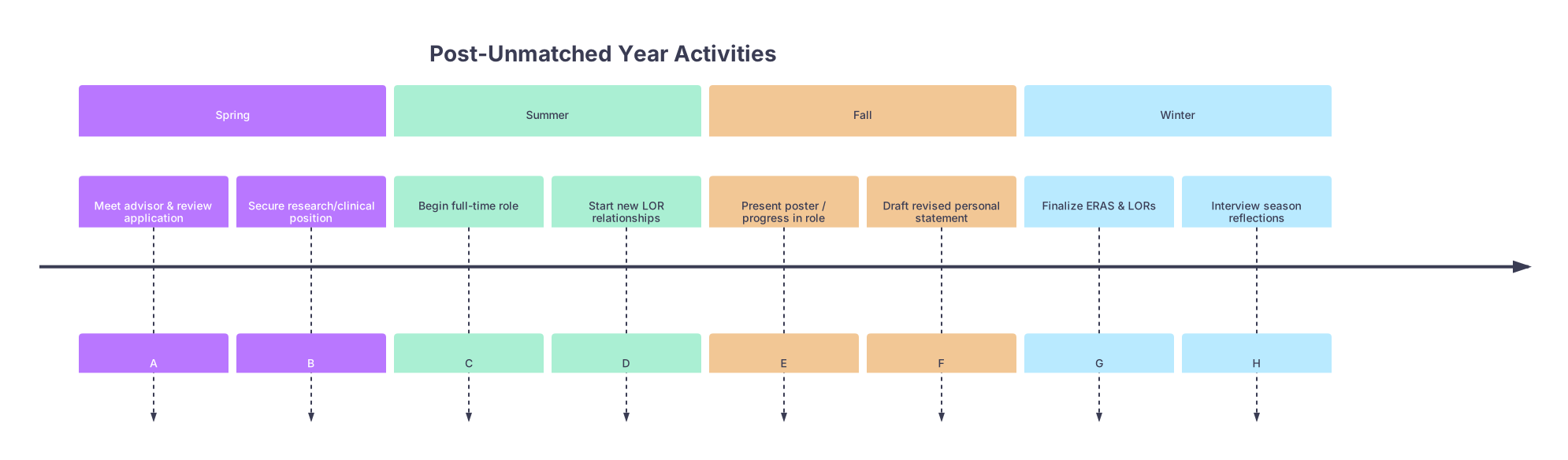
| Period | Event |
|---|---|
| Spring - Meet advisor & review application | A |
| Spring - Secure research/clinical position | B |
| Summer - Begin full-time role | C |
| Summer - Start new LOR relationships | D |
| Fall - Present poster / progress in role | E |
| Fall - Draft revised personal statement | F |
| Winter - Finalize ERAS & LORs | G |
| Winter - Interview season reflections | H |

| Aspect | Weak Approach | Strong Approach |
|---|---|---|
| Tone | Emotional, defensive | Calm, accountable, forward-looking |
| Unmatch Explanation | Long, detailed story | 2–5 sentences, specific, then pivot |
| Gap Year Description | Vague: “research, observerships” | Concrete roles, hours, outputs |
| Specialty Rationale | Generic interest statements | Day-in-the-life specifics, feedback cited |
| Growth Description | “I have grown a lot” (no evidence) | Clear before/after behaviors and outcomes |
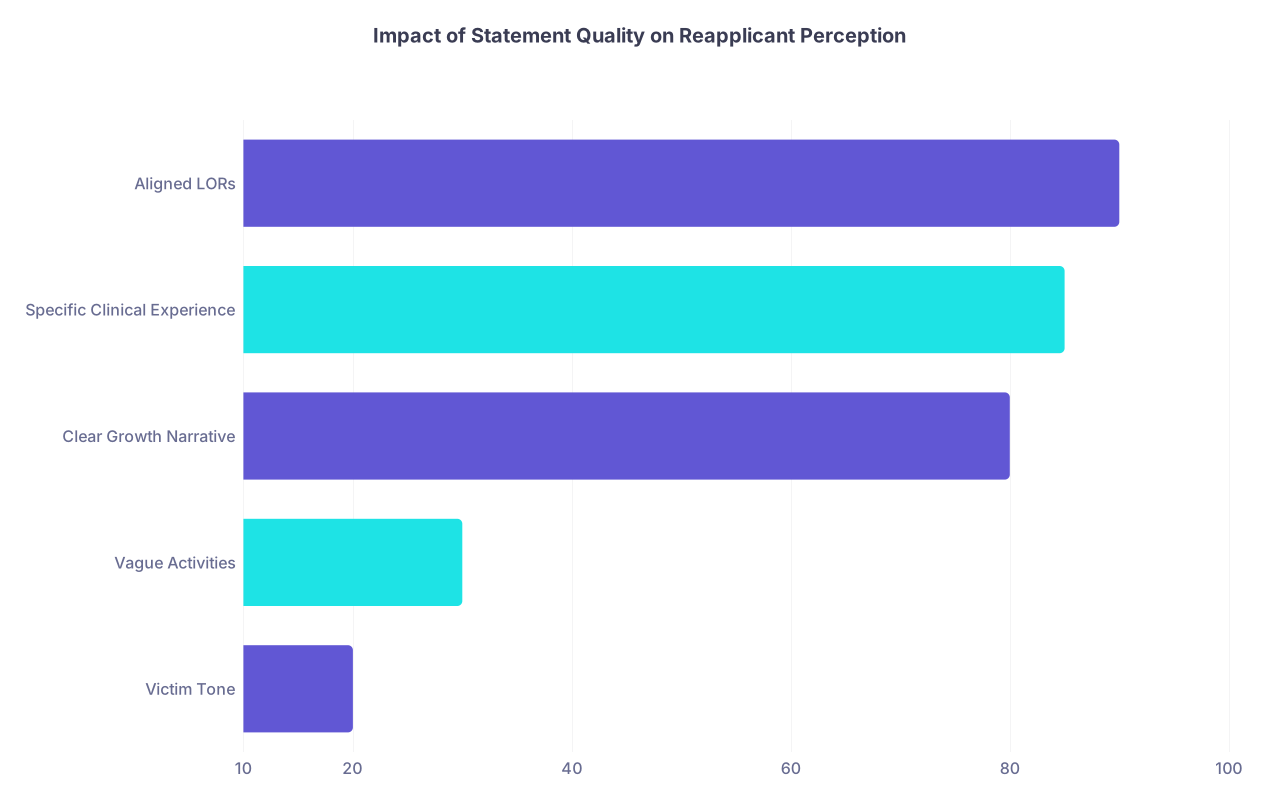
| Category | Value |
|---|---|
| Victim Tone | 20 |
| Vague Activities | 30 |
| Clear Growth Narrative | 80 |
| Specific Clinical Experience | 85 |
| Aligned LORs | 90 |
FAQ (Exactly 3 Questions)
1. Should I explicitly use the word “unmatched” or “SOAP” in my personal statement?
Use clear language, but you do not have to over-label it. “I did not match in the 2024 cycle” is fine. If the SOAP outcome is relevant (prelim vs completely unmatched), you can say “I matched into a one-year preliminary position through the SOAP” or “I did not secure a position during the SOAP process.” Avoid euphemisms that make programs work to decode what happened.
2. Can I reuse parts of my old personal statement?
You can reuse specific stories or experiences that are still accurate, but you should not just recycle the old structure. Your vantage point has changed. At minimum, your opening, your “why this specialty,” and a new section on what you did after going unmatched need to be substantially rewritten. If your prior statement is full of generic lines, this is the time to burn it down and start fresh.
3. How honest should I be about feeling devastated or burned out after not matching?
You can acknowledge the emotional impact in one short sentence, max. Something like, “Not matching was difficult, but it pushed me to reexamine my goals and address clear areas for improvement.” Anything beyond that starts to feel like you’re asking for sympathy instead of showing resilience. The more powerful move is to let your actions over the last year carry the story of how you responded.
Key takeaways:
Focus your new personal statement on clear growth and specific actions after the unmatched/SOAP experience, not on the pain of the event. Address the gap and outcome briefly, take responsibility for fixable issues, and then spend most of your words proving you’re now a stronger, safer bet for residency in this specialty.