
It’s late November of your M4 year. ERAS is submitted. You’re sitting with your personal statement file open again because something’s changed: you are no longer going into the specialty you built your entire narrative around.
Maybe you bailed on surgery for anesthesia after a brutal month of 5:00 a.m. pre-rounds. Maybe you went through a psych rotation and realized you actually like talking to people. Maybe your Step scores or life circumstances forced a more “realistic” plan.
Whatever the reason, you’re in the same uncomfortable spot:
“I already told everyone I wanted X. I did research in X. My letters are in X. How do I not look flaky or confused when I’m now applying to Y?”
This is fixable. But you cannot just copy‑paste your old personal statement and change the word “cardiology” to “radiology.” Programs will smell that from a mile away.
Let me walk you through how to rebuild your story so it sounds intentional, coherent, and mature—even if your pivot was messy in real time.
Step 1: Get Honest About Why You Pivoted (The Real Reason)
Before you write a single sentence, you need a brutally honest answer to one question:
Why are you changing specialties?
Not the polished version. The actual one.
Some common real reasons I’ve seen:
- You realized your initial specialty’s lifestyle would destroy your relationships or health.
- Your Step scores are not competitive enough for your initial choice. - An unexpected rotation (psych, EM, pathology, anesthesia) clicked hard.
- You were following someone else’s dream (mentor, parent, “med school groupthink”) and finally noticed.
- You had a life event—illness, caregiving, pregnancy—that changed your priorities.
Write down the messy version in a separate document. You are not going to send this to programs, but you need it. Because your polished story should be rooted in truth, not spin.
Now: from that messy answer, pull out the mature narrative. That sounds like:
- “I realized I want long-term patient relationships more than procedural volume.”
- “Clinically, I’m most energized by diagnostic problem-solving and longitudinal care.”
- “I learned that the setting and daily rhythm of my work matter as much as the content.”
- “I recognized that my strengths align more with X type of thinking and Y kind of work.”
You have to be able to say, in one or two sentences:
“I started medical school aiming for A. Over time, through B and C experiences, I realized I’m actually at my best doing D, which is why I’m committed to E specialty now.”
That sentence is the spine of your personal statement.
Step 2: Audit Your Past Experiences and Rename Them
You’re worried everything on your CV screams your old specialty. Research, interest groups, away rotations, mentors.
Keep this in mind:
Residency programs read how you think about your experiences more than they care about the label on them.
Do a quick experience audit with a specialty-neutral lens. Take a scratch sheet and write 3 columns:
| Old Label (What it was) | Neutral Skill / Theme | New Specialty Relevance |
|---|---|---|
| Surgery research | Data, outcomes, teamwork | QI, evidence-based practice |
| Cardiology rotation | Complex chronic care | Internal medicine fit |
| EM scribe work | Rapid decision making | EM, anesthesia, ICU |
| Psych volunteering | Communication, empathy | All specialties |
Now go through your:
- Research
- Leadership
- Clinical experiences
- Jobs / volunteering
- Hobbies (if genuinely relevant)
Ask:
- What did this teach me about patient care, systems, myself?
- What skills did I actually develop?
- How does that skill or insight translate to the new specialty?
Example:
You did pediatric surgery research and now you’re applying to pediatrics. On paper, it looks like a failed surgery attempt. Unless you reframe it.
Bad framing:
“I did pediatric surgery research but realized I did not want to do surgery, so I switched to pediatrics.”
Better framing:
“Working closely with pediatric surgery teams showed me how much I valued following these patients after their operations—helping families navigate the long recovery, developmental milestones, and ongoing care. I realized I was most engaged in the moments outside the OR, which ultimately pulled me toward pediatrics.”
Same experience. Completely different story.
Step 3: Decide How Directly to Address the Pivot
You’ve got three basic options for how visible to make the “pivot” in the personal statement itself.
Option 1: Explicit Acknowledgment (Big Pivot, Obvious on Paper)
Use this if:
- You did a ton of obvious prior work in another field (2+ years of ortho research, multiple aways).
- Your letters clearly come from another specialty.
- People at your home institution will absolutely mention your previous plan.
Example paragraph (general structure):
“Early in medical school, I was drawn to [Old Specialty] and pursued experiences in that field, including [very short mention]. As I progressed through my clinical rotations, I found myself increasingly energized by [New Specialty]’s emphasis on [key elements]. During [specific rotation], I realized that the parts of patient care that stayed with me most were [describe, aligned with new field]. That shift in focus led me to seek additional exposure in [New Specialty], where I recognized a much closer fit between the work and my strengths in [X, Y, Z].”
You are not apologizing. You are explaining growth.
Option 2: Softly Implied Pivot (Moderate or Plausible Shift)
Use this if:
- Your previous specialty interest is not overwhelming on paper.
- Prior experiences translate reasonably well to the new field.
- You’re not hiding anything, but you don’t need a point‑by‑point defense.
Example approach:
- Focus almost entirely on what pulled you to the current specialty.
- Mention prior interests in one line, if at all, framed as part of exploring options.
Something like: “Through early experiences in multiple fields, including [Old Specialty in a short phrase], I realized that the clinical questions I kept returning to involved [New Specialty core themes].”
Option 3: Barely Mention It (Micro-Pivot or Same General Area)
Use this if:
- You moved between related fields (e.g., gen surg → anesthesia/EM; peds → peds neuro; IM → cards/endo before picking categorical IM).
- Nobody reading your app will be shocked.
For example, switching from academic cardiology aspirations to general internal medicine? You don’t need a “pivot story” paragraph at all. Just show why you like IM and what you’ll do with it.
Step 4: Restructure Your Personal Statement Around the New Core
Now we build the actual statement. Don’t start by editing your old one line‑by‑line. That’s how you end up with Franken-PS.
Instead, build a fresh outline:
- Hook – a concrete clinical moment or realization that points explicitly toward your current specialty.
- Background trajectory – how your experiences in med school (including previous interests) led you here.
- Evidence – 2–3 specific examples that show you functioning like a future [specialty] resident.
- Reflection – what you’ve learned about yourself and the specialty.
- Looking forward – what you want in training and what you see yourself contributing.
Notice: “pivot” is not a separate section. It’s baked into #2 and #3.
Example Skeleton for a Real Pivot
Let’s say: You were surgery‑bound; now you’re applying to anesthesia.
Intro: A single OR case, but from an anesthesia lens.
- The moment you were more focused on the patient’s hemodynamics than the suturing.
- The quiet communication with the anesthesiologist.
- The thought process you found compelling.
Background:
- Early interest in surgery → sought out surgical experiences.
- Through that work, realized you loved the physiology, critical moments, and calm under pressure more than operative technique.
- Anesthesia rotation/AWAY sealed it: clear exposure with examples.
Evidence:
- A specific case where you anticipated complications and worked with anesthesia to manage.
- Maybe some ICU experience, or EM, or critical care research—framed as pattern recognition that led you to anesthesia.
- Highlight behaviors that are anesthesia‑core: preparation, vigilance, team communication, crisis management.
Reflection:
- What you learned about how you think and function on teams.
- Why anesthesia fits both your clinical brain and your values.
Future:
- Interest in ICU, regional, academic vs community, QI, teaching.
- What type of program environment you’re looking for: volume, case diversity, mentorship, etc.
That structure works for almost any pivot with different examples plugged in.
Step 5: Avoid the Three Classic Pivot Mistakes
There are three ways applicants blow this.
Mistake 1: Trashing the Old Specialty
Do not say:
- “I realized surgeons never see their families and are miserable.”
- “Psych didn’t feel like real medicine.”
- “I didn’t want to work that hard.”
You can talk about lifestyle and fit without insulting anyone or sounding weak.
Better:
- “I recognized I wanted more continuity than the operating room schedule allowed.”
- “I missed the diagnostic breadth of internal medicine.”
- “I wanted more time for reflection and complex conversations than the ED pace allowed.”
You’re allowed to have preferences. Just don’t attack a whole field.
Mistake 2: Over-explaining or Justifying
If half your statement is you defending your pivot, you look insecure. Programs don’t have time for a manifesto.
One short paragraph acknowledging the evolution of your goals is enough. Then spend your word count proving you understand and belong in the new specialty.
Ask yourself:
“If someone only read my second and third paragraphs, would they be excited to work with me in this field?”
If the answer is no, you’re talking too much about the change and not enough about the fit.
Mistake 3: Being Vague About the New Specialty
You pivoted. Fine. Now show you actually get what this specialty is.
No generic lines like:
- “I enjoy working with people and solving problems.”
- “I love teamwork and lifelong learning.”
Everyone writes that. Instead, write things a real [specialty] person would nod at.
Examples:
- EM: Uncertainty tolerance, risk stratification, rapid rapport‑building, shift work realities.
- Psych: Long-term narrative building, managing ambiguity, alliance over procedure, emotional stamina.
- Pathology: Pattern recognition, love for morphology, integrating clinical data with microscopic findings, comfort with less direct patient contact.
- Family med: Breadth over depth, community context, behavior change counseling, continuity over decades.
Show them you did not just pivot because you panicked. You pivoted to something concrete.
Step 6: Align Your Story With the Rest of Your Application
Programs don’t read your personal statement in a vacuum. They read it alongside your ERAS, letters, and MSPE.
So you have to check for contradictions.
1. Letters of Recommendation
If most of your letters are from your old specialty, your statement needs to:
- Acknowledge your earlier interest.
- Show that those mentors saw transferable strengths.
- Ideally mention that you sought out new‑specialty mentors too, even if they did not end up writing letters.
If you do have at least one strong letter in the new specialty, highlight that experience in your statement. Make it clear you didn’t pivot based only on two good weeks by accident.
2. Experiences Section
If your ERAS “experiences” section heavily features old-specialty stuff:
- Use the personal statement to give those experiences context and show what they taught you that applies to the new field.
- Make sure the themes match. If you claim you care deeply about long-term relationships but every experience is 10‑week research stints and short acute-care jobs, that dissonance reads.
3. MSPE / Dean’s Letter
Sometimes, your school’s letter explicitly says: “Initially interested in [Old Specialty], now applying in [New Specialty].”
If they’re already stating that bluntly, you’re better off taking control of the narrative in your PS rather than pretending it doesn’t exist. Use your one clear paragraph of explanation so programs see your version first.
Step 7: Concrete Language You Can Actually Use
Here are some plug‑and‑modify lines that work well for pivots. Do not copy them verbatim, but use the structure.
To acknowledge initial interest:
- “I entered medical school strongly considering a career in ___, and sought out early experiences in that field.”
- “During my preclinical years, I focused my elective time on ___ as I explored potential career paths.”
To show what shifted:
- “As my clinical training progressed, I noticed that the moments I found most meaningful involved ___.”
- “What surprised me was that my attention kept drifting toward ___ rather than ___.”
- “The part of the day I looked forward to most was not ___, but rather ___.”
To justify the new fit:
- “In ___, I found a specialty that matched my strengths in ___ and my desire for ___.”
- “The field’s emphasis on ___ and ___ aligns with how I naturally approach patient care.”
- “I enjoy the balance of ___ and ___ that defines daily practice in ___.”
To future-orient:
- “Looking ahead, I hope to train in a program that will allow me to develop as a clinician who ___.”
- “I see myself contributing to the field through ___.”
It doesn’t need to be poetry. It just needs to be coherent and specific.
A Quick Visual: What Programs Actually Care About
Here’s how program directors mentally allocate attention when they see a pivot in your app. Not precision science, but close to reality:
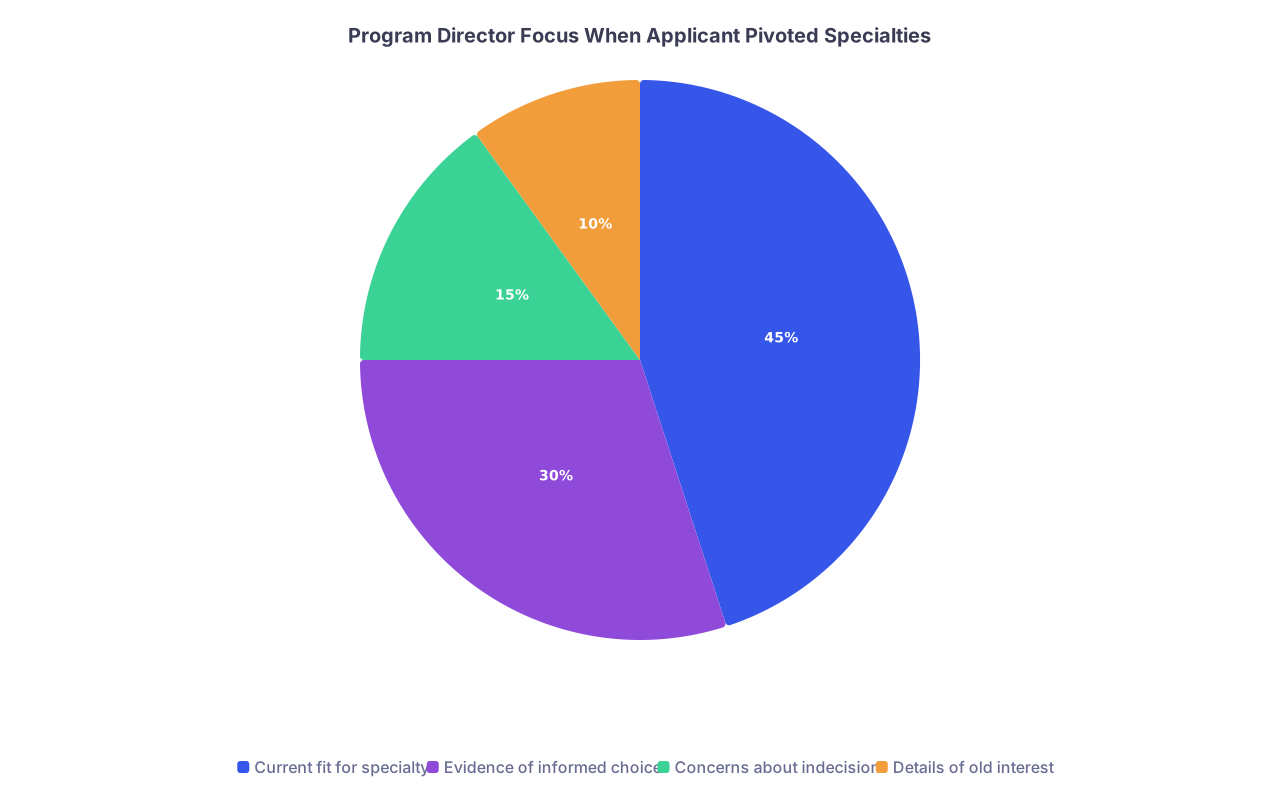
| Category | Value |
|---|---|
| Current fit for specialty | 45 |
| Evidence of informed choice | 30 |
| Concerns about indecision | 15 |
| Details of old interest | 10 |
Your job with the personal statement is to stack the first two slices—current fit and informed choice—and shrink the “concerns about indecision” slice as much as possible.
Step 8: What to Do If the Pivot Was Forced (Scores, Competitiveness, Life Stuff)
Let’s not pretend all pivots are purely passion-driven. Sometimes:
- Your Step scores knocked you out of your dream field.
- You didn’t match in your original specialty and are reapplying in a new one. - Family or health stuff narrowed your options.
You do not need to say:
- “Because of my scores, I pivoted to ___.”
- “After not matching in ___, I am now applying in ___.”
Programs can see your scores. They can see a prior SOAP or previous ERAS if they want to. Your job is not to litigate every data point; your job is to present a serious, well‑reasoned commitment to the new field.
How to handle it:
- Emphasize what you like about the new specialty genuinely.
- Focus on what you did once the path changed (extra rotations, mentors, reading, projects).
- Show you’re not “settling” so much as redirecting.
One-line acknowledgement (if absolutely necessary):
- “As I gained broader clinical experience and reconsidered how I could best contribute as a physician, I chose to pursue ___, where I have since focused my efforts in ___.”
That’s it. Don’t spend half the essay apologizing for a score report.
A Simple “Pivot” Drafting Process You Can Follow This Week
Here’s a concrete sequence you can run through in a few evenings:

| Step | Description |
|---|---|
| Step 1 | Write messy truth about pivot |
| Step 2 | Extract 1-2 line mature narrative |
| Step 3 | Audit experiences and reframe skills |
| Step 4 | Outline 5-part new statement |
| Step 5 | Draft without looking at old PS |
| Step 6 | Check for coherence with ERAS & letters |
| Step 7 | Cut over-explaining about old field |
| Step 8 | Get feedback from new specialty mentor |
If you skip A–C and just jump into editing your old essay, you’ll keep dragging the dead weight of your previous narrative into the new one.
FAQs (Exactly 5)
1. Do I have to explicitly say I changed my career goal in the personal statement?
Not always. If your previous interest is subtle on paper or related (e.g., heme/onc to IM), you can focus entirely on why you want the current specialty. If your earlier path is obvious—well-known research, letters from another specialty, an MSPE that mentions it—it’s smarter to briefly acknowledge the evolution of your interests in one clear paragraph and move on.
2. How do I handle a pivot if my strongest letters are from the old specialty?
Use your personal statement to connect those letters to relevant skills: work ethic, clinical reasoning, teamwork, communication. Mention that earlier focus in a respectful way, then show how the core strengths praised by those letter writers have continued in your new specialty experiences. If at all possible, add at least one letter from the new field, even if it’s from a shorter rotation, to prove you’ve seen the reality of the work.
3. What if programs think I’m just choosing an “easier” specialty because of my scores?
Some will assume that no matter what you write. Your counter is not a defensive essay about Step. Your counter is a mature, concrete, specialty‑specific statement that shows you understand the field, sought out meaningful experience in it, and see a plausible long‑term future there. If your behavior over the last 6–12 months backs that up—extra rotation, project, mentorship—most programs will accept the pivot as reasonable.
4. Can I reuse parts of my old personal statement?
You can reuse individual sentences about your values or background if they still make sense. But do not just swap specialty names. The whole structure needs to be rebuilt around the new field. Usually, the best approach is to start from a blank page and then selectively pull in only the lines that genuinely still fit, rather than trying to “convert” the old essay.
5. How dramatic can a pivot be before it becomes a red flag?
I’ve seen surgery → psych, neurosurgery → pathology, ortho → FM. People match with those stories every year. It becomes a red flag only if: (a) you show little understanding of the new specialty, (b) you have almost no exposure in it, or (c) your narrative makes you sound fickle or resentful. A clear explanation rooted in real experiences, plus at least one solid rotation and mentor in the new field—that’s usually enough to make even a big pivot look like growth, not chaos.
Open your current personal statement file right now. In the first paragraph, highlight every phrase that still reads like it belongs to your old specialty—specific cases, language, values, even subtle tone. Delete those lines, then write one new sentence that clearly signals: “This is who I am now, and this is the work I want to do.” Start rebuilding from there.