What do you actually write when your “gap year” had nothing to do with medicine?
You finished med school. Or maybe you took time off before residency. And instead of doing research, a prelim year, or some clinical fellowship… you worked in a family business, traveled, did tech work, stayed home with kids, or just tried to get your life together.
Now you’re staring at the ERAS Personal Statement box thinking:
“If I tell the truth, will this kill my application?”
Let me walk you through how to describe a non-clinical gap year so it does not set off alarm bells—and in some cases, actually helps you.
We’re talking about what to actually write. Sentences. Phrasing. Framing. Not vibes and empty “spin it positively!” nonsense.
What programs worry about when they see a gap
You need to understand their red-flag radar before you decide what to say.
Program directors are busy and a little jaded. They see hundreds of files. They do not hate gap years. They hate uncertainty and risk.
When they see a gap—especially a non-clinical one—they’re screening for:
- Are you unreliable?
- Are you avoiding medicine?
- Are you rusty or unsafe clinically?
- Are you hiding something serious (disciplinary issues, failure, legal troubles, mental health crisis you won’t acknowledge)?
That’s it. Everything else is details.
So your job in the personal statement and application is to quietly answer three questions:
- Were you still moving forward as a functioning adult?
- Are your reasons understandable and grounded?
- Are you now back on track with clear, believable commitment to this specialty?
If your statement doesn’t calm those three worries, you’re in trouble.
First rule: Do not over-explain or over-confess
I’ve seen applicants torpedo themselves because they felt guilty about their gap year and tried to over-correct.
They write a full emotional memoir:
- “I was very burned out…”
- “I wasn’t sure if I truly wanted to be a doctor…”
- “I needed to escape medicine…”
- “I withdrew from my friends and family…”
You think you’re being honest and vulnerable. A PD reads that and sees: flight risk.
You are not writing a diary. You’re writing a professional narrative.
Use this rule:
Explain enough that a normal adult can say, “Yeah, that makes sense,” then move on. No detailed self-flagellation. No raw therapy notes.
Step 1: Name the gap simply and factually
You must acknowledge the gap. Trying to hide it is worse than the gap itself.
Good:
“After graduating from medical school in 2022, I spent one year working in my family’s small logistics business while planning my path to residency.”
Not good:
“After an unexpected period of transition where I focused on self-development and personal priorities…”
That second line screams: “I’m hiding something.”
You want something short, concrete, and boring. Boring is your friend here.
Examples of simple, acceptable labels:
- “I worked full-time in my family’s restaurant.”
- “I worked as a software developer at a startup.”
- “I stayed home as the primary caregiver for my newborn.”
- “I took a year to address a medical issue and support my family, and then returned to full-time work.”
- “I worked outside of medicine while preparing to reapply to residency.”
You don’t need to list every job, city, or side hustle in the personal statement. One clean, simple phrase is usually enough there. Details can go in the CV if needed.
Step 2: Show that you were a responsible adult, not drifting
This is where most applicants with non-clinical gaps either say too little (“I did nothing”) or too much (“Here’s my soul’s journey”).
You want one to three sentences that:
- Show you had structure and responsibility
- Highlight transferable skills (relevant to residency)
- Don’t pretend your job was secretly a clinical fellowship
Let’s do concrete examples.
Example: Family business / non-med job
Weak version: “I worked in my uncle’s store while deciding on my future.”
Better: “During this year, I worked full-time in my uncle’s convenience store, managing inventory, handling cash, and interacting with customers on a daily basis. It was not a clinical role, but it reinforced habits of reliability, clear communication, and staying calm when the environment is busy and unpredictable.”
Notice a few things:
- You’re honest that it wasn’t clinical.
- You name specific responsibilities.
- You extract skills that actually matter to residency: reliability, communication, composure.
No fake “leadership synergy” nonsense. Just clear, grounded skills.
Example: Tech / office job
“I worked as a data analyst for a small software company, where I was responsible for cleaning and interpreting large datasets, presenting findings to non-technical teammates, and meeting weekly deadlines. While it was outside of medicine, the rigor of problem-solving and communicating clearly with others has sharpened skills I know I’ll rely on in residency.”
Again: specific tasks + believable takeaway.
Example: Staying home with kids / caregiving
People get weirdly apologetic about this. You don’t need to.
“In 2023, I became the primary caregiver for my infant son while my partner returned to full-time work. That year demanded consistent attention, patience, and rapid adaptation—skills that I recognize are equally essential in caring for patients and collaborating within a team.”
Short, honest, calm. No drama.
Step 3: Connect the gap to a believable pivot back to medicine
This is where you turn a potential red flag into something neutral or slightly positive.
You need to answer silently: Why are you back now, and why should I believe you will stay?
Wrong way: “During this time I realized that my true passion was always medicine.”
That line is so overused it’s basically noise. It also sounds like you just remembered you like oxygen.
Better strategy:
- Use 1–2 sentences max.
- Anchor your renewed commitment in something specific.
- Point toward your current clinical engagement.
Examples:
“Working outside of medicine made it clear what I missed most: caring for people in moments when they are vulnerable and uncertain. Recognizing that, I returned to clinical work, shadowing in internal medicine clinics and volunteering at a local free clinic as I prepared my application to internal medicine residency.”
Or:
“Although my role was non-clinical, conversations with customers and coworkers about their own health struggles reminded me why I chose medicine in the first place. Over the past several months I’ve re-engaged with clinical medicine through [X], and I’m ready to commit fully to residency training in family medicine.”
Anchors: conversations, specific experiences, concrete actions to re-engage. Not vague “rediscovered my passion.”
Where to put this: PS vs. ERAS vs. interviews
You do not need to dump your entire gap story into the personal statement. You just need enough to avoid confusion.
Personal statement:
- 1–3 sentences, woven briefly into your timeline.
- Do not let the gap year become the central plot of your essay.
- The core of your PS is still: why this specialty, what you offer, who you are clinically.
ERAS CV / Experiences:
- List the non-clinical job as an experience if it was substantial (full-time, several months+).
- Use objective bullet points: responsibilities, hours, roles. Not your emotional journey.
Supplemental questions or “anything else?” boxes:
- This is where you can add one clean, slightly longer explanation if needed, especially for longer or multiple gaps.
Interviews: You will get: “Tell me about this gap year.”
Have a 30–45 second script:
- What you did
- One or two useful skills or lessons
- One line on why you’re back in medicine now
Say it without defensiveness. If you sound ashamed, they start digging.
Concrete before-and-after examples
Let’s fix some actual phrasing.
Scenario 1: One-year non-clinical job after med school
Bad version in PS: “After graduation I had some uncertainty and personal issues and I took a year off to work in a non-medical field. During this period I wasn’t sure if I would return to medicine, but eventually I decided to come back and now I am very passionate about internal medicine.”
Problems:
- “Uncertainty and personal issues” sounds ominous.
- Admitting you weren’t sure you’d return suggests you might bail again.
- “Very passionate” is cheap filler.
Stronger version: “After graduating in 2022, I spent one year working full-time as a project coordinator at a small logistics company, overseeing scheduling and communication between drivers and clients. While it was outside of medicine, I learned how to manage time-sensitive problems and communicate clearly under pressure. Over the last several months, I’ve returned to clinical settings—shadowing in outpatient internal medicine and volunteering at a free clinic—and I’m ready to bring this maturity and focus into residency.”
You’ve:
- Named the work.
- Demonstrated responsibility.
- Shown current clinical engagement.
- Kept it to a tight paragraph, not an autobiography.
Scenario 2: Mental health or burnout gap
This one’s sensitive. You do not need to (and usually should not) give detailed psychiatric history in your PS.
Bad: “I became severely depressed and burned out during my final year and had to step away. After intensive therapy and medication changes, I finally feel stable again and want to re-enter medicine.”
From a human standpoint, I respect that honesty. From a PD’s perspective, that’s a massive unknown risk and they have no way to check your current stability. It invites worry.
Better:
“I took time away from training in 2021–2022 to address a significant personal health issue and to focus on recovery and family responsibilities. During that period I learned to set healthier boundaries, ask for help when I need it, and maintain habits that support resilience. Over the past year I’ve returned to consistent full-time work and regular clinical exposure, and I feel prepared to meet the demands of residency with greater self-awareness and stability.”
You’re not lying. You’re just keeping medical details private while still reassuring them:
- Problem identified
- Actions taken
- You’re now functioning at a stable level
If they really want more, they’ll probe in interviews—but many won’t if your recent performance looks solid.
Use structure: a rough template you can adapt
Here’s a simple scaffold to plug your situation into. Do not copy it word-for-word; use it like a spine.
One sentence placing the gap in your timeline:
- “After finishing [med school / last clerkship / degree] in [year], I spent [duration] doing [short description].”
One to two sentences naming responsibilities and skills:
- “In this role, I [managed / coordinated / handled / worked with]…”
- “Although it was non-clinical, it reinforced [reliability / communication / problem-solving under pressure / teamwork].”
One to two sentences on the pivot back to medicine and current state:
- “During this time I realized / I missed / I was drawn back to…”
- “Over the past [months], I have [shadowed / volunteered / taken courses / prepared for exams], and I’m ready to commit fully to residency in [specialty].”
That’s it. 4–5 sentences max. Anything longer becomes a separate essay, and you do not want that.
Quick specialty nuance: some are more forgiving than others
Let’s be blunt.
Some specialties care a lot more about “continuous clinical trajectory.” Some are more open to nonlinear paths if you can still perform.
Here’s a rough sense:
| Specialty | Sensitivity to Non-Clinical Gap | Comment |
|---|---|---|
| Internal Med | Low–Moderate | Often receptive if story is coherent |
| Family Med | Low | Very open to diverse backgrounds |
| Psychiatry | Low–Moderate | Nonlinear paths common |
| Pediatrics | Moderate | Explain clearly, show recent contact |
| Gen Surgery | High | Lack of recent clinical work is tough |
| EM | High | Want recent, intense clinical work |
Does that mean you cannot match surgery or EM with a non-clinical gap? Not automatically. But you need:
- Strong clinical letters
- Recent meaningful clinical exposure
- A very tight, no-drama explanation
For primary care fields, I’ve seen plenty of applicants with 1–3 years working in something completely different match just fine—because they wrote about it cleanly and had current clinical proof.
Show you’re clinically current somewhere in the application
If your gap is totally non-clinical and happened recently, you have another job besides explaining it: proving you’re not clinically stale.
You can do that with:
- Recent observerships / shadowing
- Free clinic or community health volunteering
- Recent Step 2 CK or OET/IELTS (for IMGs) with solid scores
- Part-time clinical work if your country allows it
And then one sentence in your PS tying it in:
“To maintain contact with clinical medicine, I volunteered weekly at a community clinic, assisting with [X].”
That line does a lot of heavy lifting.
If you have no recent clinical anything and a big non-clinical gap, your narrative cannot fully fix that. You’ll still be high risk. In that case, priority 1 is to go get real clinical exposure before the next application cycle.
Visual: how your gap explanation fits in the overall story

| Step | Description |
|---|---|
| Step 1 | Open with specialty interest |
| Step 2 | Describe key clinical experiences |
| Step 3 | Briefly place gap year in timeline |
| Step 4 | Highlight responsibility & skills in gap year |
| Step 5 | Show renewed commitment & recent clinical activity |
| Step 6 | Finish with who youll be as a resident |
Notice the proportions: the gap is not the center. It’s a bridge between your past clinical work and your current readiness.
Example mini-paragraphs for different situations
I’ll give you a few you can adapt.
Worked in non-med job, 18 months
“After earning my MD in 2021, I spent a year and a half working as a customer service supervisor at a large retail store while supporting my family financially. I managed a small team, handled escalated customer complaints, and learned to stay composed and clear-headed when multiple problems demanded my attention at once. Over the past year I’ve returned to medicine—shadowing on the inpatient internal medicine service at [Hospital], volunteering with a local blood pressure screening program, and preparing my application. I’m ready now to bring both my clinical foundation and this real-world experience into internal medicine training.”
Travel + odd jobs + then refocus
“After medical school, I took a year away from formal clinical work, during which I worked a series of short-term jobs and spent time traveling and visiting extended family abroad. That time gave me perspective on how people from different backgrounds think about illness, death, and the healthcare system. Over the last several months I have re-established consistent clinical exposure by assisting in a busy outpatient clinic and preparing for Step 2 CK, and I’m committed to training in psychiatry, where that broader perspective is an asset.”
You see the pattern by now.
One thing you must not do: pretend your gap was more “medical” than it was
Program directors can smell forced spin a mile away.
If you spent nine months playing semi-pro video games and three weeks volunteering at a blood drive, don’t write:
“Throughout my gap year I remained deeply engaged in healthcare through a variety of clinical opportunities…”
That’s not engagement. That’s a weekend.
It’s better to admit the truth in a grounded way:
“I did not spend the entire year in clinical environments. For much of that time, I supported myself with non-medical work while reassessing my long-term goals. Once I decided to pursue residency, I sought out concrete clinical experiences—shadowing in [X], volunteering in [Y]—to ensure I was returning with clear eyes and current skills.”
That kind of candor, paired with recent real work, is much more respectable than bloated spin.
Quick sanity check before you submit
Take the paragraph(s) where you address your gap and ask yourself:
- Does a stranger understand what I actually did during that time?
- Do I sound like a functioning adult or like someone in crisis?
- Is it clear why I’m back in medicine now, and why that’s stable?
- Did I keep it to a small part of the total statement?
If you can say yes to those, you’re probably fine.
If you showed it to a blunt friend and they said, “Dude, this sounds like you were falling apart,” then you need to tighten, professionalize, and move the emotional heavy lifting out of the personal statement and into your therapist’s office where it belongs.
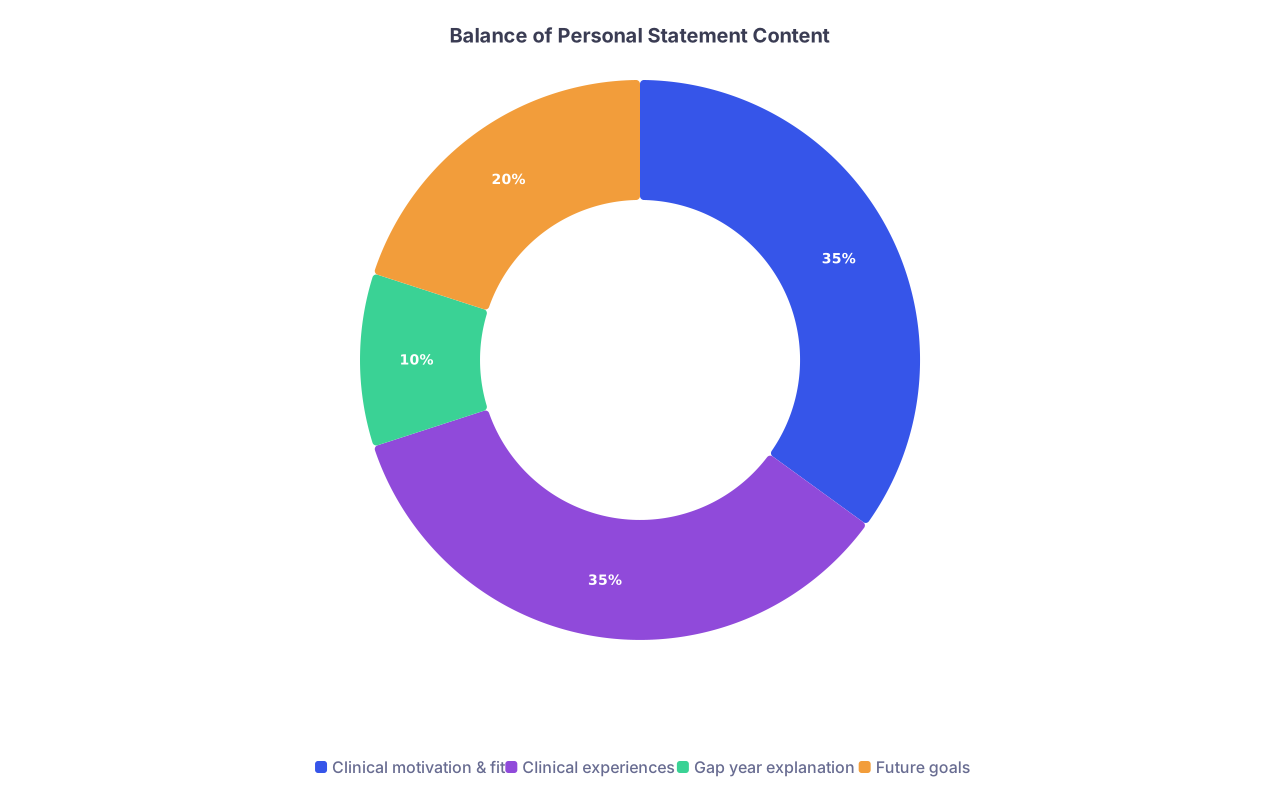
| Category | Value |
|---|---|
| Clinical motivation & fit | 35 |
| Clinical experiences | 35 |
| Gap year explanation | 10 |
| Future goals | 20 |
Bottom line: how to keep your non-clinical gap year from sinking you
You don’t need to erase your gap. You just need to make it boringly reasonable.
Three key points:
- Be concrete and brief. Name what you did, show you were responsible, and don’t turn it into a drama.
- Prove you’re back. Mention recent clinical exposure and a clear, calm commitment to your specialty.
- Keep perspective. The gap is a small bridge in your story, not the main event. The bulk of your statement should still be about who you are as a future resident and why you fit that field.
Do that, and your non-clinical year becomes exactly what it should be: context, not a red flag.