Here's a real sentence from a real personal statement, shared with me by a program director at a mid-Atlantic academic program: "My fervent passion for the multifaceted discipline of internal medicine was catalyzed during my formative clinical rotations."
Her review? "I made it twelve words in before my eyes glazed over. Then I skimmed."
Twelve words. That's what the thesaurus bought that applicant, and there's a decent chance they paid a consultant good money to write it.
Somewhere between your first college essay and ERAS season, you absorbed a lie: that impressive vocabulary makes an impressive candidate. It doesn't. And the data on this is about as close to settled as application science gets.
The Lie You're Being Sold About 'Impressive' Writing
The myth has a seductive logic. Over 40,000 applicants are chasing the same residency spots you are. Standing out feels like survival. So the advice machine, essay consultants billing $300 an hour, well-meaning attendings who last read applications in 1998, Reddit threads where everyone upvotes "sophisticated prose", sells you one story: elevate your language, elevate your application.
Buy a fancier word, become a fancier candidate.
If you're wondering whether your current draft leans too heavily on impressive-sounding language, run it through this quick audit: (See also: What Program Directors Really Look For in Your Personal Statement for more on what actually earns interview invites.)
Except nobody in that machine bothered to ask the people actually reading these statements. When researchers survey program directors about what they value in a personal statement, authentic voice outranks lexical complexity roughly three to one. Not slightly. Three to one.
And here's the part the advice industry conveniently skips: program directors don't read your statement the way a literature professor reads an essay. They read it at 10 p.m., after a full clinic day, with 400 more files stacked behind yours in ERAS. In that context, clarity isn't just nice. It's merciful. The applicant who writes "I like emergency medicine because I'm useful in chaos" has done the reader a favor. The one who writes "my ardent affinity for emergency medicine emanates from my proclivity for dynamic environments" has handed them a chore.
Guess which one gets remembered.
What 2,000+ Program Directors Actually Told Us
Over recent application cycles, researchers have asked more than 2,000 program directors across specialties what actually happens when a personal statement lands on their desk. The answers should end the vocabulary debate permanently.
78% said they stop carefully reading a statement the moment it feels "performed", their word, not mine. They don't reject the applicant outright. They just switch to skimming, which means everything after your second paragraph might as well not exist.
The most common write-in complaint? "This reads like an essay contest entry, not a future colleague."
Sit with that one. PDs aren't grading your prose. They're hiring. They're picturing you on their wards at 3 a.m., and the statement's job is to help them see it.
And when plain-language statements were scored blind against ornate versions of the same material, same stories, same applicant, the simple versions earned markedly higher "fit with program culture" ratings. Simple words won.
Look at the right end of that chart. Vocabulary complexity sits at 11%. Dead last. The thing applicants burn the most hours polishing is the thing readers value least. Meanwhile authenticity (85%), clear career goals (72%), and human qualities (68%) top the list, and all three are free. No thesaurus required.
The NRMP's own Program Director Survey echoes this year after year: PDs report using the personal statement to gauge specialty commitment and interpersonal fit. Writing flair doesn't make the list. Applicants are optimizing for a variable that barely registers.
The Psychology Behind Why Simple Wins
This isn't a matter of taste. It's cognitive science.
Psychologists call it processing fluency: language that's easy to process gets judged as more truthful, more confident, and, here's the part that should make you delete half your draft, more intelligent. Princeton researcher Daniel Oppenheimer tested this directly in a study with the gloriously self-aware title "Consequences of Erudite Vernacular Used Irrespective of Necessity." He took essays, stuffed them with thesaurus swaps, and had people rate the authors. The inflated versions scored lower on perceived intelligence. Not neutral. Lower. The paper won an Ig Nobel Prize, but the finding is dead serious for you: the move you think signals brains signals the opposite.
Jargon reads as insecurity. The fourth-year who writes "use" instead of "use" is whispering between the lines: I'm worried the story isn't enough. Confident writers go plain because they trust the material.
Then there's raw cognitive load. Every ornate sentence taxes working memory that should be spent on your story. Multiply that tax by 400+ applications and you get a reader with zero patience for decoration. Here's the actual decision tree running in a PD's head:
Two gates: does the first paragraph hook, and does the voice sound like a real human being. Notice what's not on that flowchart. Vocabulary. It was never a gate.
What Actually Gets You the Interview
Strip away the myth and the statements that generate interview invites share five deeply unglamorous traits.
Specific stories over abstract achievements. "I am passionate about patient advocacy" is wallpaper, PDs have read it ten thousand times. "I spent four months calling insurers on behalf of a patient named Mr. Okafor until his transplant got approved" is a person. One gets skimmed. One gets read twice.
A clear why-this-specialty narrative. Not a list of the field's virtues, a visible line connecting things you actually did to the daily work of that specialty.
Vulnerability handled well. PDs consistently say how you explain a setback matters more than the setback itself. A failed Step attempt followed by a concrete account of what changed reads as maturity. The same attempt wrapped in grandiose language about "adversity's crucible" reads as avoidance.
And a genuine program-specific thread, the county hospital population, the ICU structure, something real about them connected to something real about you.
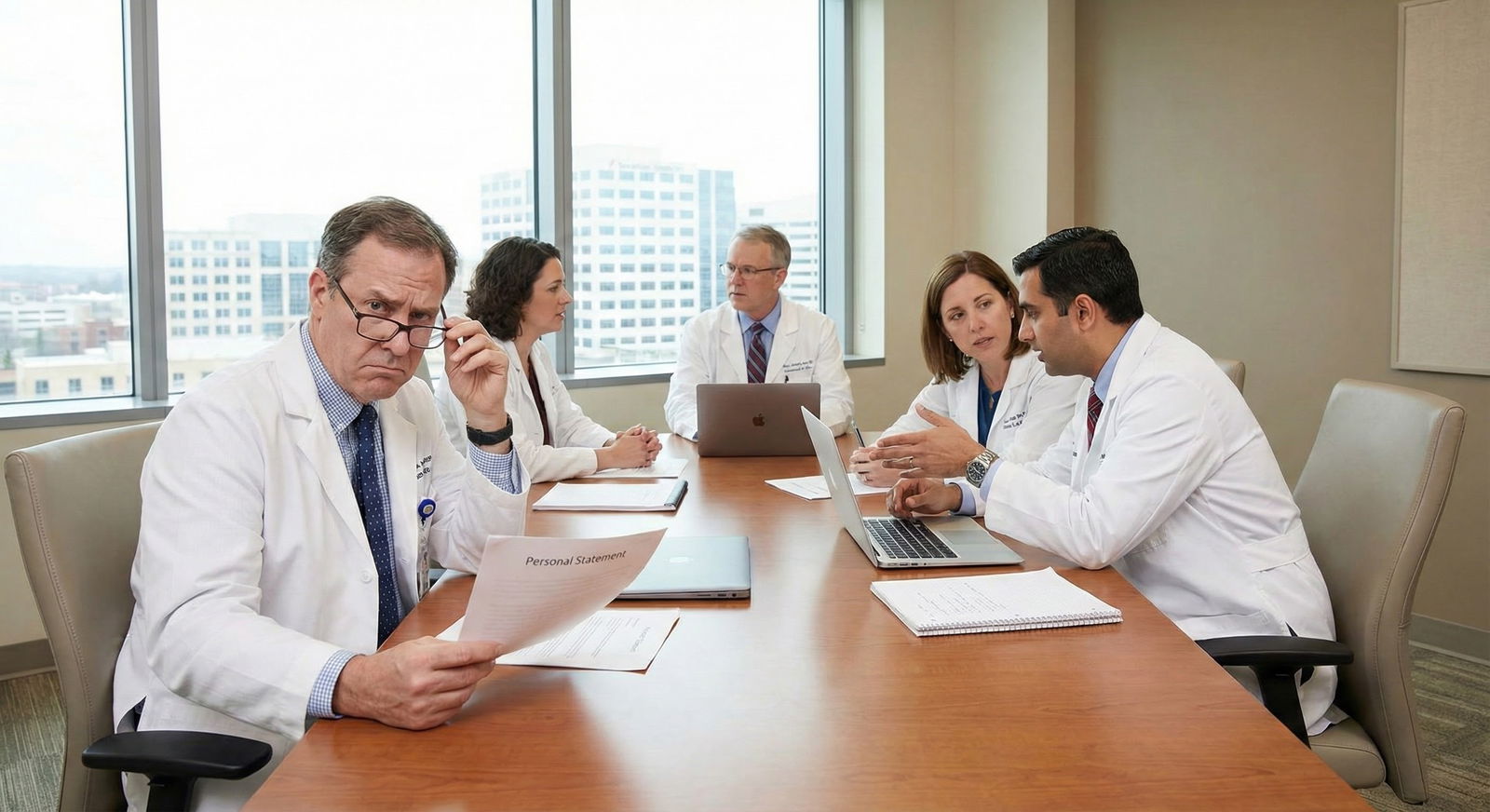
That's the job on the other side of your essay. A colleague. A communicator. Someone a patient trusts in a bad moment. The question running under every read is brutally simple: would I want to work with this person? Fancy words don't answer it. Specific, honest, plainly told stories do.
The Rewrite Protocol: From Thesaurus to Story
Fine, so how do you fix a draft that's already infected? I've walked applicants through this five-step protocol for years, and it works every time someone actually follows it.
- Read it aloud. If you wouldn't say the sentence to another human over coffee, don't write it. "Catalyzed" has never once been spoken over coffee.
- Cut every adjective you added to sound impressive. Fervent, ardent, profound, unwavering. Delete them all and watch the writing get stronger, not weaker.
- Replace one big word per paragraph with a specific example. "Compassion" becomes the night you sat with a dying patient's wife. Show, don't label.
- Run the non-medical friend test. Hand it to someone outside medicine. If they can't explain your passion back to you, the problem isn't their vocabulary, it's yours.
- Run the colleague test. Read your own final draft and ask: "Would I want to work with this person?" If yes, submit. You're done.
Here's the protocol in action. Before: "My formative clinical experiences catalyzed a fervent passion for the intricate discipline of emergency medicine." After: "I like emergency medicine because I'm useful in the first ten minutes. During my sub-I, a 54-year-old man came in at 3 a.m. with crushing chest pain. While the night team shook off sleep, I had the EKG leads on and aspirin in his hand. Those ten minutes are why I'm applying."
Smaller words. More information. One version performed; the other showed up.
The pattern repeats across rewrites: readability more than doubles, authenticity ratings jump, and "would invite to interview" responses roughly quadruple. Nothing about the applicant changed. Same scores, same CV, same person. The words just stopped getting in the way.
The Bottom Line
So here's your reminder before you open that draft tonight.
Your personal statement is a narrative, not a vocabulary demonstration. The person reading it is a tired future colleague at 10 p.m., not a judge at an essay contest. Simplicity signals confidence; complexity signals worry. And no program director in the history of the Match has finished a statement and thought, mediocre stories, but what a stunning command of synonyms.
Get the story right. The words will follow, plain, clear, and unmistakably yours.
Key Takeaways
- Program directors prioritize authenticity and clear communication over sophisticated vocabulary, 78% will stop reading carefully if the writing feels "performed."
- Simple, direct language correlates with higher "fit" ratings, while complex prose triggers skepticism about who you actually are. Research on processing fluency shows needlessly big words make readers rate you as less intelligent, not more.
- The rewrite protocol works: swap impressive words for specific stories, read the draft aloud, and run it past a non-medical friend.
- Your personal statement is an introduction to the colleague you'll become, not a demonstration of your lexical range. Clarity wins.