
The obsession with research and awards is completely out of proportion to how real residents are actually chosen.
You’re not crazy for worrying, though. I know exactly what’s running through your head: “Everyone else has publications, posters, national awards… I have… clinical rotations and some volunteering. My personal statement is going to expose how basic I am.”
Let me just say it straight: you can write a powerful residency personal statement without research, without awards, and without a single line on PubMed. But only if you stop trying to fake being someone you’re not and lean hard into what you do have.
Let’s pick apart the anxiety and then build something solid you can actually put on the page.
First: Are You Automatically Screwed Without Research?
No. You’re not.
Are there specialties where no-research is a real handicap? Yes: derm, plastics, some ortho, radiation oncology, ENT, neurosurg. If you’re applying to those with zero research, your overall application is in trouble, and a personal statement won’t magically save that.
But for most core specialties—internal medicine, family medicine, pediatrics, psychiatry, OB/GYN, EM, prelims, many IM subspecialty tracks—lack of research is a yellow flag at worst, not a deal-breaker. And programs in those fields are absolutely reading personal statements looking for something else:
- Are you actually interested in this specialty, or are you just panic-applying?
- Are you mature enough not to implode when things get hard?
- Will your attitude poison the team or help it?
- Do you understand what residents actually do in this field?
Those questions are where your personal statement lives and breathes. Not “How many posters did you present at ATS?”
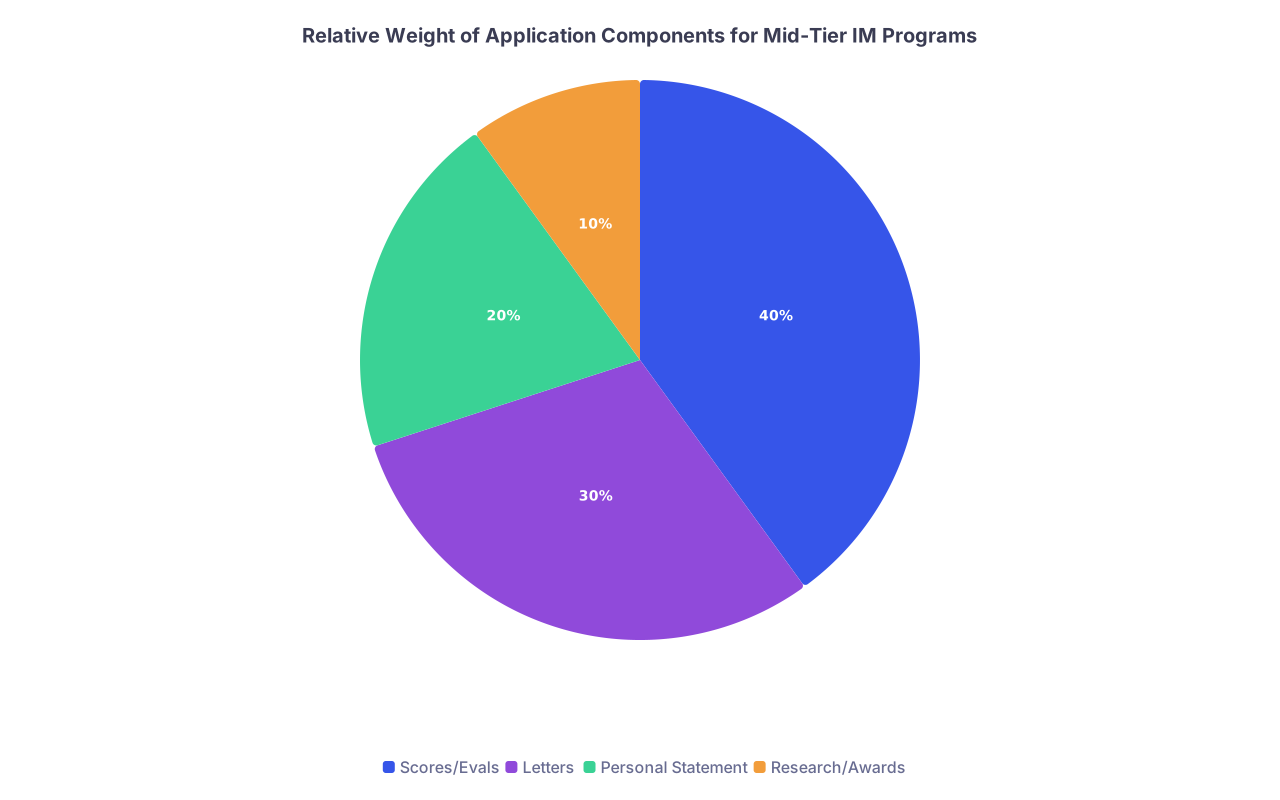
| Category | Value |
|---|---|
| Scores/Evals | 40 |
| Letters | 30 |
| Personal Statement | 20 |
| Research/Awards | 10 |
Is that exact pie chart from any one program? No. But that balance is pretty close to how many PDs talk about it behind closed doors. Research is nice. Not required.
What Your Personal Statement Shouldn’t Do (When You Don’t Have Research)
This is where people panic and make it worse.
They write a personal statement that screams: “I know I don’t have research. Please believe I’m still worthy. Let me overexplain myself to death.” I’ve seen versions like:
- “While I do not have research, I have always been very interested in…” (They already know. It’s not on your CV. Don’t spotlight it.)
- “Although I lack awards, I have worked very hard…” (You just bolded the thing you’re scared of.)
- Or the vague flexing: “My diverse experiences have prepared me…” with no concrete story, because you’re terrified your experiences are too small.
The absence of research or awards doesn’t have to be the central character in your personal statement. In fact, it shouldn’t be mentioned at all.
Let the CV say what you don’t have. Use the personal statement to scream what you do have.
So What Can You Highlight Instead?
Here’s the part nobody really walks you through: what is actually worth writing if you’re “just” a solid, non-research-heavy applicant?
Think about four big buckets you can build around:
- Clinical growth and how you handle real responsibility
- Genuine, specific connection to the specialty
- Long-term consistency in how you show up for patients and teams
- Resilience and self-awareness (without trauma-dumping or melodrama)
Let’s break those down into things you can actually write on a page.
1. Clinical Growth: Show You’re Already Acting Like a Resident
Programs care a lot more about: “Will this person function at 2 a.m. when it’s just them and a cross-cover pager?” than “Did they present at a national conference?”
So instead of lamenting your lack of publications, write about:
- The first time you carried a real patient load and didn’t completely fall apart
- A moment when feedback stung but you changed something concrete because of it
- A specific situation where you advocated for a patient—even when it was awkward
For example, in an internal medicine personal statement without research, you might write something like:
On my sub-internship, I was assigned five patients for the first time. By noon, I was behind on notes, my pager was going off, and my senior had just asked me why my discharge plan for one patient didn’t consider their lack of insurance. I went home that night feeling like I’d failed everyone. The next day, I showed up an hour earlier. I prepped social work notes, confirmed follow-ups, and clarified plans before rounds. It wasn’t glamorous. But by the end of the week, my senior trusted me to pre-round independently and update the team on changes. That shift—from “extra pair of hands” to “functional member of the team”—is what keeps pulling me back to internal medicine.
No awards. No research. But that paragraph shows teachability, reflection, and basic functional competence—huge green flags for programs.
2. Genuine Specialty Fit: Make It Impossible to Confuse You for Another Field
You’re applying to, say, pediatrics. Or psych. Or EM. If your personal statement could be swapped with any other specialty by changing three words, it’s weak.
You want them to think: “Yeah, this person gets our world.”
So you highlight:
- Actual moments on that rotation where it clicked
- What parts of the day you liked that many med students complain about
- What you were still thinking about 3 hours after leaving the hospital
For psych: maybe how you found yourself thinking about the subtle dynamics in a family meeting long after it ended—and how that confirmed you want deeper longitudinal relationships, not quick procedures.
For EM: maybe how the organized chaos of an overnight shift felt invigorating, not terrifying—and how you noticed you stayed calm while others spiraled.
You do not need a thesis on the future of the specialty. You need: “Here’s my lived experience in your field, and here is how I behaved.”
But I Don’t Have “Big” Stories—Is That a Problem?
No. Let me be blunt: personal statements overloaded with massive, dramatic patient stories can feel fake. Or worse, exploitative.
You can absolutely build a strong statement around “small” moments:
- The elderly patient who insisted on telling you about his garden every morning, and what that taught you about listening when you’re in a rush
- The child who stopped crying because you actually sat on the floor and played with them for two minutes
- The attending who quietly told you, “You’re good with families. Don’t lose that,” and how that stuck with you
Programs don’t need your life to be a Netflix special. They need evidence that you’re thoughtful, reliable, and capable of growth.
How Do I Compete With People Who Have Publications?
You don’t compete on their battlefield. You change the game.
Let’s be real: if someone has a 260+ Step 2, five papers in the exact specialty, glowing letters from big names, and a polished personal statement… you’re not outrunning them at MGH or UCSF just with a great essay.
But lots of programs aren’t looking for academic superstars. They’re looking for people who:
- Show up
- Do the work
- Don’t crumble under stress
- Aren’t impossible to work with
A personal statement without research is fine if it screams: “I know what residency actually is, and I want that, not just prestige.”
That is your lane.
Concrete Things You Can Highlight (That Actually Matter)
Let’s talk about what you can pull from your own life.
You can highlight:
- Long-term commitment to something unsexy: working as a CNA for years, tutoring, scribing, EMS, being a medical assistant before med school. This screams reliability.
- Real-world responsibilities: caring for a family member, working full-time before med school, being the main breadwinner. Not as trauma porn, but as evidence you know what responsibility feels like.
- Being the glue person on teams: not the loudest, but the one who texts the group to divide tasks, summarizes the plan, covers for someone who’s drowning. PDs love glue people.
- Clear growth arc: “I started out defensive about feedback, then this happened, and now I actively ask for it and adjust in these specific ways.”
None of this needs a line on PubMed to be compelling.
What If They Judge Me For Having “Nothing Impressive”?
They might. Some programs absolutely will. Let’s not sugarcoat it.
There are programs that skim: Step score, research, class rank, done. You weren’t getting much love from them anyway.
But the majority? They’re skimming for: “Will I regret being on call with this person at 3 a.m.?” That’s where you can win.
| Priority | What You Can Show In Your Statement |
|---|---|
| Work ethic | Concrete examples of doing more than required |
| Team compatibility | Stories of supporting peers, nurses, staff |
| Clinical judgment growth | A case where your thinking improved over time |
| Resilience | A setback and how you practically responded |
| Specialty motivation | Specific moments that pulled you into the field |
How To Mention Your Lack of Research (If You Really Need To)
Most of the time: you don’t mention it. At all.
The only exceptions where a brief nod may make sense:
- You started a project that fell apart for reasons outside your control, but the process still taught you something meaningful (about QI, about systems, about how you think).
- You made a late pivot into this specialty and literally didn’t have time to build a research portfolio, and that context matters.
Even then, keep it short. Example:
I came to psychiatry later in medical school, after initially planning on internal medicine. By the time I realized I wanted a career in mental health, there wasn’t enough time to build a traditional research portfolio in the field. Instead, I’ve focused on finding every possible clinical and elective opportunity to work with patients with severe mental illness, including…
That’s it. You explain, pivot, and get back to what you have done.
No apologies. No groveling.
Rough Outline You Can Steal
Here’s a simple structure that works well when you don’t have research or awards to lean on:
- Opening: One concrete clinical moment that captures you in this specialty. Not dramatic, just real.
- Development: How that moment reflects your values or how you like to work (team-based, longitudinal, procedural vs cognitive, etc.).
- Growth: A time you were challenged, messed up, or got hard feedback, and how you changed.
- Connection to specialty: Specific aspects of that field’s daily work that match who you are. Show you understand the reality.
- Future orientation: What kind of resident you’ll be, what environments you’re drawn to (community vs academic, underserved, etc.), and what you’re excited to learn.
No research required. Just honesty and specificity.

| Step | Description |
|---|---|
| Step 1 | Clinical Moment |
| Step 2 | Personal Values |
| Step 3 | Growth Story |
| Step 4 | Why This Specialty |
| Step 5 | Future Resident Identity |
The Anxiety You’re Not Saying Out Loud
Underneath all of this is a nastier thought: “Maybe I just don’t have enough to offer. Maybe I wasted med school.”
You didn’t.
You went to class. You passed. You took care of actual human beings. You survived rotations that broke other people. Maybe you worked jobs, supported family, put out fires in your own life.
Programs are not looking for superheroes. They’re looking for people who can do the job and not implode. Your personal statement is where you quietly say: “I can carry the weight. And here’s evidence of that.”
You don’t need an award to prove it.

FAQ: Anxious Questions You’re Probably Still Thinking
1. Do I need to explain why I don’t have research?
Usually no. Programs can read your CV. If you start explaining, you risk overemphasizing it. Only explain if there’s important context (late specialty switch, long-term personal responsibilities, non-traditional path) and even then keep it to 1–2 sentences, then move on.
2. Should I try to make my volunteering sound like “research-adjacent”?
Don’t force it. Saying “I participated in a quality improvement project” when you mean “I helped hand out surveys” is transparent. If you did QI or projects, describe what you actually did and what you learned. You’re not fooling anyone by trying to disguise basic volunteering as research.
3. Is a strong personal statement enough to overcome no research in a competitive specialty?
For ultra-competitive fields (derm, plastics, ENT, neurosurg, some ortho, rad onc): probably not by itself. Those specialties often use research as a screen. A strong statement can help at mid-tier or more holistic programs, or if you’re backed by incredible letters, but it won’t replace a missing major pillar in those fields.
4. How many patient stories should I include if I don’t have research to talk about?
Usually one main story, maybe a brief secondary one. Don’t stack five cases. It starts to sound like a chart review. Depth over quantity. Choose one case that shows how you think and who you are, not just an emotionally heavy story.
5. Can I talk about personal hardships instead of research or awards?
You can, but be careful. The hardship shouldn’t replace clinical substance. Use it to show resilience, perspective, and how it shapes you as a physician—not as a plea for pity. And always, always connect it back to how you’ll function as a resident.
6. What’s the biggest mistake applicants without research make in their personal statements?
Apologizing on the page—directly or indirectly. Writing like you’re trying to convince the reader you’re “not as bad as you look on paper.” That energy oozes insecurity. Focus instead on clear, grounded examples of you showing up for patients and teams. That confidence (even if you have to fake it a bit while you write) is far more persuasive than a paragraph of excuses.
Bottom line:
You’re not disqualified from writing a strong residency personal statement just because you don’t have research or awards. Focus on what programs actually need to know: how you behave clinically, why this specialty fits you, and how you’ve grown. Make it specific, honest, and grounded in real experiences. Let your CV show what’s missing; let your personal statement show why they should still say yes.