
The obsession with a “defining story” is ruining a lot of perfectly good personal statements.
You’re not crazy for thinking, “I have no big tragedy, no life-changing epiphany, no miracle patient—so my residency personal statement is going to sound boring and they’ll just toss my app.” I hear this constantly. Especially from people who are actually very solid applicants.
Let me say this as plainly as I can: programs are not sitting there with a checklist that says, “Trauma? Check. Near-death experience? Check. Overcame six disasters before breakfast? Check.”
They’re asking something much more practical: “If I work with this person at 3 a.m. on a terrible call night, do I trust them? Do I like them? Do they seem grounded and self-aware?”
That’s it. That’s the whole game.
The Lie You’re Probably Falling For
There’s a very popular myth: A great personal statement = one epic, cinematic story that defines your entire life and career choice.
That’s not how real people work. Or how real applications are read.
Most residents’ lives look more like this:
- Some decent clinical moments
- A few interesting patients
- A couple of mentors who nudged them
- Gradual interest in a specialty, not a thunderbolt from the sky
And yet those people match. All the time.
You know what actually does hurt personal statements?
Not being honest.
Trying so hard to be “unique” that you sound fake.
Rambling in a vague way about “passion for helping others” and “lifelong dream” with zero concrete details.
You don’t need a defining story. You need a coherent, believable narrative.
That’s a different thing.
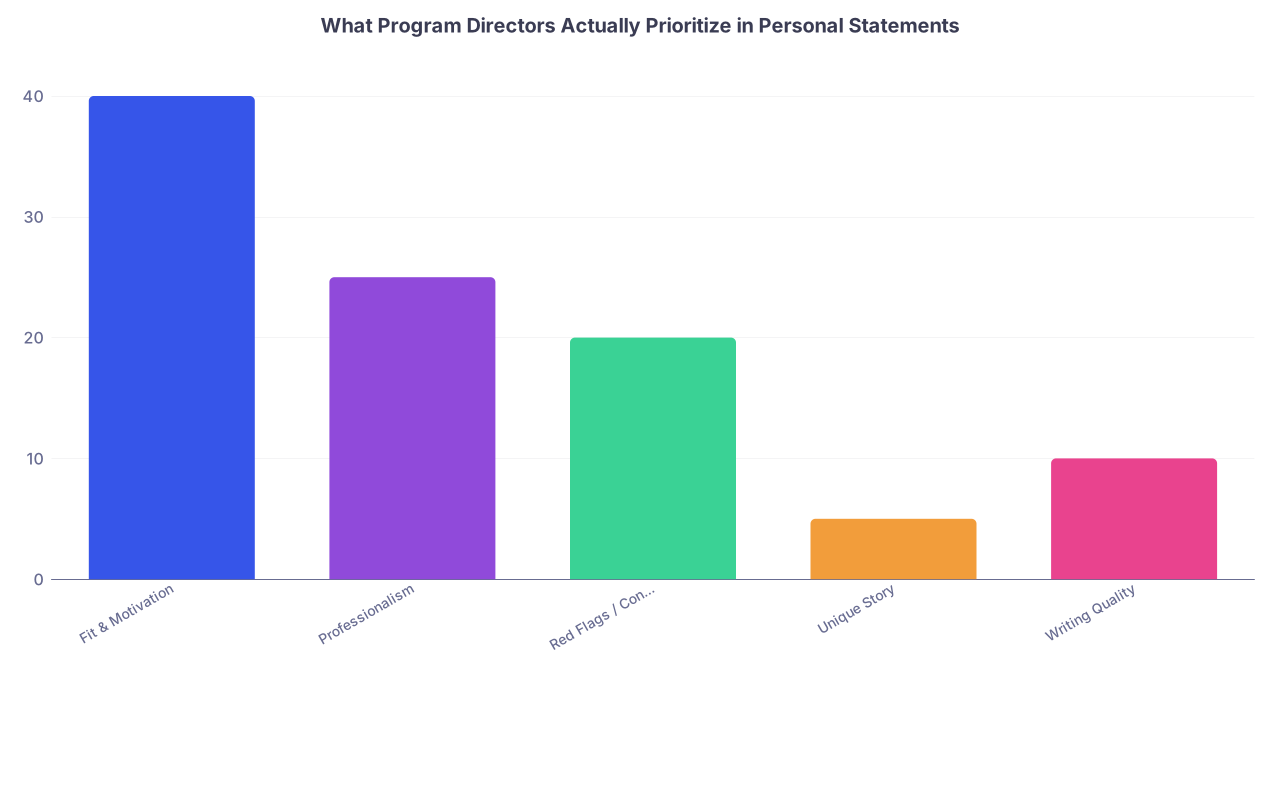
| Category | Value |
|---|---|
| Fit & Motivation | 40 |
| Professionalism | 25 |
| Red Flags / Concerns | 20 |
| Unique Story | 5 |
| Writing Quality | 10 |
What Program Directors Are Actually Looking For
Let me pull back the curtain a bit. I’ve seen how these things get discussed behind closed doors.
No one is saying, “She didn’t have a dramatic story, so we’re not ranking her.”
What you hear more often is:
- “He seems immature.”
- “Her statement was all over the place—does she even know why she wants this specialty?”
- “He threw his school and attendings under the bus, that’s a red flag.”
- “She sounds solid and grounded. Not flashy, but I’d work with her.”
That last one gets people ranked. A lot.
So what do they actually care about?
They want your personal statement to answer, in some form:
- Who are you on a normal Tuesday, not just on your “best day ever”?
- Why this specialty, in a way that sounds like you’ve actually seen the realities?
- What are you like to work with—self-aware, teachable, decent under pressure?
- Any context for bumps in your record, if relevant, without sounding defensive?
Nowhere in there is “Did this person survive a major life catastrophe?”
If you have some big story and it’s authentic, fine. Use it. But if you’re stretching to invent a “defining moment” out of a pretty standard clerkship encounter, it reads as forced. And program directors are very good at sniffing out manufactured drama.
How to Build a Strong Personal Statement Without a Big Story
You’re probably asking, “Okay, but what do I actually write?”
So let’s be concrete.
You can build a great residency personal statement around these four pillars, even if nothing in your life feels “epic”:
- A clear, honest arc of how you came to like this specialty
- A few small, specific moments that show how you think and behave
- Reflection on what you’ve learned about yourself as a future resident
- A grounded sense of who you’ll be on their team
1. The clear, honest arc
You don’t need, “I knew I wanted to be a surgeon when I was five and cut open my teddy bear.” That stuff reads ridiculous anyway.
Perfectly acceptable arc:
- Went into med school open-minded
- Found X rotation interesting for these concrete reasons
- Confirmed it with sub-I / electives / research / talking to residents
- Now you have a realistic view of the field and still want in
That’s enough. Truly.
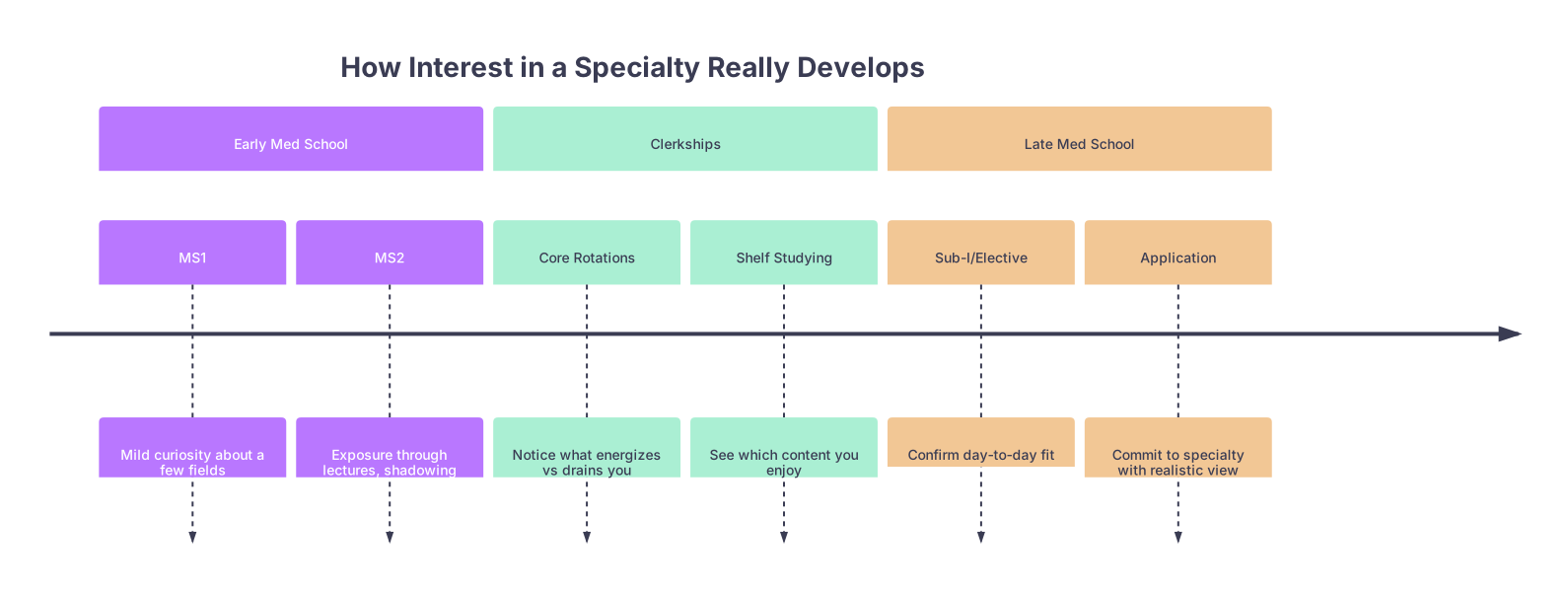
| Period | Event |
|---|---|
| Early Med School - MS1 | Mild curiosity about a few fields |
| Early Med School - MS2 | Exposure through lectures, shadowing |
| Clerkships - Core Rotations | Notice what energizes vs drains you |
| Clerkships - Shelf Studying | See which content you enjoy |
| Late Med School - Sub-I/Elective | Confirm day-to-day fit |
| Late Med School - Application | Commit to specialty with realistic view |
2. Small, specific moments (not epic ones)
You think you need the biggest, wildest patient ever. You don’t.
You need a few real, small moments:
- The day you realized you liked following complex patients over time
- The consult where you watched a senior calmly handle chaos and thought, “I want to be like that”
- The morning you found yourself excited to look up labs, imaging, or tweak a treatment plan
These aren’t cinematic. But they’re credible. And credibility is more valuable than drama.
Red flag move: taking a totally normal patient and writing it like a Netflix medical drama. “Time stood still as I held his hand and realized my destiny.” No. It didn’t. You didn’t.
Better: “On inpatient medicine, I noticed I was the one who actually enjoyed pre-rounding—piecing together overnight events, labs, and clinical changes into a coherent story. I liked that quiet detective work more than anything else that month.”
That line doesn’t sound impressive. But it sounds true. And that’s the point.
3. Real reflection, not Hallmark-card reflection
Most bad statements suffer from one main disease: vague reflection.
Things like:
“I learned the importance of empathy.”
“This experience taught me the value of teamwork.”
Those are non-statements. Of course empathy and teamwork matter. If you can swap your line into 500 other essays and it still fits, it’s useless.
You want concrete + reflective:
- What specifically did you notice about yourself?
- How did you actually behave differently after that?
- What did you get wrong first, then improve?
Example of generic: “I learned communication is key when working with a care team.”
Example of real: “Early in third year, I’d silently double-check orders rather than ask the resident when I was unsure. After a missed lab draw and a gentle but firm conversation, I started forcing myself to speak up—even if I felt stupid. It’s uncomfortable, but now I’d rather sound uncertain at noon than realize at midnight that I should’ve asked.”
See the difference? That’s growth. That’s someone I’d want on my team.
4. Who you’ll be at 3 a.m. on night float
Residency is not abstract. It’s bodies in beds, pages going off, tired people trying not to screw up.
Your personal statement should give a quiet signal of:
- How you handle being wrong
- What you’re like when you’re tired but still responsible
- Whether you can take feedback without melting down or blaming everyone else
You don’t need to say, “I am resilient and hardworking.” Everyone says that.
Show it in your examples:
The time you took responsibility for a missed detail and fixed your system.
The way you prepared more thoroughly after you froze during a pimping session.
How you adjusted after realizing you were snapping at nurses when stressed.
Again: small, human, believable. That’s what lands.

“Normal” Background? Here’s How You Use It
A lot of anxiety comes from comparisons: “Everyone else was a refugee, Olympic athlete, or had ten siblings and raised three of them. I just…went to school.”
Here’s the unglamorous truth: programs actually like predictable, low-drama people who show up, do the work, and don’t create chaos.
If your life story is:
- Middle-class background
- No major disasters
- Reasonably supportive family
- Straight-through college → med school
That’s fine. You don’t have to apologize for not suffering more.
What matters is how you’ve used your opportunities and how you function now.
Your “normal” can still show:
- Reliability (you show up, consistently)
- Curiosity (you notice patterns, ask good questions)
- Emotional maturity (you’re not constantly the victim in your own story)
You can say something like: “I don’t have a single defining moment that pushed me toward internal medicine. My interest developed slowly over repeated experiences: watching long, complicated admissions evolve over days, following up with patients I’d seen in clinic, and realizing I enjoyed synthesizing information more than any single procedure.”
That kind of honesty is refreshing. And believable. And enough.
The Worst-Case Scenarios You’re Imagining (And What Actually Happens)
Let’s actually name the fears, because they’re loud in your head anyway.
Fear #1: “My statement will sound generic and I’ll get screened out.”
Reality: You’re not getting screened out solely on your personal statement unless it’s truly bad (unprofessional, weird, arrogant, or full of errors). Most of the heavy lifting is done by scores, MSPE, grades, and letters.
Where the personal statement matters most:
- Clarifying your story when there are concerns
- Differentiating you slightly among similar applicants
- Avoiding red flags that push you down the rank list
So if you write a clean, honest, grounded personal statement with no drama? You’re already in the safe zone. The goal is “competent and coherent,” not “life-changing literature.”
Fear #2: “Programs will think I lack depth because I don’t have trauma.”
No. Depth doesn’t come from trauma. It comes from reflection.
You can be incredibly shallow with trauma and incredibly deep without it. They’re not the same thing.
If your essay shows that you think about:
- Your own limitations
- The kind of colleague you want to be
- The reality of your chosen field (the boring parts too)
You’ll come across as mature. That’s what they care about.
Fear #3: “Everyone else’s story is better than mine.”
You’re seeing Instagram versions of their stories. Personal statements that actually get read on selection committees? A huge chunk of them are very normal.
Lots sound like: “I grew to enjoy X specialty through exposure in medical school, mentorship, and hands-on patient care. Here’s who I am, how I work, and what I hope to learn.”
You’re not behind. You’re just not marketing yourself like a TV character. That’s a good thing.
A Simple Structure You Can Steal (That Doesn’t Require a Big Story)
If you’re staring at a blank page and spiraling, try this skeleton. It works even if your life feels aggressively average.
Paragraph 1: A small, real moment or observation that introduces you in the context of your specialty. Not necessarily your “defining” moment, just a representative one.
Paragraph 2–3: How your interest in the specialty actually developed over time—rotations, mentors, aspects of the work that fit how your brain and personality operate.
Paragraph 4: Reflection on what you’ve learned about yourself on the wards—your growth, the kind of teammate you are, what you’re working on improving.
Paragraph 5: A grounded look forward—what excites you about residency, what kind of training environment you’re seeking, the kind of resident you aim to be.
Nowhere in that outline is “insert trauma here” or “insert cinematic story here.” And yet this format has produced plenty of strong, ranked-high personal statements.
| Feature Type | Strong Example | Weak Example |
|---|---|---|
| Story Style | Small, specific, believable | Overly dramatic, movie-like |
| Motivation for Specialty | Gradual, reality-based interest | Instant 'destiny' moment |
| Reflection | Concrete growth and self-awareness | Vague 'I learned empathy' lines |
| Tone | Grounded, professional, human | Grandiose, fake-humble, or generic |
| Impact on Application | Confirms fit, avoids red flags | Raises questions, feels performative |

Quick sanity check before you hit submit
Ask yourself:
- Does this sound like a real human, or like ChatGPT + a thesaurus + a Hallmark card?
- Could my best friend read this and say, “Yeah, that’s you,” without laughing?
- Did I avoid inventing drama or pretending I had one magical “calling” moment that I actually didn’t?
If yes, you’re in better shape than you think.
One more thing you probably need to hear
You’re allowed to be a regular person and still be a strong applicant.
You’re allowed to have a slow-burn interest in your specialty.
You’re allowed to not bleed your entire life story onto the page.
A strong personal statement for residency is not a confessional diary entry or a superhero origin story. It’s a clear, honest, specific snapshot of who you are as a future colleague.
That’s more than enough.