
The ugly question: do big words buy you interviews?
You’ve seen them. Those “sample personal statements” circulating in group chats where every other word sounds like it escaped from a Victorian novel. You read one and think: Is this what programs actually want? Am I supposed to write like a thesaurus that went to med school?
Let me be blunt: if you’re stuffing your residency personal statement with flowery vocabulary and tangled sentences because you think it makes you sound smarter, you’re not aiming at the wrong target.
You’re aiming at the wrong sport.
Let’s dismantle the myth and look at what actually happens when program directors and faculty read your statement—and what the data and real-world experience say about fancy language.
What the people reading your personal statement actually care about
Most applicants write as if their personal statement will be dissected like a New England Journal paper. It won’t.
Here’s the reality I’ve heard over and over from program directors and selection committee members:
- They skim. Heavily.
- They read hundreds of these, often at the end of long clinic days.
- They care about clarity, red flags, and authenticity.
- They do not care how many synonyms for “passionate” you can generate.
We have decent data on this. NRMP Program Director surveys (2018, 2020, 2022) consistently show that the personal statement is “important,” but not because of vocabulary. It’s used to:
- Detect poor communication skills
- Detect lack of professionalism or weirdness
- Understand your interest in their specialty and sometimes their program
Notice what’s missing: “sophisticated vocabulary” or “complex sentence structure.”
Those are not on the list. Anywhere.
In fact, what they actually penalize—this comes up repeatedly in PD panels and workshops—is:
- Overly dramatic language
- Clichés and generic filler
- Confusing or rambling prose
- Statements that feel fake or performative
Which is exactly where overcomplicated writing loves to hide.
Why flowery writing backfires in residency applications
Let’s clear something up: writing clearly is not the same as writing “dumb.” You can be intellectually sophisticated and still write in plain English.
The problem is not using some advanced vocabulary. The problem is when:
- The words are obviously above your natural speaking level.
- The complexity makes your meaning harder to understand.
- The style feels like you’re trying to perform intelligence instead of communicate.
I’ve reviewed a lot of personal statements. The patterns are painfully consistent.
Here’s what actually happens with flowery language and convoluted sentences.
1. It kills clarity
Residency is about communication. Orders. Handoffs. Progress notes. Explaining bad news to patients at 3 a.m.
If your personal statement reads like this:
“This formative odyssey through the labyrinthine corridors of clinical medicine indelibly catalyzed my burgeoning ardor for internal medicine as a vocation.”
You’ve just told the reader two things:
- You don’t prioritize clarity.
- You think sounding fancy is more important than being understood.
Here’s what a program director hears behind that kind of sentence: Is this how they chart? Is this how they’ll present a patient?
They don’t want that on rounds.
2. It signals insecurity, not intelligence
A brutal truth: overcomplication often reads as compensation.
Overuse of words like “plethora,” “myriad,” “innately,” “profoundly,” “ameliorate,” and “alleviation of suffering” doesn’t make you unique. It makes you indistinguishable from every other applicant who panicked and tried to “sound impressive.”
Authentic confidence shows up like this:
- Specific stories
- Honest reflection
- Straightforward language
Insecure writing shows up like this:
- Heavy adjectives and adverbs
- Abstract claims about “passion” and “resilience”
- Zero concrete detail
When someone writes, “I have always been deeply and profoundly passionate about the intricate and multifaceted nature of the human condition,” what they’re really saying is: “I don’t know how to show you who I am, so I’ll hide behind big, vague language.”
And yes, readers notice.
3. It injects cognitive friction—and that costs you
Readers are tired. Your job is to reduce their mental workload, not increase it.
If someone has to reread your sentence to grasp what you mean, they won’t think, “How sophisticated.” They’ll think, “I don’t have time for this,” and skim faster.
That skimming? That’s where nuance, depth, and any real insight you included goes to die.
Complex sentences can work—if they’re controlled and intentional. But endless 40–50 word sentences chained with “which,” “therefore,” and “consequently” just slow the reader down and irritate them.
What the data and real-world behavior quietly confirm
We do not have a randomized controlled trial of “flowery vs. plain-language personal statements” and match outcomes. But we have three useful pieces of indirect evidence.
1. Program director surveys
They consistently rate:
- “Evidence of professionalism”
- “Written communication skills”
- “Interest in the specialty”
as important in personal statements.
Again: no one is scoring your “lexical complexity.” Communication skills in medicine = clarity + appropriateness + focus. Not verbal gymnastics.
2. Interview behavior
Here’s what I’ve seen over and over: a wildly ornate statement leads to one of two reactions in interviews.
Scenario A:
Faculty: “Your writing style in the statement was very…literary. You speak quite differently. Did you get a lot of help with your essay?”
That’s a soft version of “Did you actually write this?” Not great.
Scenario B:
They ignore the statement entirely because it felt like “performance” and focus on your experiences instead. You blew your chance to have your story guide the conversation.
3. Time pressure
Most faculty reviewing applications are doing so in snatches of 5–15 minutes between real work. Under time pressure, people lean toward what’s easy to process.
Overcomplicated writing is effortful to read. The easier your statement is to follow, the more of it actually lands.
To drive this home, think of it like this:
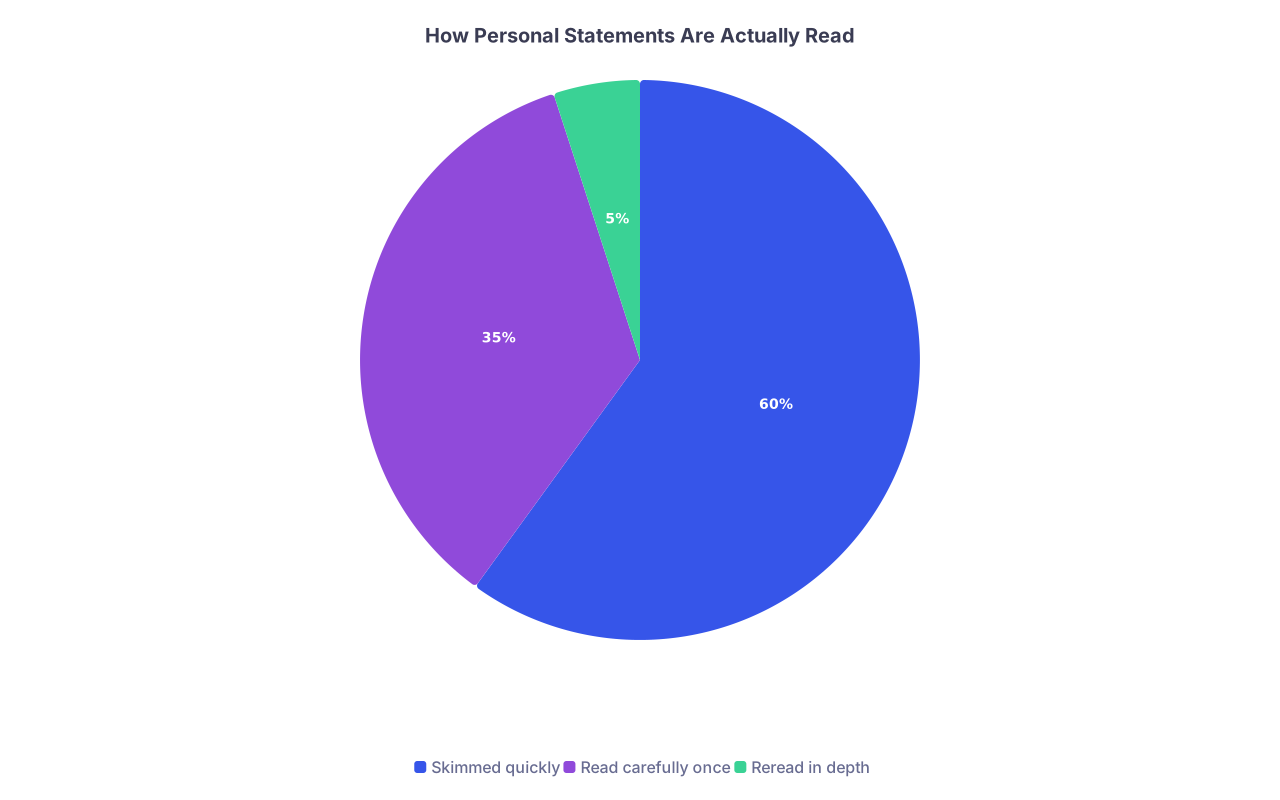
| Category | Value |
|---|---|
| Skimmed quickly | 60 |
| Read carefully once | 35 |
| Reread in depth | 5 |
The tiny sliver of “reread in depth” is not where you live. Write for the 60% who are skimming, then reward the 35% who read carefully with substance—not ornament.
Where complex language is allowed—and where it’s poison
Nuance matters. I’m not saying you should write at a 6th grade level and pretend you never went to college.
You’re a physician. Some complexity is expected. The trick is being precise, not decorative.
Appropriate uses of more advanced language
- Technical terms when they’re the clearest option: “decompensated cirrhosis,” “hemodynamic instability,” “shared decision-making.”
- Exact emotional descriptions: “ambivalence,” “disillusionment,” “humility,” “frustration.”
- Occasional, well-placed rhetorical flourish—one metaphor that fits, not six per paragraph.
The question is always: does this word or structure make my meaning sharper or blurrier?
Places where flowery language is toxic
- Your opening line. If your first sentence sounds like the back cover of a novel, they roll their eyes and brace themselves.
- Describing patients as “characters” or “archetypes” in your “journey.” That’s how you dehumanize people without realizing it.
- Generic “medicine is noble” paragraphs. This is where people go full Hallmark card with “indelible impact,” “sacred privilege,” and “relentless commitment.” Everyone else is already doing that. You don’t want to blend into that soup.
Concrete examples: what actually reads better
Let’s stack some versions against each other.
Example 1: Overwritten vs. effective
Overwritten:
“I was profoundly humbled and irrevocably transformed by bearing witness to the tenacity of the human spirit in the face of overwhelming adversity during my sub-internship in internal medicine.”
Cleaner, stronger:
“On my internal medicine sub-internship, I watched a patient with end-stage heart failure fight to walk five steps with physical therapy. That day changed how I think about what ‘progress’ means.”
Second version uses simpler words, more concrete detail, and lands a sharper point. It feels real.
Example 2: Vocabulary inflation
Overwritten:
“I have always possessed an innate proclivity for meticulous attention to detail and a fervent dedication to the amelioration of human suffering.”
Cleaner, stronger:
“I pay attention to details, and I care about whether my patients actually feel better.”
Is the second one less “fancy”? Yes. Is it more trustworthy? Absolutely.
The hidden risk: mismatch between how you write and how you speak
Program directors are not stupid. When they see a statement dripping with ornate language and then meet an applicant who speaks plainly and casually, they notice the disconnect.
Then two questions show up:
- Who really wrote this?
- How much of what I’m seeing in this application reflects the real person?
That’s not great when you’re trying to win trust.
Your written voice doesn’t have to match your spoken voice perfectly. But they should be cousins, not strangers.
Practical test:
Read your statement out loud as if you’re answering an interview question. If you’d never talk like that in real life, your writing is trying too hard.
What actually impresses in a residency personal statement
Here’s the part everyone wants: what does work?
It’s not mysterious, but it is harder than throwing adjectives at the page.
1. Specific, grounded stories
A single concrete moment beats a paragraph of abstractions.
“I learned the importance of communication” is meaningless.
“I watched a patient’s face change when I stopped talking in acronyms and asked what worried her most about going home” tells me something real.
2. Clear articulation of why this specialty
Your “fit” for a specialty is not about declaring “I am deeply passionate about X.” Show:
- The types of patients you like
- The problems you enjoy working through
- The settings you’re drawn to
And do it with simple, direct language.
3. Thoughtful reflection—using plain words
The rarest thing in personal statements is not vocab. It’s honest self-awareness.
What did you get wrong before? What did you learn the hard way? How have you changed?
That’s what people remember.
A quick comparison: what program directors actually use essays for
Let’s lay out the contrast directly.
| What They Want To See | What Applicants Think Impresses |
|---|---|
| Clear communication | Fancy vocabulary |
| Professional judgment | Dramatic life story |
| Fit with specialty | Grand philosophical musings |
| Maturity and insight | Complex sentence structures |
| Red flags (or lack of them) | Quotations and metaphors |
Those right-hand items are exactly where most people waste their time.
How to strip the fluff from what you’ve already written
You probably already have a draft. And it probably has some of the issues I’m talking about. Fixable.
Here’s a simple, ruthless process that works better than any “use this template” nonsense.
- Highlight every adjective and adverb.
- Delete a third of them. At least.
- Find every sentence longer than 30 words. Break most of them into two.
- Change vague verbs (“was,” “had,” “did,” “helped”) into more concrete ones where it matters.
- Replace any word you wouldn’t comfortably say out loud on rounds.
If you want one more structural tool, map your statement against this:

| Step | Description |
|---|---|
| Step 1 | Hook: 2-3 sentences |
| Step 2 | 1-2 clinical stories |
| Step 3 | What you learned and how you changed |
| Step 4 | Why this specialty fits you |
| Step 5 | What you bring to a program |
| Step 6 | Simple, confident closing |
Nowhere in that flow is there a step labeled: “Insert elaborate vocabulary to impress.”
Why this myth survives (and why you should ignore it)
So if the evidence and real-world behavior are this clear, why do people still cling to the “big words = impressive” idea?
Three reasons:
- Prestige anxiety. People assume academic = ornate. They confuse journal-article density with personal-statement effectiveness. Different genre, different rules.
- Bad models. Online “best sample essays” are often selected by test-prep companies or random websites, not actual program directors. They bias toward theatrics.
- Peer pressure. You read a classmate’s statement packed with fancy language and think, “Mine sounds too simple.” What you’re actually noticing is: “Mine sounds like me.” That’s an advantage.
The people who read hundreds of these each year are not seduced by verbal fireworks. They’re relieved when someone just tells them, clearly and honestly, who they are and why they belong in that specialty.
The bottom line
Flowery vocabulary and complex sentences are not impressive. They’re camouflage.
Three things to remember:
- Clear, concrete, authentic writing beats ornate, performative prose every single time.
- Big words and convoluted sentences usually signal insecurity, not intelligence—and readers sense that.
- Your personal statement should sound like a thoughtful, slightly polished version of you, not like a Victorian novelist who shadowed on your rotations.