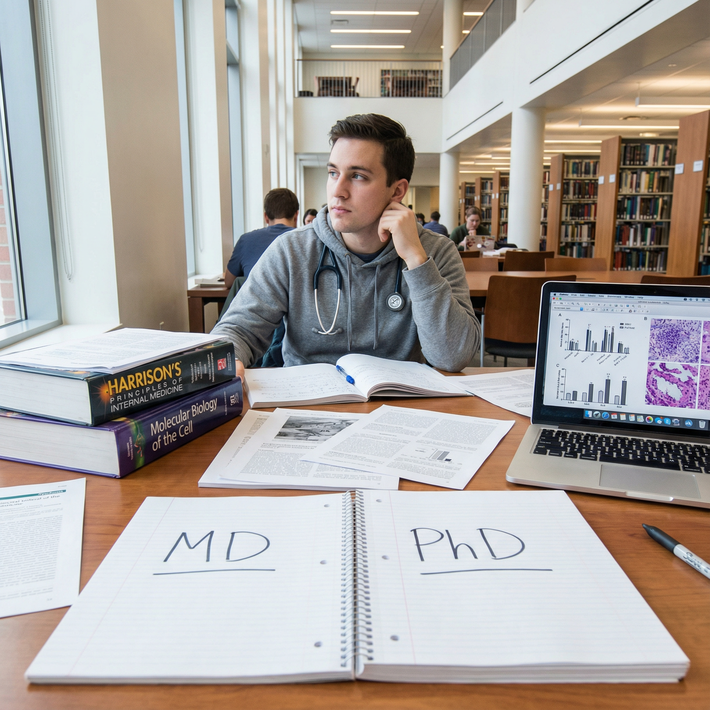
Burnout is an occupational hazard in academic medicine. It is not a matter of if, but when and how hard it hits. But here is the reality most institutions ignore: this hazard is not evenly distributed across degree paths. We treat MD-only and MD-PhD physicians as if they experience the exact same systemic pressures. They don't. Treating them identically is a lazy administrative shortcut that costs us brilliant minds.
To understand the gap, we have to define the three domains of burnout. First, emotional exhaustion, running on fumes and dreading the pager. Second, depersonalization, the cynicism that creeps into patient encounters and lab meetings. Third, low personal accomplishment, the creeping suspicion that you are a fraud. Physician-scientists face a unique dual identity strain. They are constantly code-switching. One hour they are managing a crashing ICU patient; the next, they are troubleshooting a failed assay.
So, what is the actual impact of the dual degree? Do MD-PhDs burn out less, more, or just differently than their MD-only peers? Let's look at the data, cut through the noise, and get to the protocols that actually fix the problem.
(See also: fear burnout in lab-loving students for a personal perspective.)
The following insights regarding career trajectories and salary timelines are for educational purposes only. This is not financial advice, not legal advice, and not tax advice. Because institutional policies and figures vary, you should consult a qualified professional before signing any employment contracts.
The Academic Medicine Burnout Baseline: Why Degree Path Matters
Look at the numbers. Large surveys and meta-analyses tell a very specific story about the physician-scientist pipeline. Early in training, MD-PhD residents actually report lower burnout than their MD-only peers. During residency, you see roughly 34% burnout for MD-PhDs versus 41% for MD-only trainees.
(Also see: when MD-PhD surpasses straight MD for earnings data.)
Why the gap? Protected research time. A built-in buffer. MD-PhD residents often have dedicated research months or integrated scientist tracks that pull them out of the relentless clinical grind. It gives them a psychological breather and reinforces their primary identity as investigators.
But wait until the faculty transition. The gap narrows dramatically. By mid-career, the burnout rates sit at 36% for MD-PhDs and 38% for MD-only faculty. The early MD-PhD "advantage" completely evaporates when funding stress and clinical demands peak.
You have to understand the confounders here. The data is messy. Selection bias plays a massive role; MD-PhDs are heavily filtered for extreme grit and delayed gratification before they even start medical school. Specialty choice is another factor. MD-PhDs cluster heavily in internal medicine subspecialties, avoiding the high-burnout surgical fields that skew MD-only data.
But the funding climate is the great equalizer. When the NIH payline drops, everyone hurts. But the MD-PhD hurts differently. Their entire professional identity and tenure track are tied to that grant. An MD-only clinician can pivot to pure clinical practice if academia gets too toxic. An MD-PhD who loses their funding often feels they have lost their reason for existing in the academic space. The burnout isn't just about working too many hours. It's about existential professional threat.
Why the PhD Pathway Cuts Both Ways: Protective Factors and Added Stressors
The dual degree is a double-edged sword. It reshapes the timing and triggers of burnout across the career arc.
On the protective side, the PhD pathway builds a structured research identity. You know who you are and what you are trying to build. It also forces a high tolerance for ambiguity. Science fails 90% of the time. You learn to eat failure for breakfast and keep going. That resilience translates directly to clinical setbacks. Add in a built-in peer cohort of other physician-scientists, and you have a strong psychological buffer.
But the risk factors are brutal. The training is a marathon, often stretching 8 to 10 years. That means a massively delayed attending salary and delayed life milestones. Then comes the "double expectation" trap. You aren't just expected to be a good doctor or a good scientist. You are expected to be a star at both.
I've watched brilliant MD-PhDs quit academia because they felt like mediocre clinicians when they were in the lab, and mediocre scientists when they were in the clinic. The cognitive load of maintaining dual competencies is exhausting.
When you map out the burnout-risk pathway, the divergence is clear. If an MD-PhD hits the faculty transition with secure funding, they experience renewed purpose. If they hit it with unstable funding and creeping clinical demands, they spiral into imposter syndrome and exhaustion. The MD-only pathway has its own cliffs, but the MD-PhD cliff is uniquely tied to the loss of the research identity they spent a decade building.
Structural Fixes That Move the Needle: Time, Funding, and Mentorship
Enough diagnosing the problem. Here is how we fix it. If you are a department chair, division chief, or training director, you have a fiduciary duty to implement these protocols. Hope is not a strategy. Structural changes are.
1. Implement Time-Banked Clinical Effort Stop telling MD-PhD faculty they have "50% protected research time" and then quietly expecting them to cover clinical shortfalls. It's a lie, and they know it. Implement a time-banked system. Set a hard minimum of 50% protected research time with a hard stop on clinical overruns. If the clinical side demands 60% of their effort due to staffing shortages, the department must buy back that 10% from the research side with hard dollars to hire clinical coverage. Make the clinical overruns financially visible to the department leadership. When it hits the budget, the behavior changes.
2. Mandate Dual-Mentorship Committees Kill the single-mentor model for physician-scientists. It's archaic. A pure clinician doesn't understand the pressures of an R01 submission, and a pure PhD doesn't understand the fatigue of taking overnight call. You must assign dual-mentorship committees featuring both a clinical champion and a research champion. Tie promotion criteria to team science rather than just solo productivity. If you force MD-PhDs to be lone wolves, they will burn out trying to hunt everything themselves.
3. Deploy Burnout Surveillance Dashboards You cannot fix what you do not measure, and "overall faculty burnout" is a useless metric. It hides the pain of specific subgroups. Build burnout surveillance dashboards stratified by degree path and career stage. Look specifically at "MD-PhD junior faculty" versus "MD-only junior faculty." When the dashboard flags a spike in emotional exhaustion among your K-award recipients, act on the data immediately with targeted interventions. Don't wait for the annual wellness survey. Run pulse checks quarterly.
4. Provide Grant-Transition Coaching and Bridge Funding The gap between a K award (career development) and an R01 (independent research) is where academic careers go to die. The stress of this transition is a massive burnout trigger. Provide dedicated grant-transition coaching to help them navigate the brutal NIH review process. More importantly, guarantee institutional bridge funding. If an MD-PhD's K award ends and their R01 is pending or needs resubmission, the institution must bridge their salary and lab space for at least 12 months. Protect the vulnerable window where faculty burnout spikes.
5. Redefine Clinical RVU Expectations MD-PhDs should not be held to the same Relative Value Unit (RVU) targets as pure clinicians. It is mathematically impossible to generate the same clinical revenue while running a lab. Adjust their RVU targets downward to reflect their research effort, and subsidize the difference through the department's academic mission fund. Penalizing them for lower clinical productivity while they are writing grants is a fast track to depersonalization and resentment.
Your Next Step: Use the Data to Build a Sustainable Academic Career
Data without action is just trivia. It is time to move.
If you are an MD-PhD trainee or junior faculty member, calculate your own burnout load right now. Look at your clinical hours, your lab hours, and your sleep. If the math doesn't work, negotiate for protected time and clear RVU expectations before the crisis hits. Get it in your contract. Do not rely on verbal promises from well-meaning but overextended division chiefs.
If you are a leader in academic medicine, run the degree-stratified burnout numbers in your department this week. Identify your most vulnerable cohort. Then, implement at least one of the structural interventions listed above this quarter. Start with the time-banked clinical effort. It is the single highest-yield fix you can deploy.
The goal here is not to avoid MD-PhD stress entirely. Stress is inherent to pushing the boundaries of human knowledge and healing the sick. The goal is to make the dual career sustainable, structured, and deeply rewarding. We need physician-scientists to cure the diseases we can't yet touch. Let's stop burning them out before they find the answers.