
The biggest myth in academic medicine is that promotion criteria are “the same for everyone.” They are not. MD and PhD faculty are playing related but structurally different games.
Let me break this down specifically, because this misunderstanding derails careers. I have watched excellent clinicians stall at assistant professor for a decade while basic scientists blow past them to early-tenure associate professor. Not because one group is better, but because they were being judged against different scorecards.
This is not about generic “teach, do research, serve.” It is about the weighting of those pillars, what actually counts as “impact,” and who really writes the rules at promotion time.
The Basic Framework: Same Titles, Different Currencies
Most academic medical centers use the same rank structure:
- Instructor
- Assistant Professor
- Associate Professor (often with tenure potential)
- Professor (sometimes “full Professor”)
On paper, both MD and PhD faculty are evaluated across three pillars:
- Research / scholarly output
- Teaching / education
- Service / institutional citizenship (committees, leadership, clinical admin)
The problem is that MD and PhD tracks translate those pillars into different currencies.
- For PhDs, the dominant currency is grant dollars and high-impact publications.
- For MDs, the effective currency is clinical reputation, program-building, and educational/clinical leadership, with scholarship often defined more broadly and less heavily weighted.
But that is the 10,000-foot view. You need the 10-foot details if you actually want promotion.
| Track Type | Research / Scholarship | Teaching / Education | Service / Clinical Work |
|---|---|---|---|
| Basic Science PhD | 60–70% | 15–25% | 10–20% |
| Research MD | 50–60% | 15–25% | 20–30% |
| Clinician-Educator MD | 20–30% | 40–50% | 20–40% |
| Pure Clinical MD (non-tenure) | 10–20% | 20–30% | 50–70% |
Those are not official numbers any dean will print. They are what you see in closed-door promotion meetings.
How PhD Promotion Criteria Actually Work
PhD faculty in medical schools are usually on tenure-track or equivalent “research-intensive” pathways. Their primary job is to bring in grant funding, publish, train scientists, and raise the department’s research profile.
Core expectations by rank: PhD track
Think in terms of Assistant → Associate → Full. The slope is steepest between assistant and associate.
Assistant Professor (PhD)
Typical unwritten expectations within 5–7 years:
- Independent, peer-reviewed external funding as PI
- At many R1 medical centers this means an R01-equivalent (NIH R01, VA Merit, major foundation)
- At least one solid multi-year grant where you are clearly the intellectual lead
- A coherent program of research, not random one-off projects
- First- or senior-author papers in respectable or high-impact journals in your field
- Early evidence of national presence:
- Presentations at major meetings (e.g., Society for Neuroscience, ASH, AACR)
- Invited talks at other institutions
- Participation in study sections or early reviewer pools (if you are fast-tracked)
The assistant-to-associate jump is fundamentally a “can this person run their own lab” question.
Associate Professor (PhD)
Promotion to associate with tenure is where PhDs either make it or leave.
Typical committee questions:
- Does this person have sustained, independent funding?
- More than one grant cycle. Not a single R01 about to expire with no renewal in sight.
- Evidence of renewals or new grants in related areas.
- Are they recognized nationally as a leader in a specific niche?
- Regular invited talks, symposium leadership, review articles, editorial boards.
- Is their publication record consistent and upward-trending?
- Senior/last-author papers from their lab
- Clear mentoring of postdocs and PhD students to successful next steps
- Do letters from external referees describe them not just as "productive" but as field-defining or clearly rising?
Funding and independent intellectual identity dominate. Teaching and service are required but rarely decisive unless you are wildly outstanding (and occasionally even that is undervalued relative to grants).
Professor (PhD)
Full professor is about reputation and scale.
Promotion committees expect:
- Long-term, sustained funding over many years (multiple grant cycles, sometimes multiple grants at once)
- A clear national or international reputation:
- Study section leadership (chair roles)
- Leadership positions in major societies
- Editorial roles for high-level journals
- Evidence that you have built something:
- A distinctive lab program, multi-site consortium, a research center, or a major methodological contribution adopted by many groups
- Strong mentoring record:
- Trainees who have gone on to faculty positions, industry leadership, or significant roles
Teaching, again, is necessary but rarely career-defining. If you are a superb teacher with weak funding, you will not become a full professor on a classic PhD research track at most medical schools.
Metrics that actually matter on PhD promotion dossiers
Let us be granular.
Committees look for:
- Grant history:
- Total direct costs over 5–10 years
- Role (PI vs co-PI vs co-investigator)
- Agency prestige (NIH > some private foundations; not always fair, but real)
- Publication metrics (imperfect but used):
- Number of first-/senior-author papers
- Journals (field-specific ranking, IF is talked about even when policy says “we do not use IF”)
- Citation counts, H-index (no one admits it publicly, but they get quoted in rooms)
- External letters:
- Are letter writers unbiased, senior, and at equal or better institutions?
- Are the letters specific, with strong superlatives and clear comparisons to peers?
If you are a PhD in a medical school and you think “being a great course director” will carry you to associate professor without serious funding and publications, you are lying to yourself. That gets you teaching awards, not tenure.
How MD Promotion Criteria Actually Work
MDs are not supposed to live like grant-obsessed PhDs. Clinical care generates revenue and reputational capital for the medical center. So MD tracks are more heterogeneous and divided:
- Research-intensive MD track (often tenure-track or “physician-scientist”)
- Clinician-educator track
- Pure clinical / clinical excellence track (sometimes called “clinical scholar,” “clinical track,” or “professional track”)
The promotion rules for MDs are written in the same triad language (research, teaching, service) but enforced differently depending on track.
Research-intensive MDs: essentially PhD rules plus clinic
If you are an MD on a physician-scientist track, you are evaluated almost like a PhD, with the additional expectation that you maintain a minimal clinical profile.
Core expectations:
- Protected time (50–80%) is supposed to translate into:
- Competitive external funding as PI (R01 or equivalent)
- A clear research program with sustained output
- Clinical work:
- Usually 0.2–0.5 FTE; must be competent and non-problematic, but rarely the main focus of evaluation
- Teaching:
- Some involvement in resident or fellow teaching, but not leadership at the scale of non-research MDs
Promotion questions look nearly identical to PhD criteria: funding, publications, national reputation. The difference is you also have to be a safe and reasonably effective clinician.
If you are on this track and you let your research slip because of clinical creep, your promotion is at risk. I have seen MD-PhDs drift into 60–70% clinical “just for a few years” and then find themselves completely unfundable and effectively reclassified as clinician-educators without a clear plan.
Clinician-educator track: promotion by educational and program impact
This is where most MDs live. They see patients, teach learners, maybe do some QI or pragmatic research, and get judged less by R01s and more by:
- Clinical excellence and unique expertise
- Teaching quality and educational leadership
- Program-building and administrative contributions
Assistant to Associate (Clinician-Educator MD)
What committees look for:
- Clear clinical niche or reputation
- The “go-to” person for a disease area, procedure, or patient population
- Referrals from outside institutions, invited talks at regional CME, guideline involvement
- Substantial and documented teaching contributions:
- Regular high-quality clinical teaching (evaluations matter here much more than for PhDs)
- Leadership roles: clerkship director, fellowship program director, core course co-director
- Concrete products: curricula, assessment tools, standardized patients design, online modules
- Scholarship, but broader definition:
- QI projects with publications
- Clinical reviews, case series, educational research, book chapters
- Participation in clinical trials (site PI, protocol committees)
- Service:
- Departmental and hospital committees, guideline committees, task forces
The key difference: you can achieve associate professor without an R01 if you have a coherent narrative of clinical and educational leadership plus some scholarly output.
Associate to Professor (Clinician-Educator MD)
Now the bar shifts to national impact in education and/or clinical practice.
Committees look for:
- Sustained leadership roles:
- Director of a major training program, vice chair for education, key institutional curriculum lead
- National presence in education or clinical expertise:
- National committee memberships (ACGME, specialty boards, specialty societies)
- Invited CME talks, national courses, guideline authorship, national exam writing roles
- Educational scholarship that others actually use (curricula adopted at other institutions, widely cited education research)
- Mature portfolio of scholarly output:
- Not just local QI posters. Peer-reviewed articles in medical education or clinical journals, ideally as first or senior author
- A demonstration that you produce work that leaves your institution’s four walls
You are not competing with PhD grant-mills for H-index supremacy. But you are expected to show that your work shapes practice or education beyond your own department.
Pure clinical / clinical excellence tracks: the least standardized
Some institutions now have explicit “clinical excellence” or “professional” tracks for MDs whose work is 70–90% patient care. These tracks are where policies get fuzzy and local culture dominates.
Typical expectations:
- High-volume, high-quality clinical practice
- Often documented by RVUs, referral patterns, quality metrics
- Reputation as a superb clinician locally and regionally
- Contributions to clinical programs:
- Building new service lines, leading multidisciplinary clinics, telemedicine expansion
- Clinical guideline implementation, pathways, institutional protocols
- Teaching at the bedside and in small groups
- Strong evaluations, participation in resident education, maybe some CME
- “Scholarship” usually means:
- Clinical reviews, practice guidelines, QI work, case series, involvement in trials
- Frequently the least clearly defined category—this is where many clinicians get tripped up
Associate professor on a pure clinical track still usually expects some scholarly output and leadership. Full professor often requires clear regional or national clinical impact—guidelines, widely adopted care pathways, society leadership, reference-level clinical expertise.
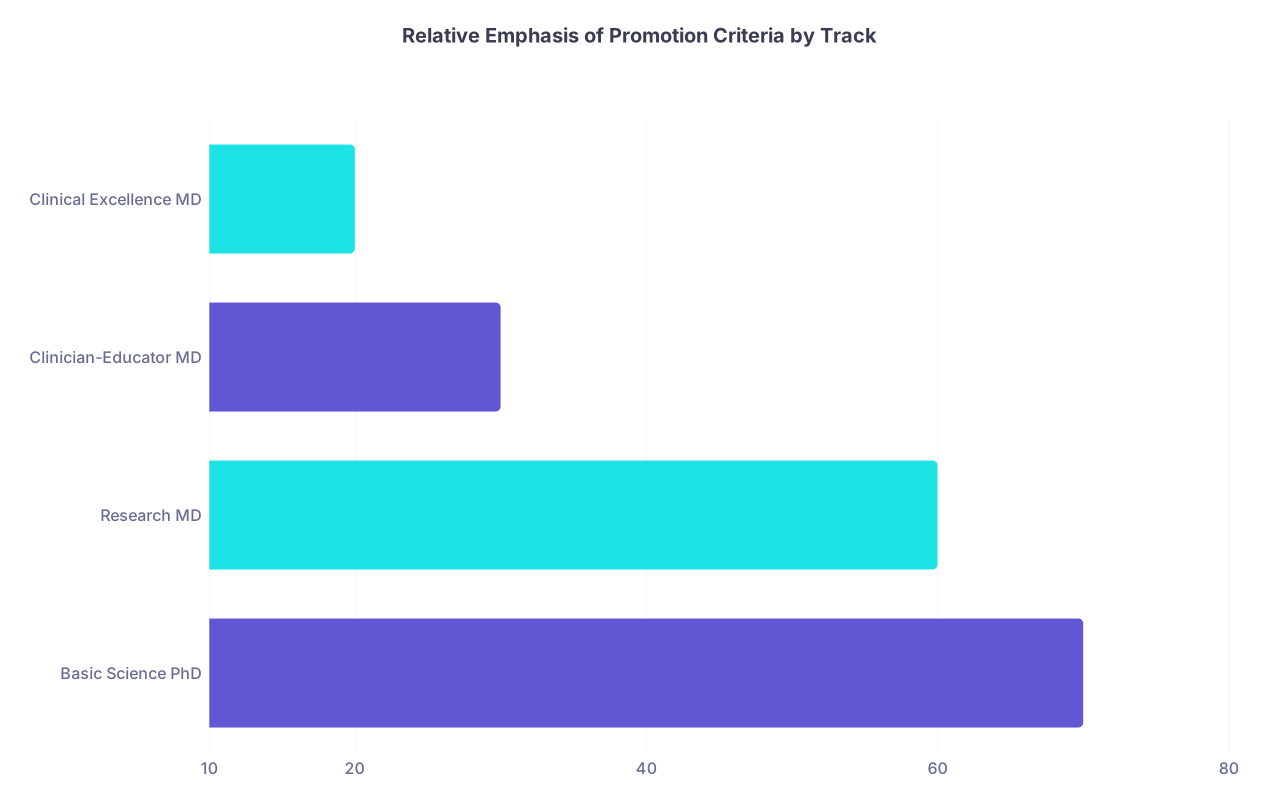
| Category | Value |
|---|---|
| Basic Science PhD | 70 |
| Research MD | 60 |
| Clinician-Educator MD | 30 |
| Clinical Excellence MD | 20 |
(Values represent approximate % emphasis on research/scholarship vs other domains; the remaining balance goes to teaching, service, and clinical care.)
Tenure vs Non-Tenure: Where MD and PhD Worlds Diverge Hard
Tenure complicates everything.
PhD faculty in medical schools are often on true or quasi-tenure tracks. MDs are increasingly on non-tenure clinical or educator tracks, even when they are called “professor.”
What tenure actually means in academic medicine
In a classic sense, tenure used to mean:
- Strong job security
- Salary protection
- Academic freedom
In current academic medicine, especially at large health systems:
- It often means partial salary coverage from the school (base salary), with the rest from clinical or grants
- Protection from abrupt, non-justified termination, but not from shifting your clinical/research balance
PhD tenure standards remain harsh: sustained external funding + national reputation. They must show they can carry their salary and overhead directly or indirectly through grants.
MDs on tenure lines are rarer now. When they exist, promotion with tenure often requires:
- For research MDs: PhD-like metrics (long-term R01-level funding)
- For clinician-educators: a very strong national educational reputation and robust scholarly output, not just “busy clinician and good teacher”
If you are an MD, you must know:
- Am I actually on a tenure-eligible line?
- If yes, is my institution serious about requiring funding for tenure? Many are. Some pretend they are not, until promotion time.
If you are a PhD, tenure expectations are almost never “soft.” The clock is real.
Hidden Differences in Evaluation Culture
The formal criteria are written in promotion handbooks. The real differences between MD and PhD promotion tracks live in culture and in the rooms where decisions are made.
How committees talk about PhDs vs MDs
For PhD candidates, I have heard:
- “Good teacher, but where is the independent funding?”
- “He is still second author on the chair’s grants — is he actually independent?”
- “She has six R01s as co-investigator but only one as PI; that worries me.”
For MD clinician-educator candidates, I have heard:
- “She built the entire palliative care consult service from scratch.”
- “He is the best teacher in the residency — the residents worship him.”
- “Does he have enough scholarship? These are mostly local QI projects.”
Same room. Different evaluative language.
CVs that play to the wrong rules
Classic pitfalls:
- PhD CV that buries grants and publications under teaching and service. Committees do not want that. Lead with funding and publications.
- MD clinician-educator CV that lists clinical work and teaching but has almost no section on “Educational Scholarship and Products” with abstracts, toolkits, and published curricula.
- Physician-scientist CV that looks like a clinician-educator: tons of clinical service, little evidence of independent PI-level funding.
Your CV has to match your track’s promotion story. Committees are busy and brutal. If they cannot see in 2–3 minutes that you fit a recognizable success template for your track, you start with a disadvantage.

Concrete Comparative Scenarios
Let us make this painfully explicit.
Scenario 1: PhD at year 7 vs MD at year 7
- PhD, 7 years in:
- One R01 as PI renewed once, one R21, 30 publications with 10 as senior author, regular talks at major conferences, 3 PhD students graduated.
- Teaching: co-directs a graduate course, decent evaluations.
- Service: 2 departmental committees, ad hoc NIH review panels.
Promotion committees: “Strong case for associate with tenure. Classic trajectory. Approve.”
- MD clinician-educator, 7 years in:
- Built a new heart failure transition clinic, sees high patient volume, top 10% teaching evaluations every year, multiple teaching awards, associate program director for the residency.
- Scholarship: 1 review article, 2 case reports, 3 QI posters (1 published as a brief report).
Promotion committees:
- On a clinical/educator track: “Good candidate for associate professor, but we should push for more peer-reviewed scholarship.”
- On a research-intensive track: “Insufficient research. This is not a research trajectory.”
Same years. Very different judgment. Because the tracks are different.
Scenario 2: MD-PhD who drifted clinically
- Hired on physician-scientist track with 70% research, 30% clinical.
- Over 5 years, expanded clinical time to 60% to “help the division” and for income stabilization.
- Grants: one K award that ended, one small foundation grant, no R01.
- Publications: mostly middle-author on clinical papers driven by others.
Promotion committees:
- Research committees: “No evidence of sustained independent funding. Not ready for associate.”
- Department: “He is incredibly clinically productive, but his track is misaligned.”
Outcome: Often, a quiet reclassification to a clinician-educator or clinical track, with recalibrated expectations and a delayed promotion timeline.
How to Align Your Career With the Right Criteria
You cannot brute-force your way through misaligned expectations. MD and PhD promotion tracks reward different strategic choices. Here is the non-sugar-coated version of how to align.
For PhD faculty in medical schools
Your job is to optimize for:
- Independent funding
- High-quality, consistent publications
- Visible scientific identity
That means:
- Say “no” to endless teaching add-ons that do not lead to publications or grants.
- Treat service as a secondary responsibility until you are clearly established (assistant stage).
- Use every early year to build track record and preliminary data for major grants.
- Structure mentoring so your trainees produce publishable work that reinforces your core program.
If you enjoy teaching more than grant-writing and hate the funding treadmill, consider movement toward education-focused roles. But do not pretend the classic research PhD track will value teaching more than funding. It will not.
For MD clinician-educators
Your leverage points are different. You should build:
- A defined clinical niche or domain (e.g., transplant ID, structural heart disease, women’s mental health)
- A serious educational or program-building portfolio
- A pipeline of scholarly products that show exportable impact, even if not RCTs or bench science
Concrete strategies:
- Turn every meaningful QI or curriculum project into at least an abstract, then a paper.
- Document outcomes of your programs: reduced readmissions, improved exam scores, increased retention. Use those data in scholarship.
- Apply for education grants (small, but useful) or clinical innovation grants; they count as scholarship.
- Get involved in national committees in your specialty’s education or quality arms.
And ruthlessly document everything. Promotion committees love structured educational portfolios and clinical impact summaries with data.
For research MDs / physician-scientists
You are being graded on the PhD metric with less time. Harsh, but true.
You need to:
- Protect research time aggressively. Saying “yes” to extra clinics kills your trajectory.
- Prioritize grants that position you clearly as PI and intellectual driver.
- Collaborate, but avoid being everyone’s free methods or recruitment machine without corresponding authorship and leadership roles.
Your clinical work must be good, but your promotion depends almost entirely on your research record.

| Step | Description |
|---|---|
| Step 1 | Start Faculty Position |
| Step 2 | Research PhD Track |
| Step 3 | Shift to Education or Admin Roles |
| Step 4 | Physician Scientist Track |
| Step 5 | Clinician Educator Track |
| Step 6 | Clinical Excellence Track |
| Step 7 | Prioritize funding over clinics |
| Step 8 | Build education and scholarship |
| Step 9 | Build clinical reputation and programs |
| Step 10 | MD or PhD |
| Step 11 | Enjoy grants and lab work |
| Step 12 | Primary professional identity |
Key Differences in One View
To anchor it, here is a side-by-side comparison.
| Dimension | PhD (Basic Science / Research) | MD (Clinician-Educator / Clinical) |
|---|---|---|
| Primary currency | Grants + publications | Clinical excellence + education + applied scholarship |
| Funding expectation | R01-equivalent as PI, sustained | Helpful but not required on most educator/clinical tracks |
| Teaching weight | Moderate, mostly box-checking | High; evaluations and leadership heavily weighted |
| Clinical work | None or minimal | Central; volume, quality, niche expertise matter |
| Tenure probability | Common but high bar | Decreasing; many on non-tenure lines |
| National reputation type | Scientific discovery | Clinical/educational leadership and impact |
That is the real split. Same titles, different games.
Final Takeaways
- MD and PhD promotion tracks are not equivalent. PhDs rise on funding and publications; MDs advance on a blend of clinical, educational, and broader scholarship, depending on track.
- Your track determines your currency. Misalign your daily work with that currency and you stall, regardless of how busy or “excellent” you are locally.
- The only rational strategy is intentional alignment: know your track, learn its real (not just written) criteria, and build a portfolio that speaks in that language from day one.