This article is for educational purposes only. It is not financial advice, not legal advice, and not tax advice. Figures vary by individual circumstances, so consult a qualified professional before acting.
The GPA Gap: Why You're Stuck in the Middle
A 3.2 overall GPA will get your application filtered out before a human reader ever looks at your personal statement. A 3.5 overall GPA will at least keep you in the stack. That 0.3 gap is where thousands of pre-med applicants get trapped every single application cycle.
Fixing that gap requires math, not hope. You cannot fix a bad transcript by wishing medical schools looked at your "upward trend" when your upward trend consists of two introductory psychology courses and an online sociology elective. Admissions committees look for hard science capacity under load.
First, calculate your actual deficit. Run your transcripts through an AMCAS GPA calculator. Determine the exact credit hours required to move your cumulative GPA and your Science GPA (BCPM: Biology, Chemistry, Physics, Math) to target thresholds:
- Small Deficit (0.1 to 0.2 shift): Requires roughly 8 to 12 credit hours of straight A grades.
- Moderate Deficit (0.2 to 0.35 shift): Requires 20 to 30 credit hours of straight A grades.
- Severe Deficit (>0.35 shift): Requires more than 30 credit hours. An undergraduate post-bacc alone will not rescue a sub-3.0 science GPA; you need a Special Master's Program (SMP) with a hard medical school linkage.
The most common trap I see applicants fall into is the summer rush. Candidates realize in April that their GPA is non-competitive. Desperate to avoid losing a application year, they enroll in an accelerated 8-week summer post-bacc program, drop $15,000, overload on chemistry, and wind up with two B-plus grades.
The result? The GPA barely shifts. The wallet is empty. The application cycle is ruined.
Speed sacrifices depth. If your MCAT score is sitting above 512, you can occasionally afford a short-term GPA touch-up. But if your MCAT is below 505 and your science GPA is sub-3.3, rushing through summer courses is tactical suicide. You must establish a budget, calculate your credit requirements, and choose the correct tool for the job.
The Summer Post-Bacc: The Quick Fix with High Risk
Summer post-baccalaureate coursework compresses 16 weeks of rigorous upper-level science into 6 to 8 weeks. That means taking exams every ten days while absorbing biochemistry, genetics, or organic chemistry at twice the speed of standard terms.
The Math on Summer Tuition
Summer programs charge a premium for compressed delivery. When you evaluate summer offerings, stop looking at total package price and compute the Cost Per Credit Hour.
- Standard Academic Term Rate: $500, $900 per credit hour (In-State Public).
- Accelerated Summer Rate: $1,200, $1,800 per credit hour.
You pay double for the luxury of speed. If you are taking 8 credit hours, expect to pay upwards of $12,000 to $15,000 including university fees, lab access fees, and expedited transcript generation costs.
The Grade Deflation Threat
Fast-paced courses destroy retention. Summer curricula rely heavily on short-term memorization rather than deep conceptual synthesis.
Professors teaching summer courses fall into two categories: those who cut material out of necessity, and those who compress standard examinations without adjusting grade curves. If you hit a tough curve in an accelerated course, you do not have eight weeks of homework and extra credit to buffer a failed mid-term. One bad exam destroys your course grade.
A grade lower than an "A" in a summer post-bacc program actively damages your application. Admissions committees view summer performance through a harsh lens: if you cannot earn an "A" in a single accelerated class, how will you manage 30 credit hours of medical school coursework running at four times that pace?
Who Should Take This Route?
The summer post-bacc is a specialized tool reserved strictly for applicants who fit a specific criteria:
- Strong MCAT Score: You already hold a verified score of 512+.
- Isolated Deficit: Your cumulative GPA is acceptable (3.5+), but you need 1-2 specific science prerequisites or a minor BCPM push (less than 0.15 increase required).
- Application Timeline: You must submit your AMCAS or AACOMAS application by late August with a updated transcript.
Do not use a summer program as an academic reset button. It is a scalp lock, not a foundation.
The Academic Year Program: The Full Overhaul
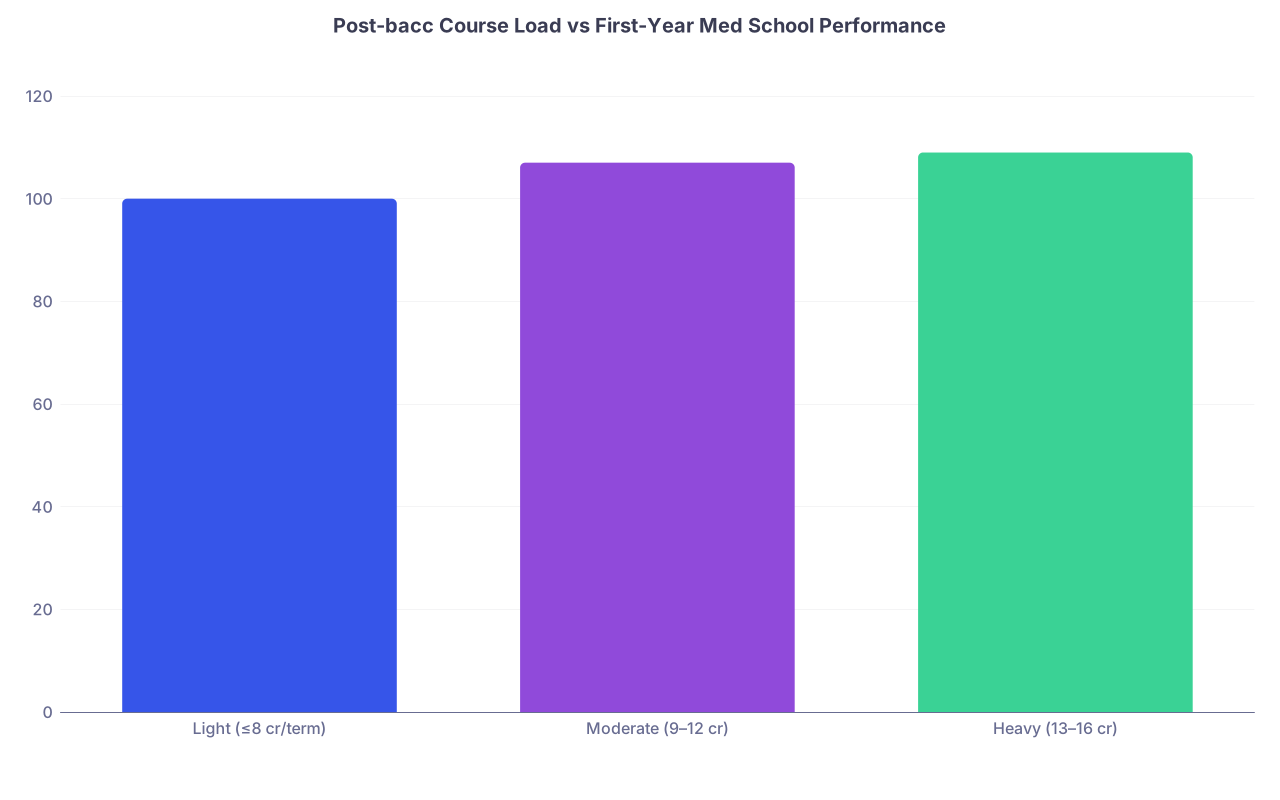
When your science GPA is stuck at a 3.1 and your transcript shows repeated B-minus and C-plus grades across multiple semesters, quick fixes fail. Medical school admissions committees want sustained evidence of academic transformations. They want to see that you can manage 15 units of upper-level science simultaneously over an extended period.
That requires an Academic Year Post-Bacc (Formal or DIY).
Tuition Structures: Semester vs. Quarter
Academic year programs run over 9 to 12 months. They are priced either through structured semester tuition or per-unit quarter rates.
- Formal Post-Bacc Programs: Range from $20,000 to $45,000 per year. They often include structured committee letters, advising, and pre-health resources.
- DIY Post-Baccs (Non-Degree Enrollee): Range from $10,000 to $18,000 per year at public state universities.
Notice the cost-per-credit reality. While the total outlay for an academic year is higher than a summer program, the cost per credit hour is 30% to 50% lower. You gain double or triple the credit volume for less than double the total financial investment.
The Opportunity Cost Calculation
Taking nine months off to complete a post-bacc carries an opportunity cost. You delay entry into medical school by one full cycle. That means losing one year of attending physician salary decades down the road, an estimated $250,000 to $400,000 in gross lifetime earnings.
However, applying early with a weak GPA costs significantly more. Re-applying costs thousands in secondary fees, secondary application software, and interview travel, not to mention the psychological toll of rejection letters.
Fix your transcript once. Fix it correctly.
The Strategic Advantages of Depth
A full academic year gives you structural advantages that summer speed runs cannot offer:
- Professor Relationships: Nine months allows you to attend office hours, secure strong, detailed Letters of Recommendation (LORs) from science faculty, and secure research opportunities.
- MCAT Preparation Integration: You can align your upper-division coursework (Biochemistry, Advanced Cell Biology, Physiology) directly with your MCAT study timeline, using your classes as primary content review.
- Clinical Experience: A regular weekly course schedule allows you to maintain continuous clinical volunteering or paid work (e.g., medical scribing, EMT shifts) alongside your studies. Admissions committees value sustained clinical contact over short bursts of summer activities.
The Decision Matrix: Which One is Your Profile?
Stop guessing which path to take. Use this systematic protocol to choose your trajectory based on your metrics, budget, and timeline.

Protocol 1: The "GPA Gap" Calculation Rule
Compute the exact difference between your current science GPA and the 10th percentile science GPA of your target medical schools (typically a 3.4 for DO programs and 3.5 for MD programs).
- If the Gap is < 0.2: Enroll in a Summer Post-Bacc. You need 8 to 10 credit hours of straight A's to hit your target. Speed is acceptable because the volume of credits required is low.
- If the Gap is >= 0.2: Enroll in an Academic Year Program. You need 20 to 30 credit hours of A grades to shift your cumulative numbers. A summer program cannot physically provide enough credit volume to move your metric.
Protocol 2: The MCAT & GPA Combination Matrix
Use this matrix to locate your specific applicant tier:
| Current Science GPA | MCAT Score | Recommended Strategy | Primary Objective |
|---|---|---|---|
| 3.4-3.5 | 512+ | Summer Program (6-8 Credits) | Target minor upper-level science deficit; apply same cycle. |
| 3.4-3.5 | < 505 | Academic Year + MCAT Prep | Focus heavily on MCAT performance while taking 12-15 credits. |
| < 3.3 | 512+ | Academic Year Program | Prove academic rigor through 24+ credits of heavy science load. |
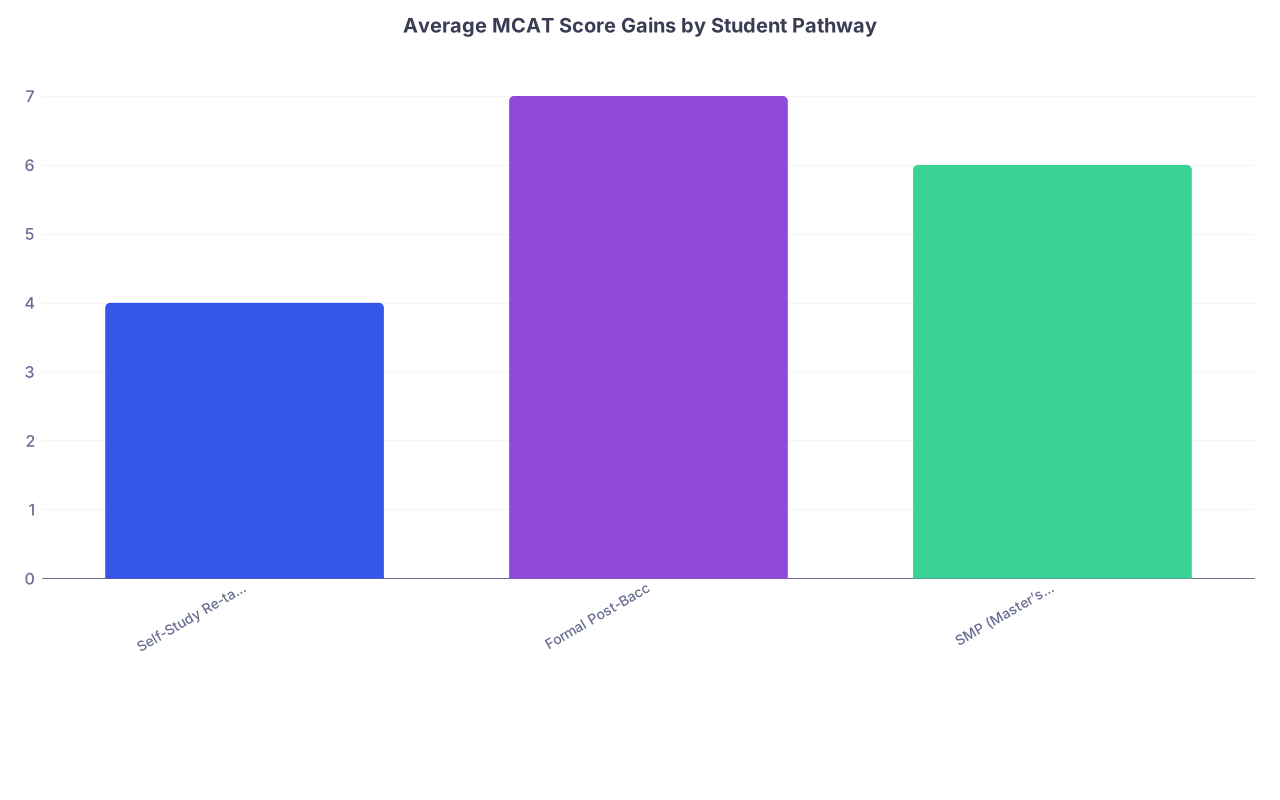
| < 3.3 | < 505 | Full Academic Year or SMP | Complete systematic academic reset; delay application by 1-2 years. |
Protocol 3: The Financial Runway Test
Before enrolling in any summer program, execute this calculation:
Total Summer Cost = (Tuition per Credit * Credits) + Rent + Living Expenses + Opportunity Cost of Lost Work
If your summer cost exceeds $1,500 per credit hour and you do not have guaranteed funding, stop. Do not take out high-interest personal loans to finance a fast-paced summer course. Move into a public university DIY academic-year program where you can establish residency, reduce tuition costs, and work part-time as a scribe or lab assistant.
Program Rigor Audit: Science vs. Non-Science
Do not attempt to inflate your GPA with non-science, introductory-level courses. Medical school admissions teams see right through this tactic.
Your post-bacc work must consist of 3000- and 4000-level science courses. Target courses such as:
- Biochemistry II
- Human Physiology
- Genetics & Genomics
- Immunology
- Neurobiology
Earning an "A" in an upper-division Immunology class demonstrates medical school readiness. Earning an "A" in introductory Geology does not.
Action Plan: How to Execute Your Strategy
Follow this step-by-step protocol to select, apply, and succeed in your post-bacc strategy.
Step 1: Audit Your Transcript for Weak Points
Pull your unofficial transcripts today. Export every science course into a spreadsheet. Identify patterns:
- Did you fail specific foundational courses (General Chemistry, Physics)?
- Did your performance drop during heavy-load semesters (e.g., taking Organic Chemistry alongside Biology and Physics)?
- Are your lowest grades clustered in freshman year, or are they spread evenly throughout your degree?
If your low grades stem from specific prerequisites (C or lower), you must retake those specific courses. If your low grades are scattered B-minus and C-plus marks across advanced sciences, you need a heavy volume of new upper-division courses to override the average.
Step 2: Build Your Comparison Matrix
Create a tracking sheet for three Summer programs and three Academic Year programs. Track these six variables:
- Cost per credit hour.
- Admissions timeline and transcript release dates.
- Average class size.
- Availability of upper-division science seats for post-bacc students.
- Linkage agreements with medical schools.
- Proportion of student enrollment earning A/A-minus grades.
Step 3: Call the Admissions Offices Directly
Do not rely on marketing brochures. Pick up the phone and ask admissions advisors these exact questions:
- "Are post-bacc students given equal registration priority for upper-division science courses, or do degree-seeking undergraduates register first?"
- "What percentage of students in your post-bacc track achieve a 3.7 GPA or higher in summer/academic year terms?"
- "Does your institution auto-release official transcripts within five business days of final exams?"
If an institution restricts registration access for post-bacc students, meaning you are stuck taking leftover introductory courses, cross them off your list immediately.
Step 4: Secure Funding and Lock In Registration Early
Submit your post-bacc applications early in the cycle (January/February for summer; March/April for fall academic year programs). Securing early admission gives you first access to high-demand science courses, financial aid packages, and health professions advising support.
Once enrolled, treat every class as a high-stakes scenario. Earning an "A" in every post-bacc course is not optional, it is the baseline expectation required to repair your application and secure your medical school seat.
Key Takeaways
- Match the tool to the gap: Summer programs are designed for minor GPA adjustments (< 0.2 increase). Academic year programs are required for structural grade repairs (> 0.2 increase).
- Watch the hidden costs: Accelerated summer courses carry a 30% to 50% higher cost-per-credit hour and present a higher risk of grade deflation.
- Leverage high MCAT scores: If your MCAT is above 512, a short summer push preserves your application timeline. If your MCAT is low, choose a full academic year to address both metrics concurrently.
- Focus on upper-division science: To prove academic readiness, fill your post-bacc schedule with 3000- and 4000-level BCPM courses like Biochemistry, Genetics, and Physiology.
- Calculate before you enroll: Always compute your exact credit needs and cost-per-credit hour before committing funds to any post-bacc program.